Key takeaways
- Cool-season grasses (Kentucky bluegrass, tall fescue, perennial rye): the two valuable windows are early fall and late spring. If you’re correcting a P and K deficiency, fall is the best moment — roots are actively growing and potassium improves winter hardiness.
- Warm-season grasses (Bermuda, zoysia, St. Augustine): feed after full green-up in late spring, with a possible second application in mid-summer if the soil test warrants it. Stop all nitrogen feeding about 6–8 weeks before your first expected frost.
- Any grass, any season: never spread before a heavy rain forecast or onto frozen or saturated ground — water-soluble granules wash straight into storm drains before roots ever see them.
Yes — 10-10-10 fertilizer is good for lawns when a soil test shows your yard is short on phosphorus and potassium as well as nitrogen, but for most established turf it delivers two nutrients your grass doesn’t need, which makes a high-nitrogen lawn fertilizer the smarter buy. The bag itself is never the problem; the mismatch between a balanced formula and your soil’s actual needs is. Here’s how to tell which camp your lawn falls into, exactly how much to spread if 10-10-10 is the right call, and when to leave it on the shelf.
Our top picks
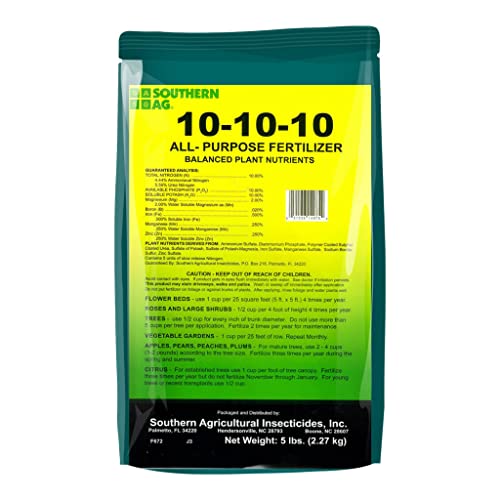
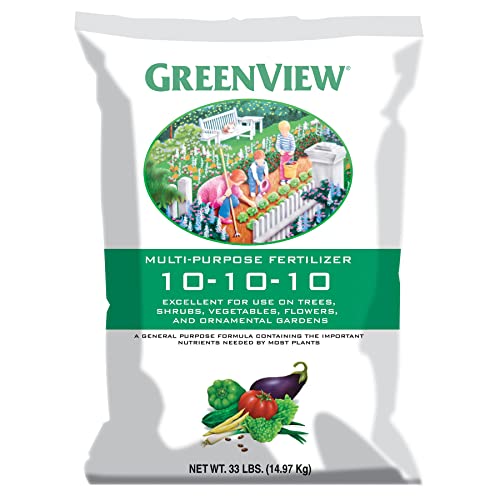

As an Amazon Associate we earn from qualifying purchases at no extra cost to you.
What the Three Numbers Actually Deliver
A 10-10-10 analysis means the product is 10% nitrogen (N), 10% phosphate (P2O5), and 10% potash (K2O) by weight. A 40-pound bag contains four pounds of each nutrient. Nitrogen drives blade growth and color, phosphorus supports root development and establishment, and potassium improves drought tolerance, disease resistance, and cold hardiness.
The catch: phosphorus doesn’t leach quickly. In established lawns that have been fertilized before, P often accumulates to adequate or even excessive levels, while nitrogen needs replenishing every season. Feeding a balanced blend to satisfy nitrogen demand means buying and spreading P your soil may already hold — and surplus phosphorus runoff is exactly why a number of states, particularly across the Upper Midwest and Northeast, restrict lawn phosphorus unless a soil test shows a deficiency or you’re establishing new grass. Check your local rules before you buy.
When to Use It — and When to Skip It
Your situation determines whether 10-10-10 is the right tool or an expensive habit:
| Your situation | Verdict on 10-10-10 | Better option |
|---|---|---|
| Soil test shows low P and low K | Use it — one pass corrects all three | Or a custom blend matched to the test |
| Test shows adequate P, low K only | Skip | Nitrogen + potash product (e.g., 15-0-15, 24-0-12) |
| No soil test, established lawn | Skip for now | Test first ($10–30 via county extension); default to a turf fertilizer |
| Seeding or laying sod | Acceptable, not ideal | Starter analysis like 18-24-12 with higher P |
| Centipedegrass or other low-fertility turf | Skip | Light nitrogen feeding plus iron; avoid surplus P |
| State restricts lawn phosphorus | Skip unless test or new-seeding exemption applies | Phosphorus-free turf fertilizer |
How Much to Apply: Rates per 1,000 Square Feet
Because the analysis is 10%, the math is simple: pounds of product needed = target nitrogen rate ÷ 0.10. Most lawns should never receive more than 1 pound of quick-release nitrogen per 1,000 square feet in a single pass.
| Product per 1,000 sq ft | N delivered | P2O5 delivered | K2O delivered | Typical use |
|---|---|---|---|---|
| 3 lb | 0.30 lb | 0.30 lb | 0.30 lb | Light correction of a mild deficiency |
| 5 lb | 0.50 lb | 0.50 lb | 0.50 lb | Standard single feeding for most lawns |
| 7.5 lb | 0.75 lb | 0.75 lb | 0.75 lb | Hungry warm-season grass in peak growth |
| 10 lb | 1.00 lb | 1.00 lb | 1.00 lb | Maximum single dose — only with test confirmation |
Worked example: a 6,000-square-foot lawn fed at the standard 5 lb/1,000 rate needs 30 pounds of product — roughly three-quarters of a 40-pound bag. At the common market range of about $20–40 a bag, that’s roughly $15–30 per feeding, or $2.50–5 per 1,000 square feet. Annual nitrogen demand runs about 2–4 lb per 1,000 square feet for cool-season grasses and up to 4–5 for Bermuda, so budget your yearly program around nitrogen first, then let the soil test decide whether the P and K should ride along.
10-10-10 vs. the Fertilizers It Competes With
| Fertilizer (typical analysis) | Lbs needed for 1 lb N per 1,000 sq ft | Also delivers (P2O5 / K2O) | Release profile | Best use |
|---|---|---|---|---|
| Generic 10-10-10 | 10.0 | 1.00 lb / 1.00 lb | Mostly quick-release | Correcting confirmed P + K deficiency |
| High-N turf food (e.g., Scotts Turf Builder, 32-0-4) | 3.1 | 0 / 0.13 lb | Partly slow-release | Routine feeding of established lawns |
| Starter blend (e.g., 18-24-12) | 5.6 | 1.33 lb / 0.67 lb | Mostly quick-release | New seed and sod establishment |
| Milorganite (6-4-0) | 16.7 | 0.67 lb / 0 | Slow-release organic | Gentle feeding; supplies iron |
The pattern is clear: dedicated turf fertilizers deliver the same nitrogen green-up with a third of the product weight and no phosphorus surplus, while starter blends deliver more phosphorus than 10-10-10 when establishment actually calls for it. Balanced 10-10-10 wins only in the middle case — a confirmed across-the-board deficiency — which is precisely what a soil test identifies.
Timing by Grass Type
- Cool-season grasses (Kentucky bluegrass, tall fescue, perennial rye): the two valuable windows are early fall and late spring. If you’re correcting a P and K deficiency, fall is the best moment — roots are actively growing and potassium improves winter hardiness.
- Warm-season grasses (Bermuda, zoysia, St. Augustine): feed after full green-up in late spring, with a possible second application in mid-summer if the soil test warrants it. Stop all nitrogen feeding about 6–8 weeks before your first expected frost.
- Any grass, any season: never spread before a heavy rain forecast or onto frozen or saturated ground — water-soluble granules wash straight into storm drains before roots ever see them.
Applying It Correctly
- Test the soil first. A mail-in or county extension lab test runs roughly $10–30 and reports actual P and K levels with recommended rates — it’s the only way to know whether the second and third numbers on the bag are doing anything.
- Measure your lawn area. Length × width for rectangles, and subtract beds and pavement; rate errors almost always come from guessing square footage.
- Calculate product: pounds needed = (target N rate ÷ 0.10) × (square feet ÷ 1,000). Write it on the bag for next time.
- Set the spreader to roughly half the target rate and make two perpendicular passes. This halves striping and missed spots compared to a single full-rate pass.
- Apply to dry foliage, then water in with about a quarter to half an inch within 24–48 hours to move nutrients to the root zone and off the blades.
- Blow or sweep stray granules off driveways and sidewalks — they stain concrete and feed algae downstream, not your lawn.
Mistakes That Burn Grass or Waste Money
- Using it as a routine feed. Most 10-10-10 blends are nearly all quick-release nitrogen, which means a growth surge, extra mowing, and a fast fade. Check the label for the percentage of slow-release N; for steady feeding, a coated turf fertilizer behaves better.
- Spreading it over seed. Balanced blends carry a relatively high salt index and can cut germination. If you’re seeding, either work it into the top few inches of soil beforehand or switch to a starter product.
- Stacking applications. A weed-and-feed pass followed by a fertilizer pass doubles the nitrogen dose and causes burn — track your total seasonal N, not your trips to the garage.
- Feeding dormant or drought-stressed grass. Quick-release salts concentrate damage on turf that can’t grow it off.
- Ignoring the open bag. Granular fertilizer absorbs moisture and cakes; reseal and store it dry, and it’ll keep for years instead of spreading in clumps next spring.
FAQ
Can I use 10-10-10 on all grass types?
Technically yes — the nutrients are the same for every turfgrass. The real question is whether the grass and soil need all three. Bermuda and other heavy feeders can use it at higher rates during peak growth; centipedegrass and fine fescues prefer lean feeding and rarely need the phosphorus.
How often should I apply it?
Only as often as a soil test justifies — typically once or twice a year at most. Plan your schedule around nitrogen demand (2–4 lb per 1,000 sq ft annually for most lawns) and repeat the balanced formula only if P and K remain low.
Is it safe around kids and pets?
Keep them off the lawn until the product is watered in and the grass is dry, and store the bag sealed and out of reach. Granules tracked indoors are the main exposure risk.
Will it fix a yellow lawn quickly?
If nitrogen deficiency is the cause, quick-release N produces visible greening within about a week. If the yellowing comes from iron chlorosis, grub damage, compacted soil, or fungus, no fertilizer ratio will fix it — diagnose before you spread.