Key takeaways
- Best Glass Beverage Dispensers for Parties The best glass beverage dispensers for parties are the ones whose capacity, tap, opening, and stand match the drink and serving location: choose a 5-litre dispenser for small indoor gatherings, an 8- to 10-litre…
Best Glass Beverage Dispensers for Parties
The best glass beverage dispensers for parties are the ones whose capacity, tap, opening, and stand match the drink and serving location: choose a 5-litre dispenser for small indoor gatherings, an 8- to 10-litre model for family events, and a raised two-dispenser setup when guests need both alcoholic and non-alcoholic options.
Quick comparison: which dispenser suits your party?
| Dispenser type | Typical capacity | Approx. filled weight | Tap quality | Ice compatibility | Best use |
|---|---|---|---|---|---|
| Compact glass jar | 3–5 litres | 4–7 kg | Basic plastic or chrome-effect tap | Small cubes only | Indoor lunches and drinks for up to 8 people |
| Large glass jar | 7–10 litres | 9–13 kg | Metal-look or stainless-steel tap | Ice cubes, if the opening is wide | Garden parties and buffets for 10–20 people |
| Two-dispenser stand set | 2 × 4–5 litres | 11–15 kg total | Two separate taps; quality varies | Good for separate chilled drinks | Serving water and punch at the same time |
| Insulated beverage urn with glass-style presentation | 8–12 litres | 10–16 kg | Usually more reliable than decorative taps | Often uses an internal ice chamber | Frequent hosts prioritising temperature control |
Filled weight is an important practical specification. One litre of water weighs approximately one kilogram, before adding the glass, fruit and ice. A 10-litre dispenser can therefore exceed 12 kg when full. Put it on its final table before filling it, rather than carrying it across a patio.
Our top picks



As an Amazon Associate we earn from qualifying purchases at no extra cost to you. Ratings are shown as listed on Amazon.
Our picks by situation
Best for small parties: a 3–5 litre glass dispenser
A compact jar is the sensible choice for an indoor dinner, afternoon tea or small balcony gathering. It takes up less table space and is easier to wash in a kitchen sink. A 5-litre capacity provides roughly 20 servings of 250 ml, although allowing space for fruit and ice reduces the usable drink volume.
Look for a broad screw-top or clip-top opening, a tap positioned low enough to use most of the liquid, and a base that keeps the outlet clear of the table edge. Kilner’s glass drinks dispensers are a familiar example of this traditional jar format. They are especially suitable for water, lemonade and lightly flavoured drinks.
Best for garden parties: a 7–10 litre jar on a sturdy stand
For outdoor service, capacity and clearance matter more than decorative detailing. A large dispenser should have a stand at least 10–15 cm high, allowing a cup to slide underneath without being tilted. Without a stand, guests may have to hold their glass awkwardly below the tap, and the jar can be lifted repeatedly as it empties.
Choose thick, moulded glass with a stable base and a stand that supports the full footprint rather than three narrow contact points. Decorative metal stands can look attractive but may flex under a heavy jar. A 7-litre dispenser gives about 28 servings at 250 ml; a 10-litre model gives about 40, before accounting for ice and fruit.
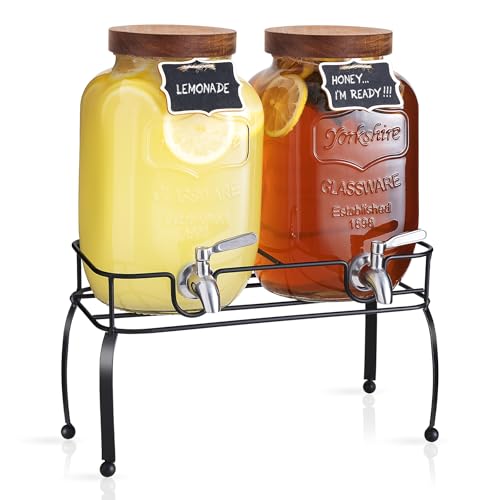
Best for two drinks: a paired dispenser set
A two-dispenser set is more useful than one very large jar when guests have different preferences. Serve still water or iced tea in one and lemonade, punch or fruit-infused water in the other. It also avoids repeatedly opening a single container to top up or remove floating fruit.
Check whether both jars use the same replacement tap and gasket. If one tap fails, compatible parts can be difficult to find on decorative sets. The stand should be wide enough that the two containers cannot knock together when someone operates a tap.
Best for regular hosts: a dispenser with replaceable parts
If you host often, prioritise ownership costs over appearance. The tap, silicone gasket and threaded retaining nut usually wear out before the glass does. A model with a standard threaded outlet and readily available replacement seals is a better long-term buy than a visually striking jar with a proprietary fitting.
Stainless-steel taps generally resist staining and retain a firmer feel than very light plastic taps, but the quality of the seal matters more than the material label. A metal tap can still drip if the gasket is thin, misaligned or compressed unevenly.
What to check before buying
Capacity and usable volume
Do not treat the printed capacity as the amount available for serving. Leave approximately 10% of the jar empty for fruit, ice and movement. A 5-litre dispenser therefore has around 4.5 litres of practical drink capacity, equal to 18 servings of 250 ml.
Use this calculation for a party: number of guests × expected drinks per guest × serving size. For 12 guests having three 250 ml servings each, the requirement is 12 × 3 × 0.25 = 9 litres. Add a reserve of 10–20%, so two 5-litre dispensers are more suitable than one 8-litre jar.
Tap position and flow
A tap placed too high leaves a large amount of drink trapped below the outlet. A tap placed too low may hit the tabletop or make the jar difficult to clean around. The outlet should project far enough for a glass to fit beneath it, while the handle should operate without scraping the jar or stand.
Before first use, fill the dispenser with water and leave a cup underneath for 10 minutes. This reveals slow leaks that may not appear during a quick rinse. Open and close the tap several times; a stiff handle can be frustrating when many guests are serving themselves.
Glass thickness and shape
Thicker glass improves resistance to minor knocks, but it also increases weight. Look for an even rim without chips, a flat base, and no sharp moulding seams around the tap hole. Ribbed or embossed glass can be attractive but creates more areas where pulp, sugar and detergent residue collect.
For outdoor use, keep the jar away from paving edges and do not place chilled glass directly onto a hot surface. Sudden temperature changes can stress glass regardless of its advertised thickness.
Ice and fruit compatibility
Wide-mouth dispensers are much easier to use with ice. A practical opening is at least 9–10 cm across, allowing standard ice cubes to be added without forcing them through the neck. Avoid large frozen spheres unless the opening is substantially wider.
Ice placed directly into a glass dispenser cools the drink but can block the tap as it shifts. Citrus slices, berries and fresh herbs can cause the same problem. For drinks containing pieces, use a removable infusion basket or add fruit in a mesh bag. Keep ice above the tap inlet where possible.
Cleaning access
The opening should be wide enough for a bottle brush or hand to reach the bottom. A narrow-neck dispenser may look elegant but is harder to clean, particularly after sugary punch. A removable tap is a major advantage: unscrew it after each event, wash the outlet and soak the gasket separately.
Decision matrix
| Your priority | Recommended choice | Why |
|---|---|---|
| Lowest purchase cost | 3–5 litre basic jar | Less glass and a simpler tap keep the general market price lower, commonly about £20–£45. |
| Limited table space | One compact dispenser or two narrow 4-litre jars | Uses less depth and is easier to position indoors. |
| Weekly or frequent use | Thick glass with replaceable stainless-steel tap | Replacement parts and stronger hardware reduce avoidable waste. |
| First-time host | 5–7 litre wide-mouth jar with stand | Manageable weight, simple cleaning and enough capacity for a modest gathering. |
| Large outdoor party | Two 5-litre dispensers or one 10-litre unit | Provides backup capacity and can separate different drinks. |
Setup and maintenance that prevent most problems
- Wash every part first. Clean the jar, tap, nut, washer and gasket separately to remove manufacturing dust and packaging residue.
- Install the gasket on the correct side. Follow the supplied instructions; an incorrectly positioned washer is a common cause of leaks.
- Test with water. Leave the filled dispenser on a tray for 10–15 minutes before adding a coloured or sticky drink.
- Fill only at the serving position. A full 8–10 litre jar may be unsafe to carry, especially on grass or paving.
- Empty and rinse promptly. Sugary drinks become harder to remove as they dry around the tap and bottom corners.
- Dry with the lid off. Storing a sealed, damp dispenser encourages stale odours and leaves moisture around the gasket.
Final verdict
For most homes, the best glass beverage dispensers are wide-mouth 5–7 litre jars with a raised stand, a low-leak tap and enough clearance for a normal glass. Choose a 3–5 litre model when space and easy handling matter most, move to 7–10 litres for larger outdoor events, and select paired dispensers when serving two drinks. The strongest buying priorities are a reliable seal, accessible cleaning, suitable ice clearance and a stand that supports the filled weight—not simply the largest capacity or most decorative glass.