Key takeaways
- Best overall for a quarter-acre or less: Greenworks 25022, 20-inch deck, 12 amps, 7 cutting heights.
- Best for tight side yards and mulching: Greenworks 25012, 18-inch deck, 12 amps.
- Best wide-deck value: Earthwise 50520, 20-inch deck, 12 amps, with rear and side discharge.
- Best for thick, fast-growing grass: BLACK+DECKER MM2000 and CRAFTSMAN CMEMW213, both 20-inch decks with 13-amp motors.
- Best for postage-stamp lawns and storage: Greenworks MO09B01 (14-inch), BLACK+DECKER BEMW472BH (15-inch), or Lawnmaster MEB1114K (15-inch).
- Best for dense obstacles (trees, beds, planters): Sun Joe MJ404E-360, a 16-inch zero-turn style deck.
The best corded electric lawn mowers for small lawns are the Greenworks 25022 (20-inch deck, 12-amp motor) for most yards, the Greenworks 25012 (18-inch) for tight spaces where mulching matters, and the Sun Joe MJ403E (17-inch) for the lightest cut-and-collect routine. A plug-in mower beats a battery model when your lawn is roughly a quarter acre or smaller, your outlet is within easy reach, and you do not want to buy, charge, or replace batteries.
This guide is built for people with a small, mostly rectangular lawn: a front yard, a townhouse back yard, or a suburban lot where every spot of grass can be reached by a cord. It covers the specs that actually separate corded mowers (motor amps, deck width, height range, discharge options), how to manage the cord safely, and a simple calculation for deciding whether corded or cordless makes more sense for your lot.
Our top picks
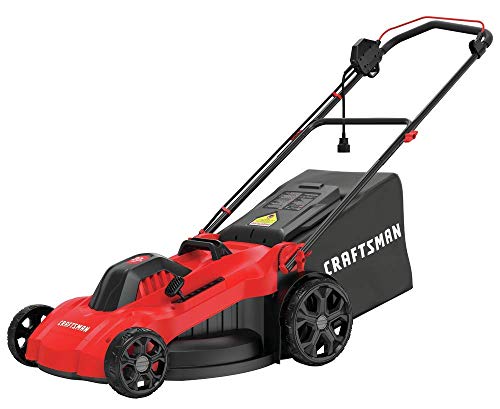

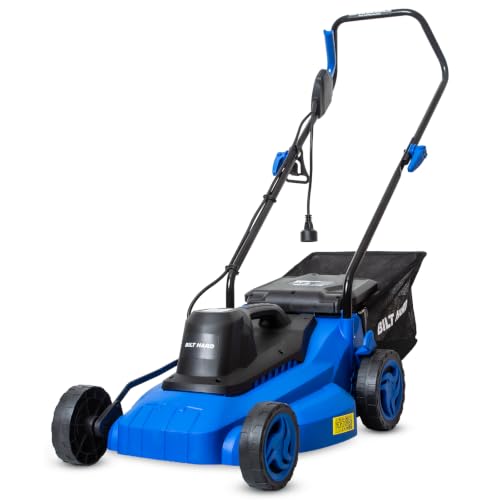

As an Amazon Associate we earn from qualifying purchases at no extra cost to you.
Quick Answer: Our Top Picks by Lawn Situation
- Best overall for a quarter-acre or less: Greenworks 25022, 20-inch deck, 12 amps, 7 cutting heights.
- Best for tight side yards and mulching: Greenworks 25012, 18-inch deck, 12 amps.
- Best wide-deck value: Earthwise 50520, 20-inch deck, 12 amps, with rear and side discharge.
- Best for thick, fast-growing grass: BLACK+DECKER MM2000 and CRAFTSMAN CMEMW213, both 20-inch decks with 13-amp motors.
- Best for postage-stamp lawns and storage: Greenworks MO09B01 (14-inch), BLACK+DECKER BEMW472BH (15-inch), or Lawnmaster MEB1114K (15-inch).
- Best for dense obstacles (trees, beds, planters): Sun Joe MJ404E-360, a 16-inch zero-turn style deck.
How We Chose
This is a research-based guide. We compared manufacturer specifications and published model listings for current corded walk-behind mowers sold in the United States, then filtered for the features that matter on small lawns. We did not run physical trials, and we do not claim to have used these mowers on a lawn. Where a spec could not be confirmed from published sources, such as weight, cord length, or bag capacity, we left it out rather than guess, and we say so in the verification notes below.
Our selection criteria were:
- Deck width between 14 and 20 inches. Wider than 20 inches is rare in corded models and makes cord management harder on a small lot.
- Motor rating of 10 amps or more for models with 15 inches or wider decks, so the mower can handle normal growth without bogging.
- A usable height range. At least five positions, and ideally a top height near 3.5 to 4 inches for the first cut of spring or after a vacation.
- Discharge flexibility. Models that offer more than one of bagging, mulching, and side or rear discharge fit more lawns.
- Folding handles for garage or shed storage.
Corded Electric Mowers Compared at a Glance
| Model | Deck | Motor | Height positions | Height range | Cutting options |
|---|---|---|---|---|---|
| Greenworks 25022 | 20 in | 12 A | 7 | 1.4 to 3.75 in | Bag, mulch, side discharge |
| Greenworks 25012 | 18 in | 12 A | 7 | 1.75 to 3.75 in | Mulch, side discharge |
| Earthwise 50520 | 20 in | 12 A | 7 | 1.5 to 4 in | Bag, mulch, rear and side discharge |
| BLACK+DECKER MM2000 | 20 in | 13 A | 7 | 1.5 to 4 in | Bag, mulch, side discharge |
| CRAFTSMAN CMEMW213 | 20 in | 13 A | 7 | 1.5 to 4 in | Bag, mulch, rear discharge |
| Sun Joe MJ403E | 17 in | Not confirmed | 7 | 0.98 to 2.87 in | Bag, mulch |
| Sun Joe MJ404E-360 | 16 in | Not confirmed | 4 | 1.2 to 2.4 in | Bag |
| BLACK+DECKER BEMW472BH | 15 in | 10 A | 6 | 1 to 3 in | Bag |
| Lawnmaster MEB1114K | 15 in | Not confirmed | 6 | 1 to 3 in | Bag |
| Greenworks MO09B01 | 14 in | Not confirmed | 5 | 0.6 to 2.6 in | Bag, mulch, rear discharge |
Why a Corded Mower Wins on a Small Lawn
Corded mowers have three structural advantages. First, they deliver constant power for as long as the outlet works, so there is no battery fade halfway through the back strip. Second, there is no battery to replace; the motor is the only wear item besides the blade. Third, they are typically the lightest and simplest machines in the category, with no gas, oil, spark plug, or charger.
The trade-off is obvious: the cord. You cannot mow beyond roughly the length of one outdoor-rated extension cord, and every turn means moving the cord. That is why the decision comes down to lawn geometry rather than brand.
Corded vs battery: a quick decision matrix
| Situation | Corded wins | Battery wins |
|---|---|---|
| Lawn size | Under about a quarter acre | Larger than that, or split into zones |
| Outlet position | Exterior outlet near the middle or one end of the lawn | Outlet far from the grass, or none outside |
| Obstacles | Few trees, simple rectangle | Many trees, curved beds, fences you must loop around |
| Ownership cost | Wants no battery replacement | Already owns a battery platform |
| Storage | Folding handle in a closet | Needs a charging spot |
Cord Length, Amps, and Extension Cord Rules
Most corded mower specs do not publish a cord length, because the mower ships with a short lead and you add an extension cord. What matters is the extension cord you buy.
- Use an outdoor-rated cord marked for outdoor use, with a three-prong grounded plug.
- Match gauge to length. As a general rule for 10 to 13 amp tools, a 16 AWG cord is adequate up to about 50 feet, and a 14 AWG cord is the safer choice for 100 feet. Heavier gauge (lower number) reduces voltage drop. Always follow the mower manual if it lists a minimum gauge.
- Do not daisy-chain light cords. Two short cords connected is acceptable only if the total length and gauge fit the rule above.
- Use a GFCI-protected outlet. A ground-fault outlet or a portable GFCI adapter cuts power quickly if the cord is damaged.
- Inspect the cord before each mow and discard any with cuts, exposed wire, or damaged plugs.
Amps tell you how hard the motor can work. A 10-amp motor is fine for a regularly cut small lawn. Moving to 12 or 13 amps gives more headroom for thick, damp, or overgrown grass. Because amps are the only power figure most corded mowers publish, compare them only within the same deck width.
Worked Example: Is a 20-Inch Corded Mower Right for Your Lot?
Suppose you have a rectangular lawn of 40 feet by 60 feet with an outdoor outlet at one short end. A 20-inch deck, overlapped by about two inches per pass, cuts an effective 18 inches (1.5 feet) per pass.
- Passes: Mowing along the 60-foot direction, you need 40 divided by 1.5, or about 27 passes.
- Distance walked: 27 passes times 60 feet is about 1,620 feet.
- Time: At a typical walking pace of around 2.5 miles per hour (about 220 feet per minute), that is roughly 7 to 8 minutes of pure mowing, plus turns and cord handling, so plan for 15 to 20 minutes.
- Cord reach: If the outlet is at one end and you start nearest the outlet, the far end is 60 feet away at most, so a 100-foot cord leaves slack for turns. Starting at the far side and working back keeps the cord on the already-mowed grass.
These are planning estimates, not published specs. The takeaway is that a 2,400 square foot lawn is a comfortable fit for a corded 18 to 20-inch mower, and a 100-foot cord covers the whole thing from a single outlet. If your lawn is twice as deep or the outlet is on the opposite side of the house, a battery mower becomes the better fit.
Our Top Picks in Detail
Greenworks 25022, 20-inch
Spec line: 20-inch steel deck · 12-amp motor · 7 height positions (1.4 to 3.75 in) · bag, mulch, and side discharge · folding handles · larger rear wheels
Best for: Most small and medium-small lawns where you want one mower that can bag, mulch, or discharge to the side.
Skip if: You need a top cutting height above 3.75 inches or you must mow around many tight obstacles.
- Pros: Wide cut for a corded model, three discharge modes, low minimum height for fine turf, larger rear wheels help on uneven spots.
- Cons: Wider deck is harder to maneuver in narrow gaps.
Greenworks 25012, 18-inch
Spec line: 18-inch deck · 12-amp motor · 7 height positions (1.75 to 3.75 in) · mulch and side discharge · folding handles
Best for: Smaller lawns with narrow side yards where two extra inches of deck do not matter, and where you want to mulch clippings back into the turf.
Skip if: You want to bag clippings, because the published listing shows mulching and side discharge only.
- Pros: Same 12-amp motor as the 20-inch version in a narrower deck; useful for tight gate openings.
- Cons: Higher minimum height than the 20-inch model, so it cuts a little less close.
Earthwise 50520, 20-inch
Spec line: 20-inch deck · 12-amp motor · 7 height positions (1.5 to 4 in) · bag, mulch, rear and side discharge · folding handles · larger rear wheels
Best for: Lawns that grow quickly and need a taller top setting, with a choice of discharge routes.
Skip if: You want a very low cut for short-bladed turf, since the minimum is 1.5 inches.
- Pros: Four-inch top height, both rear and side discharge options.
- Cons: Fewer low-cut positions than the Greenworks 25022.
BLACK+DECKER MM2000, 20-inch
Spec line: 20-inch deck · 13-amp motor · 7 height positions (1.5 to 4 in) · bag, mulch, side discharge · folding handles · larger rear wheels
Best for: Thicker grass types and homeowners who value extra motor headroom on a standard-width deck.
Skip if: You are shopping for an 18-inch or narrower deck for tight spaces.
- Pros: 13-amp motor is one of the higher ratings among corded decks; wide height range.
- Cons: Higher amps do not mean a better cut by themselves, and a heavier cord load calls for a proper-gauge extension cord.
CRAFTSMAN CMEMW213, 20-inch
Spec line: 20-inch deck · 13-amp motor · 7 height positions (1.5 to 4 in) · bag, mulch, rear discharge · folding handles · larger rear wheels
Best for: A brand alternative to the BLACK+DECKER with the same deck and motor class.
Skip if: You prefer side discharge, because the published listing shows rear discharge.
- Pros: Same 13-amp, 20-inch, 7-position structure; cut, collect, and mulch.
- Cons: Rear discharge can throw clippings toward the cord path if you are not careful with the mowing pattern.
Sun Joe MJ403E, 17-inch
Spec line: 17-inch deck · 7 height positions (0.98 to 2.87 in) · bag and mulch · grass-box-full indicator · folding handles · larger rear wheels
Best for: Short, regularly mown lawns where you want to see when the bag is full.
Skip if: You mow tall grass, since the maximum height is under 3 inches.
- Pros: Full-bag indicator, folding handles, very low minimum height.
- Cons: Motor amperage was not confirmed in the listings we reviewed; limited top height.
Sun Joe MJ404E-360, 16-inch
Spec line: 16-inch deck · 4 height positions (1.2 to 2.4 in) · bag · zero-turn style 360-degree pivot · grass-box-full indicator · folding handles
Best for: Small lawns packed with trees, beds, and planters where tight turns beat straight-line speed.
Skip if: You mow open lawn with tall grass or want to mulch, since the listing shows bagging only and a 2.4-inch maximum height.
- Pros: Pivoting design reduces back-and-forth around obstacles.
- Cons: Narrow 16-inch cut means more passes; limited height options.
BLACK+DECKER BEMW472BH, 15-inch
Spec line: 15-inch deck · 10-amp motor · 6 height positions (1 to 3 in) · bag · folding handles · larger rear wheels
Best for: Very small, regularly mown lawns and storage-limited homes.
Skip if: You often face overgrown or damp grass, since 10 amps with a narrow deck gives less headroom.
- Pros: Compact footprint, low minimum height.
- Cons: Bagging only; 3-inch maximum height.
Greenworks MO09B01, 14-inch
Spec line: 14-inch deck · 5 height positions (0.6 to 2.6 in) · bag, mulch, rear discharge · folding handles
Best for: Tiny front lawns, courtyards, and patio-sized turf.
Skip if: Your lawn is more than a couple of thousand square feet, because the narrow deck multiplies passes.
- Pros: Lowest minimum height in this guide, easy to store.
- Cons: Narrow deck, short height range; motor amperage not confirmed.
Grouped by Buyer Criteria
If your lawn is under 2,000 square feet
Choose a 14 to 17-inch deck: Greenworks MO09B01, Lawnmaster MEB1114K (15-inch, 6 heights, 1 to 3 inches, bagging), BLACK+DECKER BEMW472BH, or Sun Joe MJ403E. These are easy to store and quick to turn.
If your lawn is 2,000 to 8,000 square feet
Choose an 18 to 20-inch deck with at least 12 amps: Greenworks 25012, Greenworks 25022, Earthwise 50520, BLACK+DECKER MM2000, or CRAFTSMAN CMEMW213. The wider deck saves the most time here.
If your lawn has many obstacles
Choose the Sun Joe MJ404E-360 or a 14 to 15-inch deck. Narrow decks reduce the number of times you need to lift and reposition the cord.
If your grass grows fast or you mow infrequently
Choose a model with a 4-inch top height and 12 to 13 amps: Earthwise 50520, BLACK+DECKER MM2000, or CRAFTSMAN CMEMW213. Raise the deck for the first pass, then lower it for a second.
Cord Management: A Step-by-Step Mowing Pattern
- Plug the extension cord into the outlet first, then connect the mower end and loop a loose knot (or use the strain-relief hook) so it cannot pull apart.
- Start at the point nearest the outlet and mow away from the cord, so the cord always trails over cut grass, not ahead of the blade.
- Mow in straight strips parallel to the cord side. At each turn, flip the cord to the already-cut side before starting the next strip.
- Keep the cord behind you and over your shoulder or on the mowed side. Never mow toward it.
- When the cord gets tight, stop the mower, release the safety bar, and reposition the cord. Do not tug it.
- Finish at the outlet end, unplug, then coil the cord loosely, avoiding sharp bends.
Safety and Care Basics
- Never mow wet grass or in rain with an electric mower. Wet grass also clumps and stalls the motor.
- Unplug the mower before clearing the deck, adjusting the height, or inspecting the blade.
- Wear closed-toe shoes and eye protection. Pick up sticks and toys before mowing.
- Keep the cord clear of the blade path, and keep children and pets away.
- Sharpen or replace the blade according to the manual; a dull blade pulls more amps and tears grass.
- Store the mower dry, with the handle folded and the cord coiled loosely.
Corded vs Battery: When Corded Stops Making Sense
Corded mowers are a good match for lawns under about a quarter acre with a simple layout. Once you have a long, narrow yard, multiple separate lawn sections, or an outlet that is inconvenient, battery mowers pay back the convenience. Battery models also win if you already own batteries from a trimmer, blower, or other tools on the same platform. Corded mowers win when you want no charging, no replacement battery cost, and a lighter machine.
Verification Notes
Specs in the tables and spec lines come from published model listings available in 2026 searches. Motor amperage was not confirmed for the Sun Joe MJ403E, Sun Joe MJ404E-360, Lawnmaster MEB1114K, and Greenworks MO09B01, so we describe those by deck width and height range only. Weight, bag capacity, and supplied cord length were not consistently published, so we do not state them. Availability changes, so confirm the exact model number before buying.
Frequently Asked Questions
What size lawn is best for a corded electric mower?
A corded mower suits lawns up to roughly a quarter acre with a simple layout and an outlet nearby. Beyond that, cord handling and reach make battery or gas mowers more practical.
If your lawn is larger but split into one or two close zones, a long outdoor-rated extension cord can still work, but you will spend more time moving cord.
How long of an extension cord can I use?
For a 10 to 13 amp mower, a 16 AWG cord is generally adequate up to about 50 feet, and a 14 AWG cord is the safer choice up to 100 feet. Always check your manual.
Use an outdoor-rated, grounded cord and avoid chaining multiple light-duty cords together.
How many amps do I need in a corded mower?
For small, regularly mown lawns, 10 amps is workable; 12 to 13 amps gives more headroom for thick or overgrown grass on 18 to 20-inch decks.
Amps only compare fairly within the same deck width, since wider decks demand more power.
Is a 20-inch deck too big for a small lawn?
Not usually. A 20-inch deck saves passes on lawns above a couple of thousand square feet, but it is harder to maneuver in narrow gaps under about 24 inches.
If your gates or side yards are very narrow, choose the 18-inch Greenworks 25012 or a 14 to 16-inch deck instead.
Can I mulch with a corded electric mower?
Yes, several models support mulching, including the Greenworks 25022 and 25012, Earthwise 50520, BLACK+DECKER MM2000, CRAFTSMAN CMEMW213, Sun Joe MJ403E, and Greenworks MO09B01.
Mulching works best on dry grass cut often, removing no more than about a third of the blade height at a time.
Can I use a corded mower in damp grass?
You should avoid it. Wet grass increases the risk of electric shock and clumps under the deck, which can stall the motor and clog the discharge.
Wait until the lawn and cord path are dry, and use a GFCI-protected outlet every time.
Is corded cheaper to own than battery?
Generally yes, because there is no battery or charger to replace. The ongoing costs are blade sharpening and the occasional replacement extension cord.
If you already own a battery platform for other tools, the gap narrows, since batteries can be shared across tools.
Do corded mowers need maintenance?
Very little. Keep the deck clean, sharpen or replace the blade as needed, check the cord and plug for damage, and store the mower dry.
There is no oil, fuel, spark plug, or air filter to service as there is on a gas mower.