Key takeaways
- Working width: 40 to 48 inches for tow-behind units. Wider means fewer passes, but a 48 inch unit may not clear a narrow gate.
- Tine length: About 3 inches is standard on tow-behind models. Actual depth is usually less, around 2.5 to 2.75 inches in published measurements, because soil resists.
- Tine count: More tines mean more holes per pass. Published counts include 24 on the Brinly-Hardy 40 inch, 32 on the Agri-Fab 48 inch and 48 on the John Deere 48 inch.
- Weight tray: Cores only penetrate if the unit has weight. Trays hold added weight such as sandbags or concrete blocks. The Agri-Fab holds about 140 pounds additional and the John Deere about 250 pounds additional, according to published specs.
- Hitch: Universal hitches fit most lawn tractors and zero-turn mowers. Check your mower’s hitch height before buying.
- Handle and foot platform (manual): A wide foot plate and T-handle reduce strain.
The best core aerator for most lawns is the Agri-Fab 48-inch Tow-Behind Plug Aerator for yards of roughly a quarter acre and up, the Brinly-Hardy 40-inch Tow-Behind Plug Aerator for mid-size yards behind a small tractor or mower, and the Yard Butler Manual Lawn Coring Aerator for spot work on lawns under about 1,000 square feet. The John Deere 48-inch Tow-Behind Plug Aerator is the heavier-duty alternative if your soil is compacted clay.
Core aeration pulls small plugs of soil out of the lawn so water, air and fertilizer reach roots. It differs from spike aeration, which pokes holes and can press soil tighter around each hole. University extension guidance generally favors core or plug aeration for compacted turf. This guide explains which type fits your lawn size, what the specs mean, and gives a worked estimate of effort so you do not buy the wrong tool.
Our top picks


As an Amazon Associate we earn from qualifying purchases at no extra cost to you.
Quick picks by lawn size and tractor access
| Lawn situation | Best type | Top pick | Why |
|---|---|---|---|
| Under about 1,000 sq ft, spots, pet paths | Handheld core aerator | Yard Butler Manual Lawn Coring Aerator | Deep 3.5 inch penetration, cheap, no storage problem |
| 1,000 to 5,000 sq ft, no tractor | Handheld or rental | Corona YardBreather or rental machine | Tow-behind needs a mower or tractor hitch |
| 5,000 sq ft to half acre, riding mower | Tow-behind plug | Brinly-Hardy 40 inch | Narrower path fits gates and tight turns |
| Half acre and up | Wide tow-behind plug | Agri-Fab 48 inch | Fewer passes, large weight tray |
| Heavy clay, compacted | Heavy tow-behind plug | John Deere 48 inch | Heavier frame and more tines |
How we chose
This is a research-based comparison. We reviewed 2026 manufacturer specifications and published roundups to learn what buyers compare, then judged each aerator on core versus spike design, working width, tine length and count, weight tray capacity, hitch requirements and fit to lawn size. We did not run physical field trials. Where a spec could not be confirmed we describe the product by type instead of quoting a number. Check current listings before ordering because kits and hitch parts change.
Core aerator vs spike aerator vs liquid
Core (plug) aerators
Hollow tines pull cylindrical plugs, usually about half an inch to three quarters of an inch wide, and leave them on the lawn to break down. They relieve compaction best and are what most extension guides recommend.
Spike aerators
Solid spikes or spiked sandals push holes. They are cheap but can compact the soil walls of each hole. They help a little on sandy or light soil and almost not at all on clay. We do not recommend them as a primary tool.
Liquid aerators
Soil conditioners sold as liquid aerators claim to loosen soil chemically. Results are hard to measure and they are not a substitute for removing cores on compacted turf, so we leave them out of the picks.
Specs that matter
- Working width: 40 to 48 inches for tow-behind units. Wider means fewer passes, but a 48 inch unit may not clear a narrow gate.
- Tine length: About 3 inches is standard on tow-behind models. Actual depth is usually less, around 2.5 to 2.75 inches in published measurements, because soil resists.
- Tine count: More tines mean more holes per pass. Published counts include 24 on the Brinly-Hardy 40 inch, 32 on the Agri-Fab 48 inch and 48 on the John Deere 48 inch.
- Weight tray: Cores only penetrate if the unit has weight. Trays hold added weight such as sandbags or concrete blocks. The Agri-Fab holds about 140 pounds additional and the John Deere about 250 pounds additional, according to published specs.
- Hitch: Universal hitches fit most lawn tractors and zero-turn mowers. Check your mower’s hitch height before buying.
- Handle and foot platform (manual): A wide foot plate and T-handle reduce strain.
Worked example: how long will it take?
Take a 10,000 square foot lawn with compacted soil. Goal: roughly 16 holes per square foot, which is about 3 inch spacing (12 divided by 3, squared).
Handheld coring
Total holes needed: 10,000 x 16 = 160,000. A three-tine handheld tool makes three holes per step, so roughly 53,000 steps. At one step per second that is about 15 hours of stepping, not counting breaks. Handheld is a spot tool, not a lawn tool, once you pass about 1,000 square feet.
40 inch tow-behind at walking pace
Width is 40 divided by 12, about 3.3 feet. At roughly 3 miles per hour (15,840 feet per hour) one pass covers about 52,000 square feet per hour in theory. Real-world efficiency with turns and a second perpendicular pass drops that to around 10,000 to 13,000 square feet per hour. Your 10,000 square foot lawn takes about an hour for a double pass, plus emptying and weighting time.
The takeaway: tow-behind is about 15 times faster than handheld on a lawn this size. If you do not own a tractor, renting a gas core aerator for a day usually beats both.
The best core aerators for lawns in 2026
Agri-Fab 48 inch Tow-Behind Plug Aerator
Spec line: 48 inch width · 32 spikes · 3 inch tines · about 2.5 inch core depth · about 92 lb · holds about 140 lb additional weight
Best for: larger lawns and acreage behind a lawn tractor or zero-turn mower.
Skip if: your gate is narrower than 48 inches or you only have a push mower.
- Pros: wide path cuts passes; galvanized tines resist rust; big weight tray; universal hitch.
- Cons: needs added weight to reach full depth; takes garage space; fewer tines than the John Deere.
Brinly-Hardy 40 inch Tow-Behind Plug Aerator
Spec line: 40 inch width · 24 spikes · 3 inch tines · about 2.75 inch average core depth · tow-behind hitch
Best for: mid-size yards where a compact tow-behind fits through gates and around beds.
Skip if: your soil is heavy clay and you cannot add weight.
- Pros: narrower footprint; published core depth is the deepest among the tow-behind group; easy to store.
- Cons: 24 tines mean more passes on big lawns; lighter frame than the 48 inch units.
John Deere 48 inch Tow-Behind Plug Aerator
Spec line: 48 inch width · 48 spikes in 12 four-way assemblies · 3 inch tines · about 2.5 inch depth with added weight · about 101 lb · holds about 250 lb additional weight
Best for: compacted soil and big properties where you want maximum hole density.
Skip if: you have a small mower that struggles to tow a loaded unit.
- Pros: highest tine count and weight capacity in this list; heavier build.
- Cons: heavy to load and move by hand; adds drag on small mowers; premium pricing tier.
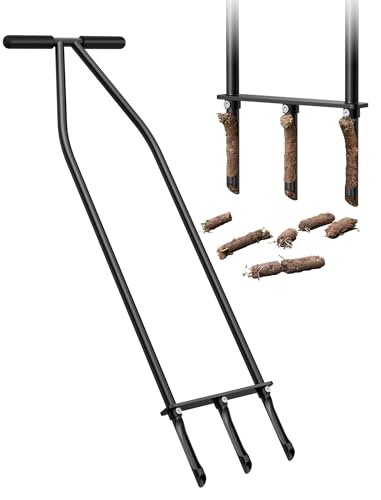
Yard Butler Manual Lawn Coring Aerator
Spec line: handheld T-handle · hollow tines · about 3.5 inch plug depth · about 3.5 lb · foot platform
Best for: small lawns, bare patches, pet paths and spot treatments.
Skip if: your lawn is above about 1,000 square feet; it is a hard workout.
- Pros: very deep cores; low entry price tier; stores in a closet.
- Cons: slow; hard on knees and back; ineffective in dry, rock-hard clay.
Corona YardBreather Aerator with ComfortGel Grip
Spec line: handheld · about 3.5 inch tines · about 3.5 lb · gel grip handle
Best for: small spots and gardeners who want a more comfortable grip.
Skip if: you need to cover a full lawn.
- Pros: comfortable handle; consistent depth; easy storage.
- Cons: same area limits as every handheld; tines can bend in rocky soil.
LawnVigor Manual Core Aerator
Spec line: manual · three hollow tines · wide foot pedal
Best for: spot aeration with more holes per step than a two-tine tool.
Skip if: your soil is very dry or rocky.
- Pros: three tines per step cut the effort; wide pedal protects feet.
- Cons: still limited to small areas; plug depth is not as well documented as on bigger units.
Agri-Fab 40 inch Plug Aerator (smaller version)
Spec line: about 40 inch width · galvanized knives · universal hitch · weight tray (verify current model details)
Best for: owners who want the Agri-Fab design with a narrower path.
Skip if: you have more than about half an acre.
- Pros: brand parts support; narrower path.
- Cons: confirm the current model number and tine count on the seller page before ordering.
Rental gas core aerator (class pick)
Spec line: self-propelled · gas engine · 18 to 22 inch drum · pulls plugs on every pass
Best for: lawns between 2,000 and 10,000 square feet with no tractor and no storage space.
Skip if: you want to aerate on your own schedule at no rental fee.
- Pros: powerful and fast; no storage; no hitch needed.
- Cons: heavy to transport; rental cost and availability vary; learning curve on slopes.
Decision matrix: which compaction problem needs which tool
| Symptom | Likely cause | Tool class | Extra step |
|---|---|---|---|
| Water pools or runs off after short rain | Surface compaction | Tow-behind or rental core aerator | Two perpendicular passes |
| Screwdriver will not push in more than about 3 inches when soil is moist | Deep compaction, often clay | Heavy tow-behind with full weight tray | Aerate every year |
| Thin turf along a dog run or footpath | Local traffic compaction | Handheld core aerator | Overseed the strip |
| Spongy lawn with thick brown layer at the soil line | Thatch, not only compaction | Dethatch first, then core aerate | Fertilize after |
| Sandy, fast-draining lawn | Usually little compaction | Spike tool may be enough | Topdress with compost |
Budget tiers and what you give up
Entry-level handheld coring tools cost the least and suit small spots, but your time cost climbs fast. Mid-range tow-behind units add speed and hole density, and they are the best value once your lawn passes roughly 5,000 square feet and you own a mower with a hitch. Premium options such as the John Deere unit buy a heavier frame, more tines and a larger weight capacity, which matter mostly on clay. Renting avoids storage and purchase costs entirely, so if you only aerate once a year it is often the smartest choice for mid-size lawns without a tractor.
When to aerate
Aerate when the grass is actively growing so it can fill the holes. Cool-season lawns such as fescue, bluegrass and ryegrass respond best in early fall and also in spring. Warm-season lawns such as Bermuda, zoysia and St. Augustine do best in late spring through early summer. Avoid aerating during drought or dormancy. Soil should be moist but not soggy: water the lawn a day or two before.
How to use a core aerator step by step
- Mow slightly shorter than normal and remove debris.
- Mark sprinkler heads, shallow irrigation lines and buried cables with flags.
- Water a day or two earlier so the tines can penetrate.
- Add weight to the tray if the cores are shallower than about 2 inches.
- Make passes in one direction, then a second pass at right angles on compacted areas.
- Leave the plugs on the lawn; they break down within a couple of weeks.
- Overseed and fertilize right after for the best results, because holes make a good seedbed.
Safety and handling
- Wear closed-toe boots. Tines are sharp and cores spray soil.
- Do not tow a loaded aerator on steep slopes; the unit can push the mower downhill.
- Disengage and park the mower before adding or removing weight.
- Keep children and pets away during operation.
- Store the aerator with the tines covered or pointed down.
Frequently asked questions
What is the best core aerator for a small lawn?
A handheld coring tool such as the Yard Butler is best for lawns under about 1,000 square feet. Above that, renting a gas core aerator is usually faster.
Tow-behind units require a mower or tractor with a hitch, which many small-lawn owners do not have.
Is a core aerator better than a spike aerator?
Yes, on compacted soil. Core aerators remove plugs, while spikes can press soil tighter around holes. Extension guidance generally favors cores.
Spikes may be acceptable on light, sandy soil as a quick tune-up.
How deep should a core aerator go?
Aim for 2 to 3 inches. Published measurements for tow-behind units cluster around 2.5 inches, and handheld tools can reach about 3.5 inches.
If your cores are shallower than 2 inches, add weight or aerate when the soil is moister.
How often should I aerate my lawn?
Once a year is typical for compacted or heavily used lawns. Healthy lawns on loose soil may need it only every two to three years.
Clay soil and lawns with heavy foot traffic benefit from annual aeration.
Do I need to add weight to a tow-behind aerator?
Usually yes. Weight pushes the tines deeper, and the trays hold sandbags, bricks or concrete blocks up to the limit listed for the model.
Check the published tray capacity and your mower’s towing limit before loading.
Should I remove the soil plugs?
No. Leave the plugs on the lawn. They contain soil and microbes and break down in a couple of weeks after rain or mowing.
Raking them up wastes effort and removes soil from the lawn.
Should I aerate before or after seeding?
Aerate first, then seed and fertilize. The holes create good seed-to-soil contact and shelter germinating seed.
Water lightly and often for a few weeks after overseeding.
Can I use a core aerator on wet soil?
Avoid saturated soil, which clogs the tines and smears. Soil should be moist enough for tines to penetrate but not muddy.
A day or two after watering or light rain is ideal.
Bottom line
Match the tool to the lawn. A handheld core aerator handles spots, a 40 inch tow-behind such as the Brinly-Hardy suits mid-size yards, and a 48 inch unit such as the Agri-Fab or John Deere makes sense for large or compacted lawns. Add weight until cores reach at least two inches, aerate when the grass is growing, and finish with seed and fertilizer.