Key takeaways
- Motor power: 10 to 13 amps for corded; enough for typical suburban thatch. Voltage matters on battery units.
- Working width: 13 to 16 inches suits small lawns. Wider covers faster but is harder to turn in tight beds.
- Depth settings: At least three. Five gives finer control and is better for avoiding scalping.
- Tine type: Spring steel tines dethatch; fixed blades or wire reels scarify. Some models include both heads.
- Collection bag: Small bags fill quickly. Plan to empty often or rake after.
- Weight: Lighter units are easier to turn but can bounce on uneven ground.
- Cord or battery: Decide this first, because it changes everything else.
The best dethatcher for small lawns is the Sun Joe AJ801E 12-amp corded electric dethatcher for most buyers with an outdoor outlet, the Greenworks 40V cordless dethatcher if you do not want a cord, and the WORX WG850 as the lighter, foldable option for lawns under about 5,000 square feet. For lawns under roughly 1,000 square feet with light thatch, a hand thatch rake such as the Ames 15-inch model is enough.
Thatch is the tight mat of dead stems, roots and runners that sits between green grass blades and the soil. A thin layer, under about half an inch, is normal and even helpful. When it grows past that, water and fertilizer run off instead of soaking in, and the lawn feels spongy underfoot. A dethatcher uses spinning tines or blades to lift that layer out. This guide explains how to confirm you need one, what specs to compare for a small yard, and which models are worth shortlisting in 2026.
Our top picks



As an Amazon Associate we earn from qualifying purchases at no extra cost to you.
Quick picks for small lawns
| Lawn and preference | Pick | Power | Width | Why |
|---|---|---|---|---|
| Small to mid lawn, outlet nearby | Sun Joe AJ801E | 12 amp corded | About 13 inches | Five depth positions, widely recommended |
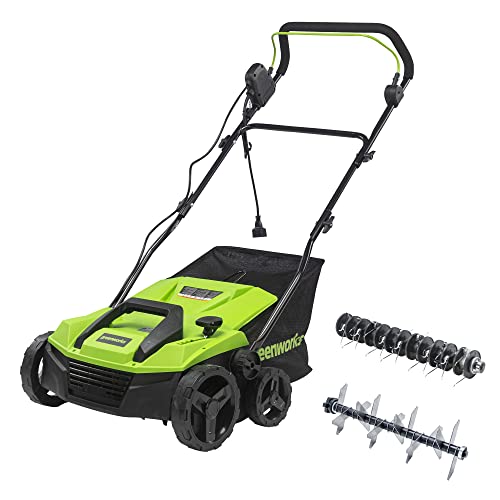
| No outlet or cord hassle | Greenworks 40V (DT40B00) | 40V battery | About 14 inches | Cordless, dethatcher and scarifier modes |
| Light weight, storage-limited | WORX WG850 | 12 amp corded | About 14 inches | Foldable handle, lighter body |
| Wider path, corded | WEN DT1315 | 13 amp corded | About 15 inches | Dual dethatcher and scarifier heads |
| Under 1,000 sq ft, light thatch | Ames 15-inch thatch rake | Manual | 15 inches | Lowest cost, no cord, easy to store |
How we chose
This is a research-based comparison. We reviewed 2026 manufacturer specifications and published roundups to see what buyers compare, then judged each dethatcher on motor class, working width, depth adjustment, bag or catcher, weight, cord or battery convenience and fit to small yards. We did not run physical trials. Source specs sometimes conflict, so where a figure was inconsistent we give a rounded range or describe the class. Confirm current numbers on the seller page before ordering.
Step 1: Confirm you actually have a thatch problem
- Cut a small wedge of turf about 3 inches deep with a trowel or knife.
- Measure the brown, spongy layer between the green blades and the soil.
- Under half an inch: do not dethatch. Mow and water normally.
- Half an inch or more: dethatch.
- If the lawn is mostly bare or very compacted, consider core aeration instead or in addition.
Dethatching a healthy lawn with thin thatch strips live grass for no benefit, so this check saves you both work and damage.
Dethatcher types explained
Corded electric
The default for small lawns. They are lighter than gas models, quiet, and need no fuel. The limit is cord reach and the extension cord needed for far corners.
Cordless battery
No cord, slightly heavier because of the battery, and the runtime depends on the pack and thatch density. Best when the lawn is far from an outlet or has obstacles that snag a cord.
Manual thatch rake
A rake with sharp curved blades on both sides. It is the cheapest option and good for small patches, but it is hard work beyond about 1,000 square feet.
Tow-behind
Wide units such as the Agri-Fab 45-0294 and Brinly DT-480BH-A are made for tractors and larger lawns. They are overkill for small yards.
Specs that matter on a small lawn
- Motor power: 10 to 13 amps for corded; enough for typical suburban thatch. Voltage matters on battery units.
- Working width: 13 to 16 inches suits small lawns. Wider covers faster but is harder to turn in tight beds.
- Depth settings: At least three. Five gives finer control and is better for avoiding scalping.
- Tine type: Spring steel tines dethatch; fixed blades or wire reels scarify. Some models include both heads.
- Collection bag: Small bags fill quickly. Plan to empty often or rake after.
- Weight: Lighter units are easier to turn but can bounce on uneven ground.
- Cord or battery: Decide this first, because it changes everything else.
Worked example: time and cord for a 2,000 square foot lawn
Time estimate
Take a 13 inch path, about 1.08 feet wide. Walking at roughly 1.5 miles per hour (7,920 feet per hour), one pass covers about 8,500 square feet per hour in theory. Real work is slower because of turns, overlap and bag emptying. A realistic rate is about 3,000 to 4,000 square feet per hour for one pass. Dethatchers are often run in two perpendicular passes, so a 2,000 square foot lawn takes about 1 to 1.5 hours of machine time, plus raking time for the debris.
Cord estimate
Measure from the outlet to the farthest corner, then add 10 percent for turns. At up to 50 feet a 14-gauge extension cord is the usual minimum for a 12 to 13 amp tool; at up to 100 feet, a 12-gauge cord is the safer choice, because thinner cords overheat and lose power. If your lawn is farther than 100 feet from an outlet, choose battery.
The takeaway: for a lawn this size, any 12 amp corded unit is fast enough, and the real decision is cord reach versus battery convenience.
The best dethatchers for small lawns in 2026
Sun Joe AJ801E Electric Dethatcher
Spec line: 12 amp corded · about 13 inch path · 5 depth positions · detachable bag · about 27 lb · dethatcher plus scarifier modes
Best for: small to mid-size lawns with an outlet and mixed grass types.
Skip if: the lawn is far from an outlet or you want a big catcher.
- Pros: five depth positions; spring steel tines; popular with small-lawn owners; adjustable depth.
- Cons: small bag fills quickly; cord limits range; plastic housing durability concerns in some reviews.
Greenworks 40V Cordless Dethatcher (DT40B00)
Spec line: 40V battery · about 14 inch path · 5 depth positions · dethatcher and scarifier · about 30 lb · USB port on the battery
Best for: small to medium lawns with obstacles where a cord would snag.
Skip if: thatch is thick and you need long runtimes; battery life varies with load.
- Pros: no cord; quiet; dual-function heads; low maintenance.
- Cons: battery and charger may be sold separately; runtime depends on thatch density; heavier than corded rivals.
WORX WG850 Corded Electric Dethatcher
Spec line: 12 amp corded · about 14 inch path · 3 depth settings · collection bag · about 18.6 lb · foldable handle
Best for: lawns under about 5,000 square feet and owners with limited storage.
Skip if: you want fine depth control; there are only three settings.
- Pros: lightest corded option in this list; folds for storage; easy to maneuver.
- Cons: bag needs frequent emptying; cord limits range.
WEN DT1315 Electric Dethatcher
Spec line: 13 amp corded · about 15 inch path · 5 depth positions · collection bag · dethatcher and scarifier heads
Best for: small lawns where you want a wider path at a mid-range tier.
Skip if: thatch is heavy; reviewers note it is not for demanding jobs.
- Pros: stronger motor class; two interchangeable heads; adjustable depth.
- Cons: bag fills fast; needs an extension cord; confirm weight on the seller page because source listings conflict.
Earthwise DT71613 Corded Electric Dethatcher
Spec line: 13 amp corded · about 16 inch path · adjustable depth · large catcher (verify capacity on listing)
Best for: small to mid-size lawns where you want a wider swath and less bag emptying.
Skip if: you have a very small yard where a wide, heavier body is awkward.
- Pros: wide path; large collection volume; zero emissions.
- Cons: plastic build concerns; weight around 30 lb; catcher size claims should be checked.
Greenworks 10 Amp Corded Dethatcher (27022 class)
Spec line: 10 amp corded · about 14 inch path · lighter motor class · budget tier (verify current model number and weight)
Best for: very small lawns with light thatch and a limited budget.
Skip if: thatch is thick; the motor is the weaker class here.
- Pros: lower price tier; easy to push; fine for light work.
- Cons: less power for dense thatch; stock availability varies.
Ames 15 inch Thatch Rake (manual)
Spec line: 15 inch head · manual · about 5 lb · curved double-sided blades
Best for: lawns under about 1,000 square feet and spot patches.
Skip if: your lawn is bigger or thatch is thick; it is tiring.
- Pros: lowest cost; no cord or charging; trivial storage.
- Cons: physically demanding; slow; the head bends if forced into dense mats.
Agri-Fab 45-0294 Tow-Behind Dethatcher (large-lawn contrast)
Spec line: 40 inch width · tow-behind · universal hitch · heat-treated tines
Best for: larger lawns behind a tractor.
Skip if: your yard is small; it needs a tractor and lots of storage.
- Pros: wide coverage; durable frame.
- Cons: needs a tractor; no collection bag; assembly needed.
Match by buyer criteria
Lawn under 1,000 square feet
Use a manual thatch rake. A power unit costs more and will sit in storage most of the year.
Lawn 1,000 to 5,000 square feet with an outlet
Choose a corded 12 to 13 amp unit with at least three depth positions: Sun Joe AJ801E, WORX WG850 or WEN DT1315.
Lawn with obstacles, far from an outlet
Choose the Greenworks 40V cordless. If you already own Greenworks 40V batteries, the tool-only price tier makes it more attractive.
Heavy thatch or a neglected lawn
Consider renting a gas power rake, because small electrics struggle on a thick mat. Make several passes at increasing depth over a few weeks rather than one deep pass.
Corded versus cordless: a simple decision rule
Walk from your nearest outdoor outlet to the farthest corner of the lawn and count the steps; two steps are roughly five feet. If the distance is under 100 feet and the route has few trees or beds, a corded 12 to 13 amp unit gives more sustained power for less money. If the route snakes around planters, fences or a pool, or the distance is over 100 feet, the battery model saves frustration, but you should budget for a spare pack if the lawn is near the upper end of small. Battery units also suit people who store tools in a shed without power, since there is no cord to coil afterward.
When and how to dethatch
Dethatch when the grass is actively growing and can recover. Cool-season lawns do best in early fall or spring. Warm-season lawns such as Bermuda and zoysia do best in late spring to early summer, after green-up. Never dethatch during drought, heat stress or dormancy.
- Mow to about half the usual height.
- Mark sprinkler heads and shallow lines.
- Set the depth so tines just reach the thatch layer, not deep into soil.
- Make passes in one direction, then a second pass at right angles if the thatch is thick.
- Rake and bag the debris.
- Overseed bare areas, fertilize and water lightly and often for two to three weeks.
Safety notes
- Wear eye protection, closed shoes and long pants; tines throw debris.
- Use a cord rated for outdoor use and a GFCI-protected outlet.
- Keep the cord behind you and away from the tines.
- Unplug or remove the battery before clearing jams or adjusting depth.
- Keep children and pets away while the machine runs.
Frequently asked questions
What is the best dethatcher for a small lawn?
The Sun Joe AJ801E is the most commonly recommended pick for small lawns with an outlet. It has a 12 amp motor and several depth positions.
For cordless convenience, the Greenworks 40V cordless model is the usual alternative.
How do I know if my lawn needs dethatching?
Cut a small plug and measure the spongy layer above the soil. If it is half an inch or more, dethatch.
Less than that and mowing and watering are enough.
Is a dethatcher the same as a scarifier?
Not exactly. Dethatchers use springy tines to lift thatch, while scarifiers use fixed blades that cut into the surface. Many electric units ship with both heads.
Use the dethatching head for normal thatch and the scarifier head only for renovation work.
Can I use a manual thatch rake on a small lawn?
Yes, for lawns under about 1,000 square feet or for spot treatment. It is cheap but tiring.
Beyond that size, an electric unit saves hours.
What time of year should I dethatch?
Dethatch during the active growing season. For cool-season grass that is early fall or spring, and for warm-season grass it is late spring to early summer.
Avoid drought and heat stress, when the lawn cannot recover.
Should I dethatch before or after aerating?
Dethatch first, then aerate if the soil is compacted. Removing thatch lets the aerator reach soil more easily.
Overseed and fertilize after both steps.
How often should I dethatch?
Only when thatch measures half an inch or more, which for most lawns is every one to three years at most. Lawns with spreading grasses such as Bermuda or zoysia build thatch faster.
Routine dethatching on a healthy lawn can do more harm than good.
Do I need an extension cord for a corded dethatcher?
Almost always. Use an outdoor-rated cord with the right gauge, such as 14-gauge up to about 50 feet and 12-gauge up to about 100 feet.
If your lawn is farther from an outlet than that, choose a battery model.
Bottom line
Check thatch depth first. For a small lawn with an outlet, the Sun Joe AJ801E, WORX WG850 or WEN DT1315 are sensible corded choices. For cord-free convenience, take the Greenworks 40V. For lawns under about 1,000 square feet, a hand thatch rake does the job. Dethatch during active growth, then overseed and fertilize for a quick recovery.