
Key takeaways
- Dense shade (about 3 to 4 hours of direct sun or less): Scotts Turf Builder Grass Seed Dense Shade Mix, Jonathan Green Black Beauty Dense Shade, Outsidepride Legacy Fine Fescue, or Pennington Smart Seed Dense Shade.
- Partial shade (roughly 4 to 6 hours of sun): Pennington Smart Seed Dense Shade or Scotts Turf Builder Grass Seed Sun & Shade Mix.
- Mixed light across one lawn: Scotts Turf Builder Grass Seed Sun & Shade Mix or Pennington Smart Seed Sun & Shade.
- Small bare patches under trees: Pennington Smart Patch Dense Shade or Scotts EZ Seed Patch & Repair Sun & Shade.
For most shaded yards, Pennington Smart Seed Dense Shade is the safest all-around pick, Scotts Turf Builder Grass Seed Dense Shade Mix is the best fine-fescue-heavy choice for the darkest corners, and Scotts Turf Builder Grass Seed Sun & Shade Mix is the right call when light changes across the day. The real decision is not the brand. It is how many hours of direct sun the spot gets, how much tree-root competition sits under the soil, and which cool-season grass family the bag is built on.
This guide groups eight seed products by shade level so you can match the bag to the yard instead of guessing. It also includes a seed-quantity calculation, a light-hours decision matrix, and a short establishment plan, because shade seed fails far more often from timing and soil problems than from picking the wrong label.
Our top picks


As an Amazon Associate we earn from qualifying purchases at no extra cost to you.
Quick answer: which seed for which shade
- Dense shade (about 3 to 4 hours of direct sun or less): Scotts Turf Builder Grass Seed Dense Shade Mix, Jonathan Green Black Beauty Dense Shade, Outsidepride Legacy Fine Fescue, or Pennington Smart Seed Dense Shade.
- Partial shade (roughly 4 to 6 hours of sun): Pennington Smart Seed Dense Shade or Scotts Turf Builder Grass Seed Sun & Shade Mix.
- Mixed light across one lawn: Scotts Turf Builder Grass Seed Sun & Shade Mix or Pennington Smart Seed Sun & Shade.
- Small bare patches under trees: Pennington Smart Patch Dense Shade or Scotts EZ Seed Patch & Repair Sun & Shade.
How we chose
This is a research-based comparison, not a product trial. We compared manufacturer labels and species descriptions, university turf-extension guidance on shade-tolerant cool-season grasses, and the shortlists that recur across 2026 buyer guides. A product made the list only if it is a currently sold seed line with a clear shade positioning. Where a manufacturer does not publish an exact blend percentage or a coverage figure that we could confirm, we describe the seed by grass class instead of quoting a number. Always read the tag on the bag you buy, because blends are adjusted between production lots.
Our criteria, in order of weight:
- Grass species in the blend. Fine fescues (creeping red, chewings, hard, sheep) tolerate the least light. Tall fescue and shade-leaning Kentucky bluegrass need more. Perennial ryegrass establishes fast but fades in low light.
- Stated sun range. A realistic label names a minimum number of sun hours rather than promising grass in “any shade.”
- Coating and fertilizer. Coated seed holds water longer and helps in dry shade under trees, but coating adds weight, so a coated bag holds less actual seed than the same-weight uncoated bag.
- Use case. Full renovation, overseeding, and patch repair are different jobs and call for different products.
- Weed-seed and inert content. The tag lists these as percentages. Lower is better.
Understand shade before you shop
Shade is not one condition. Three variables matter more than the word on the bag.
Hours of direct sun
Watch the spot during the growing season, not in winter when deciduous trees are bare. Note the hours in which sunlight actually touches the soil. Under a maple canopy in July, “dappled all day” often delivers less usable light than a spot that gets a clean three hours of morning sun and then full shade. Direct sun hours count for more than bright but filtered light.
Root competition
Large trees such as maple, beech, and oak pull moisture and nutrients from the top foot of soil, exactly where grass roots live. Seed that has the right light but no water will still thin out by midsummer. If roots are visible at the surface, the fix is often mulch or a shade garden bed instead of more seed.
Soil and traffic
Shaded soil is frequently compacted, acidic, and damp on top while dry beneath the canopy. Most cool-season turfgrasses prefer a soil pH near 6.0 to 7.0, and a basic soil test tells you whether lime is needed before seeding. Shade grasses are also less tolerant of foot traffic, because they grow more slowly and recover more slowly.
Comparison table
| Product | Grass class | Positioned for | Best job | Coated or fertilized |
|---|---|---|---|---|
| Pennington Smart Seed Dense Shade | Fescue-based blend (published makeup varies by source) | Dense to partial shade | Renovation and overseeding | Coated, marketed as low-water |
| Scotts Turf Builder Grass Seed Dense Shade Mix | Fine fescue (creeping red, chewings) | Dense shade, about 3 hours of sun | Darkest zones, overseeding | Coated with fertilizer |
| Scotts Turf Builder Grass Seed Sun & Shade Mix | Multi-species cool-season blend | Full sun to partial shade | Mixed-light lawns | Coated with fertilizer |
| Jonathan Green Black Beauty Dense Shade | Fine-fescue-heavy shade blend | Dense shade, northern climates | Large shady areas | Typically uncoated |
| Outsidepride Legacy Fine Fescue | Fine fescue | Dense shade, cooler regions | Large areas, low maintenance | Uncoated |
| Pennington Smart Patch Dense Shade | Shade grass seed with mulch mix | Dense shade patches | Bare-spot repair | Mulch and fertilizer blend |
| Pennington Smart Seed Sun & Shade | Multi-species cool-season blend | Sun and partial shade | Overseeding thin lawns | Coated |
| Scotts EZ Seed Patch & Repair Sun & Shade | Multi-species blend with mulch | Sun and partial shade patches | Small repairs | Mulch and fertilizer blend |
Best for dense shade
Dense shade means about three to four hours of direct sun or less. Fine fescues are the only cool-season grasses that hold up here, and even they will thin in deep, all-day gloom. Choose one of these products only if the spot meets that minimum.
Scotts Turf Builder Grass Seed Dense Shade Mix
Spec line: Fine fescue blend (creeping red and chewings) · Coated · Fertilizer-enriched coating · Dense-shade positioning at about 3 hours of sun.
Best for: Dark corners and north sides of houses where other mixes fail.
Skip if: The spot gets more than about six hours of sun or sees regular foot traffic, because fine fescue is thinner and less wear-tolerant than tall fescue.
- Pros: The most shade-tolerant grass class. Coating helps seed hold moisture. Easy to find and widely stocked.
- Cons: Coating means less seed per pound. Fine fescue looks fine-bladed and can differ in texture from a bluegrass lawn nearby.
Jonathan Green Black Beauty Dense Shade
Spec line: Shade-focused fine-fescue-heavy mix · Cool-season · Intended for northern and transition-zone shade · Check the bag tag for exact blend percentages.
Best for: Homeowners who want a seed-heavy, budget-minded bag for a big shaded area.
Skip if: You live in the deep South, where fine fescue struggles with summer heat.
- Pros: Seed-heavy bag stretches further per pound. Well known in northern lawn circles.
- Cons: Uncoated seed dries out faster, so you will water more often in the first weeks.
Outsidepride Legacy Fine Fescue
Spec line: Fine fescue · Uncoated bulk seed · Low-input turf · Cooler regions and shade.
Best for: Large shady acreage, wooded lots, and low-mow, low-fertilizer lawns.
Skip if: You want a thick, manicured, bluegrass-style carpet or heavy kid and pet traffic.
- Pros: Bulk packaging suits large areas. Fine fescues need less fertilizer and less mowing.
- Cons: No coating or starter nutrition, so you must do the soil prep and watering carefully yourself.
Best for partial shade and mixed light
If the lawn gets four to six hours of sun, or sun on one end and shade on the other, a blend that includes tall fescue or shade-leaning Kentucky bluegrass gives a more traditional look and better wear tolerance than pure fine fescue.
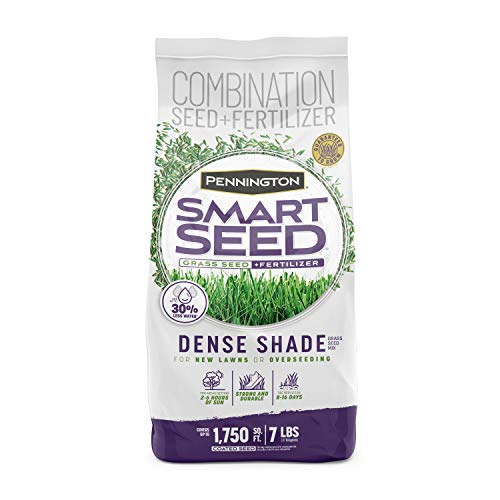
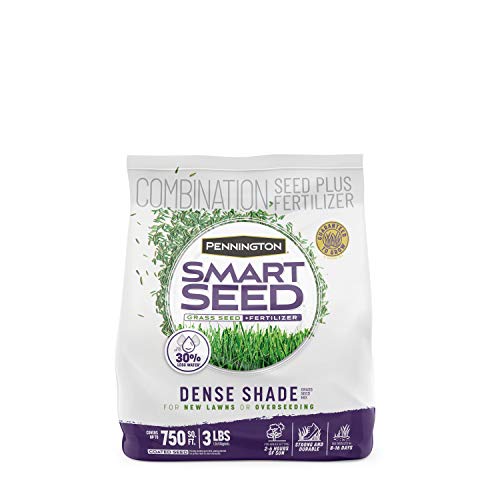
Pennington Smart Seed Dense Shade
Spec line: Fescue-based shade blend · Coated · Marketed as needing less water once established · Sold in multi-pound bags.
Best for: Most homeowners who have genuine shade under trees but still want a reasonable lawn texture.
Skip if: The spot is truly sunless, because no seed blend will survive under permanent heavy canopy.
- Pros: Covers the broadest range from partial to dense shade. The low-water positioning helps in dry shade.
- Cons: Published descriptions of its species makeup differ between sources, so read the tag on your bag before comparing it with a pure fine fescue.
Scotts Turf Builder Grass Seed Sun & Shade Mix
Spec line: Multi-species cool-season blend · Coated · Feed-enriched coating · Full sun to partial shade.
Best for: A single lawn that swings between sun and shade through the day.
Skip if: Your problem area gets under about four hours of sun. A dense-shade formula will outlast this mix there.
- Pros: Flexible across light conditions. Widely available and easy to apply with a spreader.
- Cons: It is a compromise blend. In the shadiest zones the sun-loving species will fade and fine fescue will take over.
Pennington Smart Seed Sun & Shade
Spec line: Multi-species cool-season blend · Coated · Low-water positioning · Sun to partial shade.
Best for: Overseeding a thin lawn that mixes open and tree-covered areas.
Skip if: Part of the lawn is dense shade. Treat that part separately with a dense-shade product.
- Pros: Good fit for general overseeding. Coating helps seed-to-soil moisture contact.
- Cons: Not a dense-shade solution on its own.
Best for patching bare spots
Patch kits combine seed with mulch and starter fertilizer so you can fix a small area without buying a large bag. They cost more per pound of seed than a bulk bag, so use them for spots totaling no more than a few hundred square feet.
Pennington Smart Patch Dense Shade
Spec line: Shade seed blend with mulch and fertilizer · Patch-and-repair format · Dense-shade positioning.
Best for: Bare spots under trees, pet damage in shade, and thin areas along shaded fence lines.
Skip if: You are reseeding a whole lawn. The cost per square foot is higher than bulk seed.
- Pros: Mulch holds moisture and discourages washout. Simple one-bag repair.
- Cons: Mulch can mask poor soil contact if you skip raking and loosening first.
Scotts EZ Seed Patch & Repair Sun & Shade
Spec line: Multi-species seed with mulch and fertilizer · Patch format · Sun and partial shade.
Best for: Small repairs where the area gets at least a few hours of sun.
Skip if: The patch sits in deep shade, where you want a dense-shade formula instead.
- Pros: Widely sold and easy for beginners. Mulch holds water through germination.
- Cons: Less shade-focused than a dedicated dense-shade product.
Decision matrix: match light to seed
| Direct sun per day | Tree competition | Best seed class | Realistic outcome |
|---|---|---|---|
| Under 3 hours | Any | Fine fescue only, or switch to mulch or groundcover | Thin turf even with the right seed |
| 3 to 4 hours | Light | Fine fescue dense-shade mix | Good, with fall seeding |
| 3 to 4 hours | Heavy roots | Fine fescue plus extra watering and mulch beds near trunks | Fair |
| 4 to 6 hours | Light to moderate | Dense-shade fescue blend or sun and shade mix | Good to very good |
| 6 hours or more | Any | Sun and shade mix, or tall-fescue-based blend | Very good |
Worked example: how much seed do you need
Seed bags state coverage on the label, but you can do the math yourself and avoid running short. Use these steps.
- Measure the area. A shaded strip that is 25 feet wide and 40 feet long is 1,000 square feet. Subtract planters or beds. If a 60-square-foot bed sits inside, the seeded area is 940 square feet.
- Find the label rate. Tags list a new-lawn rate and a lower overseeding rate, usually as pounds per 1,000 square feet. Rates differ by species and coating. For this example assume the tag says 4 pounds per 1,000 square feet for a new lawn and half that for overseeding. Use the number on your own tag.
- Multiply. New lawn: 940 divided by 1,000 times 4 equals about 3.8 pounds. Overseeding: about 1.9 pounds.
- Add a small buffer. Add roughly 10 percent for edges and spreader overlap, which gives about 4.2 pounds for a new lawn.
- Compare to bag size. A 7-pound bag would cover this strip with seed left over for patching. A 3-pound bag would not.
Remember that coated seed is part coating by weight, so a 7-pound coated bag holds less actual seed than 7 pounds uncoated. This is why the label rate, not the bag weight, is the number to trust.
Establishment plan for shade lawns
- Time it for early fall. Cool-season seed germinates best when soil is roughly 50 to 65 degrees Fahrenheit. Fall also gives the seedlings time before summer stress and avoids competition from tree leaf-out. Spring seeding works but has less time to establish before heat.
- Prune and thin the canopy. Raise low branches and remove crowded limbs. Even an extra hour of sun matters more than any seed upgrade.
- Test the soil. Add lime if the test calls for it. Do not guess.
- Clear leaves and loosen the surface. Rake out debris and scratch the top quarter inch so seed touches soil.
- Spread seed evenly. Split the amount in two passes at right angles for even coverage, then press it in with a roller or the back of a rake.
- Keep the surface moist. Light watering once or twice a day until germination, then taper to deeper, less frequent watering. Fine fescue usually sprouts in one to two weeks, though slower in cool soil.
- Mow high and light. Mow shade grass at the higher end of the recommended range, roughly three to four inches, and never remove more than one-third of the blade at once.
- Go easy on nitrogen. Shade grass uses less fertilizer. Too much encourages weak growth and disease.
Common mistakes
- Buying a sun mix for deep shade. Sun species germinate, then die back within a season.
- Seeding on top of leaf litter or thatch. Seed has to touch mineral soil.
- Over-fertilizing. Shade lawns are slow growers and need less feed.
- Ignoring root competition. Water seedlings more under large trees than in open areas.
- Using the lawn as a path. Heavy foot traffic on shade grass compacts soil and kills the stand. Install stepping stones or a path.
When seed is the wrong answer
If the area gets under about three hours of direct sun, has dense surface roots, or stays soggy, no seed will deliver a thick lawn. Consider shade-tolerant groundcovers, mulch, a woodland planting bed, or pruning the canopy to open the area first. Putting good seed in a bad spot just repeats the failure the following year.
Frequently asked questions
What is the best grass seed for heavy shade?
Fine fescue blends are the best for heavy shade because they tolerate the least light. Scotts Turf Builder Grass Seed Dense Shade Mix and Jonathan Green Black Beauty Dense Shade are common examples. Even these need roughly three hours of direct sun.
Fine fescues, including creeping red and chewings, also tolerate drier, less fertile soil, which suits tree-root zones.
How many hours of sun does shade grass need?
Most shade seed needs about three to four hours of direct sun daily at minimum. Below that, expect thin turf regardless of brand.
Filtered, dappled light counts for less than direct sunbeams, so measure on a clear day during the growing season.
When should I plant grass seed in shade?
Early fall is the best time for cool-season shade grass. Soil is still warm, air is cooler, and trees are dropping leaves, which lets more light reach the seedlings.
Spring is the second choice, but summer heat and leaf-out arrive quickly and stress young grass.
Why does grass keep dying under my tree?
Usually the cause is a mix of low light and root competition. The tree takes the water and nutrients, and shade slows the grass down.
Prune low limbs, water seedlings more often than the rest of the lawn, and consider mulch near the trunk instead of forcing turf.
Can I mix sun and shade seed?
Yes, a sun and shade mix is designed for that. It blends several species so different parts of the lawn can favor the one that suits the light.
For very dark spots, spread a dense-shade product there separately for better results.
Is coated seed worth it in shade?
Coated seed can help by holding moisture and adding starter nutrients, which is useful in dry shade. It is not required if you water consistently.
Coated bags hold less actual seed per pound, so compare coverage by label rate, not by bag weight.
Should I rake or aerate before seeding in shade?
Yes, loosen the surface so seed touches soil. Rake out leaves and thatch and scratch the top layer lightly.
On compacted shade soil, core aeration before overseeding improves water entry and seedling roots.
How long until shade grass fills in?
Fine fescue often sprouts in one to two weeks, but full density can take a full season or longer. Shade grass grows slowly.
Plan for a second light overseeding the following fall to thicken the stand.


