Key takeaways
- Best for most gardens: Tenax 7 ft x 100 ft deer netting
- Best heavy-duty poly: Tenax Maximum Duty 7.5 ft (via Benner)
- Strongest poly option: Tenax Super Duty 7.5 ft (via Benner)
- Best large-property roll: Deerbusters 7.5 ft x 330 ft heavy-duty with reinforced bottom edge
- Best permanent barrier for heavy pressure: Deerbusters 8 ft welded wire fence
- Best budget with stakes and ties: FEED GARDEN 7 ft deer netting
- Best low-cost seasonal option: Dalen Deer-X
The best deer fencing for most home gardens is Tenax 7 ft x 100 ft black polypropylene deer netting, with the heavier Tenax Maximum Duty or Super Duty grades for areas with strong deer pressure and the Deerbusters 8 ft welded wire fence for the toughest sites. Budget gardeners can start with FEED GARDEN or Dalen Deer-X 7 ft netting. The right choice comes down to three numbers: fence height, break strength and mesh size. A fence that is too short or too weak fails in one night, so this guide starts with the criteria and ends with a worked calculation that tells you how much to buy.
Deer are browsers and jumpers. A white-tailed deer can clear a fence of around 6 feet without effort when motivated, which is why most guidance points to 7 to 8 feet for a dependable barrier. Netting works because deer have poor depth perception and are reluctant to jump what they cannot see through clearly, but a hungry deer in winter will test any barrier. Matching the fence to deer pressure is the entire game.
Our top picks


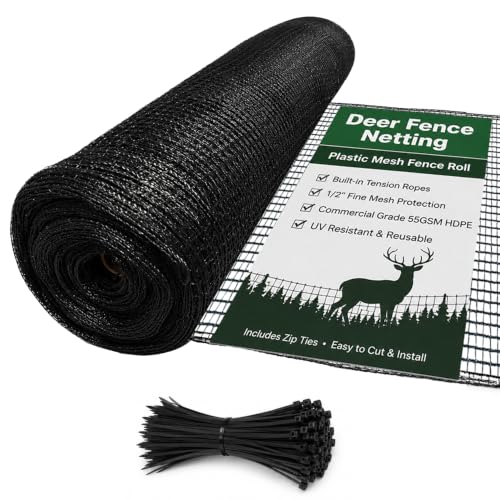
As an Amazon Associate we earn from qualifying purchases at no extra cost to you.
Quick Picks
- Best for most gardens: Tenax 7 ft x 100 ft deer netting
- Best heavy-duty poly: Tenax Maximum Duty 7.5 ft (via Benner)
- Strongest poly option: Tenax Super Duty 7.5 ft (via Benner)
- Best large-property roll: Deerbusters 7.5 ft x 330 ft heavy-duty with reinforced bottom edge
- Best permanent barrier for heavy pressure: Deerbusters 8 ft welded wire fence
- Best budget with stakes and ties: FEED GARDEN 7 ft deer netting
- Best low-cost seasonal option: Dalen Deer-X
How We Chose
This ranking is research-based. We compared manufacturer and dealer specification pages, published buyer guides and fence-installer advice, and we focused on measurable properties: height, mesh size, break strength, material and stated life expectancy. We did not install these products for this article and make no claim of personal use. Where sources disagreed, for example on the exact Tenax mesh dimension, we say so rather than choose a number.
We grouped products by deer pressure, since that is how professional installers choose: light pressure (occasional browsing), moderate pressure (regular visits to a food source) and heavy pressure (deer with few alternatives, such as in winter or in dense populations).
Comparison Table
| Product | Type | Height | Key specs | Deer pressure |
|---|---|---|---|---|
| Tenax 7 ft x 100 ft deer netting | Black polypropylene mesh | 7 ft | 100% virgin polypropylene, UV stabilized, mesh about 0.63 x 0.75 in (one dealer lists 3/4 x 1 in), about 9 lb shipping weight | Light to moderate |
| Tenax Maximum Duty (Benner) | Extruded polypropylene | 7.5 ft | 950 lb break strength | Moderate to heavy |
| Tenax Super Duty (Benner) | Extruded polypropylene | 7.5 ft | Described as the strongest polypropylene fence available | Heavy |
| Deerbusters heavy-duty with reinforced bottom edge | Extruded poly | 7.5 ft x 330 ft roll | 650 lb break strength, 80 g/m2, mesh about 1.75 x 2 in, 10 to 15 year life | Light to moderate |
| Deerbusters welded wire | Welded wire | 8 ft | Permanent metal fence | Heavy |
| FEED GARDEN 7 ft netting | Poly netting | 7 ft class | Includes stakes and ties | Light |
| Dalen Deer-X | Poly netting | 7 ft class | Low-cost seasonal netting | Light |
What Matters When Choosing Deer Fencing
Height
Seven feet is the practical minimum for a dependable physical barrier, and 8 feet is safer where deer are numerous. Netting that stands only 4 to 5 feet is more of a deterrent than a barrier. If you cannot go that high, slant the top outward or use a double-fence design, since deer judge jump width as well as height.
Break strength
Break strength tells you how much force the netting resists before tearing. Light-grade netting may be adequate for seasonal use or small areas, while grades rated in the hundreds of pounds, such as 650 lb or 950 lb, hold up when a deer pushes into the fence. Higher strength matters most where deer have learned the garden contains something attractive.
Mesh size
A mesh of about three-quarters of an inch is nearly invisible at distance and prevents deer from threading their muzzle through to browse. Larger meshes around 1.75 by 2 in are still effective against most deer, but smaller animals, such as rabbits, will pass through unless you add a lower layer of finer mesh or reinforcement at the bottom.
Material
Polypropylene netting is light, easy to cut and install, and UV stabilized in good products. It resists rust and rolls up for storage. Welded wire is stronger and permanent but costs more per foot and demands a proper post system. For most home gardens, poly netting on sturdy posts is the sweet spot.
Life expectancy
Dealer figures range from 10 to 15 years for heavy-duty poly and 20 plus years claimed for some premium lines. Treat these as maximums under good conditions. UV exposure, snow load and tree falls shorten life.
Posts and bottom edge
The fence is only as strong as its posts. Use steel T-posts or treated wood posts every 8 to 10 feet, driven at least 18 to 24 inches deep and taller than the netting so you can attach a top tension line. Secure the bottom edge to the ground with landscape staples every 12 to 18 inches, because deer will push under a loose hem.
The Best Deer Fencing
1. Tenax 7 ft x 100 ft Deer Netting
Spec line: 7 ft x 100 ft · black polypropylene · 100 percent virgin material · UV stabilized · mesh about 0.63 x 0.75 in (dealer listings vary) · about 9 lb
Best for: Vegetable gardens, orchards and landscape beds with light to moderate pressure.
Skip if: Deer in your area are numerous and hungry through winter; step up to a heavier grade.
- Pros: Nearly invisible when installed, light enough to handle alone, cut to fit with ordinary shears, made in the USA according to retailer listings.
- Cons: The base grade is described by the maker as suited to light pressure and smaller areas, and it needs good posts and tension.
2. Tenax Maximum Duty 7.5 ft (via Benner)
Spec line: 7.5 ft height · extruded polypropylene · 950 lb break strength
Best for: Properties where deer test the fence repeatedly.
Skip if: Your garden is small and deer visit rarely, because the heavier grade costs more.
- Pros: High break strength and extra height over 7 ft netting; same easy installation.
- Cons: Higher cost tier; needs a strong post system to take advantage of the netting strength.
3. Tenax Super Duty 7.5 ft (via Benner)
Spec line: 7.5 ft height · extruded polypropylene · highest-strength poly grade offered by the dealer
Best for: Large or exposed sites where a poly fence must hold for years.
Skip if: You need a published break strength number; confirm it on the dealer page.
- Pros: Strongest polypropylene option described in the sources reviewed.
- Cons: Cost and the need for a full post-and-tension setup.
4. Deerbusters 7.5 ft x 330 ft Heavy-Duty With Reinforced Bottom Edge
Spec line: 7.5 ft x 330 ft · 650 lb break strength · 80 g/m2 · mesh about 1.75 x 2 in · 10 to 15 year life
Best for: Acreage, pastures and orchards where long runs are needed.
Skip if: Small animals such as rabbits are the main issue; the larger mesh lets them pass without added ground-level wire.
- Pros: Very long roll reduces seams; reinforced bottom edge is more resistant to rodent damage and snags at ground level.
- Cons: The roll is heavy to unspool and needs a team; the larger mesh is more visible than lighter netting.
5. Deerbusters 8 ft Welded Wire Fence
Spec line: 8 ft · welded wire · permanent installation
Best for: Heavy deer pressure and gardeners who want a barrier that lasts decades.
Skip if: You want a quick, low-cost seasonal solution.
- Pros: The strongest and most permanent option in this group; resists chewing and pushing.
- Cons: Highest cost, heavy panels or rolls, and a post system that needs proper depth and bracing. Municipal rules may limit fence height, so check before building.
6. FEED GARDEN 7 ft Deer Netting
Spec line: 7 ft class · poly netting · stakes and ties included
Best for: First-time buyers wanting a ready-to-install kit for a small plot.
Skip if: Your deer pressure is moderate or higher.
- Pros: Low entry cost and included hardware.
- Cons: Lighter grade; included stakes are short for a 7 ft fence, so you may want sturdier posts.
7. Dalen Deer-X
Spec line: 7 ft class · poly netting · light-duty
Best for: Seasonal protection around a few plants, such as new shrubs.
Skip if: You need multi-year protection for a large garden.
- Pros: Very inexpensive and easy to move.
- Cons: Not meant for heavy pressure or long-term installation.
Worked Example: How Much Fence Do You Need?
Take a rectangular garden of 30 ft by 40 ft and work through the purchase.
- Perimeter. 2 x (30 + 40) = 140 ft of fence line. Add 10 percent for overlaps and corners: 154 ft.
- Rolls. A 100 ft roll covers 100 ft, so two rolls are required. With 200 ft you have 46 ft of spare for a gate and repairs. A single 330 ft roll would also cover the run, with leftover for a second garden.
- Posts. At one post every 8 ft, 140 / 8 = 17.5, so 18 posts, plus 2 extra for the gate: 20 posts. Use taller corner and gate posts with diagonal braces.
- Height. 7 ft netting needs posts that rise at least 7.5 ft above ground, which means roughly 9.5 ft overall when you bury them 24 in deep. Choose 8 ft posts only for a 6 ft fence.
- Anchoring the bottom. Landscape staples every 18 in means 140 x 12 / 18 = 93 staples; buy 100.
- Top line. Run a taut wire or cord along the post tops, 140 ft plus 10 percent, and attach the netting to it with ties every 12 in: about 154 ties for the top alone.
With this plan a gardener knows to buy two Tenax rolls (or one larger heavy-duty roll), about 20 posts, 100 staples and roughly 300 ties before starting, instead of discovering shortages halfway through.
Installation Tips
Plan the gate first
A fence is useless if you leave the gate loose. Build a framed gate the full height of the fence, hang it on a heavy post, and make the bottom gap no larger than 4 inches.
Keep netting taut
Slack netting invites deer to push through. Attach it to a top line and tension it evenly across posts. Use ties designed for outdoor use, and check them every spring.
Make the fence visible at first
For the first two weeks tie strips of white cloth or flagging at eye height. Deer then learn that there is a barrier, rather than running into it.
Mind other wildlife
Netting can entangle birds and small animals if left loose at the bottom. Keep the bottom edge pinned to the ground and check for gaps. Where rabbits, groundhogs or voles are present, bury a strip of hardware cloth along the base.
Check local rules
Some towns and homeowner associations limit fence height. Confirm before purchase, and call your utility locator service before driving posts.
When Fencing Is Not Enough
Even a good fence can fail when deer find a gap. Walk the line weekly in autumn and winter, when pressure is highest. Fix tears and loose staples quickly. Add plant selection to the plan: deer tend to avoid strongly scented herbs and tough-leaved plants, though no plant is truly deer-proof. Fencing remains the only method that works reliably on every plant.
Frequently Asked Questions
How tall should a deer fence be?
Aim for 7 to 8 feet. Anything shorter works only against light pressure or when deer have other food.
If you cannot build that high, use a double fence or an outward-angled top to discourage jumping.
Is plastic deer netting effective?
Yes, when it is 7 feet tall, taut and well anchored. It suits light to moderate pressure, and heavier grades handle more.
Plastic netting fails when installed slack, too short or with loose bottoms.
What mesh size works best?
A mesh of about three-quarters of an inch is less visible and blocks muzzles. Larger meshes still work against deer but let small animals through.
Add hardware cloth at the base if rabbits or groundhogs are a problem.
How long does polypropylene deer fencing last?
Dealer figures run from about 10 to 15 years for heavy-duty poly, with some premium lines claiming 20 plus. Actual life depends on sunlight, snow and damage.
Inspect every season and replace torn sections promptly.
Can deer chew through netting?
Deer usually push or tangle rather than chew, but a determined animal can damage light-grade netting. Higher break strength reduces that risk.
Choose a grade rated in the hundreds of pounds for sites with heavy, persistent pressure.
How far apart should fence posts be?
Set posts every 8 to 10 feet and drive them 18 to 24 inches deep. Use stronger, braced posts at corners and gates.
Closer spacing increases strength, which helps in wind and heavy snow.
Is welded wire better than netting?
Welded wire is stronger and more permanent, but it costs more and needs a stronger post system. Netting is cheaper and easier to install.
Choose wire for heavy pressure and long-term plans, netting for most home gardens.
Do I need to check local regulations?
Yes. Many municipalities and homeowner associations set height and material limits for fences, and underground utilities need marking.
Check rules and call the local utility locator service before driving any posts.
Final Recommendation
Measure the perimeter, decide how hungry your local deer are, and buy accordingly. For most gardens, Tenax 7 ft deer netting on sturdy posts is the efficient answer. Step up to Tenax Maximum Duty or Super Duty where pressure is high, choose the Deerbusters long roll for acreage, and invest in the 8 ft welded wire when you want the fence to last for decades. Spend as much time on posts, tension and the bottom edge as on the netting itself, because those details decide whether deer stay out.