Key takeaways
- Germination (first sprouts) and establishment (a lawn you can mow and walk on) are different clocks.
- Soil temperature controls speed more than the calendar: cool-season seed likes roughly 50 to 65 degrees F, warm-season seed likes soil above about 65 to 70 degrees F.
- Keep the top inch of soil moist, with short, frequent watering until seedlings are up, then water deeper and less often.
- First mow when the grass reaches about 3 to 4 inches (for cool-season lawns), with a sharp blade and never more than a third of the height at a time.
- Check the seed bag. The tag lists species, germination rate, and the maker’s timeline for that blend.
How long does grass seed take to grow? Most seed sprouts in 5 to 30 days, depending on the species and the soil temperature: perennial ryegrass is fastest at roughly 5 to 10 days, tall fescue takes about 7 to 14 days, and Kentucky bluegrass is the slow one at 14 to 30 days or more. Warm-season grasses such as Bermuda and zoysia also swing widely with heat. A thick, mowable lawn takes longer than germination, typically 6 to 12 weeks, so plan your watering, mowing, and foot traffic around those two stages.
Our top picks


As an Amazon Associate we earn from qualifying purchases at no extra cost to you.
Key takeaways
- Germination (first sprouts) and establishment (a lawn you can mow and walk on) are different clocks.
- Soil temperature controls speed more than the calendar: cool-season seed likes roughly 50 to 65 degrees F, warm-season seed likes soil above about 65 to 70 degrees F.
- Keep the top inch of soil moist, with short, frequent watering until seedlings are up, then water deeper and less often.
- First mow when the grass reaches about 3 to 4 inches (for cool-season lawns), with a sharp blade and never more than a third of the height at a time.
- Check the seed bag. The tag lists species, germination rate, and the maker’s timeline for that blend.
How Long Does Grass Seed Take to Grow? Timelines by Grass Type
The ranges below are general guidance drawn from typical extension-style advice and seed-maker labels. Your own timeline will be shorter in ideal weather and longer in cold or dry conditions, so use the bag as the final word.
| Grass type | Season | Typical germination | First mow | Ideal soil temperature |
|---|---|---|---|---|
| Perennial ryegrass | Cool | 5 to 10 days | About 3 to 4 weeks | About 50 to 65 F |
| Tall fescue | Cool | 7 to 14 days (can reach 21) | About 4 to 6 weeks | About 50 to 65 F |
| Fine fescue | Cool | 7 to 21 days | About 4 to 6 weeks | About 50 to 65 F |
| Kentucky bluegrass | Cool | 14 to 30 days (sometimes longer) | About 6 to 8 weeks | About 50 to 65 F |
| Bermudagrass (seed) | Warm | 7 to 14 days when hot, up to 30 when cooler | About 4 to 6 weeks | Above about 65 to 70 F |
| Zoysia (seed) | Warm | 14 to 21 days, often longer | Several weeks; slow to fill in | Above about 70 F |
| Centipede (seed) | Warm | 14 to 28 days | Several weeks; slow to fill in | Above about 70 F |
Those are ranges, not promises. A seed blend that mixes species, such as a lawn mix of Kentucky bluegrass with ryegrass, will show fast green growth from the ryegrass first, while the bluegrass catches up weeks later. That fast green is helpful, but it does not mean the whole lawn is established.
Germination vs Establishment: What the Two Timelines Mean
- Germination is when seeds absorb water, sprout, and push a first blade above the soil. Thin, patchy green is normal at this stage.
- Seedling stage covers the first few weeks, when roots are shallow. Dry spells and foot traffic do the most damage here.
- Establishment happens when the roots reach deep enough and the turf fills in; you can mow regularly and use the lawn normally. For many lawns this is around 8 to 12 weeks, and some slow species take through the first full season.
How to Germinate Kentucky Bluegrass Fast
Kentucky bluegrass has a reputation for slowness, and it is true that it is the slowest of the common cool-season grasses. You cannot turn it into ryegrass, but you can remove the things that slow it further.
- Seed at the right time. For cool-season lawns, late summer to early fall gives warm soil and cool air, the combination bluegrass likes. Spring seeding works but faces weed competition and summer heat.
- Get seed-to-soil contact. Rake the area so the surface is loose, spread the seed, and press it in lightly. A roller or the back of a rake works.
- Use the right rate. Follow the bag: the coverage rate for new lawns is higher than for overseeding.
- Add a thin cover. A light cover of peat moss, straw, or a seed-starter mulch helps hold moisture. A thick layer smothers seed.
- Keep the surface moist. Bluegrass seed must not dry out between germination and its first leaves.
- Be patient. If nothing has shown by week three, wait. Cold soil can add another week or two.
A blend that includes a share of perennial ryegrass can give early cover and shade the slower bluegrass seed while it sprouts. If you want speed, look for a blend that lists ryegrass; if you want a pure bluegrass lawn, accept the slower timeline.
Watering Schedule for New Grass Seed
This is the part that makes or breaks a new lawn. Seed that dries out after it has started to sprout is lost. The general pattern is frequent and light, then less frequent and deep.
| Stage | Frequency | Amount per session | Goal |
|---|---|---|---|
| Seeding to first sprouts (about weeks 1 to 2) | 1 to 3 times a day, depending on heat and wind | Enough to dampen the top 1 inch; about 5 to 10 minutes with a sprinkler | Keep the surface from drying |
| Seedlings up (about weeks 2 to 4) | Once or twice a day, tapering off | Slightly longer sessions | Encourage roots to go down |
| Establishing (about weeks 4 to 8) | Every other day, then 2 to 3 times a week | Deeper, to wet the top 4 to 6 inches | Build deep roots |
| Established lawn | 1 to 2 times a week | About 1 inch of water a week including rain | Normal lawn care |
Use a rain gauge or a tuna can set on the lawn to measure how much a sprinkler delivers. Water in the early morning when winds are light, and skip a watering when rain has already soaked the soil. Puddles and runoff wash seed away, so use a gentle spray rather than a hard stream.
When to Mow After Overseeding
This question comes up for new lawns and overseeded ones alike. The rule that applies to both: wait until the new grass is tall enough, and your mower will not tear it out.
- Cool-season lawns: mow when seedlings reach about 3 to 4 inches. Set the deck high, around 3 inches, and take off no more than a third of the blade height.
- Warm-season lawns: mow at the height recommended for the species once the seedlings have filled in. Check the seed label.
- Blade: start with a sharp blade. A dull one can pull up shallow-rooted seedlings.
- Timing: mow when the lawn is dry and the soil is firm, not just after a heavy watering.
- Bagging: bag clippings for the first mow if seed heads or thick clumps are likely, then mulch afterward.
As a rule of thumb, how long after seeding can I mow is answered by the grass height, not the date. In an overseeded lawn, the existing turf may already be tall enough to mow sooner, but you should still hold off cutting too close to avoid scalping the seedlings.
Perennial Ryegrass Seed: The Fast Option
If speed matters, perennial ryegrass is the common choice. It sprouts in about a week under good conditions, which makes it popular for overseeding warm-season lawns in winter and for quick cover on bare patches. The trade-off is that ryegrass is less durable in extreme heat or cold than some other species, and it does not spread by runners. For a permanent lawn, many people choose a blend rather than straight ryegrass. Read the label for the blend of species and for the percentage of each.
Feed, Weed, and Walk: What to Do and Avoid While Seed Grows
- Starter fertilizer. A starter formula, which is higher in phosphorus, is applied at seeding according to the bag’s directions. Check local rules and the product label, since some areas limit phosphorus.
- Weed control. Most pre-emergent herbicides stop grass seed from sprouting. Use a product labeled safe for new seed, and wait the number of weeks given on the label before applying regular weed killers.
- Foot traffic. Keep kids, pets, and heavy foot traffic off for the first several weeks. Mark the area with stakes and string.
- Birds and rain. A light mulch cover and gentle watering reduce seed loss.
Gear that helps
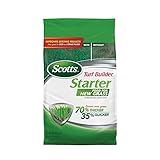
- Scotts Turf Builder Starter Food for New Grass, 3 lb: starter fertilizer · covers 1,000 sq ft per the listing · use when planting seed
- Jonathan Green Veri-Green Fertilizer for Seeding and Sodding: granular starter · 1,500 and 5,000 sq ft bag sizes listed · for all grasses per the listing
Worked Example: Planning a Fall Seeding Calendar
Say you seed a tall fescue lawn on September 15 and daytime highs are in the 70s. Here is how the weeks might play out, using the general ranges above.
- Days 1 to 7: water lightly once or twice a day. Nothing may show yet; this is normal.
- Days 7 to 14: first thin green blades appear. Keep the surface moist and stay off the area.
- Weeks 3 to 4: seedlings are 2 to 3 inches tall. Cut watering to once a day, then every other day, but make each session a bit longer.
- Weeks 4 to 6: first mow at about 3 to 4 inches, with a sharp blade and a high deck setting.
- Weeks 6 to 10: shift to a normal schedule of 1 to 2 deep waterings a week. Apply a regular lawn fertilizer according to the label if the lawn looks pale.
If a cold snap arrives in week 4, expect the timeline to stretch by a week or two rather than treating it as a failure. Write your seeding date on the calendar and compare it with the bag’s days-to-germinate range so you know when to start worrying.
Why Grass Seed Is Slow: A Troubleshooting List
- Soil too cold or too hot. Check soil temperature with a probe thermometer before you seed.
- Seed dried out. Dry spells after the seed has started to sprout set back the whole stand.
- Seed too deep. Most lawn seed does best at about one-quarter inch or less. Buried seed may never come up.
- Old seed. The tag lists a germination-check date; seed past that date can have lower germination. Use fresh seed.
- Thick thatch or compacted soil. Seed lands on thatch and never touches soil. Rake or dethatch first.
- Heavy shade. Use a shade-tolerant blend and expect a slower start.
Frequently Asked Questions
How long does grass seed take to grow in cold weather?
Slowly. Cool-season grasses can still germinate in soil as low as the 50s F, but it can take 3 to 4 weeks or more. In truly cold soil, germination can stall until spring.
How long does it take for new grass to fill in?
Most lawns look reasonably full in 8 to 12 weeks, though slower species may take a full season. Overseeding a thin lawn shows results faster because existing turf is already there.
Can I mow new grass after two weeks?
Usually not. Wait until the seedlings are around 3 to 4 inches tall for a cool-season lawn, which often takes 3 to 6 weeks. Check the seed label.
Why is my grass seed not growing?
Look at soil temperature, moisture, seeding depth, and seed age first. Dry spells and poor seed-to-soil contact are the most common problems.
How often should I water new grass seed?
Light and frequent at the start, once or several times a day to keep the top inch moist, then taper to deeper and less frequent watering as seedlings establish.
Does perennial ryegrass seed grow faster than other types?
Yes. It is typically the quickest of the common lawn grasses, often sprouting in 5 to 10 days when conditions suit.
FAQ
How long does grass seed take to grow in cold weather?
How long does it take for new grass to fill in?
Can I mow new grass after two weeks?
Why is my grass seed not growing?
How often should I water new grass seed?
Does perennial ryegrass seed grow faster than other types?
More from Amazon
Programs that pair well with the guide above. Offers and eligibility are set by Amazon and may change.
Collect the home and kitchen items you want in one registry that guests can shop from.
Create a wedding registrySet up recurring deliveries of everyday items on eligible products. Terms and savings are set by Amazon.
Explore Subscribe & SaveFree shipping on eligible items, Prime Video and more. Eligible new members can start with a free trial.
Start a Prime free trialAudiobooks and podcasts to listen to on the go. Eligible new members can start with a free trial.
Try Audible freeAs an Amazon Associate we earn from qualifying purchases.