Key takeaways
- Hiking backpacks carry water, layers, and trail food on day hikes and weekend trips in framed designs. Compare liter sizes, hip belts, and vents.
As an Amazon Associate we earn from qualifying purchases.
Choosing a hiking backpack comes down to three things: how much you carry, how far you walk, and how the pack moves the load from your shoulders to your hips. A day hike with water, layers, and trail food asks for something different than a two-night trip with a sleeping bag and a stove, and the five packs below cover that spread. The lineup runs from an 18 liter frameless daypack to a 55 liter internal frame pack with a sleeping bag compartment, with framed day packs and a packable travel option in between. Each entry lists the capacity in liters, the frame type, and the hip belt and back panel details exactly as the maker prints them, so you can match the pack to the trip you actually take. Sizes and torso ranges are stated as the listings state them, because a pack that fits one hiker well can dig into the shoulders of another. Read the notes on sizing before you order, and measure your torso if a listing gives a range.
Disclosure: This article may contain affiliate links. If you buy through these links, we may earn a small commission from Amazon.
Osprey Talon 44L Men’s Hiking Backpack

The Talon 44 is the largest Osprey in this roundup and the one aimed at hikers who split their time between long day hikes and light overnight trips. The main compartment loads from the top, and an external hydration sleeve holds a reservoir up to 3 liters, sold separately, so the water sits outside the main bag and away from your layers. Two zippered hipbelt pockets keep small items at hand, and a zippered slash pocket in the top lid covers the items you reach for at every stop. Stretch mesh pockets on both sides hold bottles or wet gear. The harness adjusts at the shoulders so you can dial the fit to your torso, and the listing offers the pack in S/M and L/XL sizes. A Stow-On-The-Go attachment point lets you clip trekking poles to the pack while you are still wearing it, which helps on scrambles where you want both hands free. With 44 liters of room, the Talon carries a full day kit with space to spare, or a compact overnight load when you pack light and skip bulky extras.
Specs
- Capacity: 44 liters
- Access: top-loader main compartment
- Hydration: external sleeve for a reservoir up to 3 liters (reservoir sold separately)
- Hip belt: padded hipbelt with two zippered pockets
- Sizes: S/M and L/XL, with an adjustable shoulder harness
- Extras: Stow-On-The-Go trekking pole attachment, stretch mesh side pockets
TETON Sports Scout 55L Internal Frame Backpack
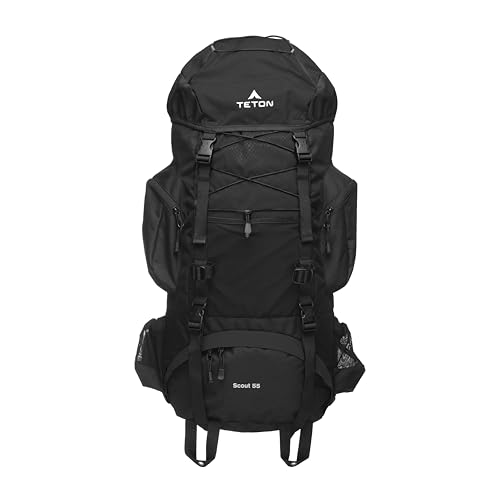
The Scout 55L is TETON’s internal frame entry for weekend and multi-day trips, and it is the biggest pack here. The frame and the padded back panel work together to move weight onto the hip belt, which adjusts from 26 to 60 inches, and the torso adjusts across a 15 to 19.5 inch range, so the same pack fits a wide span of hikers, including smaller frames and youth hikers as the listing describes. A separate sleeping bag compartment sits at the base, and the main compartment accepts a hydration bladder up to 3 liters, though the bladder itself is not included. A rainfly is sewn into the pack and tucks away when the sky is clear, so weather protection travels with you instead of living in a closet at home. Angled side pockets put a water bottle within reach without taking the pack off. At 4.5 pounds empty, the Scout is not the lightest option in this group, but the trade is a structured carry, a full set of compartments, and room for two to four days of gear when you pack with some discipline.
Specs
- Capacity: 55 liters
- Frame: internal frame with a padded, channeled back panel
- Dimensions: 30 x 16 x 10 inches
- Weight: 4.5 pounds
- Fit ranges: torso adjusts 15 to 19.5 inches; hip belt adjusts 26 to 60 inches
- Rain cover: sewn-in rainfly included
- Hydration: sleeve holds a bladder up to 3 liters (bladder not included)
- Extras: sleeping bag compartment, angled bottle pockets
Deuter Trail 30L Backpack

The Trail 30 sits in the middle of the range: a 30 liter day pack built around a U-frame, with a narrow fit that keeps the load close to the body. Deuter positions the hip fins small and high, hugging the body so the pack stays put on uneven ground, and the carrying system is built for breathability on warm climbs. At 2.47 pounds, it is light enough for fast day hikes yet structured enough for a full day of food, water, and extra layers. The Trail 30 also works for biking and trekking according to the listing, which makes it a reasonable single pack for people who mix trail days with rides. The Almond-Deepsea colorway in the listing is one of several, and the pack is listed for adult hikers. If your day hikes run long and your loads run past the basics — a full rain shell, a sit pad, a book, lunch for two — the extra structure over a frameless pack pays off in how steady the load feels at mile ten.
Specs
- Capacity: 30 liters
- Frame: U-frame with body-hugging hip fins
- Weight: 2.47 pounds (1,120 grams)
- Dimensions: 24.8 x 11.42 x 7.87 inches
- Fit: narrow fit carrying system with breathability features
- Use: hiking, biking, and trekking, per the listing
Venture Pal 35L Packable Hiking Backpack

The Venture Pal 35L takes the opposite approach to the framed packs above: it folds into its own zippered inner pocket, so it rides inside a suitcase, a car trunk, or a larger pack until you need it. Unfolded, it measures 20.5 x 13.5 x 8 inches and opens to a 35 liter main compartment with two separators, two zippered front pockets, and two side pockets. At 0.7 pounds, it weighs less than the water you will put in it. The shoulder straps use breathable mesh with sponge padding, the strap length adjusts, and a chest strap with a whistle buckle locks the pack in place. A double-layer bottom piece and bar-tack stitching at the main stress points address the two places packable bags usually fail first. The fabric is tear resistant and water resistant per the listing. This is not the pack for a heavy overnight load — there is no frame and no padded hip belt — but as a summit bag on a longer trip, a spare daypack for travel, or a light trail bag for water and layers, the fold-away design solves a real packing problem.
Specs
- Capacity: 35 liters
- Weight: 0.7 pounds
- Dimensions: 20.5 x 13.5 x 8 inches unfolded; folds to 9 x 8.5 x 2.2 inches
- Pockets: main compartment with two separators, two zippered front pockets, two side pockets
- Straps: breathable mesh shoulder straps, adjustable length, chest strap with whistle buckle
- Fabric: tear resistant and water resistant material with a double-layer bottom
Peak Design Outdoor Backpack 18L

The Peak Design Outdoor Backpack is the smallest pack here at 18 liters, and the most design-led. It is frameless, weighs 879 grams (1.94 pounds), and opens with a 270-degree rear zip, so the back panel swings wide and the whole main compartment is visible at once — a layout borrowed from camera bags, where Peak Design built its name. The listing pitches it for day hikes, hydration carry, camera carry, and commuting, and that mix is honest: this is an everyday pack that handles a trail day, rather than a trail pack that handles a commute. The Kelp colorway in the listing is one of the options offered. With no frame and a compact shape, the 18L suits short hikes, travel days, and riders who want one bag for the train and the trailhead. Photographers will find the rear access natural for swapping lenses, while hikers get a clean, low-profile carry for water, a shell, and snacks. If your day hikes are short and your kit list is short too, this is the tidiest option in the group.
Specs
- Capacity: 18 liters
- Weight: 879 grams (1.94 pounds)
- Frame: frameless design
- Access: 270-degree rear zip opening
- Use: day hikes, hydration carry, camera carry, and commuting, per the listing
- Color shown in the listing: Kelp
How to Choose
Start with trip length. For day hikes under ten miles with water, food, and a layer or two, 18 to 30 liters is the working range: the Peak Design and the Deuter Trail 30 live there. For long days or light overnights, 35 to 44 liters gives room for a fuller kit, which is where the Venture Pal and the Osprey Talon 44 sit. For two nights or more, the 55 liter TETON Scout adds the sleeping bag compartment and the frame to carry the extra weight.
Next, look at the frame. An internal frame or a U-frame moves load to the hip belt and keeps a heavy pack stable; a frameless pack is lighter and folds smaller but puts the load on your shoulders, so it suits lighter loads. Hip belts matter once a load passes roughly a day’s food and water: padded belts with pockets, like the ones on the Talon 44 and the Scout, keep snacks and a phone at hand.
Check the fit numbers the listing prints. Torso ranges, belt adjustment ranges, and size splits such as S/M and L/XL tell you whether the pack can be set up for your body. Measure your torso from the base of your neck to the top of your hip bones and compare it with the printed range before ordering.
Finally, sort the extras. A sewn-in rain cover, like the Scout’s rainfly, removes one item from your packing list. A hydration sleeve matters if you drink from a reservoir; side pockets matter if you prefer bottles. A packable design, like the Venture Pal, earns its place when the pack itself has to travel inside other luggage.
FAQ
How many liters do I need for a weekend trip?
Most hikers land between 35 and 55 liters for a weekend. A light summer kit with a compact sleeping bag fits in a 44 liter pack like the Talon 44, while bulkier gear or a third night points to a 55 liter pack like the TETON Scout. Day hikes need far less: 18 to 30 liters covers water, food, and layers for most routes.
What is the difference between an internal frame and a frameless pack?
An internal frame uses stays or a frame sheet inside the pack to move weight onto the hip belt and keep the load steady, which suits heavier loads and longer days. A frameless pack skips that structure, so it is lighter and often folds smaller, but your shoulders carry more of the weight. Frameless designs work best with light loads.
Do these packs include a rain cover or a hydration bladder?
It varies by model. The TETON Scout includes a sewn-in rainfly, and its hydration sleeve holds a bladder up to 3 liters that is sold separately. The Osprey Talon 44 also uses an external hydration sleeve for reservoirs up to 3 liters, sold separately. Check the listing for the pack you choose, because covers and bladders are often separate purchases.
How do I choose the right torso size?
Measure from the bony bump at the base of your neck down to the line across the top of your hip bones, then match that number to the range the listing prints. The TETON Scout adjusts across 15 to 19.5 inches, while the Osprey Talon 44 splits its fit into S/M and L/XL sizes with an adjustable harness. If you fall between sizes, follow the maker’s guidance in the listing.
Conclusion
The right hiking backpack is the one that matches your longest regular trip, not your most ambitious one. Day hikers are served by the Deuter Trail 30 or the Peak Design 18L, travelers who need a spare bag get the fold-away Venture Pal 35L, and weekend hikers have two strong framed options in the Osprey Talon 44 and the TETON Scout 55L. Check the capacity, frame, and fit numbers against your own kit list, and the pack will take care of the miles.
More from Amazon
Programs that pair well with the guide above. Offers and eligibility are set by Amazon and may change.
Collect the home and kitchen items you want in one registry that guests can shop from.
Create a wedding registrySet up recurring deliveries of everyday items on eligible products. Terms and savings are set by Amazon.
Explore Subscribe & SaveFree shipping on eligible items, Prime Video and more. Eligible new members can start with a free trial.
Start a Prime free trialAudiobooks and podcasts to listen to on the go. Eligible new members can start with a free trial.
Try Audible freeAs an Amazon Associate we earn from qualifying purchases.