Key takeaways
- A rotary cultivator rolls a set of bladed wheels through bed soil, breaking crust and uprooting small weeds. Compare wheel forms, widths, and builds.
As an Amazon Associate we earn from qualifying purchases.
A rotary cultivator is the tool that sits between a hand fork and a powered machine. A row of bladed wheels rolls through the top layer of a bed as you push and pull, breaking a hard crust, lifting small weeds out by the root, and mixing compost or granular feed into the surface where young plants can reach it. Because the wheels turn with the motion of the tool, the work feels more like raking than digging, and you stay standing the whole time.
The five tools below are all manual, long-handled models sold on Amazon, and each one takes a slightly different approach. One converts between a full-width head and a single wheel for tight spots. One uses six wheels on a telescoping steel pole. Two use long sectional stainless poles that come apart for storage, and one keeps its wheels interchangeable so the head can change with the job. Wheel count, working width, handle length, and head build are the details that separate them, and those are the details each section sticks to, taken from the listing for that exact model.
Disclosure: This article may contain affiliate links. If you buy through these links, we may earn a small commission from Amazon.
Garden Weasel Rotary Cultivator and Hand Tiller 2-in-1 (91206)

The Garden Weasel is the long-running name in this category, and the current 91206 build is a two-form tool. In its full form, a set of rotating blade wheels runs across the head and breaks up soil for planting, reseeding grass, and general bed preparation. Remove the handle extension and one part of the head, and it converts to a shorter single-wheel cultivator, which is the form you want between seedlings, along a fence line, or inside a raised bed where a full-width head would clip the plants you are trying to keep.
The shaft is powder-coated carbon steel. It measures 30 inches in the short form and extends to 54.5 inches with the extension fitted, so the same tool works kneeling-height jobs and standing rows. The grip is a 6-inch textured TPR rubberized handle, which gives a firm hold when the soil is damp. The maker positions the tool for loosening soil, weeding, cultivating, planting, and reseeding, and that list matches the wheel design: the blades slice and lift rather than chop, so worked soil stays loose on the surface instead of being turned over in clumps.
Specs
- Handle length: 30 inches, extending to 54.5 inches with the extension fitted
- Shaft build: powder-coated carbon steel
- Grip: 6-inch textured TPR rubberized handle
- Head form: rotating blade wheels; converts to a 24.5-inch single-tine cultivator form
- Model number as printed: 91206
Fiskars Telescoping Rotary Cultivator (40 to 60 Inch)
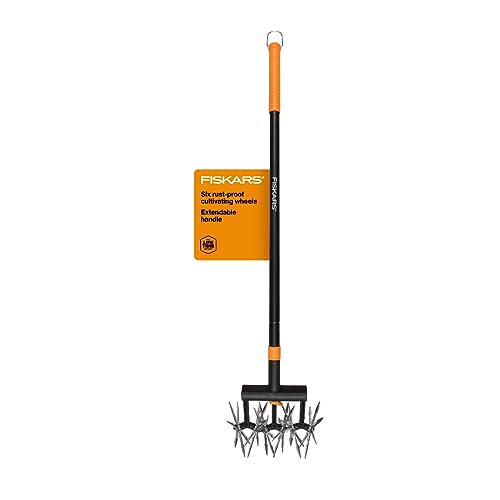
The Fiskars entry takes the opposite approach to the Garden Weasel: instead of changing the head, it changes the pole. The all-steel shaft telescopes from 40 inches to 60 inches and locks at the length you set, so one tool fits shorter and taller gardeners and both flat beds and deep raised planters. At 2.4 pounds it is also one of the lighter tools in this group, which shows on long sessions.
The head is FiberComp, the reinforced composite Fiskars uses across its hand tool line, and it holds six cultivating wheels. The wheels are aluminum and described by the maker as rust-proof, and they are ground to bite into firm soil rather than skate over it. The center wheels can be removed, narrowing the working path so you can run the tool down a seedling row and loosen the soil on both sides of the plants without disturbing the roots in the middle. That removable-center design is the detail to note if you grow in close rows: most fixed heads force you to skip the row middles or work them by hand afterward. The listing gives the head width through its dimensions, 8.5 inches across, a sensible middle width for vegetable beds.
Specs
- Handle length: telescoping steel pole, 40 to 60 inches
- Wheel count: six aluminum cultivating wheels, center wheels removable
- Head build: FiberComp composite head
- Item weight: 2.4 pounds
- Dimensions as printed: 5 x 8.5 x 42.3 inches
CKLT 66-Inch Rotary Cultivator with Spring Steel Tines

The CKLT is built around its tines. The wheels use tempered spring steel blades with a sand-textured powder-coated finish, and the maker describes the wheel shape as multi-angled spoked wheels that cut through soil while mixing in compost or feed in the same pass. Spring steel matters here because the tines flex slightly when they strike a stone or a thick root instead of bending permanently, which is the usual failure point on thin stamped wheels.
The handle is stainless steel, built from tubes that connect to set the length, and the full tool stands 65 inches tall as printed in the dimensions, under a 66-inch name. Assembly is four steps: align the head and handle holes, tighten the screws with the included L-shaped wrench, connect the tubes to your preferred length, and work. The maker also suggests lightly moistening the soil before cultivating, which is sound advice for every tool in this article but is printed in this listing in particular. At 3.9 pounds it is the heaviest of the sectional-pole models here, and the extra weight sits in the head, which helps the wheels bite into crusted ground with less downward pressure from your arms.
Specs
- Tine build: tempered spring steel with a textured powder-coated finish
- Handle build: stainless steel sectional tubes, length set during assembly
- Dimensions as printed: 6.75 x 5.5 x 65 inches
- Item weight: 3.9 pounds
- Power source as printed: manual
Fiedyka 2-in-1 Garden Rotary Cultivator Tool
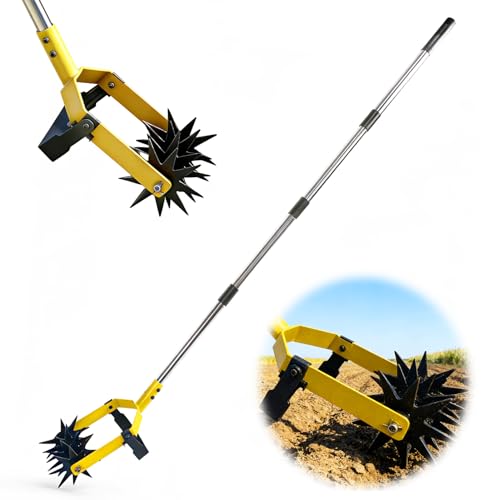
The Fiedyka pairs its rotary head with a second tool: a manganese steel weeding knife shaped for pulling weeds and roots with precision. That pairing makes sense for bed work, where the wheels loosen a whole strip and the knife then picks out the deep-rooted weeds the wheels lifted but did not remove. The head and knife are both manganese steel, a hard alloy that holds an edge well and resists the bending that softer steels show in stony ground.
The handle adjusts to length, and the printed dimensions give the assembled tool at 66.9 inches tall with a 5.9-inch head width, the narrowest working width in this group. A narrow head is not a drawback for row crops and closely planted beds; it simply means more passes on open ground. The listing describes the tool for loosening soil, lawn care, reseeding grass, weeding, and soil mixing, and the maker sells it as a manual yard tiller, which matches the fence for this article: no motor, no cord, just wheels and body weight. If your beds are narrow and your weed pressure is high, the included knife makes this the most complete single purchase of the five.
Specs
- Build: manganese steel head and weeding knife
- Dimensions as printed: 7.48 x 5.9 x 66.9 inches
- Included extra: manganese steel weeding knife for weeds and roots
- Power source as printed: hand powered, manual operation
- Model number as printed: FD-RC01
BARAYSTUS Rotary Cultivator Garden Tool

The BARAYSTUS builds its head from three spoked wheels in aluminum, mounted on a stainless steel pole. The maker describes the wheel shape as a spoked head designed to crush soil finely, and the three-wheel layout keeps the head compact at 6.5 inches wide while still tracking straight on a push-pull stroke. Aluminum wheels keep the weight down: the listing prints 2.2 pounds for the whole tool, the lightest figure in this group.
The handle adjusts to three set lengths, 29.7 inches, 43.7 inches, and 57 inches, by adding or removing pole sections. The shortest setting suits raised beds and work close to the body; the longest gives a standing reach for open rows. The listing names crushing soil, weeding, deep tillage, and aeration as the jobs, and the brand copy stresses the rust-resistant pairing of aluminum and stainless steel, which suits a tool that will live in a shed and get hosed down after use. One caution is printed in the listing itself: the tool should not be used on hard or rocky surfaces, both for the wheels and to keep debris from being thrown. Gardeners with stony soil should look at the spring steel CKLT instead; gardeners with worked, stone-free beds get the lightest tool here.
Specs
- Wheel count: 3 spoked wheels
- Build: aluminum wheels with a stainless steel pole
- Handle lengths: 29.7, 43.7, and 57 inches
- Size as printed: 57 x 6.5 inches
- Product weight as printed: 2.2 pounds
How to Choose
Begin with the width of the ground you actually work. Open vegetable beds and reseeding patches reward a wider head and more wheels, which is where the six-wheel Fiskars earns its place. Narrow rows, raised beds, and planted corners reward a head that can shrink, either by removing center wheels, as on the Fiskars, or by converting to a single wheel, as on the Garden Weasel. The narrowest fixed heads, the Fiedyka at 5.9 inches and the BARAYSTUS at 6.5 inches, suit close planting but take more passes on open soil.
Next, match the handle to your height and your beds. Telescoping poles, like the Fiskars at 40 to 60 inches, adjust in fine steps and lock. Sectional poles, like the CKLT, Fiedyka, and BARAYSTUS, adjust in fixed steps and come apart for storage in a small shed or a car trunk. If two people of different heights will share the tool, the telescoping form is the simpler choice.
Then look at the wheel build against your soil. Tempered spring steel, as on the CKLT, flexes over stones and roots. Manganese steel, as on the Fiedyka, is hard and holds its shape in abrasive ground. Aluminum wheels, as on the Fiskars and BARAYSTUS, will not rust and keep the tool light, but the BARAYSTUS listing itself warns against hard or rocky surfaces. Weight follows the same split: the aluminum tools print 2.2 to 2.4 pounds, while the steel-head CKLT prints 3.9 pounds, and that head weight helps on crusted soil and tires the arms sooner on loose soil.
Finally, consider the extras. The Fiedyka includes a weeding knife, which closes the gap between loosening a strip and clearing it. The Garden Weasel converts to a short single-wheel form, replacing a separate hand cultivator for tight spots. None of the five needs fuel or charging, so the deciding factors stay with width, handle, and wheel build.
FAQ
How deep does a rotary cultivator work the soil?
These tools work the top layer of the bed, breaking crust and mixing in surface feed rather than digging to spade depth. The wheels bite as far as the soil lets them, which is deeper in loose, damp ground and shallower on a hard crust. For new beds, loosen the ground with a fork first, then use the cultivator to level and mix the surface.
Can a rotary cultivator remove weeds, or does it just loosen soil?
It does both, within limits. The wheels lift small and shallow-rooted weeds out as they turn, and the loosened soil makes hand pulling faster afterward. Deep-rooted weeds often survive the pass with roots loosened rather than removed, which is why the Fiedyka pairs its head with a weeding knife and why most gardeners follow a cultivator pass with a quick hand check of the row.
Will a rotary cultivator work on a lawn as well as on beds?
Yes, for surface work. The Garden Weasel and BARAYSTUS listings both name reseeding grass among their uses, and the wheels open the surface so seed reaches soil instead of sitting on thatch. They do not replace a mower, a scarifier, or a powered machine for renovating a whole lawn, but for patching bare spots and preparing small areas they are the right scale of tool.
How should the tool be stored between uses?
Rinse the wheels clean, let the head dry, and check that the wheel fixings are snug. Sectional-pole models come apart and store in a fraction of their working length, while the telescoping Fiskars shortens to 40 inches. Steel heads benefit from a dry shed; aluminum wheels will not rust, but pole joints still last longer kept dry.
Conclusion
For most beds, the choice comes down to head width and soil. The Fiskars is the all-round pick for open rows, with six wheels, removable centers, and the widest handle range. The Garden Weasel suits mixed beds where a convertible single-wheel form earns its keep. The CKLT brings the toughest tines for stony or crusted ground, the Fiedyka adds a weeding knife for narrow, weedy beds, and the BARAYSTUS is the lightest option for worked, stone-free soil.
More from Amazon
Programs that pair well with the guide above. Offers and eligibility are set by Amazon and may change.
Collect the home and kitchen items you want in one registry that guests can shop from.
Create a wedding registrySet up recurring deliveries of everyday items on eligible products. Terms and savings are set by Amazon.
Explore Subscribe & SaveFree shipping on eligible items, Prime Video and more. Eligible new members can start with a free trial.
Start a Prime free trialAudiobooks and podcasts to listen to on the go. Eligible new members can start with a free trial.
Try Audible freeAs an Amazon Associate we earn from qualifying purchases.