Key takeaways
- Self-contained batch freezer: A built-in refrigeration system freezes the mix in a removable or fixed cylinder. It is the most practical option for many small shops because it avoids a separate pre-frozen bowl. Verify the model’s rated batch size and hourly output; these vary widely.
- Pre-freeze bowl machine: The bowl must be frozen ahead of time, typically for many hours. It costs less and takes little counter space, but output is constrained by the number of bowls you can keep frozen and the time needed between batches. Many products in this category are intended for home use, so check food-service certification carefully.
- Floor-standing commercial batch freezer: Built for higher, more repeatable output and frequent service. It takes more floor space, may require a dedicated electrical circuit, and can cost substantially more. It makes sense when a countertop machine would leave you behind during the rush.
Best Commercial Ice Cream Makers for Small Shops
The best commercial ice cream makers for most small shops are self-contained compressor batch freezers sized to your busiest hour, not your average day: choose a countertop model if you need roughly 2–6 quarts per hour and have limited space, or a floor-standing commercial batch freezer if you need consistent production above that range. Before buying, confirm the manufacturer’s rated output, electrical requirements, cleaning procedure, and whether the exact model is NSF certified or listed for your local food-service rules.
“Commercial” covers machines with very different production rates. A countertop unit may be suitable for made-to-order desserts or a short menu, but it is not a substitute for a production freezer just because it has a powerful compressor. Likewise, a home-style machine with a removable bowl may not be approved for commercial use. Treat capacity, certification, and serviceability as separate checks.
Our top picks
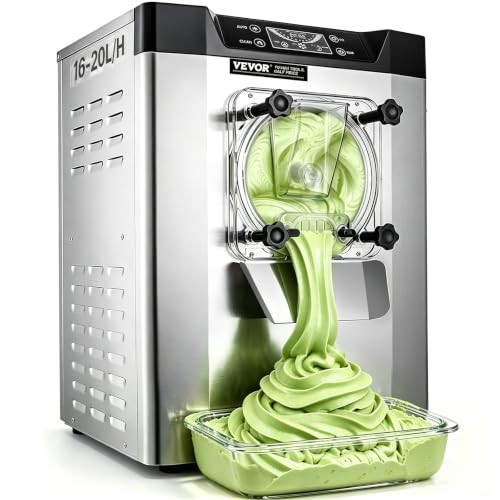 VEVOR Commercial Ice Cream Machine 1400W 20/5.3
- Efficient Ice Cream Making: With the built-in 1.1…
- Excellent Heat Insulation: Composed of stainless steel shell…
- Intelligent LCD Panel: This hard serve ice cream…
 VEVOR Commercial Ice Cream Maker
- Powerful Performance: The high power provides continuous and…
- Pre-cooling & One-click Thawing: When making ice cream,…
- Smart LCD Control Panel: Our soft-serve ice cream…
 Whynter Upright Automatic Ice Cream Maker
- CNN Best Ice Cream Maker: The Whynter Upright…
- Upright Space Saving Build: This ice cream maker…
- No Pre Freeze Compressor: A self-contained compressor freezes…
| Product | Key specs | |
|---|---|---|
| VEVOR Commercial Ice Cream Machine 1400W 20/5.3 | Efficient Ice Cream Making: With the built-in 1.1… Excellent Heat Insulation: Composed of stainless steel shell… Intelligent LCD Panel: This hard serve ice cream… | Check price |
| VEVOR Commercial Ice Cream Maker | Powerful Performance: The high power provides continuous and… Pre-cooling & One-click Thawing: When making ice cream,… Smart LCD Control Panel: Our soft-serve ice cream… | Check price |
| Whynter Upright Automatic Ice Cream Maker | CNN Best Ice Cream Maker: The Whynter Upright… Upright Space Saving Build: This ice cream maker… No Pre Freeze Compressor: A self-contained compressor freezes… | Check price |
 Commercial Ice Cream Machine 1400W Commercial Ice Cream Machine 1400W | High Productivity & 10-35 Mins Rapid Freeze: Equipped… Silky-Smooth Texture: This commercial gelato machine Features a… Ergonomic LCD Smart Control Panel: Designed with an… | Check price |
As an Amazon Associate we earn from qualifying purchases at no extra cost to you.
Compare the machine types before comparing brands
- Self-contained batch freezer: A built-in refrigeration system freezes the mix in a removable or fixed cylinder. It is the most practical option for many small shops because it avoids a separate pre-frozen bowl. Verify the model’s rated batch size and hourly output; these vary widely.
- Pre-freeze bowl machine: The bowl must be frozen ahead of time, typically for many hours. It costs less and takes little counter space, but output is constrained by the number of bowls you can keep frozen and the time needed between batches. Many products in this category are intended for home use, so check food-service certification carefully.
- Floor-standing commercial batch freezer: Built for higher, more repeatable output and frequent service. It takes more floor space, may require a dedicated electrical circuit, and can cost substantially more. It makes sense when a countertop machine would leave you behind during the rush.
Output is not the same as the amount of finished ice cream you can sell. Mix temperature, recipe, overrun, batch size, draw time, and time spent transferring and cleaning all affect real production. Ask the manufacturer whether its figure means mix processed per hour, finished product per hour, or a theoretical maximum.
Capacity and footprint: a practical comparison
The ranges below are planning bands, not specifications for every model. Commercial manufacturers do not use one standard test method for hourly output, and dimensions vary by configuration. Obtain the exact model’s current spec sheet before reserving counter or floor space.
| Machine type | Typical planning output | Approximate footprint | Cooling approach | Best fit |
|---|---|---|---|---|
| Pre-freeze bowl machine | About 1–3 qt/hour, depending on bowl count and cycle time | About 12–18 in. wide countertop space | Frozen bowl; no active refrigeration during churning | Very low-volume service, trials, or a non-commercial setting where permitted |
| Compact self-contained batch freezer | About 2–6 qt/hour | About 12–20 in. wide countertop space | Built-in compressor | Small menus, occasional batches, and shops with tight floor plans |
| Higher-capacity countertop batch freezer | About 6–15 qt/hour | About 18–30 in. wide countertop space | Built-in compressor | Regular service when a floor model will not fit |
| Floor-standing commercial batch freezer | About 15–60+ qt/hour | Roughly 24–40 in. wide, plus operating clearance | Integrated or remote refrigeration, model-dependent | Repeated batches and sustained rush-hour production |
These approximate size and output ranges are category-level estimates, not promises. Some machines require clearance for ventilation, a drain, or a water connection, so the listed machine width alone is not a reliable fit check. Measure the doorways and route into the shop as well as the final location.
Best choices by shop situation
For a café adding one rotating flavor
Look first at a compact self-contained compressor batch freezer. It avoids advance bowl freezing and can support occasional small batches. Choose this route only if the rated output covers your busiest period with time left for cleaning and flavor changes. If the machine is not NSF certified, confirm acceptability with your health department before purchasing.
For frequent service with limited counter space
Compare higher-capacity countertop models with floor-standing machines rather than assuming the counter model is automatically the better fit. A countertop unit saves floor area but occupies valuable prep space and may need more clearance than expected. If production is continuous, a floor model can be easier to work around and may provide a better serviceable design.
For the lowest purchase cost
A pre-freeze design has the simplest refrigeration setup and is often the least expensive category. Its limitation is scheduling: one bowl cannot churn continuously, and extra bowls need freezer space and advance preparation. It is a poor choice when customers expect several consecutive batches or when commercial certification is required but unavailable.
For a shop expecting to scale
Buy against the next realistic level of demand, not an optimistic sales forecast. Check whether the manufacturer or a local service company can supply parts and repair the exact model. A machine that is technically capable but difficult to service can become an expensive bottleneck during peak season.
Work out the rush-hour requirement
Suppose a shop expects to sell 24 half-cup scoops in its busiest hour. That is 12 cups, or 3 quarts, of finished product. If you plan around a 30-minute production-and-turnover cycle, you need to make at least 3 quarts in that window, and possibly more to cover transfer losses, flavor changes, or a second rush. A machine advertised at 6 quarts per hour may appear sufficient on paper, but only if its rating reflects usable finished product and your recipe and workflow match the test conditions.
Use this quick check before ordering:
- Estimate the busiest hour in finished quarts, not daily sales.
- Ask how long one batch takes from loading to draw and whether the cylinder needs recovery time.
- Allow for time to transfer product, refill, and clean between flavors.
- Keep a reserve of hardening or storage capacity; a batch freezer usually makes the product, but does not necessarily store it at serving temperature.
NSF certification and food-service readiness
NSF certification is a useful way to verify that a model has been evaluated against relevant sanitation and food-equipment requirements, but the exact listing matters. Check the manufacturer’s documentation or the certification directory for the precise model and configuration; a brand’s general claim does not establish that every machine it sells is certified. Local health codes and inspectors determine what is accepted in your jurisdiction, so confirm requirements before purchase.
Also check the food-contact parts, whether the cylinder and dasher can be removed, and how the machine’s seals and product-contact surfaces are cleaned. A fast machine is not a good fit if its disassembly takes too long for your closing routine or if replacement seals are difficult to obtain.
Ownership details that affect output
In regular use, seals, gaskets, scrapers, and other parts that contact the mix or cylinder are common wear items. Ask for their replacement intervals, availability, and cost before committing. Compressor units also need adequate ventilation: blocking vents or placing a machine beside a heat source can reduce performance and add strain. Follow the manufacturer’s cleaning schedule and approved detergents; abrasive tools can damage product-contact surfaces.
Two common planning mistakes are loading more mix than the rated batch size and treating maximum hourly output as a sustainable all-day rate. Overfilling can affect freezing and draw quality, while repeated batches leave less time for cleaning and recovery. A smaller machine with a realistic schedule may serve a small shop better than a larger unit that cannot be installed, cleaned, or maintained conveniently.
What to verify before you buy
- Rated batch capacity and hourly output, with the manufacturer’s definition of each
- Exact width, depth, height, weight, ventilation clearance, and doorway access
- Voltage, amperage, plug type, and whether a dedicated circuit is needed
- NSF listing or other locally required food-service certification for the exact model
- Cleaning and sanitizing steps, disassembly time, and replacement-part availability
- Warranty terms, local service coverage, and any required water or drain connections
For most small shops, a self-contained compressor batch freezer is the best starting point when reliable, on-demand production matters. Choose a pre-freeze model only for genuinely low-volume use and where permitted; move to a floor-standing commercial machine when demand, batch frequency, or countertop constraints justify the larger investment.