Key takeaways
- Long runs, permanent spot: Liberty Garden 703-1 (steel, wall or freestanding)
- Reaching several beds from one wall mount: Liberty Garden Navigator (all-metal, rotates)
- Big property, no wall nearby: Liberty Garden 871S cart
- Hiding the hose and avoiding tangles: Ames 2519500 NeverLeak cabinet
- Short run, no cranking: Hoselink retractable
- Short run, wall mount with a wide swing: Gardena wall-mount retractable
- Light-duty, lowest effort per use: Flexzilla Pro retractable (short, stretchy hose)
- Budget plastic, weather-sheltered spot only: Suncast Hose Hideaway class reels
The best garden hose reels for most yards are the Liberty Garden 703-1 for a fixed wall or freestanding steel reel, the Liberty Garden Navigator for a swiveling all-metal manual reel, the Liberty Garden 871S for a wheeled cart, the Ames 2519500 NeverLeak for a self-guiding cabinet reel, and the Hoselink retractable for a short, tidy run near a spigot. Which one is right depends on how far the hose has to reach, how much you want to crank, and whether the reel has to stay put or roll around the yard.
A hose reel does three jobs: it keeps the hose off the lawn and out of the sun, it prevents kinks that shorten hose life, and it puts the hose where you need it. Most disappointment comes from buying on the printed capacity number. This guide explains how to read capacity honestly, how swivels and inlet fittings cause leaks, why metal and resin age differently, and which reel type fits which yard.
Our top picks
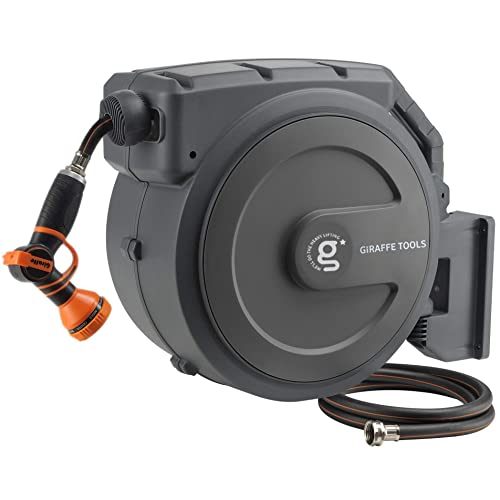

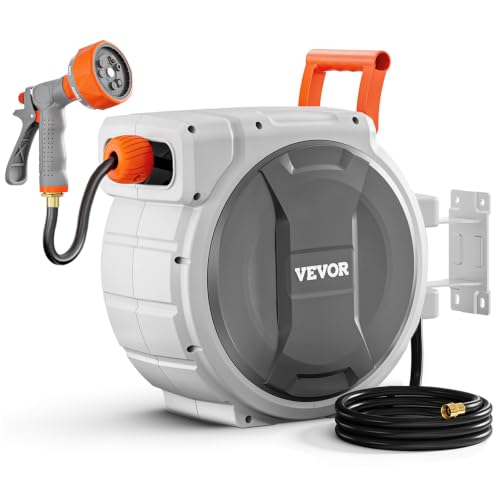

As an Amazon Associate we earn from qualifying purchases at no extra cost to you.
Quick picks by situation
- Long runs, permanent spot: Liberty Garden 703-1 (steel, wall or freestanding)
- Reaching several beds from one wall mount: Liberty Garden Navigator (all-metal, rotates)
- Big property, no wall nearby: Liberty Garden 871S cart
- Hiding the hose and avoiding tangles: Ames 2519500 NeverLeak cabinet
- Short run, no cranking: Hoselink retractable
- Short run, wall mount with a wide swing: Gardena wall-mount retractable
- Light-duty, lowest effort per use: Flexzilla Pro retractable (short, stretchy hose)
- Budget plastic, weather-sheltered spot only: Suncast Hose Hideaway class reels
How we chose
This guide is built from published reviewer findings, manufacturer specifications and the recurring complaints that surface across buyer discussions, not from our own use of any product. We favored reels that appear repeatedly in independent roundups, kept only models that are still sold or have a direct current equivalent, and sorted them by the criteria that decide real satisfaction: mount type, honest capacity, material, swivel and inlet design, hose guide, and assembly effort. Where a spec could not be confirmed, we describe the product by class rather than quote a number. Check the current listing for exact dimensions before buying, since manufacturers revise models.
Reel types explained
Wall-mount manual reels
A steel or aluminum frame bolts to a wall, post or stud, and you crank the hose in. These carry the most hose, last the longest and cost the least per foot of capacity. The trade-off is effort: you hand-wind every time, and a fixed bracket points the hose one way unless the reel pivots on its mounting arm.
Cart reels
A cart reel rolls to the work, which suits large lots with several water points or no suitable wall. Wheels matter more than the frame: inflatable tires roll over lawn and gravel, small hard wheels bog down. Carts are the most tip-prone type, especially with a full load of hose and a lifted handle.
Cabinet and hideaway reels
Closed housings keep the hose out of the sun and tidy the patio. Many include a level-wind guide that spreads the hose evenly. Metal cabinets are heavier and last longer; plastic ones are cheaper and more vulnerable to UV and cold. A single inlet fitting inside the housing is the typical leak point.
Retractable reels
A spring pulls the hose back when you tug and release, and a latch locks it at any length. They are the fastest to use and the neatest, but capacity is short, the hose supplied is often thinner than a standard one, and the spring and latch add parts that eventually wear. Treat them as a convenience product for a spigot-adjacent area, not a way to water a whole yard.
Comparison table
| Model | Type | Frame material | Capacity (stated or reviewer-reported) | Rotates or swivels | Notable weak point |
|---|---|---|---|---|---|
| Liberty Garden 703-1 | Wall-mount or freestanding manual | Steel, zinc-plated and cast-brass fittings | 196 ft of 5/8 in. hose | Fixed bracket | Needs tools to assemble; rubber feet are fiddly |
| Liberty Garden Navigator | Rotating manual | All metal | 125 ft class | 360 degrees | Hose guide is manual; no auto-level wind |
| Liberty Garden 871S | Cart | 13-gauge steel, powder-coated | 250 ft claimed; about 100 ft is realistic | Fixed | Handle can loosen while unwinding; no winding guide |
| Ames 2519500 NeverLeak | Cabinet, auto-track | Metal with aluminum fittings | 100 ft class | Cabinet pivots on its stand | Hose can bunch at the ends |
| Hoselink retractable | Retractable | Anti-UV polymer | 50 to 82 ft, depending on version | Rotates on mount | Short capacity |
| Gardena wall-mount retractable | Retractable | Polymer | 100 ft class | 180 degrees | Plastic housing over many seasons |
| Flexzilla Pro retractable | Retractable | UV-resistant polypropylene | 70 ft class | Limited | Stretchy supplied hose; small capacity |
| Suncast Hose Hideaway class | Plastic cabinet | Resin | Up to 240 ft on some versions | Swivel base on some versions | Resin aging; inlet fitting design |
Best garden hose reels, reviewed
Liberty Garden 703-1
Spec line: Steel frame · zinc plating · cast-brass fittings · 196 ft of 5/8 in. hose · wall-mount or freestanding · manual crank
Best for: A permanent spot beside the house or garage where you want the most capacity per unit cost and a frame that outlasts plastic alternatives.
Skip if: You will not use hand tools during assembly, or you need the hose to pivot to different beds from one mount.
- Pros: Steel build, brass fittings, low center of gravity that resists tipping when freestanding, large capacity, a conventional design with replaceable parts.
- Cons: Plain look, hand tools required, the rubber feet are awkward to fit, and a fixed frame points one direction.
Liberty Garden Navigator
Spec line: All-metal frame · about 125 ft of 5/8 in. hose · rotates 360 degrees · bolt-together assembly · manual crank
Best for: A wall mount that has to serve a front bed, a side path and a vegetable garden by swinging the reel instead of dragging the hose around corners.
Skip if: You want a self-guiding level wind or a hose longer than about 125 ft.
- Pros: Full rotation, metal construction, straightforward bolts, steady in use.
- Cons: Capacity is moderate, you still wind by hand, and the guide arm needs manual attention for even layers.
Liberty Garden 871S cart
Spec line: 13-gauge steel · powder coating · inflatable tires · 250 ft claimed, roughly 100 ft realistic with 5/8 in. hose · portable cart
Best for: Large lots with several spigots or no wall at the point of use, where a rolling reel saves carrying a hose by hand.
Skip if: You are prone to over-trusting the claimed capacity or you live where rust is aggressive and the finish will sit wet.
- Pros: Inflatable tires handle uneven ground, a sturdy frame, easy to relocate.
- Cons: Reviewers report the handle can unscrew while unwinding, spots of surface rust, and no winding guide, so layers pile up unevenly.
Ames 2519500 NeverLeak
Spec line: Metal cabinet · aluminum fittings · 100 ft class capacity · auto-track winding · about 29 lb · adjustable intake valve
Best for: A patio or deck where you want the hose hidden, quickly re-coiled and out of sun.
Skip if: You need a hose far longer than 100 ft, or you mind occasional re-seating when the hose bunches near the ends.
- Pros: Auto-track winding coils quickly, aluminum fittings resist corrosion, decorative housing, adjustable intake valve.
- Cons: Hose can bunch at the edges of the spool, heavier to move than plastic cabinets, and a closed unit is harder to inspect.
Hoselink retractable
Spec line: Anti-UV polymer housing · 50 to 82 ft depending on version · valves included · wall-mount · spring rewind
Best for: A short run to a small garden or container area, where tug-and-release convenience matters more than reach.
Skip if: Your furthest plant is more than about 80 ft from the spigot or you want to use your own hose.
- Pros: Reviewers report solid valves and few leaks, fast retraction, tidy footprint.
- Cons: Short capacity, a supplied hose of limited diameter, spring wear over long use.
Gardena wall-mount retractable
Spec line: Polymer housing · 100 ft class · 180-degree swing · wall-mount · spring rewind
Best for: Corner wall locations that need a sweep across a bed or lawn edge without a long manual hose.
Skip if: You water large lawns or leave equipment outside year-round in freezing winters.
- Pros: Wide arc, no manual winding, no specific leak complaints in published reviews.
- Cons: Plastic housing ages in sun, capacity limits reach, and cost rises compared with manual steel reels.
Flexzilla Pro retractable
Spec line: UV-resistant polypropylene · about 70 ft class · light, stretchy hose · wall-mount · spring rewind
Best for: Light-duty watering near a spigot, car washing or patio rinsing.
Skip if: You want a full-length 5/8 in. run or high-flow watering.
- Pros: Compact, quick, no leaks reported in published reviews, and light for one-person mounting.
- Cons: Short, the hose is stretchy and thin, and the spring mechanism adds a wear point.
Suncast Hose Hideaway class
Spec line: Resin cabinet · level-wind guide on many versions · up to 240 ft stated on some versions · swivel base on some versions
Best for: Budget buyers with a sheltered spot who want the hose out of sight.
Skip if: The reel will sit in full sun, hard freezes or heavy daily use.
- Pros: Low cost, the level-wind design spreads hose evenly, and light weight.
- Cons: Reviewers criticize resin lifespan and inlet fitting design, and some budget manual versions wobble and leak.
Decision logic: which reel type fits your yard
Measure first, then pick capacity
Measure from the spigot to the furthest point you will water, following the path the hose would take, not a straight line. Add 15 percent for slack and corners. A 70 ft path therefore needs about 80 ft of working hose. Buy a reel rated comfortably above that number, not at it, because capacity ratings depend on hose diameter.
Worked example: converting a reel rating to a 3/4 in. hose
Capacity ratings usually assume 5/8 in. hose. Volume on a fixed spool scales roughly with the cross-sectional area of the hose, so a rough rule is to compare diameter squared.
- 5/8 in. = 0.625, squared = 0.39
- 3/4 in. = 0.75, squared = 0.5625
- Ratio: 0.39 divided by 0.5625 = 0.69
- A reel rated for 150 ft of 5/8 in. hose therefore holds about 150 x 0.69 = 104 ft of 3/4 in. hose.
Real-world spools lose a bit more because hose coils unevenly, which is why a cart rated at 250 ft is described as realistically about 100 ft by reviewers. Use this calculation as a sanity check, and use the lower number when you decide.
Decision matrix
| Your situation | Best type | Capacity target | Why |
|---|---|---|---|
| One wall, one bed, up to about 60 ft | Retractable | 70 to 100 ft class | Convenience beats reach |
| One wall, three or four beds | Rotating manual reel | 125 ft class | Swing replaces dragging |
| Long run on one side of the house | Fixed steel reel | 150 to 200 ft class | Highest capacity per unit cost |
| Large lot, several taps, no wall | Cart | Plan on 100 to 150 ft real | Rolls to the work |
| Patio, hide the hose, sun exposure | Metal cabinet | 100 ft class | Shielded hose, tidy coil |
What to check before buying
Swivel and inlet fittings
Most leaks happen at two places: the rotating joint where water enters the spool and the connection between the hose end and the reel. Brass or aluminum swivel bodies with replaceable washers survive far longer than molded plastic. Keep a small bag of spare washers and use thread tape on the supply connection. A leak at the swivel wastes water and soaks the hose wound on the reel.
Metal versus resin
Powder-coated steel is strong but can show rust wherever the coating chips, especially at bolt heads and the crank. Aluminum does not rust but is lighter and can bend under load. Resin does not corrode but becomes brittle under years of UV and cold, and plastic inlet fittings crack first. For a permanent outdoor mount in sun, a metal frame with brass fittings is the better long-term choice. For a sheltered spot that sees casual use, resin can be adequate.
Hose guide
A level-wind guide or auto-track makes the hose lay flat across the spool. Without one, hose piles up at the ends, limits capacity and can catch on the frame. If you choose a manual reel without a guide, guide the hose with your hand while cranking for the first few layers.
Assembly difficulty
Steel reels arrive in parts and reviewers consistently note tools are needed. Plan for a socket set and a screwdriver, and allow time to seat rubber feet. Retractable reels are mostly a single bracket mount, but the wall anchor must reach a stud or masonry because a fully extended spring pulls hard.
Mounting surface
Fasten wall-mount reels to a stud, masonry or a post, not to thin siding. A loaded reel with 100 ft of water-filled hose is heavy. If you rent or cannot drill into the wall, a freestanding steel reel or a cart is the better option.
Winter care
Drain the hose and disconnect it from the spigot before freezing weather. Water trapped in a swivel can crack the housing. Store plastic cabinets and retractables inside if you can.
Common mistakes
- Buying on stated capacity instead of the realistic capacity for your hose diameter.
- Choosing a retractable for a long run, then wearing out the spring by pulling to maximum length every time.
- Mounting a manual reel too low, so the crank scrapes the ground or a shrub.
- Mixing a heavy rubber hose with a light resin reel and straining the frame.
- Leaving a water-filled hose under pressure on the reel when not in use, which stresses the swivel.
Frequently asked questions
Are retractable hose reels worth it?
Yes for short runs near a spigot, where speed and tidiness matter more than reach. For long runs they are a poor fit, because capacity is short and springs wear faster.
Most retractable models hold about 50 to 130 ft, and their supplied hoses are often thinner than a standard garden hose, so flow at the nozzle is lower.
How much hose do I need on a reel?
Measure the real path from the spigot to the furthest spot and add about 15 percent for slack. Choose a reel whose realistic capacity exceeds that.
A 70 ft route calls for roughly 80 ft of hose, so a reel that realistically holds 100 ft gives you headroom.
Is a metal or plastic hose reel better?
Metal frames with brass fittings last longer in sun and heavy use. Plastic costs less and does not rust but ages under UV and cold.
For a permanent outdoor mount, metal is the safer choice. For a sheltered, light-duty spot, plastic is fine and easier to move.
Why does my hose reel leak?
Leaks almost always come from the swivel joint or the hose-to-reel connection, where worn washers or plastic fittings let water escape under pressure.
Replace the washers, add thread tape to the supply connection, and tighten the fittings by hand plus a quarter turn. If the swivel body is cracked, replace the reel or the swivel assembly.
Should I choose a wall-mount or a cart reel?
Wall-mount reels suit a fixed watering area, and carts suit large lots with several spigots or no wall. A wall mount is more stable and carries more hose.
Carts trade stability for mobility: they can tip when loaded, so look for a wide base and inflatable tires if the ground is uneven.
Does 3/4 inch hose fit a standard reel?
It fits only if the reel is rated for it, and it reduces capacity by roughly a third compared with 5/8 inch hose.
Check that the hose guide, swivel and inlet fitting are designed for the bigger diameter, and expect a lower realistic length.
How do I stop the hose from bunching on the reel?
Use a reel with a level-wind guide or auto-track, or guide the hose by hand during the first layers as you crank.
Wind at a steady pace and keep the hose under light tension. Bunching at the spool ends reduces capacity and makes unwinding harder.
How should I store a hose reel for winter?
Drain the hose, disconnect it from the spigot and keep the reel out of freezing weather where possible.
Water left in the swivel can freeze and crack plastic parts. If the reel is mounted outdoors, cover it and leave the hose coiled loosely and empty.