Key takeaways
- Gear pullers draw bearings, pulleys and gears off shafts with two and three jaw arms and forcing screws. Compare jaw spreads, reaches, and tonnage figures.
As an Amazon Associate we earn from qualifying purchases.
A gear puller earns its place in a shop the first time a bearing, pulley or gear refuses to move by hand. Instead of pry bars and hammer blows that bend shafts and scar housings, a puller hooks its jaws behind the part, centers a forcing screw on the shaft end, and draws the part off in a straight line. The five tools below cover the main forms of the job: three-jaw sets for everyday gears, pulleys and flywheels, a bearing separator for races seated where jaw arms cannot reach, a clamshell puller built for differential carrier and pinion work, and a specialty puller shaped for tie rod ends and inner bearing races. Every figure quoted here, from jaw spread and jaw reach to weight and capacity, comes straight from the Amazon listing for that tool. Spread tells you the widest part the arms can hook around, reach tells you how far along the shaft the jaws can grab, and the two numbers together decide whether a puller fits your job. Match them to the parts on your bench before you order, and the pulling itself stays uneventful, which is exactly what you want from this kind of tool.
Disclosure: This article may contain affiliate links. If you buy through these links, we may earn a small commission from Amazon.
DURATECH 4-Piece 3-Jaw Gear Puller Set
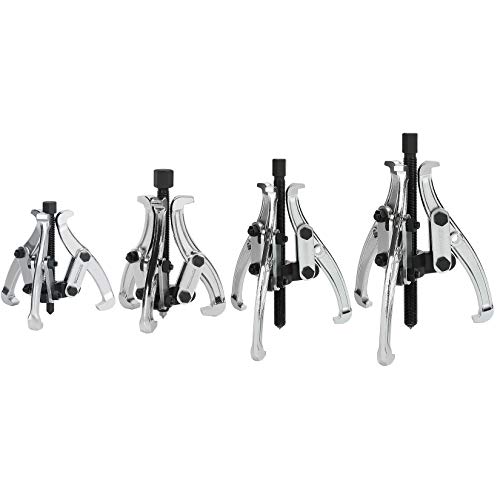
This four-piece set is the straightforward answer for a bench that sees a mix of gears, pulleys, bearings and flywheels. It bundles 3, 4, 6 and 8 inch pullers, each one a three-jaw tool, and each jaw reverses so the same puller grips a part from the outside or hooks it from the inside. The listing describes universal 4 or 8-position reversible jaws that give short, standard, long or extra-long reach settings, which is how one set covers both shallow pulleys and parts seated deeper on a shaft. The jaws are drop-forged CR-V steel, heat-treated, with fine chrome plating, and the drive screw carries a black phosphatized finish. The pullers arrive fully assembled, so there is no loose hardware to sort out before the first job. Force comes from a wrench, ratchet or spanner on the screw, and the three-jaw layout spreads that force around the part instead of loading two opposite points. For general shop repairs across a wide spread range, this is the most complete mechanical set in this group.
Specs
- Four pullers sized 3, 4, 6 and 8 inches, each with 3 jaws
- Jaw spread of 3, 4, 6 and 8 inches across the set
- Jaw reach of 3-9/16, 4-29/32, 2-9/16 and 9-1/16 inches
- CR-V steel jaws, drop-forged and heat-treated, with chrome plating
- Reversible jaws for internal and external pulling, no assembly required
- Item weight: 10.98 pounds
Orion Motor Tech 3-Jaw Gear Puller Set, 3, 4 and 6 Inch

Orion Motor Tech sells this three-piece set for the smaller end of the pulling range, with 3, 4 and 6 inch pullers aimed at pulleys, gears, bearings and flywheels on compact machinery and automotive work. Each puller carries three jaws, and the jaws reverse, so a puller set up to grip the outside of a pulley can be flipped to hook a bearing from the inside instead. That reversibility matters in small engine and equipment repair, where the same shaft may hold a part you grip by its rim on one job and a race you can only reach from behind on the next. The set is a hand tool in the plain sense: a forcing screw does the work, turned with whatever wrench or ratchet is already on the bench. At under six pounds for the whole kit, it is the lightest set here and the easiest to keep in a service cart or carry to the machine instead of bringing the machine to the bench. Shops that rarely meet a part wider than six inches can stop at this set and still cover most daily pulling.
Specs
- Three pullers sized 3, 4 and 6 inches
- 3 jaws on each puller, reversible for inside or outside grip
- For gears, pulleys, bearings and flywheels
- Item weight: 5.79 pounds
- Product dimensions: 8 x 8 x 3 inches
ABN Bearing Puller and Separator

Some bearings sit so close to a housing or a shoulder that no jaw arm can get behind them, and that is the gap this ABN tool fills. It is a bearing separator: two splitter halves with knife-like angled edges that slip into the narrow space behind a bearing, gear or pinion, then clamp together so a pushing or pulling attachment, working through the standard SAE threaded holes in the plates, can draw the part off. The jaw opening runs from 1/2 inch to 4-5/8 inches, which covers a wide band of shaft bearings, wheel hub work and pinion bearings. ABN builds it from heat-treated, chrome-plated steel with a black oxide finish. The listing points it at pinions and differential bearings, shaft bearings and gears, and transmission rebuilding, which tells you the work it was shaped for: seated races and press-fit parts in drivetrain assemblies rather than open pulleys. If your pulling jobs keep failing because the jaws cannot find a purchase, a separator is the form that solves it.
Specs
- Jaw opening range: 1/2 inch to 4-5/8 inches
- Splitter plates with SAE standard threaded holes for pulling attachments
- Heat-treated, chrome-plated steel with a black oxide finish
- Item weight: 5.74 pounds
- Product dimensions: 9 x 7.5 x 1.25 inches
VEVOR Carrier and Pinion Bearing Puller

Differential work has its own puller form, and this VEVOR kit is it. Instead of jaw arms, it uses three clamshells that close around a carrier or pinion bearing and hold it evenly while the center bolt draws it free, a shape the listing says removes the bearing with minor damage and without prying into the pinion sealing surface. The kit is built for Dana 30, 40, 50, 60, 70 and 80 axles and Ford 10.25 inch bearings. The clamshell diameters are 4.45 inches for the black shell, 4.45 inches for the yellow shell and 5.2 inches for the white shell, so match your bearing against those three figures before anything else. The whole kit is 45# steel, welded and processed, and the box carries the main puller body, plug, center bolt, three clamshells, retaining ring, adjuster rings and a stand. Operation follows the listing sequence: seat the tool, adjust the upper and lower rings, pick the clamshell that fits, tighten the retaining ring, and drive the center bolt. Axle builders will find this more useful than any general jaw set.
Specs
- 45# steel construction, welded and processed
- Three clamshells: 4.45 inch, 4.45 inch and 5.2 inch diameters
- Fits Dana 30, 40, 50, 60, 70 and 80 and Ford 10.25 inch bearings
- Kit includes main puller body, plug, center bolt, retaining ring, adjuster rings and stand
- Item size: 8.9 x 5 x 11 inches
- Item weight: 32.8 lbs, per the listing specifications section
OTC 7503 Tie Rod and Inner Bearing Race Puller

The OTC 7503 is the specialist of this group. Its name gives away its two jobs: pulling tie rod ends and pulling inner bearing races, the press-fit rings that stay in a hub or housing after the bearing itself comes out. The listing describes a tool built to apply up to 5 tons of force, which is serious pulling power from a tool that weighs only 2.65 pounds and is sized for front-end and hub work rather than bench work. OTC aims it at front-wheel-drive and rear-wheel-drive cars, both import and domestic, so it belongs in the drawer of anyone who does steering and hub service rather than general machinery repair. A general three-jaw set can sometimes be persuaded onto a tie rod end, but the jaws rarely seat squarely, and a puller that slips under load can damage the stud or the arm. A purpose-shaped puller seats the same way every time. If your repair work is mostly automotive front ends and wheel bearings, this is the pick shaped for it; general shops will treat it as the complement to a jaw set, not a replacement.
Specs
- Pulling force of up to 5 tons, per the listing description
- For tie rod ends and inner bearing races
- Fits front-wheel-drive and rear-wheel-drive import and domestic vehicles
- Item weight: 2.65 pounds
- Product dimensions: 12 x 6 x 2.5 inches
How to Choose
Start with the part, not the tool. Measure the diameter of the gear, pulley or bearing you need to move and compare it with the jaw spread figures printed for each puller: the spread must clear the part with the jaws hooked behind it. Then check reach. A part seated deep on a long shaft needs jaws that extend far enough to get behind it while the forcing screw still lands on the shaft end, and reach is the figure shoppers most often skip. The DURATECH set prints both numbers for every size, which makes that matching exercise simple.
Jaw count comes next. Three jaws spread the load around the part and keep the pull centered, which protects thin pulley rims and gear teeth; two jaws fit into tighter spaces and suit smaller parts. Reversible jaws add range to any set, because internal pulling, hooking a bearing out of a bore, is a different grip from external pulling, and a reversible set handles both without a second tool.
When there is no room behind the part at all, change form instead of forcing a jaw set. A separator like the ABN works its thin edges into gaps that arms cannot enter, and a clamshell like the VEVOR wraps a differential bearing evenly instead of point-loading it. Specialty shapes, like the OTC tie rod puller, earn their keep when the same job comes back every week.
Finally, respect the capacity figure a listing prints and the material wording beside it. Drop-forged, heat-treated steel is what lets a jaw hold its shape under a long pull, and a screw-driven puller should be worked steadily, a quarter turn at a time, keeping the screw centered on the shaft so the part walks off straight.
FAQ
What is the difference between jaw spread and jaw reach?
Jaw spread is the widest part the arms can open around, measured across the jaws. Jaw reach is how far along the shaft the jaws can extend to get behind the part. A puller can have enough spread for a pulley and still fail the job if its reach falls short of where the pulley sits, so check both figures against your part before choosing a size.
When does a bearing separator work better than a jaw puller?
A separator works better when the bearing or gear sits flush against a housing, shoulder or another part, leaving no gap for jaw arms to hook into. Its thin, angled plates slide into that narrow space and clamp behind the part, giving a pulling attachment something solid to draw against. Jaw pullers remain the faster choice whenever there is open room behind the part.
Can one puller handle both internal and external pulling?
Yes, if its jaws reverse. Reversible jaws mount one way to grip the outside of a gear or pulley and flip to hook a bearing or race from inside a bore. Both the DURATECH set and the Orion Motor Tech set in this group use reversible jaws, which is why a small set of them can cover more jobs than its size count suggests.
How much force does a gear puller need?
It depends on how tight the press fit is and how much corrosion has built up. Many shop jobs free up with steady screw pressure from a hand-driven puller, while stubborn races and front-end parts call for a tool whose listing prints a higher capacity figure, such as the 5 tons printed for the OTC 7503. Work the screw gradually and keep the pull straight rather than shocking the part loose.
Conclusion
For most benches, the DURATECH four-piece set is the center of the kit: four sizes, printed spread and reach figures, reversible jaws and forged CR-V steel. The Orion Motor Tech set covers the same ground in a smaller, lighter range. Add the ABN separator for bearings seated where jaws cannot go, the VEVOR clamshell for differential carrier and pinion work, and the OTC 7503 for tie rod ends and inner races, and the five forms together answer nearly every pulling job a repair shop meets. Measure your parts, match the spread and reach, and let the screw do the work.
More from Amazon
Programs that pair well with the guide above. Offers and eligibility are set by Amazon and may change.
Collect the home and kitchen items you want in one registry that guests can shop from.
Create a wedding registrySet up recurring deliveries of everyday items on eligible products. Terms and savings are set by Amazon.
Explore Subscribe & SaveFree shipping on eligible items, Prime Video and more. Eligible new members can start with a free trial.
Start a Prime free trialAudiobooks and podcasts to listen to on the go. Eligible new members can start with a free trial.
Try Audible freeAs an Amazon Associate we earn from qualifying purchases.