The best mechanical keyboards for both gaming and work are a 75% or TKL (tenkeyless) board with hot-swappable tactile or linear switches, PBT keycaps, and a gasket-mounted design, because that combination balances typing comfort for long work sessions, speed for gaming, and desk space without sacrificing essential keys.
Our top picks
 Redragon Mechanical Gaming Keyboard Wired
- Brilliant Color Illumination- With 11 unique backlights, choose…
- Support Macro Editing: The K671 Mechanical Gaming Keyboard…
- Hot-swappable Linear Red Switch- Our K671 gaming keyboard…
 Logitech G413 SE Full-Size Mechanical Gaming Keyboard
- Take your gaming skills to the next level:…
- PBT keycaps: Heat- and wear-resistant, this computer gaming…
- Tactile mechanical switches: Uncompromising performance is always within…
 AULA F75 Pro Wireless Mechanical Keyboard
- Tri-mode Connection Keyboard: AULA F75 Pro wireless mechanical…
- Hot-swap Custom Keyboard: This custom mechanical keyboard with…
- Advanced Structure and PCB Single Key Slotting: This…
| Product | Key specs | |
|---|---|---|
| Redragon Mechanical Gaming Keyboard Wired | Brilliant Color Illumination- With 11 unique backlights, choose… Support Macro Editing: The K671 Mechanical Gaming Keyboard… Hot-swappable Linear Red Switch- Our K671 gaming keyboard… | Check price |
| Logitech G413 SE Full-Size Mechanical Gaming Keyboard | Take your gaming skills to the next level:… PBT keycaps: Heat- and wear-resistant, this computer gaming… Tactile mechanical switches: Uncompromising performance is always within… | Check price |
| AULA F75 Pro Wireless Mechanical Keyboard | Tri-mode Connection Keyboard: AULA F75 Pro wireless mechanical… Hot-swap Custom Keyboard: This custom mechanical keyboard with… Advanced Structure and PCB Single Key Slotting: This… | Check price |
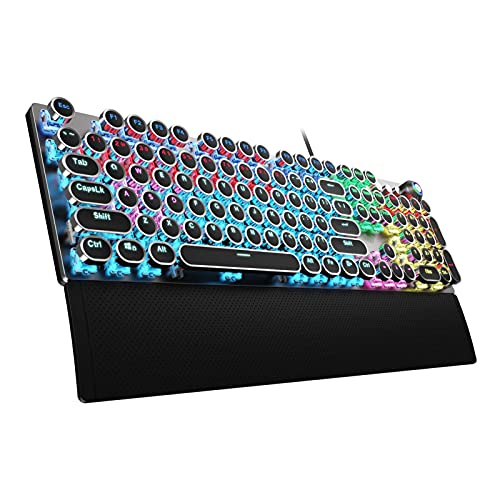 AULA F2088 Typewriter Style Mechanical Gaming Keyboard AULA F2088 Typewriter Style Mechanical Gaming Keyboard | Retro Typewriter Style Round Keycaps: Mechanical blue switch… Multimedia and Backlight Control Knob: This wired mechanical… Metal Panel and Magnetic Wrist Rest: The computer… | Check price |
As an Amazon Associate we earn from qualifying purchases at no extra cost to you.
Choosing by Switch Type: Feel and Noise Matter Most
Switches determine how a keyboard feels, sounds, and fatigues your fingers. All mechanical switches fall into three families, and your choice here affects typing accuracy and whether the board is suitable for an office or shared room.
1. Linear (Red-style) – Smooth and Fast
Linear switches travel straight down with no bump or click. Examples include Cherry MX Red, Gateron Red, and Kailh Box Red. They require about 45g of force and actuate at around 2.0mm. Gamers favor them because rapid key presses and double-taps feel effortless, but typists who rely on feedback may make more errors until they adjust.
- Sound: Quiet, only the bottom-out thock
- Best for: FPS/MOBA gaming, fast typists who bottom out lightly
- Downside: Easier to accidentally press keys while resting fingers
2. Tactile (Brown-style) – The Work-Gaming Compromise
Tactile switches like Cherry MX Brown, Gateron Brown, and Akko Cream Yellow Pro have a small bump at the actuation point without a loud click. Actuation force is typically 50-55g. That bump tells your fingers a key has registered, which reduces bottoming out hard and helps with long-form typing.
- Sound: Moderate thock, office-friendly if paired with PBT caps and foam dampening
- Best for: People who split time 50/50 between typing and gaming
- Downside: Slightly less smooth for rapid spamming than linears
3. Clicky (Blue-style) – Loud and Precise
Clicky switches such as Cherry MX Blue and Kailh Box Jade add both a tactile bump and an audible click bar. They need 50-60g of force and are the loudest option at 65-75 dB at desk level.
- Sound: Sharp click on every press, not suitable for open offices or late-night gaming near others
- Best for: Solo typists who want maximum feedback
- Downside: Fatigue over long sessions, can be distracting for voice chat
For mixed use in 2026, most buyers choose tactile or light linear switches (45-55g). If you work from home and game in the same space, avoid clicky switches. Hot-swappable boards let you try one type now and swap switches later for around $20-$35 per 35-switch pack without soldering.
Layout Size: How Much Keyboard Do You Need?
Layout determines desk space, ergonomics, and how far you have to reach for your mouse. Full-size boards are rarely the best choice for dual gaming/work setups unless you enter numbers constantly.
| Layout | Keys | Typical Dimensions (W x D) | Weight Range | What You Lose / Gain |
|---|---|---|---|---|
| Full-Size (100%) | 104-108 | 440 x 135 mm / 17.3 x 5.3 in | 1.0 – 1.4 kg | Keeps numpad and F-row; takes most desk space |
| TKL (80%) | 87-88 | 360 x 135 mm / 14.2 x 5.3 in | 0.9 – 1.2 kg | Drops numpad; better mouse room; retains F-row |
| 75% | 81-84 | 320 x 145 mm / 12.6 x 5.7 in | 0.8 – 1.1 kg | Compact but keeps F-row and arrows; most popular for work+gaming |
| 65% | 67-68 | 315 x 110 mm / 12.4 x 4.3 in | 0.6 – 0.9 kg | No F-row or dedicated navigation cluster; needs Fn layer |
| 60% | 61-62 | 295 x 105 mm / 11.6 x 4.1 in | 0.5 – 0.8 kg | Smallest mainstream size; no arrows/F-row/dedicated keys |
A 75% or TKL layout saves 80-120mm of width compared to full-size, which lets you keep your mouse closer to your body and reduces shoulder strain during long sessions. If your work involves spreadsheets, consider a 96% or 75% with a number row accessed via layer, or keep a separate low-cost numpad you can move aside when gaming.
Build Materials: What Changes Typing Feel and Longevity
The case and keycaps matter more for daily comfort than RGB or software.
- Case: Full aluminum cases (e.g., Keychron Q-series, Lemokey P-series) weigh 1.5-2x more than plastic cases and do not flex when you type hard. They also absorb vibration, which lowers ping and makes the sound deeper. Plastic cases (ABS) are lighter and often have more hollow sound unless they include internal foam.
- Mounting Style: Gasket-mounted boards use small rubber or silicone gaskets between the plate and case, creating a softer, cushioned bottom-out. Tray-mount boards screw the plate directly to the case and feel stiffer and louder. For long typing days, gasket mount reduces finger fatigue.
- Keycaps: PBT (polybutylene terephthalate) resists shine and oil from fingers and feels textured after 12-18 months of heavy use. ABS caps are smoother out of the box but develop a glossy shine within 6-12 months and can become slippery. Look for 1.3-1.5mm thick PBT with dye-sublimated legends for the longest life.
- Plate Material: Aluminum plates feel firm and high-pitched; polycarbonate or FR4 plates flex slightly and sound softer and deeper. Many work-friendly boards now use polycarbonate for comfort.
Comparison Table: Popular Picks for Gaming and Work in 2026
These models cover the main categories and are widely available from their manufacturers and authorized retailers in the $80-$230 market range.
| Model | Layout | Switch Options | Keycaps / Case | Connection | Battery Life (approx.) | Weight |
|---|---|---|---|---|---|---|
| Keychron Q1 Max | 75% | Gateron Jupiter Red/Brown/Banana, hot-swappable | PBT, full aluminum | 2.4GHz / Bluetooth 5.1 / Wired | 120-180 hours (no backlight), 35-50 hours with RGB low | 1.65 kg |
| Logitech G Pro X TKL Lightspeed | TKL | GX Red Linear, Brown Tactile, Blue Clicky, hot-swappable | PBT blend, plastic + aluminum plate | 2.4GHz Lightspeed / Bluetooth / Wired | 50 hours with RGB, 60-70 hours no lighting | 0.88 kg |
| Corsair K70 Core | Full-size | Corsair MLX Red linear, pre-lubed | ABS double-shot, plastic case with aluminum top | Wired USB | N/A wired only | 1.05 kg |
| NuPhy Air75 V2 | 75% low-profile | Gateron low-profile Red/Brown/Blue 2.0 | PBT, aluminum + plastic | 2.4GHz / Bluetooth 5.0 / Wired | 45-65 hours, 220 hours with backlight off | 0.53 kg |
| Leopold FC750R | TKL | Cherry MX Red/Brown/Blue/Black/Silent Red | 1.5mm thick PBT, plastic case | Wired USB | N/A wired only | 1.03 kg |
| Ducky One 3 TKL | TKL | Cherry MX Red/Brown/Blue/Speed Silver, hot-swappable | PBT double-shot, plastic case | Wired USB | N/A wired only | 0.98 kg |
Decision Matrix: Match Your Situation to the Right Board
Use your budget, space, and primary use to narrow the choice quickly.
| Your Situation | Recommended Layout & Switch | Recommended Build Features | Why |
|---|---|---|---|
| Small desk / shared apartment, mix of work and competitive gaming | 75% with linear 45g (Red-style) | Gasket mount, PBT caps, wireless tri-mode | Saves 8-10cm for mouse, easy to move, quiet enough for calls |
| Full-time writer / programmer, 6+ hours typing daily | TKL or 75% with tactile 50-55g (Brown-style) | Heavy aluminum case, polycarbonate plate, silent or tactile switches | Feedback reduces errors, cushioned mount limits fatigue |
| Data-heavy work (accounting, spreadsheets) plus casual gaming | Full-size or 96% with tactile switches | Wired, PBT caps, standard Cherry profile | Numpad saves thousands of keystrokes daily; wired avoids battery anxiety |
| Carry between office and home, tight budget ($80-$120 range) | 65% or low-profile 75% with Brown or Red | Plastic case, hot-swappable, Bluetooth | Lightweight (under 0.7kg), compact for backpacks, switch swaps extend life |
| Open office or streaming with microphone | Any layout with silent linear (Cherry MX Silent Red, Gateron Milky Yellow Pro Silent) | Foam-dampened case, PBT caps, O-rings optional | Drops keystroke noise from ~58 dB to ~42 dB |
Cost per use helps put price in perspective. A $170 board used 5 days a week, 6 hours a day, for 3 years costs about $0.04 per hour of use before any switch or cap replacement, while a thin membrane board that needs replacement every 12-18 months due to worn legs or faded legends often costs more over the same period.
Durability and Ownership Realities
Mechanical keyboards last longer than membrane, but not every part wears equally.
- What wears first: ABS keycaps shine and legends fade in 9-14 months of daily use; stabilizers for the spacebar and shift keys rattle if not lubed; cheaper clip-in stabilizers need re-lubing every 12-18 months. Switches themselves are rated for 50-100 million presses, so they rarely fail before other parts.
- Cleaning: Pull keycaps every 3-6 months and remove dust and hair with a soft brush or compressed air held at an angle. Wipe PBT caps with warm water and mild soap; avoid alcohol on printed legends. Never submerge the board.
- Common mistakes: Spraying lubricant directly into switches without desoldering or removing them can make them mushy. Over-tightening screws on aluminum cases strips threads. Using a high-pressure vacuum too close to switches can pull out stems.
- Consumables: Plan for a $15-$25 set of stabilizer grease and switch lube if you want to maintain sound quality, and keep 4-6 spare switches of your type for quick replacement on hot-swap boards.
- Battery care for wireless: Lithium batteries lose capacity faster if always charged to 100% and left plugged in. If you use the board wired most of the time, cycle it on battery to 40-80% once a month to prolong overall battery life beyond the typical 3-5 year span.
Setup Tips for Work and Gaming on One Board
Set the polling rate to 1000Hz for gaming and leave it there for work, there is no downside for typing. Program a Fn layer for media controls, mute, and window snapping so a 75% or 65% can replace a full-size for productivity. If your board supports QMK/VIA, save one profile for work (tactile curve, lower RGB brightness, macro for email) and one for gaming (linear feel, disabled Windows key, game-specific macros) so you can switch without reprogramming.
Frequently Asked Questions
Are mechanical keyboards bad for your wrists?
They are not inherently better or worse. Height matters: many mechanical boards are 32-38mm tall at the front versus 20-25mm for low-profile keyboards. Use a wrist rest that keeps your wrists neutral and float your hands while typing rather than resting weight on the rest.
Do I need a hot-swappable board?
Not required, but it is the most practical way to change switch feel without buying a new board. If you are unsure between tactile and linear, hot-swap gives you a low-cost way to experiment and replace a single faulty switch.
How loud will a mechanical keyboard be in a call?
With linear or tactile switches, foam dampening, and PBT caps, most boards sit at 45-55 dB at 30cm, similar to a quiet conversation. Clicky switches are 10-15 dB louder and will be picked up by most microphones even with noise suppression.