Key takeaways
- Removable soil tray: A metal or plastic tray catches compost and allows you to empty it instead of sweeping the ground.
- Tool hooks: Four to six hooks keep frequently used hand tools visible. Hooks should be spaced at least 3 inches apart.
- Bag storage: A lower bay 12–16 inches high is large enough for a typical small compost bag, but it should be ventilated and protected from rain.
- Drawers: Useful for labels and gloves, but only when they have drainage or a weatherproof lid. Enclosed wooden drawers can trap dampness.
- Wheel compatibility: Locking casters help move a bench on a hard surface, but fixed feet are safer on soil or uneven paving.
The best potting benches for most gardeners are a weather-resistant wooden bench with a work surface about 34–38 inches high, a removable soil tray, and at least one lower shelf; choose galvanized steel for maximum durability, recycled plastic for low maintenance, or a folding bench when storage space is limited.
Our top picks
 Polyhouz Outdoor Potting Bench with 3 Tier
- Ample Storage & Organization:This garden potting bench offers…
- Versatile Gardening Center: More than just a repotting…
- Weather-Resistant Durability: Made from fade-resistant and corrosion-resistant HDPE/composite…
 SERWALL Outdoor Potting Bench with Removable Sink
- HDPE Material: Constructed from 100% HDPE material, the…
- Product Sizes: Overall size: 16.9″D x 39.8″W x…
- Large Storage Space: Equipped with multiple storage options,…
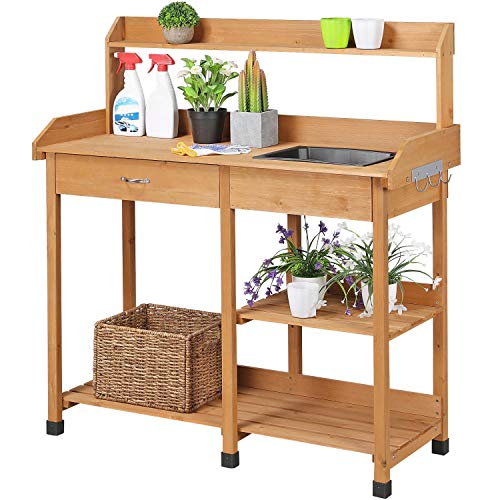 Yaheetech Potting Bench with Sink & Drawer
- Made of Natural Fir: This solid fir wood…
- Open Storage, Easy Access: Featuring generous shelves and…
- Thoughtful Details: Back baffles on the tabletop and…
| Product | Key specs | |
|---|---|---|
| Polyhouz Outdoor Potting Bench with 3 Tier | Ample Storage & Organization:This garden potting bench offers… Versatile Gardening Center: More than just a repotting… Weather-Resistant Durability: Made from fade-resistant and corrosion-resistant HDPE/composite… | Check price |
| SERWALL Outdoor Potting Bench with Removable Sink | HDPE Material: Constructed from 100% HDPE material, the… Product Sizes: Overall size: 16.9″D x 39.8″W x… Large Storage Space: Equipped with multiple storage options,… | Check price |
| Yaheetech Potting Bench with Sink & Drawer | Made of Natural Fir: This solid fir wood… Open Storage, Easy Access: Featuring generous shelves and… Thoughtful Details: Back baffles on the tabletop and… | Check price |
 Goplus Garden Potting Bench Table with Stainless Goplus Garden Potting Bench Table with Stainless | Natural Wood Build: Crafted from non-deformable fir wood,… Smart Storage Layout: The gardening workstation includes a… Easy-to-clean Work Surface: The stainless steel surface on… | Check price |
As an Amazon Associate we earn from qualifying purchases at no extra cost to you.
Best potting benches by gardening situation
| Gardener or space | Best bench type | Useful specifications | Expected price range in 2026 |
|---|---|---|---|
| Occasional container gardener | Compact wooden bench | 30–36 in wide, 18–24 in deep, 34–36 in high; one shelf | $90–$180 |
| Frequent seed starter | Full-size wooden workbench | 40–48 in wide, 20–26 in deep, 36–38 in high; 200–300 lb capacity | $180–$400 |
| Wet or coastal climate | Galvanized steel bench | 36–48 in wide; zinc-coated frame; slatted or perforated top | $150–$350 |
| Low-maintenance household | Recycled plastic or resin bench | 30–42 in wide; rustproof; 100–200 lb capacity | $120–$300 |
| Balcony or shed storage | Folding potting table | 24–36 in wide, under 8 in folded depth, 75–150 lb capacity | $60–$180 |
What makes a potting bench comfortable?
Work-surface height has the greatest effect on everyday comfort. A bench that is too low encourages prolonged bending, while one that is too high makes mixing compost and filling pots awkward. As a starting point, measure from the floor to your wrist crease while standing naturally with your elbows relaxed. A potting surface roughly 2–4 inches below that measurement is usually a practical range for light-to-moderate work.
For many adults, this means 34–38 inches. Gardeners who prefer to sit should look for a 28–32-inch surface or a design with room for a stool. If more than one person will use the bench, a 36-inch height is a reasonable compromise. Check the height of the lower shelf as well: a shelf only 4–6 inches above the ground is difficult to reach and tends to become a damp storage area.
A useful top is at least 18 inches deep. Twenty-two to 26 inches gives more room for trays, hand tools, and a bucket without making the bench excessively bulky. Look for a raised lip at the back and sides, ideally 1–2 inches high, to stop loose compost sliding onto the ground.
Wood, metal, or plastic: which material wins?
Wooden potting benches
Wood offers the most natural appearance and is often the easiest material to repair. Cedar, redwood, and pressure-treated softwood are common choices. Cedar and redwood resist decay better than untreated pine, but they still benefit from being kept off standing water. A bench made from 1-inch-thick boards generally feels more stable than one made from thin slats.
Wood is the best choice when appearance, repairability, and a solid work surface matter. Its weaknesses are seasonal movement, staining from wet compost, and fastener corrosion. Stainless-steel or hot-dipped galvanized screws are preferable to ordinary steel screws, which can rust and leave dark marks. Expect to clean and reseal exposed wood every one to three years, depending on sun and rainfall.
Galvanized steel
Galvanized steel handles wet compost, spilled fertilizer, and frequent washing better than most wood. It is also thinner and easier to keep clean. Choose a bench with a galvanized or powder-coated frame, rounded edges, and a worktop that drains rather than holding puddles.
Steel can become hot in direct summer sun and may be noisy when tools are dropped onto it. Check the coating around screw holes and welded joints, where corrosion usually begins. A steel bench is particularly suitable for a greenhouse, allotment, or uncovered area where the surface will receive heavy use.
Recycled plastic and resin
Plastic benches do not rot or rust and can be cleaned with mild soap and water. They are a strong option for gardeners who do not want to repaint, oil, or reseal anything. However, some lightweight models flex under a heavy bag of compost and may become brittle after years of intense ultraviolet exposure.
Look for UV-stabilized material, a broad-legged base, and a stated load capacity of at least 150 pounds. Avoid placing a dark plastic bench against a wall where heat can build up, and do not assume that “waterproof” means it will remain stable in strong wind.
Storage features worth paying for
Storage is useful only when it remains accessible. A lower shelf with 10–14 inches of vertical clearance can hold pots, watering cans, and a bag of compost. A narrow upper shelf is convenient for labels, dibbers, and seed packets, but it should not shade the entire worktop or obstruct tall plants.
- Removable soil tray: A metal or plastic tray catches compost and allows you to empty it instead of sweeping the ground.
- Tool hooks: Four to six hooks keep frequently used hand tools visible. Hooks should be spaced at least 3 inches apart.
- Bag storage: A lower bay 12–16 inches high is large enough for a typical small compost bag, but it should be ventilated and protected from rain.
- Drawers: Useful for labels and gloves, but only when they have drainage or a weatherproof lid. Enclosed wooden drawers can trap dampness.
- Wheel compatibility: Locking casters help move a bench on a hard surface, but fixed feet are safer on soil or uneven paving.
Assembly and stability: the details that prevent frustration
Assembly time varies from about 30 minutes for a folding resin table to two hours for a substantial wooden bench. The number of parts matters less than whether the frame has predrilled holes, labeled hardware, and diagonal bracing. A bench with four legs but no cross-brace can wobble even when its screws are tight.
Before buying, check the assembled dimensions rather than relying on photographs. Leave at least 24 inches of working clearance in front of the bench and enough space behind it to access shelves. For a 48-inch-wide bench, allow roughly 5 feet of total wall length if you want to stand beside it and turn comfortably.
Place the bench on paving, compacted gravel, or adjustable feet rather than directly on lawn or bare soil. Level it before tightening all fasteners. On a sloping surface, one short leg can make the entire top twist when you press down while potting. If the bench is in an exposed garden, anchor it to a wall or paving with suitable brackets; a lower shelf filled with pots adds weight but is not a substitute for anchoring.
How much capacity do you need?
Estimate the heaviest routine load instead of judging by the bench’s appearance. A 40-liter bag of moist compost can weigh approximately 35–50 pounds, while a tray of wet 3-inch pots may add 15–25 pounds. If you work with one compost bag, tools, and a tray at the same time, a 150-pound rated capacity leaves useful margin. Frequent seed starting or repotting calls for 200 pounds or more.
For example, a typical session might involve a 40-pound compost bag, 20 pounds of pots and plants, and 10 pounds of tools and water. That is 70 pounds in normal use. Selecting a bench rated for at least twice that load—140 pounds or more—reduces flexing and gives a safer margin for leaning on the worktop.
Durability and ownership realities
The first parts to wear are usually the finish, fasteners, drawer runners, and feet—not the main worktop. Compost dust works into drawer slides, while repeated wetting causes wooden feet to soften. Keep the bench slightly away from a wall so air can circulate, empty the soil tray after wet jobs, and brush loose compost from joints before washing.
- Rinse plastic or galvanized surfaces with clean water after fertilizer spills; salt residue can stain or promote corrosion around damaged coatings.
- Use a stiff brush on wood, but avoid a powerful pressure washer, which can raise the grain and force water into joints.
- Inspect screws and brackets twice a year, especially after the first wet winter.
- Replace cracked feet or swollen boards promptly rather than continuing to load the bench unevenly.
- Store a folding bench dry and folded only after it is completely clean; trapped moisture can cause mildew and hardware corrosion.
Final buying decision
Choose a compact wooden bench if you pot occasionally and want a furniture-like addition to a small garden. Choose a galvanized steel model for frequent, wet, or messy work. Recycled plastic is the simplest low-maintenance option, while a folding bench is the best answer when every square foot must serve several purposes.
Whichever material you select, prioritize the correct height, a worktop at least 18 inches deep, a stable braced frame, drainage, and a realistic load rating. Those features affect comfort and longevity more than decorative roofs, extra shelves, or a long list of included accessories.