Key takeaways
- RAID 0: Stripes data across drives for capacity and speed, but offers no redundancy. One failed drive can make the entire volume unavailable.
- RAID 1: Mirrors two drives. It is simple and fault-tolerant, but usable capacity is only that of one drive.
- RAID 5: Uses the equivalent of one drive for parity. A practical balance for many four-bay editing systems, provided you maintain a separate backup.
- RAID 6: Uses the equivalent of two drives for parity, allowing two drive failures. It suits larger arrays and valuable working archives.
- RAID 10: Combines mirroring and striping. It can offer responsive reads and writes, but uses about half the raw capacity; fault tolerance depends on which drives fail.
Best RAID External Storage for Media Professionals: The Short Answer
For most video editors who need fast, expandable desktop storage, the best RAID external storage is a 4- or 8-bay Thunderbolt enclosure configured as RAID 5 with NAS-grade hard drives; choose RAID 10 for demanding multi-stream work and faster rebuilds, or RAID 0 only when every file is backed up elsewhere. The right pick depends less on a headline speed than on your footage, connection, usable capacity, and recovery plan.
Choose by the Work You Do
| Situation | Practical choice | Why | Main trade-off |
|---|---|---|---|
| One editor, 4K projects, limited budget | 4-bay enclosure, RAID 5, four 12 TB drives | About 36 TB decimal usable before formatting, with one-drive fault tolerance | Rebuilds can take many hours; sustained speed depends on the drives and workload |
| Multiple high-bitrate streams or frequent exports | 6- or 8-bay Thunderbolt enclosure, RAID 10 | Good random-access performance and tolerance for one failed drive in each mirror pair | Roughly half of raw capacity is usable |
| Large archive, occasional access | 4- to 8-bay enclosure, RAID 6 | Can survive two drive failures | Two-drive capacity cost and slower writes than simpler arrays |
| Scratch media with a separate, verified backup | RAID 0 | All drive capacity is available; can deliver high sequential throughput | Any drive failure can take down the entire array |
| Travel or a small desk setup | Two-bay USB-C hardware RAID, RAID 1 | Compact setup and a complete copy on each drive | Capacity equals one drive; USB-C alone does not guarantee high bandwidth |
Capacity figures use decimal drive sizes and exclude formatting overhead. RAID 5 capacity is approximately (number of drives minus one) × the smallest drive; RAID 6 is (number of drives minus two) × the smallest drive. RAID 10 generally provides half the combined raw capacity. Mixing drive sizes usually wastes space, so match capacities when building or expanding an array.
Our top picks
 SanDisk Professional 24TB G-RAID Project 2
- Up to 48TB (1) of max capacity on…
- Ships in RAID 0 for improved performance with…
- PRO-BLADE SSD Mag slot to easily add SSD…
 SanDisk Professional 52TB G-RAID Project 2
- (1) 1GB = 1 billion bytes and 1TB…
- Up to 52TB of max capacity on two…
- Ships in RAID 0 for improved performance with…
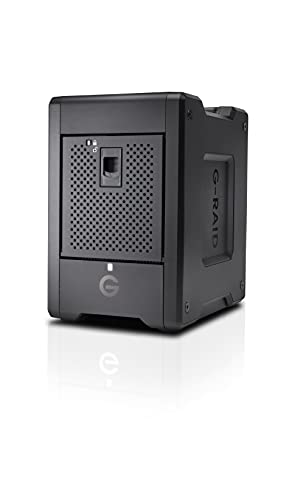 SanDisk Professional 24TB G-RAID Shuttle 4
- Massive capacity and transportable design
- Thunderbolt 3 (40Gbps) and USB-C (10Gbps) compatibility
- Supports multi-stream 4K, 8K and VR workflows
As an Amazon Associate we earn from qualifying purchases at no extra cost to you.
RAID Levels: What You Gain and What You Risk
- RAID 0: Stripes data across drives for capacity and speed, but offers no redundancy. One failed drive can make the entire volume unavailable.
- RAID 1: Mirrors two drives. It is simple and fault-tolerant, but usable capacity is only that of one drive.
- RAID 5: Uses the equivalent of one drive for parity. A practical balance for many four-bay editing systems, provided you maintain a separate backup.
- RAID 6: Uses the equivalent of two drives for parity, allowing two drive failures. It suits larger arrays and valuable working archives.
- RAID 10: Combines mirroring and striping. It can offer responsive reads and writes, but uses about half the raw capacity; fault tolerance depends on which drives fail.
RAID is not a backup. It may keep a volume running after a drive failure, but it cannot undo accidental deletion, malware, theft, fire, or enclosure failure. Keep an independent copy, ideally including an off-site or cloud copy, and test that you can restore files.
Speed, Connection, and Expandability
For large media files, sustained transfer rate matters more than a brief burst figure. A single modern spinning hard drive commonly sustains roughly 150–250 MB/s depending on model, capacity, and where data sits on the disk. A four-drive array may reach several hundred MB/s or more in sequential transfers, but parity calculations, fragmentation, background rebuilds, and small-file workloads can reduce performance. SSD arrays can be much faster, though they cost more per terabyte and can still slow under sustained writes or when nearly full.
Thunderbolt 3 and Thunderbolt 4 have a 40 Gb/s signaling rate; Thunderbolt 5 raises that to 80 Gb/s in its standard mode. These are interface rates, not guaranteed file-copy speeds. USB 3.2 Gen 2 is rated at 10 Gb/s, while USB 3.2 Gen 2×2 is 20 Gb/s; host support and cable choice determine whether the faster mode is available. Check the exact port and protocol on both the enclosure and computer. A USB-C connector does not by itself mean Thunderbolt or 20 Gb/s USB.
For expansion, distinguish between adding a drive to an empty bay and changing the RAID layout later. An empty bay gives you a straightforward growth path, but converting an existing array to a different RAID level may require a backup, reconfiguration, and restore. Some systems support online expansion; verify that capability in the manufacturer’s documentation before buying, and do not assume it works with every RAID level or disk combination.
What to Compare Before You Buy
| Factor | Useful target or check | Why it matters |
|---|---|---|
| Bays | 4 bays for a compact working array; 6–8 for more capacity or RAID 6 | More bays can improve capacity and fault-tolerance options, but increase heat, noise, and cost |
| Drive type | Matched, NAS- or enterprise-class HDDs for bulk storage; SSDs for low-latency work | Check the enclosure’s compatibility list and intended duty cycle |
| Sustained performance | Look for workload-specific independent measurements, not just interface bandwidth | Editing performance varies with codec, stream count, file size, and RAID level |
| Noise and cooling | Check fan control, drive vibration, and published noise information | Multi-drive HDD units can be distracting in a quiet recording or editing room |
| Recovery | Confirm drive-failure alerts, replacement procedure, and rebuild status reporting | A degraded array needs prompt attention; rebuilding stresses the remaining drives |
Ownership Realities: Noise, Rebuilds, and Drive Replacement
Hard-drive arrays generate vibration and fan noise, and their fans may become more audible during heavy transfers or rebuilds. Place the enclosure on a stable surface with clear airflow, not inside a sealed cabinet. SSD-based storage is usually quieter, but still needs cooling and can be limited by sustained-write behavior.
When a drive fails, replace it with a compatible drive at least as large as the failed one and follow the enclosure’s documented procedure. Keep the array powered and cooled during a rebuild, avoid unnecessary large transfers, and make sure the backup is current. Rebuild time varies widely with drive size, array load, and controller; large HDD arrays can take a day or longer. A second failure during that window can be catastrophic for RAID 5, which is one reason RAID 6 is attractive for larger arrays.
Before committing to a project, check SMART or enclosure health alerts, keep spare compatible drives if downtime is costly, and periodically perform a restore test. RAID protects availability in specific drive-failure scenarios; it does not protect the project from every way data can disappear.
Bottom Line
For a general-purpose editing workstation, start with a four-bay Thunderbolt or adequately fast USB enclosure, matched HDDs, and RAID 5 if one-drive protection and capacity balance matter. Choose RAID 6 for a larger, more valuable array; RAID 10 when performance and rebuild behavior justify losing half the raw capacity; and RAID 0 only for replaceable scratch files with another copy. Compare measured sustained transfers, not port labels alone, and budget for an independent backup from day one.