Key takeaways
- Basin depth: small songbirds prefer water roughly 0.5 to 2 inches deep. A basin deeper than about 3 inches needs a rock or a ramp.
- Panel exposure: a solar pump needs several hours of direct sun. Shade from a tree or a fence line can silence it.
- Energy storage: a battery adds runtime after a cloud passes or the sun sets, but also adds cost and one more component to fail.
- Stability: lightweight resin baths and floating pumps both move in wind. Anchoring matters.
- Winter behavior: ceramic and glass can crack when water freezes. Resin tolerates it better, but no solar fountain is freeze-proof.
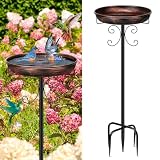
The VIVOHOME Bird Bath with Solar Fountain is the best all-in-one solar bird bath for most yards, the Aisitin 3.5W floating pump is the best budget way to add a solar fountain to a bath you already own, and the Yzert 3.5W glass-panel pump with a 2000mAh battery is the pick when you want water moving on cloudy days. The right choice depends on one question: do you want a complete bath with a built-in fountain, or a pump that floats in a basin you already have?
Moving water is the whole point of a solar bird bath. Birds notice the ripple and the sound from a distance, and a fountain keeps the surface fresher between cleanings. But solar fountains are not all alike. Some run only while direct sun hits the panel. Some store a little energy and keep spraying after a cloud passes. Some are decorative ceramic pieces that crack in a hard freeze. This guide sorts the field by what actually separates them: basin depth, panel placement, battery storage, nozzle variety, and winter durability.
Our top picks
 Mademax Solar Bird Bath Fountains
- Mademax solar birdbath fountain only needs 3 seconds…
- We have designed a retainer to avoid the…
- The package comes with 8 nozzles and 4…


As an Amazon Associate we earn from qualifying purchases at no extra cost to you.
Quick picks
| Pick | Type | Key spec | Battery | Best for |
|---|---|---|---|---|
| VIVOHOME Bird Bath with Solar Fountain | Pedestal bath with fountain | 28 in tall, 20 in basin, 4 nozzles | No | A complete, lightweight setup |
| Aisitin 3.5W Solar Fountain Pump | Floating pump | 3.5W, 6 nozzles | No | Budget upgrade for an existing bath |
| Yzert 3.5W glass-panel pump | Floating pump | 3.5W, 2000mAh battery | Yes | Cloudy climates and evening running |
| Alukiki 4W Solar Birdbath Fountain | Floating pump with LEDs | 4W, about 2 hours of evening runtime | Yes | Gardeners who want dusk lighting |
| Smart Solar Ceramic Koi Fountain | Ceramic tabletop bath | 10 ft panel cable, glazed ceramic | No | Decorative patios in mild climates |
How we chose
This guide is built from research, not from our own use of the products. We compared manufacturer specifications and the published findings of several buying guides, looked at where those sources agree and disagree, and then checked each named product against the criteria below. Where a spec could not be confirmed, we describe the product by its class instead of guessing. Rankings from affiliate-style roundups often overlap, so we weighted repeated, specific complaints (such as drifting pumps or flimsy stands) more heavily than praise.
- Basin depth: small songbirds prefer water roughly 0.5 to 2 inches deep. A basin deeper than about 3 inches needs a rock or a ramp.
- Panel exposure: a solar pump needs several hours of direct sun. Shade from a tree or a fence line can silence it.
- Energy storage: a battery adds runtime after a cloud passes or the sun sets, but also adds cost and one more component to fail.
- Stability: lightweight resin baths and floating pumps both move in wind. Anchoring matters.
- Winter behavior: ceramic and glass can crack when water freezes. Resin tolerates it better, but no solar fountain is freeze-proof.
The two types of solar bird bath
All-in-one baths with an integrated fountain
These arrive as a pedestal or tabletop bath with a pump already matched to the basin. You place it in sun and fill it. They look finished and need no sizing decisions. The tradeoff is that you are stuck with the basin shape and finish the maker chose, and a faulty pump usually means replacing a part rather than the whole product.
Floating solar pumps for an existing bath
A floating pump has a small panel that sits on the water surface or on a short tether, plus a pump and a set of nozzles. It turns almost any shallow basin into a fountain. This route costs less, gives more nozzle choice, and lets you keep a bath you like. The downside is drift: the pump wanders to the basin edge, and spray can spill over the side unless you add brackets or a weight.
Product reviews
VIVOHOME Bird Bath with Solar Fountain
Spec line: Polyresin · 28 in tall · 20 in wide basin · about 2.4 in basin depth · about 5.8 lb · 4 nozzle patterns · no battery
This is the most frequently recommended all-in-one pick across current roundups, and the reasons are practical. It weighs under 6 pounds, so one person can place it and move it. The hollow base can be filled with sand or gravel for stability, which solves the main complaint about lightweight resin baths. An automatic shut-off stops the pump from running dry.
Best for: Most yards, first-time buyers, and anyone who wants to be done in a few minutes.
Skip if: Your spot gets less than about four hours of direct sun, or you want fountain spray after sunset.
- Pros: very light, fast setup, sand-fillable base, four spray patterns, dry-run protection.
- Cons: the solar pump may need weighting so it does not drift; no battery means it stops when the sun does.
Aisitin 3.5W Solar Fountain Pump
Spec line: Floating pump · 3.5W · about 7.1 in diameter · about 12 oz · 6 interchangeable nozzles · spray reaches roughly 1.5 ft · no battery
The budget workhorse. It floats in any container, turns on with sunlight, and gives you the strongest spray-per-cost of the group. Six nozzles let you choose between a tall column, a bell, or a gentle bubbler, which matters because small birds usually dislike a hard jet.
Best for: Adding a fountain to a bath you already own, on a tight budget.
Skip if: You want it to run through passing clouds, or you need low-water protection.
- Pros: low entry cost, easy floating install, automatic on and off, strong spray, many nozzles.
- Cons: no battery backup, plain look on its own, and no automatic shut-off if the water level drops.
Yzert 3.5W Solar Fountain Pump with Battery Backup
Spec line: Floating pump · 3.5W · glass solar panel · 2000mAh battery · works on cloudy days and into the evening
Several guides name this a top pick for people whose sunshine is unreliable. The battery buffers short clouds so the fountain does not stutter on and off, which also reduces the stop-start wear that shortens pump life. See the runtime math below for what a battery of this size can and cannot do.
Best for: Partly shaded yards, cloudy regions, and people who like evening sound.
Skip if: You only want a daytime ripple and prefer the simplest, cheapest option.
- Pros: battery smooths cloudy spells, glass panel, same 3.5W class as the budget pumps.
- Cons: costs more than a no-battery pump, and the battery eventually wears out; a glass panel is more fragile than plastic.
Alukiki 4W Solar Birdbath Fountain with LED Lights
Spec line: Floating pump · 4W · about 6.3 in wide · about 15.8 oz · battery gives about 2 hours of evening runtime · colored LEDs at dusk · multiple nozzles
A stronger pump than most, with stored energy for an evening show. The LEDs are the main attraction for people who use the bath as a night feature. Be honest about the purpose: the colored lights are for you, not the birds.
Best for: Patios where the bath doubles as an evening ornament.
Skip if: You are mainly after wildlife, or you dislike a pump that wanders.
- Pros: strong spray, battery storage, LEDs switch on at dusk, simple floating setup.
- Cons: it drifts toward the bowl edge and can spill water; the lights do not draw birds.
Smart Solar Ceramic Koi Fountain
Spec line: Glazed ceramic · about 6.7 in tall · about 14.5 in wide · about 5.3 lb · separate panel on a 10 ft cable · no energy storage
This is a decorative bath with a koi that spouts water into an integral bowl. The weighted ceramic bowl is stable, and the 10-foot cable lets you put the panel in sun while the bath sits in a shadier, more bird-friendly spot. That separation is its smartest feature.
Best for: Mild-winter patios and gardeners who value looks.
Skip if: Your winters freeze hard, or you want the fountain to keep running when it is overcast.
- Pros: quality glazed ceramic, stable weight, remote panel placement, cordless in the sense of no outlet.
- Cons: shuts off when it is cloudy, ceramic is fragile and needs winter storage where it freezes, and a small fountain basin dries quickly.
Smart Solar 20622R01 Pedestal Bath with Underwater Solar Pump
Spec line: Heavy stone-look basin · 2 fountain heads · integral underwater solar pump · no wiring · weight listed around 35 lb
Roundups describe this as a weighty, no-wiring pedestal with removable decorative turtles. The heavy build resists wind and tipping, which is a real advantage over resin. Performance varies with sunlight, and the small basin volume means it needs frequent topping up.
Best for: Windy sites that need a heavy, planted-feeling bath.
Skip if: You need to move it often, or your site is shady.
- Pros: heavy and stable, no cables, two fountain heads.
- Cons: solar output varies, small water volume, harder to carry and to clean.
Ankway Solar Fountain Pump
Spec line: Floating pump · brushless motor · 8 spray patterns · no battery · needs direct sun
The brushless motor is the notable spec here, since brushless pumps generally last longer than brushed designs. Eight patterns give the widest choice in this list. It does not store energy, so output follows the sun.
Best for: People who want maximum spray variety and a longer-lived motor.
Skip if: You need cloud or evening runtime.
- Pros: brushless pump, eight patterns, simple.
- Cons: no battery, weather-dependent, needs a steady water level to avoid running dry.
Mademax Floating Solar Pump
Spec line: Floating pump · 1.4W (one common version) · 8 nozzles · 4 anti-drift brackets
The lowest-power pump here, and that is a feature for small baths: a gentler fountain is less likely to throw water out of a shallow basin. The anti-drift brackets address the most common complaint about floating pumps.
Best for: Small, shallow baths and gentle bubbling.
Skip if: You want a tall spray or a large basin.
- Pros: gentle output suits shallow basins, drift brackets included, many nozzles.
- Cons: low power limits spray height; no battery.
Spec comparison
| Model | Class | Power or size | Nozzles | Stores energy | Freeze risk |
|---|---|---|---|---|---|
| VIVOHOME Bird Bath | All-in-one | 20 in basin, 28 in tall | 4 | No | Moderate |
| Aisitin 3.5W | Floating pump | 3.5W | 6 | No | Pump only |
| Yzert 3.5W | Floating pump | 3.5W, 2000mAh | Several | Yes | Pump only |
| Alukiki 4W | Floating pump | 4W | Multiple | Yes, about 2 hours | Pump only |
| Smart Solar Ceramic Koi | Ceramic bath | 14.5 in wide | 1 spout | No | High |
| Smart Solar 20622R01 | Heavy pedestal | About 35 lb | 2 | No | Moderate |
| Ankway pump | Floating pump | Brushless | 8 | No | Pump only |
| Mademax pump | Floating pump | 1.4W version | 8 | No | Pump only |
Worked example: what a battery really buys you
Battery marketing is vague, so here is the arithmetic. A typical lithium cell is about 3.7 volts. That is an assumption, so check your pump if the maker lists a different voltage.
- Convert capacity to energy: 2000 mAh is 2 Ah. Multiply by 3.7 V to get about 7.4 watt-hours.
- Divide by the pump draw: a 3.5W pump running flat out pulls 3.5 watts, so 7.4 Wh / 3.5 W is about 2.1 hours.
- Compare with a smaller battery and bigger pump: 1500 mAh at 3.7 V is about 5.6 Wh, and a 5W pump would drain it in roughly 1.1 hours.
- Apply real conditions: batteries are rarely fully charged after a partly cloudy day, so expect less.
The takeaway: a battery bridges a passing cloud or gives you an hour or two after sunset. It does not run a fountain overnight. This matches the roughly 2-hour evening runtime quoted for the Alukiki. If you want all-day water movement regardless of weather, you need a plug-in pump on a timer, not solar.
Decision matrix
| Your situation | Choose | Why |
|---|---|---|
| No bath yet, want it finished fast | VIVOHOME Bird Bath | Bath and pump matched, sand-fillable base |
| Own a bath, tight budget, sunny spot | Aisitin 3.5W | Strong spray per cost, six nozzles |
| Own a bath, cloudy region | Yzert 3.5W with battery | Battery bridges clouds |
| Shallow basin under 2 in deep | Mademax 1.4W | Gentle flow, drift brackets |
| Wind-prone site | Smart Solar 20622R01 | Heavy base resists tipping |
| Hard-freeze winters | Resin bath plus removable pump | Avoids ceramic cracking |
| Want sound at dusk | Alukiki 4W | Battery plus LEDs |
Placement that makes birds actually use it
Product choice matters less than placement. Birds want an escape route and a view. Put the bath within about 10 feet of a shrub or tree so they can dart into cover, but not so close that a cat can ambush from the foliage. Keep it at least a few feet from windows, or very close to them, to reduce collision risk. Then give the solar panel its own sun. If the bath is shaded, use a remote-panel model like the ceramic koi, or a floating pump you can reposition with the sun.
Basin depth is the second placement issue. If your basin is deeper than 2 to 3 inches, add a flat stone so small birds can stand in shallow water. Rough surfaces help grip. Smooth glazed bowls can be slippery.
Cleaning and care
- Change the water every day or two in warm weather. Standing water breeds mosquitoes within days, and moving water helps but does not replace changing it.
- Scrub weekly with a stiff brush and a mild vinegar solution, then rinse thoroughly before refilling. Avoid soap residues.
- Clear the pump intake of debris and algae. A clogged intake is the top reason a pump seems to die.
- Wipe the solar panel with a damp cloth. Dust and bird droppings cut output.
- Top up daily: a small basin loses water quickly in heat and wind, and a pump left dry can overheat.
Winter use and storage
Solar fountains are meant for the warm season. When freezing starts, bring floating pumps indoors, drain ceramic and glass pieces, and turn resin or stone basins upside down so they cannot collect water. Ice expands with enough force to crack ceramic. If you want winter water for birds, a purpose-built heated bath is a better tool than a solar fountain, because solar output is lowest exactly when the cold is worst.
Common mistakes
- Buying a high-wattage pump for a small basin, then losing half the water to spray every sunny afternoon.
- Placing the panel in a spot that is shaded after lunch.
- Expecting a battery to run all night.
- Leaving ceramic outdoors through a freeze.
- Forgetting that the colored lights on LED models are for people, not birds.
FAQ
Do solar bird bath fountains work on cloudy days?
Models without a battery usually slow or stop under heavy cloud. Battery models keep running for a limited time. Output is lower on overcast days, so expect a weaker spray.
If your yard is often overcast, choose a pump with stored energy, such as the Yzert 3.5W or the Alukiki 4W, and set realistic expectations for how long the stored power lasts.
How much sun does a solar bird bath need?
Aim for roughly four to six hours of direct sun on the panel. More is better, and partial shade will weaken or stop the pump.
Check the spot at mid-morning, noon, and mid-afternoon before you commit. If the panel is shaded for part of the day, a remote panel on a long cable is a practical fix.
Will birds use a bath with a fountain?
Many birds are drawn to the sound and motion of moving water, but they still need shallow, stable footing and a quiet spot. A gentle spray works better than a tall jet.
If birds ignore the bath at first, reduce the spray, add a flat stone, and give them a week or two to notice it.
Can I add a solar fountain to my existing bird bath?
Yes. A floating solar pump works in most shallow basins and is the cheapest route to a solar fountain. The pump just needs open water and sun on its panel.
Pick a pump whose spray height suits your basin, and use drift brackets or a small weight if it wanders to the edge.
How do I keep mosquitoes out of a bird bath?
Change the water every day or two and keep it moving. Mosquitoes need standing water for several days to complete their cycle, so frequent changes break it.
A running fountain helps, but only while the sun is on the panel. Dump and refill on schedule rather than relying on the pump alone.
What should I do with a solar bird bath in winter?
Drain it, bring the pump indoors, and protect ceramic or glass from freezing. Store resin or stone basins upside down so water cannot collect and freeze.
Solar fountains are not designed for freezing weather. If you want birds to have water in winter, a heated bath is a safer choice.
How often should I clean a solar bird bath?
Rinse and refill every day or two, and scrub with a brush weekly. Rinse the pump intake whenever the spray weakens.
Use a diluted vinegar solution rather than soap, and rinse well so no residue remains.
Is a battery worth it on a solar bird bath pump?
It is worth it if your sun is unreliable or you want an hour or two of evening flow. It is not worth it if you only want a daytime ripple.
A 2000mAh battery at about 3.7 volts holds roughly 7.4 watt-hours, enough for about two hours at 3.5 watts, so treat it as a buffer, not a night-long power source.