Key takeaways
- Buy one only if you have formal climbing and chainsaw training, work from a rope or an aerial lift, and wear full protective equipment.
- Do not use one for felling, for ground-level bucking, for cutting above shoulder height from the ground, or as a one-handed saw while standing on a ladder.
- Required gear at minimum: a chainsaw-rated helmet with face screen, hearing protection, chainsaw-rated gloves, cut-resistant chaps or trousers, and sturdy boots. For climbing, add a rated harness, lanyard and a second attachment point.
- Anyone without climbing training should hire a certified arborist for work in the canopy. This is not a skill to learn from a product page.
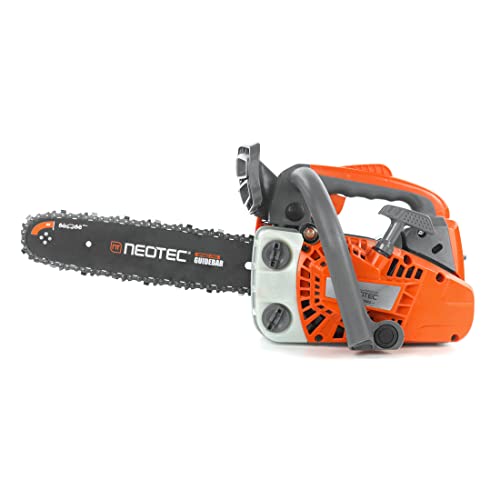
The best top-handle arborist chainsaws for trained tree climbers are the Echo CS-2511T for the lowest weight, the Husqvarna T542i XP for battery power with a gas-like clutch, the Stihl MS 201 TC-M for thicker wood and the Husqvarna T540 XP Mark II for all-day professional cutting. A top-handle saw is a specialist tool built for one-handed use in a tree while the operator is rope-supported; it is not a general yard saw and it is the wrong choice for most homeowners.
This guide explains how top-handle saws differ from rear-handle models, what the weight and power numbers mean in practice, which models are worth shortlisting, and, just as importantly, who should not buy one. Specifications come from manufacturer-sourced listings and published professional buyer guides; where a figure could not be verified, the entry says so.
Our top picks


As an Amazon Associate we earn from qualifying purchases at no extra cost to you.
Safety first: who a top-handle saw is for
A top-handle chainsaw puts the main grip on top of the body, which lets a climber hold the saw in one hand and a branch or rope in the other. That convenience removes some of the control a rear-handle saw gives you. A rear-handle saw is designed to be held with two hands, with the left arm straight and the rear hand controlling the throttle, so the body is braced against kickback. A top-handle saw can kick back toward the operator’s face and upper body with little warning.
- Buy one only if you have formal climbing and chainsaw training, work from a rope or an aerial lift, and wear full protective equipment.
- Do not use one for felling, for ground-level bucking, for cutting above shoulder height from the ground, or as a one-handed saw while standing on a ladder.
- Required gear at minimum: a chainsaw-rated helmet with face screen, hearing protection, chainsaw-rated gloves, cut-resistant chaps or trousers, and sturdy boots. For climbing, add a rated harness, lanyard and a second attachment point.
- Anyone without climbing training should hire a certified arborist for work in the canopy. This is not a skill to learn from a product page.
Quick answer: which saw for which job
- Fine pruning and removals up to roughly 8 inches in a canopy: Echo CS-2511T, Stihl MS 151 TC-E.
- Mixed climbing work with larger limbs: Stihl MS 201 TC-M, Husqvarna T540 XP Mark II.
- Noise-restricted or emissions-restricted sites: Husqvarna T542i XP, Milwaukee M18 FUEL top-handle saw.
- Light pruning only, battery ecosystem already owned: Makita top-handle battery saws.
Top-handle vs rear-handle: the real differences
| Factor | Top-handle saw | Rear-handle saw |
|---|---|---|
| Intended grip | One hand, rope-supported | Two hands, feet on ground or stable platform |
| Typical weight (no bar) | About 2.3 to 4.1 kg (5 to 9 lb) for gas models | Often 4.5 kg (10 lb) and up |
| Kickback exposure | Higher; body is not braced | Lower with correct two-hand stance |
| Best use | Canopy pruning, limbing, removals from a rope | Felling, bucking, firewood, storm cleanup |
| Bar length | Usually 25 to 40 cm (10 to 16 in) | Commonly 35 to 60 cm (14 to 24 in) |
| Cut capacity | Small to medium limbs | Trunks and large limbs |
How we chose
This is a research-based comparison. We reviewed manufacturer specification sheets and published professional-arborist buying guides for current top-handle saws, then selected models that appear repeatedly as working arborist tools, cover both gas and battery power, and span a weight range from about 2.3 kg to 4.1 kg without bar and fuel. We checked weight, engine size and safety-feature claims across at least two sources where possible, and we flagged any figure that sources reported inconsistently, for example weights quoted with or without battery, bar and chain. We did not run cutting trials, so nothing here is a performance measurement.
Comparison table
| Model | Power source | Engine / power | Listed weight | Bar | Safety features listed |
|---|---|---|---|---|---|
| Echo CS-2511T | Gas, 2-stroke | 25 cc, 1.11 kW | 2.3 kg (5.07 lb) dry, no bar or chain | 20 to 25 cm | Inertia chain brake, side chain tensioner |
| Stihl MS 151 TC-E | Gas, 2-stroke | Not confirmed here | About 2.6 kg | Not confirmed here | Chain brake (standard on the class) |
| Stihl MS 201 TC-M | Gas, 2-stroke | 35.2 cc, 1.8 kW | About 4.1 kg | Not confirmed here | Inertia brake, side tensioner, M-Tronic fuel adjustment |
| Husqvarna T540 XP Mark II | Gas, 2-stroke | 39.1 cc, 1.9 kW (T540 XP) | 3.8 kg (T540 XP) | Up to 40 cm | Inertia brake, AutoTune |
| Husqvarna T542i XP | Battery | 1.8 kW shaft equivalent | 2.9 kg without battery | Not confirmed here | Centrifugal clutch, inertia brake |
| Milwaukee M18 FUEL 2826-20T | Battery, 18V | Up to 2.7 hp peak claimed | About 7 lb with battery (listed) | 14 in | Chain brake (check listing) |
| Makita XCU06Z | Battery, 18V | Not confirmed here | About 6.5 lb with battery (listed) | 10 in | Chain brake (check listing) |
Best top-handle chainsaws by buyer need
Lightest gas option: Echo CS-2511T
Spec line: 25 cc gas · 1.11 kW · 2.3 kg dry · 20 to 25 cm bar · inertia chain brake.
The CS-2511T is repeatedly named as the lightest professional gas top-handle saw. The low weight directly reduces fatigue for a climber who holds the saw on a lanyard all day. It suits fine pruning, deadwooding and precise removals at the tips of branches.
Best for: Experienced climbers doing precision work in the outer canopy.
Skip if: You routinely cut limbs thicker than the bar can handle, or you want a battery saw with instant start.
- Pros: Very low weight, inertia chain brake, side chain tensioner for adjustments in the tree.
- Cons: Small engine limits power in hardwood, short bar, two-stroke fuel mixing.
Light, well-known pro option: Stihl MS 151 TC-E
Spec line: Gas · about 2.6 kg · top-handle · chain brake.
The MS 151 TC-E sits in the same lightweight class as the Echo. Published weights place it near 2.6 kg. Because engine displacement and bar length were not consistent across the sources reviewed, check the current manufacturer specification before buying.
Best for: Light canopy work where the Stihl dealer network matters for servicing.
Skip if: You want the maximum power-to-weight ratio or a battery-powered saw.
- Pros: Light, compact, widely serviced.
- Cons: Some listings are dated; confirm current availability and specs.
Best for thicker limbs: Stihl MS 201 TC-M
Spec line: 35.2 cc gas · 1.8 kW · about 4.1 kg · inertia brake · M-Tronic fuel adjustment.
The MS 201 TC-M is the heavier, stronger option for climbers whose work includes bigger wood. M-Tronic automatically adjusts the fuel mixture to altitude, temperature and fuel quality, which reduces carburetor tuning in the field.
Best for: Arborists who mix pruning with sectional removals and want one saw for both.
Skip if: Your work is delicate pruning where every 100 grams matters, or if you need a quiet battery saw.
- Pros: Strong power for the class, automatic fuel adjustment, inertia brake.
- Cons: Heaviest gas saw here, more fatiguing in one hand.
Best professional all-rounder: Husqvarna T540 XP Mark II
Spec line: 39.1 cc gas · 1.9 kW · 3.8 kg · up to 40 cm bar · inertia brake · AutoTune.
The T540 XP line is described across professional guides as a benchmark for top-handle saws. The figures above are for the T540 XP; the Mark II refines the design, so confirm exact weight and bar options in the current listing. AutoTune handles carburetor adjustment, and the saw is built for hard-wood work with high chain speed.
Best for: Full-time arborists who cut hard woods and want maximum power in a top-handle body.
Skip if: You are a part-time pruner. Its power and cost class exceed what light work needs.
- Pros: High chain speed, strong cutting in hardwood, AutoTune.
- Cons: Heavier than light-pruning saws, premium class, two-stroke noise and fumes.
Best battery saw for arborists: Husqvarna T542i XP
Spec line: Battery (BLi300 class) · 1.8 kW shaft equivalent · 2.9 kg without battery · centrifugal clutch · about 102 dB(A).
The T542i XP is built for work in noise- or emissions-restricted places. Its centrifugal clutch mimics the throttle response of a gas saw, which many climbers prefer to the instant torque of a typical battery saw. Published runtime is about 40 minutes per charge under working load, so professionals plan on multiple batteries.
Best for: Urban tree work, residential neighborhoods, early-morning jobs.
Skip if: You work in remote locations without charging or want the lowest tool cost.
- Pros: No exhaust, easy start, gas-like clutch feel, 2.9 kg without battery.
- Cons: Battery weight adds to the hanging load, runtime limits, battery cost.
Best broader battery platform: Milwaukee M18 FUEL top-handle saw (2826-20T)
Spec line: 18V battery · 14 in bar · up to 2.7 hp peak claimed · about 7 lb with battery.
The Milwaukee saw is aimed at trade users who already run the M18 battery system. The brand claims cutting speed beyond a 35 cc gas saw. Treat that as a manufacturer claim and not a measured comparison.
Best for: Tree workers and landscapers already invested in M18 batteries.
Skip if: You need a certified arborist-grade climbing saw with a dedicated top-handle clutch system.
- Pros: Shares batteries with other tools, no fuel mixing, instant start.
- Cons: About 7 lb with battery is heavy for one-handed overhead use, longer bar adds leverage on the saw.
Best lightweight pruning battery saw: Makita XCU06Z
Spec line: 18V battery · 10 in bar · about 6.5 lb with battery.
The 10-inch Makita is a light-duty top-handle option. Its small bar suits limbing and thinning, not heavy removals. Because some retailers list weight with the battery and others without, verify the configuration before comparing it to gas saws.
Best for: Light limbing and pruning for users already on 18V Makita batteries.
Skip if: You cut larger limbs or need professional climbing certification support.
- Pros: Compact, quiet, simple.
- Cons: Short bar, limited capacity, specifications vary by kit.
Worked example: power-to-weight and one-hand fatigue
Raw weight is not the whole story, because a stronger saw can finish a cut faster and reduce total time holding it up. A simple power-to-weight ratio, using the published figures above, gives a first-pass comparison.
- Echo CS-2511T: 1.11 kW / 2.3 kg = about 0.48 kW per kg.
- Stihl MS 201 TC-M: 1.8 kW / 4.1 kg = about 0.44 kW per kg.
- Husqvarna T540 XP: 1.9 kW / 3.8 kg = about 0.50 kW per kg.
- Husqvarna T542i XP: 1.8 kW / 2.9 kg (battery excluded) = about 0.62 kW per kg, but add the battery to the hanging weight for a fair comparison.
Read the pattern: the three gas saws cluster around 0.44 to 0.50 kW per kg, so choose among them by absolute weight and wood size. The battery saw looks best on paper, but the battery adds weight that the climber still carries. Also remember that power ratings from different brands are measured by different methods, so treat this as a rough guide and not a proof.
One-hand fatigue is driven by weight multiplied by how far the saw is from your body. A 4 kg saw held at arm’s length is far more tiring than the same saw held close; a good climber works with the saw near the body, supported by the lanyard, and avoids overhead cuts. The time between rests is usually far shorter than for two-hand work, which is another reason light saws matter.
Decision matrix
| Your situation | Best match | Why |
|---|---|---|
| Fine pruning, deadwooding, long days | Echo CS-2511T | Lowest listed weight |
| Mixed pruning and removals | Stihl MS 201 TC-M | More power, automatic fuel adjustment |
| Hard wood, full-time professional | Husqvarna T540 XP Mark II | Highest chain speed and power here |
| Quiet or low-emission jobs | Husqvarna T542i XP | Battery, gas-like clutch |
| Already own M18 batteries | Milwaukee M18 FUEL 2826-20T | Shared battery platform |
| Already own 18V Makita, light limbing | Makita XCU06Z | Small, quiet, simple |
| No climbing training | None of these | Hire a certified arborist |
Features that matter on a top-handle saw
Chain brake and kickback protection
An inertia-activated chain brake stops the chain when the saw rotates upward in a kickback. On a top-handle saw it is a basic requirement; confirm it is present and that the hand guard is not removed or modified. Low-kickback chains are also commonly specified on these saws.
Side chain tensioner
Climbers cannot easily put a saw down to adjust a chain. A side tensioner lets you tension the chain with the saw hanging on a lanyard, using a tool that can be tethered.
Vibration and handle design
Published vibration values for professional top-handle saws sit around 3.5 to 5 m/s2. Lower numbers are easier on the hand over a full day. Prolonged exposure to vibration is a recognized occupational concern, so look for anti-vibration systems and follow the maker’s guidance on work and rest periods.
Lanyard attachment point
Look for a built-in attachment point that lets you tether the saw to your harness. A dropped saw in a tree is a hazard to anyone below.
Bar length
Short bars of 25 to 40 cm are the norm. The general rule is that the bar should be at least as long as the thickest wood you cut, but long bars add leverage and weight that make one-hand control harder. Select the shortest bar that does the job.
Who should not buy a top-handle chainsaw
- Homeowners cutting firewood or storm debris: a rear-handle saw is safer and better suited.
- Anyone without climbing and saw training: the risk of serious injury is high.
- People who plan to cut from a ladder: never operate a top-handle saw one-handed from a ladder.
- Users who need to fell trees: felling needs a saw designed for it and specific training.
- Those who want a single do-everything saw: a medium rear-handle saw covers more tasks.
Frequently asked questions
What is a top-handle chainsaw used for?
It is used by trained climbers for pruning, limbing and sectional removals in trees, where one hand holds the saw and the other manages a rope or branch.
The compact, lightweight body lets a rope-supported climber work with the saw close to the body. It is not meant for ground-level cutting.
Is a top-handle chainsaw safe for homeowners?
Generally no. It is designed for trained professionals who work with full protective equipment and rope support.
The one-handed design increases kickback exposure. Homeowners should use a rear-handle saw with two-handed control, or hire a certified arborist for canopy work.
Gas or battery top-handle: which is better?
Gas gives longer runtime and more power per kilogram; battery gives quieter, cleaner, easier-starting operation and suits urban jobs.
Gas models like the Echo CS-2511T and Stihl MS 201 TC-M suit long days in the field. Battery models like the Husqvarna T542i XP suit noise-restricted work, with spare batteries required for long sessions.
How heavy is a top-handle chainsaw?
Published figures for professional gas models range from about 2.3 kg to 4.1 kg without bar and fuel; battery models vary widely depending on whether the battery is counted.
Always compare weights in the same configuration. A saw that is 2.9 kg without battery may be well over that with one attached.
What bar length is right for a top-handle saw?
Most professional models use bars between 25 and 40 cm (10 to 16 inches), with the shortest bar that handles your wood being the best choice.
A longer bar increases leverage on the saw and makes one-handed control harder. Never exceed the bar length recommended by the manufacturer.
What protective gear do I need?
At minimum: a chainsaw-rated helmet with face screen and hearing protection, cut-resistant gloves and chaps, and sturdy boots; add a climbing harness and lanyard for tree work.
Replace gear that has been cut or damaged. Protective clothing only works if it is the right class for the saw and in good condition.
Can I use a top-handle saw for felling?
No. Felling needs a two-handed saw and specific training; top-handle saws are built for canopy work.
If a tree must be felled, hire a professional or use a properly sized rear-handle saw with formal training.
Why do arborists carry spare chains and batteries?
A dull chain forces you to push harder and raises kickback risk, and a depleted battery halts work high in a tree where recovery is difficult.
Climbers typically carry a spare sharpened chain, a small file or sharpening tool and, for battery saws, extra charged batteries sized to the job.
Bottom line
Top-handle saws exist for one task: trained climbers cutting in trees with a rope holding their weight. Within that group, the Echo CS-2511T is the lightest gas option, the Stihl MS 201 TC-M and Husqvarna T540 XP Mark II handle thicker wood, and the Husqvarna T542i XP is the strongest battery choice for restricted sites. If you are not a trained climber, skip all of them and hire a certified arborist for any work above your reach.