
Key takeaways
- Cowhide construction resists punctures from standard thorns and light cactus spines
- Touchscreen-compatible index and thumb tips let you use a phone without removing the glove
- Available in medium only, so buyers with larger or smaller hands may find the fit limiting
What's inside
Roses, blackberries, bougainvillea, and cacti do not negotiate. A single thorn can punch through cotton or thin synthetic fabric in one push, leaving a splinter that embeds deep enough to require tweezers or a small incision to remove. The best garden gloves for thorns solve a specific mechanical problem: they need a barrier dense and thick enough to stop a sharp point while still letting you grip pruners, feel soil texture, and tie twine without peeling the glove off every five minutes.
What separates a worthwhile pair from a disappointment usually comes down to three things. First, the material at the palm and fingertip must be genuine leather, treated goatskin, or a layered synthetic rated for puncture—not just “thick” fabric that bunches at the joint. Second, wrist and forearm coverage determines whether long-reach pruning leaves your sleeves exposed. Third, the fit must allow enough finger articulation that you can operate bypass pruners without fumbling. This roundup for 2026 compares published specs, prices, and owner-reported experiences across eight models that buyers repeatedly shortlist for thorn-heavy work.
As an Amazon Associate we earn from qualifying purchases at no extra cost to you. Product prices and availability are accurate as of the date shown and are subject to change.




Quick Picks
| Product | Best for | Price |
|---|---|---|
| OIZEN Cowhide Leather | Touchscreen convenience with thorn protection | $13.99 |
| SLARMOR Long Sleeve | Extended forearm coverage during heavy pruning | $16.99 |
| HANDLANDY Rose Pruning | Thorn-proof work on dense rose canes | $17.86 |
| DLY Gardening Gloves | Women who want a gift-ready design | $14.68 |
| WZQH Leather Work | Budget multi-use across gardening and welding | $9.99 |
| COOLJOB Long Sleeve Large | Large hands needing full sleeve protection | $17.99 |
| COOLJOB Navy | Compact storage with solid thorn defense | $13.99 |
| SAWIDIER Adjustable Cuff | Custom fit across different wrist sizes | $9.99 |
How We Picked
We narrowed the field to eight models based on four criteria relevant to thorn work: puncture-rated material at the palm and fingertips (cowhide, split leather, or reinforced synthetic), forearm or cuff coverage that addresses reach into dense growth, dexterity reported by owners performing fine tasks like deadheading and tying, and price-to-longevity ratio where owners tracked months of weekly use. Gloves that looked protective in photos but generated recurring complaints about thorns slipping through seams were excluded.
The 8 Best Garden Gloves For Thorns in 2026
OIZEN Cowhide Leather
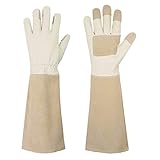
This medium-size pair targets gardeners who want to check a phone without removing gloves—useful when coordinating a landscape design or timing a watering session on the go. The cowhide palm is thick enough to stop most rose thorns and bramble points during routine weeding and planting. Owners praise the touchscreen fingertips as genuinely responsive rather than a marketing afterthought.
- Cowhide construction resists punctures from standard thorns and light cactus spines
- Touchscreen-compatible index and thumb tips let you use a phone without removing the glove
- Available in medium only, so buyers with larger or smaller hands may find the fit limiting
Skip these if you need forearm coverage for aggressive rose pruning or if you fall outside medium sizing.
SLARMOR Long Sleeve
SLARMOR is built for people who reach deep into untrimmed rose bushes or blackberry patches where thorns extend far past the wrist. The long sleeve wraps the forearm, which matters when canes spring upward and rake against your arm mid-snip. Owners note the leather is supple enough to bend at the elbow without stiffness fighting back.
- Extended sleeve design covers the forearm, reducing puncture points on exposed skin
- Leather remains flexible after break-in, so pruners close naturally
- Long sleeves can feel warm during humid summer sessions with no ventilation panel
Skip if you mostly do surface-level work like pulling annual weeds, where the extra sleeve length adds bulk without benefit.
HANDLANDY Rose Pruning
HANDLANDY occupies the premium end of this group and earns its price through consistent owner feedback on dense-thorn scenarios—old garden roses with clustered canes, climbing hydrangeas with woody spurs. The construction uses reinforced stitching at stress points where other gloves split first.
- Reinforced seam construction at knuckles and finger joints resists splitting under repeated thorn pressure
- Owners report multi-season durability without significant stiffening of the leather
- Highest price in this roundup at $17.86, which is hard to justify for occasional use
Skip if you garden only a few weekends per year and do not mind replacing cheaper gloves seasonally.
DLY Gardening Gloves
DLY markets primarily to women and positions itself as a gift item, but the underlying protection holds up in owner reports for moderate thorn work—deadheading roses, handling cactus cuttings with gloves on, transplanting spiny succulents. The blue colorway reads more like a lifestyle product than a workshop tool, which is part of its appeal.
- Attractive presentation and color make it a viable gift without re-wrapping
- Adequate thorn resistance for light-to-moderate pruning tasks per owner feedback
- Limited size range; only medium is listed, leaving larger or smaller hands without an option
Skip if you need heavy-duty protection for aggressive bramble clearing or if medium does not fit your hand.
WZQH Leather Work
At $9.99, WZQH is the cheapest entry here and doubles as a welding and general work glove, which tells you the leather is genuinely puncture-resistant rather than cosmetically thick. The grey leather finish is utilitarian, and owners appreciate that one pair handles gardening, firewood splitting, and occasional welding sparks without switching.
- Multi-purpose rating (welding plus gardening) signals a puncture barrier that exceeds most garden-only gloves at this price
- Large size accommodates bigger hands without stretching the leather thin
- Less tailored dexterity than purpose-built garden gloves, making fine tasks like wire tying slightly awkward
Skip if your primary work involves precision deadheading or grafting where fingertip sensitivity matters most.
COOLJOB Long Sleeve Large
COOLJOB’s large-size variant with extended sleeve is designed for men with broader hands who also need forearm shielding. Owners with larger frames report that medium long-sleeve gloves cut off circulation at the wrist or leave the palm too tight, and this size solves that directly. The sleeve length is generous without feeling restrictive.
- True large sizing eliminates the tight-palm problem that smaller long-sleeve gloves create for bigger hands
- Long sleeve provides forearm coverage suitable for climbing rose and bougainvillea work
- Priced at the top of this group, and the large-only sizing limits gifting flexibility
Skip if you have small-to-medium hands; the generous sizing will pool at the fingertips and reduce control.
COOLJOB Navy
The navy version from COOLJOB trades sleeve length for a more compact, storable profile. It still delivers thorn protection through the palm and fingers, but the wrist opening sits lower, making it better suited for pruning where your hand stays inside the plant rather than plunging deep into a tangle. Owners like how it fits in a tool belt without the sleeve bunching.
- Compact design stores easily and does not catch on branches during quick hand repositioning
- Palm and finger leather matches the protection level of the more expensive long-sleeve variant
- No forearm coverage means exposed wrists during deep-reach pruning into thorny growth
Skip if you regularly work inside dense thicket and need the extra sleeve barrier to protect against upward-scraping thorns.
SAWIDIER Adjustable Cuff
SAWIDIER solves a fit problem that most gardening gloves ignore: wrist circumference varies more than hand length, and a glove that fits your palm may gape or pinch at the wrist. The adjustable cuff closes that gap with a strap or hook-and-loop system, letting you dial in security without buying multiple sizes. At $9.99, the value proposition is straightforward.
- Adjustable cuff accommodates a range of wrist sizes, reducing the need for precise size guessing
- Breathable leather construction keeps hands cooler during extended summer pruning sessions
- Some owners report the adjustment mechanism loosens after several weeks of repeated opening and closing
Skip if you prefer a fixed wrist seal and do not want to fiddle with a strap mid-task.
Buying Guide
Material at the Contact Points
Thorns concentrate force onto a tip measured in fractions of a millimeter. Cotton, polyester, and thin nitrile coatings deflect a glance but surrender to a direct push. Look for full-grain cowhide, split leather, or reinforced goatskin at the palm, thumb webbing, and index-finger pad. These are the three points where thorns most commonly enter. A glove labeled “leather” that uses leather only on the back while leaving the palm as synthetic mesh will fail at the first blackberry cane.
Sleeve Length and Wrist Sealing
Decide whether your thorn work involves reaching inside plants (long sleeve) or trimming from the outside (standard cuff). Long sleeves protect against upward-scraping thorns when you pull a cane toward you, but they trap heat and can bunch when you flex your wrist. Adjustable cuffs bridge the gap for mixed-size households or people between sizes. If you buy a single pair, match sleeve length to your most common pruning posture, not your worst-case scenario.
Dexterity Versus Thickness
Every millimeter of leather added between your fingertip and a thorn also sits between your fingertip and a pruner spring. Owners consistently report that gloves with padded or doubled palms feel protective but make small wire twists and grafting knife cuts imprecise. If your work includes tying, staking, or light grafting, prioritize a thinner palm with puncture-rated density over bulk. For heavy bramble clearing where grip strength matters more than fine motor control, the thicker option wins.
Our Verdict
For the best balance of thorn protection, dexterity, and price, the OIZEN Cowhide Leather stands out as the top pick for most gardeners who encounter thorns regularly but do not plunge forearms into dense tangles daily. The WZQH Leather Work at $9.99 is the clear budget pick, delivering genuine puncture resistance at the lowest price in this group. If your primary need is forearm coverage during aggressive climbing-rose pruning and you have larger hands, the COOLJOB Long Sleeve Large is the single condition where it beats everything else here.
FAQ
Can any gardening glove stop a cactus spine?
Cactus spines are finer and stiffer than rose thorns, so they test a glove’s material density rather than just its thickness. Full-grain cowhide with reinforced fingertips handles most common glochids, but ultra-fine spines from Opuntia pads can still find gaps at stitching. Heavy-duty leather gloves rated for welding offer the most reliable defense.
How long do thorn-proof garden gloves typically last?
Owners of leather-based models consistently report two to four growing seasons of weekly use before the palm shows visible thinning. Split-leather and synthetic options degrade faster, sometimes within a single season under heavy thorn exposure. Storage in a dry, cool location extends lifespan noticeably.
Do touchscreen fingertips reduce thorn protection?
Touchscreen-capable tips usually replace leather at the index and thumb with a conductive synthetic layer. This thins the barrier at exactly the points where you press forward, so the trade-off is real. If your gardening involves significant pushing into thorny growth, prioritize full leather over touchscreen convenience.
Should I buy a size up for thick leather gloves?
No. Thick leather does not compress the way knit fabric does, so a size that feels tight at the knuckles when new will likely stay tight. Buy your measured size. The break-in period softens the leather across the joint, and the initial snugness protects against thorn entry at the finger seams.


