
Key takeaways
- Pro: Lowest price in the roundup at $43.70, making it a low-risk purchase if mobility needs change season to season.
- Pro: The 3-in-1 design typically combines a seat, storage area, and mobility function in one compact frame.
- Con: Very limited hauling capacity; not suitable for transporting bags of soil or large tool sets.
What's inside
Finding the best garden cart for seniors means solving a very specific physical problem: transporting soil, tools, and harvested produce across a yard without requiring the bending, lifting, and balancing that become increasingly painful or dangerous with age. A standard wheelbarrow demands you squat to load it, twist to dump it, and fight it over roots and ruts. A cart that fails to address any one of those demands will end up abandoned in a shed within a season.
What separates genuinely useful models from mediocre ones in this category comes down to stability on uneven ground, whether the design reduces strain at the knees and lower back during loading, and how much weight the unit actually handles relative to its own bulk. The eight options in this roundup span rolling seats for extended weeding sessions, heavy-duty dump carts for hauling mulch, and compact folding wagons for smaller yards. Prices range from under forty-five dollars to just over a hundred and thirty, so there is no single answer for every gardener.
As an Amazon Associate we earn from qualifying purchases at no extra cost to you. Product prices and availability are accurate as of the date shown and are subject to change.



Quick Picks
| Product | Best for | Price |
|---|---|---|
| 3-in-1 Rolling Seat Cart | Budget-conscious seated gardening | $43.70 |
| Suntee Garden Seat | Feature-rich rolling stool | $75.99 |
| VEVOR 4 Cu.Ft Dump Cart | Mid-range hauling capacity | $76.90 |
| VEVOR 7 Cu.Ft Heavy Duty | Large-volume bulk transport | $133.31 |
| HIKEMOON Folding Wagon | Storage-constrained yards | $56.99 |
| Gorilla Carts Poly Dump | Lightweight two-wheel maneuvering | $99.00 |
| CAMMOO 900lb Dump Cart | Maximum load tolerance | $109.99 |
| Garden Cart with Seat (3-in-1) | Seated work at a low price | $51.12 |
How We Picked
We evaluated every product in this roundup against four criteria drawn from published specifications and recurring themes in owner feedback. The first is load-to-effort ratio: how much weight the cart moves relative to the physical input required by a person with limited shoulder or wrist strength. The second is terrain handling, specifically wheel diameter, tire type, and track width, because gravel and soft soil defeat most narrow-wheeled carts. The third is loading ergonomics, including bed height and whether dumping requires tilting the entire unit. The fourth is storage footprint, which matters for seniors living in smaller homes or shared-access sheds.
The 8 Best Garden Cart For Seniors in 2026
3-in-1 Rolling Seat Cart
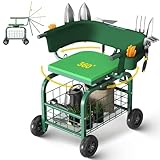
This is the entry point for seniors who primarily need a seated position while weeding, pruning, or planting at ground level. The rolling seat eliminates the worst strain of kneeling entirely, and the integrated wheels let you scoot between rows without standing.
- Pro: Lowest price in the roundup at $43.70, making it a low-risk purchase if mobility needs change season to season.
- Pro: The 3-in-1 design typically combines a seat, storage area, and mobility function in one compact frame.
- Con: Very limited hauling capacity; not suitable for transporting bags of soil or large tool sets.
Skip this if your main task is moving bulk materials rather than working seated at ground level.
Suntee Garden Seat
The Suntee occupies a middle ground between a pure rolling stool and a light utility cart. The 360-degree swivel seat and backrest mean you can turn to reach tools or change direction without lifting yourself off the unit, a genuine advantage for anyone with hip or lower-back stiffness.
- Pro: Tool storage basket and back pouch keep frequently used implements within reach, reducing trips back to a bench.
- Pro: Adjustable handle accommodates different heights and arm-reach preferences.
- Con: At $75.99 it costs nearly twice the budget rolling seat while offering similar limited bulk capacity.
Skip this if you need more than light tool transport and prefer a dedicated heavy-duty cart instead.
VEVOR 4 Cu.Ft Dump Cart
This poly-dump cart moves serious volume for seniors who maintain established beds or handle regular compost and mulch deliveries. The 600-pound rated capacity and four-wheel design provide the stability that narrower two-wheeled units lack on uneven terrain.
- Pro: Four wheels keep the bed level during loading, reducing the risk of tipping that plagues single-axle carts.
- Pro: Poly bed resists rust and is easy to rinse clean after hauling soil or fertilizer.
- Con: The dump mechanism may still require a firm grip and lower-body strength to tilt the loaded bed.
Skip this if your yard is small enough that a lighter two-wheel model would be easier to store and maneuver between tight rows.
VEVOR 7 Cu.Ft Heavy Duty
At $133.31 this is the most expensive option here, but the eight-hundred-pound capacity and seven cubic feet of volume justify the price for seniors managing large properties. The ten-inch flat-free tires roll over grass, gravel, and soft soil without puncture risk, and the quick-release system allows the raised sides to come off for loading bulky items.
- Pro: Highest volume-to-price ratio among dump carts in this group.
- Pro: Flat-free tires eliminate the maintenance headache of inner tubes going soft or punctured.
- Con: The physical size and weight of the unit itself may be difficult to lift into a vehicle trunk for off-site use.
Skip this if you have limited storage space or only need to move a few bags at a time.
HIKEMOON Folding Wagon
The HIKEMOON serves seniors who need a cart occasionally rather than constantly, particularly those in smaller yards or shared-garden situations where storage space is premium. The thirty-four-inch extra-long bed fits within its 120-liter volume, and at 360 pounds of rated capacity it handles moderate hauling tasks.
- Pro: Folds down to a compact footprint that fits in a closet or car trunk without disassembly.
- Pro: At $56.99 it offers the second-lowest price among all hauling-capable options.
- Con: Fabric body and folding frame flex under uneven loads, making it less stable than rigid poly-dump alternatives.
Skip this if you regularly haul wet soil, stone, or anything that stresses soft-sided containers.
Gorilla Carts Poly Dump
Gorilla Carts built its reputation on lightweight poly beds with steel frames, and this two-wheel model at $99 follows that formula. Four cubic feet of capacity and a 300-pound rating suit it to gardeners who need moderate hauling without the bulk of a four-wheel unit. The two-wheel design lets you tip and steer with upper-body leverage rather than brute arm strength.
- Pro: Significantly lighter self-weight than four-wheel competitors, easier to lift over curbs or into trucks.
- Pro: Strong brand reputation for replacement parts availability over the product’s lifespan.
- Con: The two-wheel design requires the operator to maintain balance while stationary, which can challenge seniors with weak grip or poor proprioception.
Skip this if balance and upper-body strength are limiting factors; a four-wheel model is safer.
CAMMOO 900lb Dump Cart
The CAMMOO pushes the load ceiling to nine hundred pounds, the highest in this roundup, while keeping the price at $109.99. Ten-inch no-flat tires provide the terrain clearance and puncture resistance that seniors with limited knee flexion need when working across rough ground.
- Pro: Best raw capacity-to-price ratio for those who move gravel, sod, or compost in volume.
- Pro: No-flat tires at ten inches diameter handle uneven lawn and driveway edges without assistance.
- Con: At full load, the cart may exceed the pulling or pushing strength of some seniors, negating the capacity advantage.
Skip this if your typical loads stay under a few hundred pounds; you will carry unnecessary weight and cost.
Garden Cart with Seat (3-in-1)
This unit closely mirrors the first product in function and design, offering a rolling seat with integrated wheels and light storage for $51.12. The slightly higher price over the entry-level model suggests marginally better materials or a more robust wheel assembly, though both serve the same seated-gardening niche.
- Pro: Under fifty dollars and still provides the core benefit of eliminating kneeling during ground-level work.
- Pro: Compact footprint means it does not dominate a shed or garage corner.
- Con: Like its budget sibling, it cannot handle bulk material hauling and is strictly a seated-work aid.
Skip this if you already own a rolling stool or plan to pair a dedicated cart with a separate kneeler system.
Buying Guide
Wheel Count and Diameter
Four-wheel carts provide inherent stability and allow you to stop mid-haul without balancing a tipping load, which is critical if grip strength is limited. Two-wheel carts are lighter and easier to tip for dumping but demand continuous muscular engagement to keep upright. On the diameter front, anything under eight inches will catch on grass roots, garden edging, or uneven paver joints. Ten-inch tires, as found on the VEVOR heavy-duty and CAMMOO models, clear obstacles that smaller wheels cannot, and flat-free variants remove the maintenance burden of checking and repairing inner tubes.
Loading Height and Dump Mechanism
A cart whose bed sits at shin height requires a squat to load, which is precisely the motion many seniors are trying to avoid. Look for units with bed heights at knee level or higher, or those with removable side panels that let you roll a bag directly into the tray rather than lifting it over a rim. For dumping, a quick-release or hinge mechanism that tilts the bed forward with minimal grip strength beats designs that require you to lift and rotate the entire loaded cart.
Frame Material and Self-Weight
Poly beds on steel frames dominate this category because poly will not rust and steel provides the load-bearing structure without excessive weight. Aluminum frames are lighter but may flex under high loads. Consider the cart’s own weight alongside its rated capacity: a unit weighing thirty or more pounds empty demands significant effort to reposition when unloaded, and over time that repeated lifting can strain shoulders. Folding wagons trade structural rigidity for storage convenience, so match the trade-off to your actual usage frequency.
Our Verdict
For the broadest range of senior gardening tasks, the VEVOR 4 Cu.Ft Dump Cart at $76.90 delivers the best balance of four-wheel stability, rust-resistant construction, and sufficient capacity for routine soil and mulch work without the bulk of larger models. The budget pick is the 3-in-1 Rolling Seat Cart at $43.70 for anyone whose primary need is comfortable seated ground work rather than hauling. However, if your property requires regular movement of heavy bulk materials, the CAMMOO at $109.99 wins decisively because its 900-pound rating and 10-inch no-flat tires handle conditions that would overwhelm every other cart on this list.
FAQ
Is a rolling seat cart enough for all gardening tasks?
A rolling seat solves kneeling and squatting pain during weeding, planting, and pruning at ground level, but it cannot transport bags of soil, compost, or heavy tools across a yard. Most seniors benefit from pairing a rolling seat with a separate four-wheel dump cart to cover both work styles.
What load capacity do I actually need for a typical home garden?
For a standard suburban garden, loads rarely exceed one or two fifty-pound bags of topsoil or a moderate amount of harvested produce and pruned branches. A 300 to 600-pound rating is more than sufficient, and selecting anything higher only adds unnecessary self-weight and cost.
Are flat-free tires worth the trade-off?
Flat-free tires eliminate puncture risk and tube maintenance, which is a genuine advantage for anyone with limited bending tolerance. The trade-off is slightly firmer ride quality on rough ground and typically higher cost. For most senior gardeners working on lawns and gravel paths, the convenience outweighs the minor comfort difference.
Can a two-wheel cart be safe for someone with balance issues?
Two-wheel carts require the operator to bear and steer part of the load through the handles while keeping the unit upright, which is risky if grip strength, wrist stability, or proprioception are compromised. A four-wheel design is the safer default for anyone who has experienced balance problems or dizziness.


