
Key takeaways
- Pros: Remains flexible in cold weather; fittings seal reliably without constant washer swaps
- Cons: Can feel light on high-pressure spray nozzles, making it harder to keep steady
A 5/8-inch garden hose is the standard diameter for residential watering, and the range of options can be paralyzing. Buyers need something that resists kinking under pressure, connects without leaking at the fittings, and survives a season of sun exposure without turning brittle. The problem is that most budget hoses fail at one or more of these points: they kink around corners, their brass or aluminum fittings corrode within months, or the polymer coating splits when you drag it over gravel. Owner reviews consistently flag these failure modes, which makes pattern recognition across thousands of reports far more useful than any single lab result.
What separates a genuinely good 5/8-inch hose from a mediocre one comes down to material construction, wall thickness, and fitting quality. Lightweight polymer hoses like Flexzilla’s line resist kinking through flexibility and handle cold weather without stiffening, while rubber-based options deliver higher burst ratings suited to heavy-duty tasks. Length matters too: a 50-foot hose on a large property creates more drag and pressure drop than you expect, but a 25-foot unit on a small yard is easier to store. This roundup compares published specifications and aggregated owner feedback to help you match the right hose to your actual use case.
As an Amazon Associate we earn from qualifying purchases at no extra cost to you. Product prices and availability are accurate as of the date shown and are subject to change.
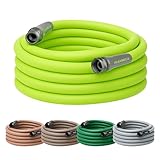


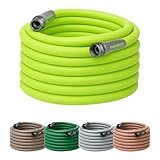


Quick Picks
| Product | Best for | Price |
|---|---|---|
| Flexzilla 50 ft. | Overall balance of weight, flexibility, and durability | $39.97 |
| Flexzilla 100 ft. | Large properties needing reach without excessive weight | $69 |
| FXFOUCS 50 ft. | Kink resistance on a moderate budget | $29.77 |
| Guitrees 100 ft. | High-pressure tasks and demanding job sites | $89.99 |
| Flexzilla 25 ft. | Small yards, patios, and compact storage | $28.55 |
| Flexzilla 75 ft. | Medium-to-large gardens needing extra reach | $54.98 |
| SPECILITE 50 ft. | Heavy-duty flexibility at a fair price | $35.98 |
| Garden Hose 25 ft. Non-Expandable | Lowest-cost reliable non-expanding option | $19.79 |
How We Picked
We evaluated each hose on four criteria drawn from published manufacturer specs and recurring themes in owner reviews: material and kink resistance (polymer versus rubber versus hybrid), working and burst pressure ratings, fitting construction and leak-free performance, and real-world weight for ease of handling. Price-to-performance ratio served as a tiebreaker, particularly among the Flexzilla variants where only length differed.
The 8 Best 5/8 Garden Hose in 2026
Flexzilla Garden Hose 5/8 in. x 50 ft.
This is the hose most buyers should start with when searching for the best 5/8 garden hose in 2026. The lightweight polymer construction stays pliable in freezing temperatures and resists kinking around trees and raised beds. Owner feedback highlights the leak-free connections as a genuine upgrade over hoses requiring replacement washers after the first summer. At 50 feet, it covers a typical suburban lot without the bulk of longer variants.
- Pros: Remains flexible in cold weather; fittings seal reliably without constant washer swaps
- Cons: Can feel light on high-pressure spray nozzles, making it harder to keep steady
Skip this if your watering routes involve sharp turns around tight obstacles repeatedly, as even flexible polymer will eventually develop a memory crease.
Flexzilla Garden Hose 5/8 in. x 100 ft.
Same construction as the 50-foot model but doubled in length, this suits large properties where dragging a shorter hose back and forth wastes time. Owners report manageable weight despite the full 100 feet, though pressure drop becomes noticeable at the far end when using high-volume nozzles. The all-weather flexibility holds up well here, and the leak-free fittings mean fewer connection points to monitor.
- Pros: Extended reach without proportional weight increase; consistent Flexzilla build quality throughout
- Cons: Pressure drop over 100 feet reduces effectiveness for heavy-duty spray tasks
Skip this if your property fits within 50 feet of a spigot; the extra length is unnecessary weight on a reel.
FXFOUCS Garden Hose 50ft x 5/8″
Positioned as a heavy-duty kink-resistant option at a moderate price, the FXFOUCS appeals to buyers who want toughness without the premium brand markup. Owner reviews confirm solid kink resistance during typical watering patterns, and the construction feels more rigid than the Flexzilla line, which some users prefer for stability. The $29.77 price makes it a reasonable middle-ground choice.
- Pros: Strong kink resistance for the price; heavier build gives it a stable feel while dragging
- Cons: Less brand track record means fewer long-term durability reports compared to Flexzilla
Skip this if you need a hose that stays supple in winter storage or cold-weather use; the rigidity that resists kinking also means it stiffens in low temperatures.
Guitrees 100FT 5/8 Heavy Duty Rubber Garden Hose
This is the most capable hose in the roundup for demanding applications. With a 300psi working pressure and 1000psi burst rating, the five-layered braided rubber construction handles agricultural sprinklers, pressure-washing pre-rinses, and construction cleanup without concern. It manages both hot and cold water, making it versatile across seasons. The 100-foot length and rubber material make it substantially heavier than polymer alternatives.
- Pros: Exceptional pressure ratings for heavy-duty tasks; hot and cold water rated for year-round use
- Cons: Weight is a genuine burden for frequent repositioning and storage
Skip this if you are watering a small garden and value easy coil-and-store; the overkill performance adds only fatigue.
Flexzilla Garden Hose 5/8 in. x 25 ft.
For patios, balconies, small front yards, or as a supplementary hose for a second spigot, the 25-foot Flexzilla offers the same all-weather flexibility in a form factor that stores almost anywhere. Owners appreciate that it does not compromise on build quality for the shorter length, and at $28.55 it costs nearly the same per foot as the 50-foot model while solving a real convenience problem.
- Pros: Identical Flexzilla durability in a space-saving package; easy to drain and coil
- Cons: Limited reach means frequent repositioning on anything larger than a patio
Skip this if you have a garden bed more than 20 feet from your water source; the shortfall in range becomes a daily frustration.
Flexzilla Garden Hose 5/8 in. x 75 ft.
The 75-foot variant fills the gap between the 50-foot standard and the 100-foot reach model. For properties where 50 feet falls just short but 100 is excessive, this is the practical compromise. Owners report the same cold-weather flexibility and leak-free connections, and the weight remains manageable for typical drag-and-coil routines.
- Pros: Ideal length for medium-to-large gardens without unnecessary extra feet; consistent quality across the line
- Cons: Slightly harder to find in stock than the 50 and 100-foot sizes
Skip this if you can already measure your maximum drag distance and it falls under 50 feet; the shorter hose is lighter and cheaper.
SPECILITE Garden Water Hose 50 ft x 5/8″
The SPECILITE occupies a similar price point to the FXFOUCS, offering heavy-duty claims with flexible handling. Owner feedback describes a hose that resists kinking while still being light enough to maneuver around flower beds without pulling stakes or disturbing plantings. At $35.98, it undercuts the Flexzilla 50-foot by a few dollars while matching its general positioning.
- Pros: Good balance of heaviness for durability and lightness for handling; competitive pricing
- Cons: Fewer published pressure specifications compared to branded alternatives make verification harder
Skip this if your use case demands documented pressure ratings, such as connection to a booster pump or agricultural equipment.
Garden Hose 25ft x 5/8″ Non-Expandable
At $19.79, this is the entry price in the roundup and proves that “non-expandable” does not automatically mean cheaply made. Owners confirm it functions as a straightforward, reliable hose for basic watering on small properties. The premium flexible construction avoids the ballooning failure mode common to expandable hoses, and 25 feet is enough for a patio or a couple of container plants.
- Pros: Lowest price with no expandable-hose fragility; adequate for simple, short-distance watering
- Cons: Limited length and basic construction mean no performance margin for anything beyond light duty
Skip this if you need reach, pressure resistance, or cold-weather flexibility; it is a single-purpose short hose and nothing more.
Buying Guide
Material and Kink Resistance
Polymer hoses like the Flexzilla line achieve kink resistance through inherent flexibility, meaning the material bends without collapsing. Rubber hoses resist kinking through wall thickness and braiding, which keeps the bore open under pressure but adds weight. For most garden use, a flexible polymer that stays pliable below freezing offers the best daily experience. If you connect to equipment that generates back-pressure or surges, the rubber construction’s higher burst rating becomes the decisive factor.
Fittings and Leak Prevention
The connection points between hose and spigot, and between hose and nozzle, are where most failures begin. Look for hoses marketed with leak-free connections, which typically means machined brass or reinforced polymer fittings that compress washers evenly. Aluminum fittings corrode and warp over time, leading to slow drips that waste water and create slippery surfaces. A hose’s fitting quality determines whether it remains serviceable after one season or needs constant attention.
Length Versus Pressure Drop
Every additional 25 feet of hose introduces friction loss that reduces available pressure at the nozzle. A 100-foot hose delivers meaningfully less force than a 50-foot one from the same spigot, particularly with high-volume spray attachments. Measure your maximum distance from water source to the farthest bed before choosing. If 50 feet reaches everything, adding 50 more feet only increases drag and weight without benefit.
Our Verdict
Top pick: The Flexzilla 50-foot offers the best combination of flexibility, cold-weather performance, leak-free fittings, and manageable weight for the majority of garden buyers. Budget pick: The 25-foot non-expandable at $19.79 is the smartest money-saving choice for small-space watering where length is not a constraint. Heavy-duty condition: If you need pressure ratings above 150psi working or hot water capability, the Guitrees rubber hose at $89.99 is the clear winner regardless of price sensitivity.
FAQ
What does 5/8 mean on a garden hose?
It refers to the inner diameter of the hose, measured in inches. A 5/8-inch bore is the residential standard and provides adequate flow for most watering tasks. Larger 3/4-inch hoses are used for commercial or high-volume applications where flow rate matters more than convenience.
How long should my garden hose be?
Measure from your spigot to the farthest point you need to reach, then add roughly 10 feet for maneuvering around obstacles. Choosing the shortest hose that covers your property minimizes weight, storage space, and pressure loss. Upgrading to 75 or 100 feet only makes sense if your measurements demand it.
Do flexible hoses last longer than rubber ones?
They last longer in cold climates and frequent coil-and-store routines because the polymer resists stiffening and cracking. Rubber hoses often outlast polymer in high-heat environments or under constant UV exposure where the material’s thickness provides a margin against degradation. The right answer depends on your climate and usage pattern.
Can I leave a garden hose connected to the spigot all season?
You can, but it is not recommended. Constant water pressure inside a connected hose accelerates fitting wear and can cause the hose to stretch or develop a slow split at a weak point. Disconnect, drain, and coil the hose after each use to extend its service life significantly.


