
Key takeaways
- Pro: Built-in edge brushes reduce or eliminate the need for separate string-trimmer passes along fences and garden beds.
- Pro: Wire-free setup means installation is essentially plug-in-and-go, with no hours spent burying a perimeter cable.
- Con: The 1/4-acre ceiling limits this unit to genuinely small properties; owners with irregular layouts or multiple garden beds report occasional navigation confusion in cluttered zones.
What's inside
A robotic lawn mower promises to eliminate a chore that steals an hour or more from your weekend every single week. The category has matured considerably, and in 2026 you can find wire-free units that navigate real slopes, handle edge trimming, and return to their charging docks without a perimeter cable buried in the soil. But the gap between a mower that genuinely saves you time and one that strands itself under a garden chair is still wide, and the price range spans from four hundred dollars to well over two thousand.
The concrete problem every buyer faces is simple: will this machine mow my specific lawn reliably without constant supervision? Coverage area, navigation method, slope tolerance, and edge-cutting capability separate the useful models from the frustrating ones. Owner feedback on forums and review sites consistently points to the same failure modes — a mower that cannot climb a moderate incline, or one that misses a strip along the fence line and forces you to pull out a string trimmer anyway. Picking the right robotic lawn mower means matching those limitations against your yard’s actual geometry.
As an Amazon Associate we earn from qualifying purchases at no extra cost to you. Product prices and availability are accurate as of the date shown and are subject to change.




Quick Picks
| Product | Best for | Price |
|---|---|---|
| WORX 1/4 Acre Wire-Free with Brushes | Small yards needing built-in edge brushes | $799.99 |
| LEBOSBO V3 AI Vision 1600 Sq.Ft | Buyers wanting AI vision on a tight budget | $399.99 |
| ECOVACS Goat A2000 LiDAR PRO | Mid-size lawns demanding precise LiDAR mapping | $1399 |
| Segway Navimow X430 4WD | Large properties with steep slopes and rough terrain | $2249 |
| YARDCARE AI Vision 1600 Sq.Ft | Budget-conscious owners of compact lawns | $399.99 |
| ECOVACS Goat O1000 RTK Care | Quarter-acre lawns wanting RTK satellite precision | $664 |
| ECOVACS Goat O1000 LiDAR PRO | Owners who want LiDAR plus edge trimming without a wire | $999 |
| WORX 4WD 1/2 Acre WR342 | Half-acre yards with moderate hills and no perimeter wire | $2069.99 |
How We Picked
We compared published specifications and aggregated owner feedback across these eight models, focusing on four criteria that consistently determine real-world satisfaction. First, coverage area versus lawn size: a mower rated for 1600 square feet will frustrate an owner with a quarter-acre lot no matter how clever the navigation. Second, the navigation method — RTK, LiDAR, or AI vision — directly affects how reliably the unit maps obstacles and returns home. Third, slope and obstacle handling, because a mower that stalls on a five percent grade is useless on a rolling property. Fourth, edge performance: built-in trimming brushes or dedicated edge-mowing passes matter enormously if you refuse to hand-trim afterward.
The 8 Best Robotic Lawn Mower in 2026
WORX Robot Lawn Mower for 1/4 Acre, Wire-Free with Brushes
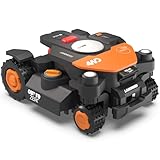
This model targets homeowners with a small, relatively flat lawn who want a single machine that mows the body and finishes the perimeter in one pass. The integrated side brushes are the headline feature, sweeping clippings and nudging grass at fence lines so the blades reach closer to edges than a standard robotic lawn mower without dedicated trimmers.
- Pro: Built-in edge brushes reduce or eliminate the need for separate string-trimmer passes along fences and garden beds.
- Pro: Wire-free setup means installation is essentially plug-in-and-go, with no hours spent burying a perimeter cable.
- Con: The 1/4-acre ceiling limits this unit to genuinely small properties; owners with irregular layouts or multiple garden beds report occasional navigation confusion in cluttered zones.
Skip it if your lawn exceeds a quarter acre or you need serious slope capability — this mower is not 4WD and will struggle beyond gentle grades.
LEBOSBO V3 AI Vision Robotic Lawn Mower, 1600 Sq.Ft, Black
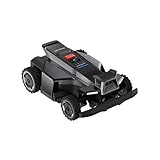
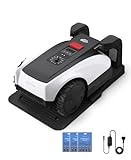
At $399.99 the LEBOSBO V3 is one of the most affordable entry points into a robotic lawn mower with camera-based navigation. It suits renters or first-time buyers with a compact rectangular lawn who want to see if autonomous mowing fits their lifestyle before committing more money. The AI vision system detects obstacles without a buried wire, which simplifies setup dramatically.
- Pro: Lowest price in this roundup alongside the YARDCARE, making the barrier to trying a robotic lawn mower essentially negligible.
- Pro: AI vision avoids the installation headache of perimeter wires while still providing obstacle detection.
- Con: The 1600-square-foot coverage ceiling means any lawn approaching a quarter acre will require multiple runs or leave patches uncut.
Skip it if your yard has slopes, dense undergrowth near trees, or anything beyond a small flat rectangle — the camera system can lose reference in shadow-heavy or visually cluttered environments.
ECOVACS Goat A2000 LiDAR PRO Robot Lawn Mower
The A2000 sits in the middle tier and delivers dual LiDAR navigation for owners who want mapping precision without paying the flagship price. Dual LiDAR sensors create a redundant point-cloud model of your lawn, which translates to more consistent path planning and fewer stuck situations than single-sensor alternatives. The larger coverage area means it handles mid-size properties where budget vision-based units leave gaps.
- Pro: Dual LiDAR provides superior obstacle mapping and self-localization compared to single-camera or single-LiDAR systems in this price bracket.
- Pro: ECOVACS software updates and app ecosystem give owners ongoing feature improvements without hardware changes.
- Con: At $1399 it is a meaningful investment, and owners report the initial mapping pass can require multiple attempts in yards with dense tree canopy or tall perennials near the mowing zone.
Skip it if your lawn is genuinely small — the ECOVACS Goat O1000 LiDAR PRO covers a quarter acre for $999 with a similar dual-LiDAR system, making the A2000 overkill unless you need the extra coverage.
Segway Navimow X430 Robot Lawn Mower Wire Free
The Navimow X430 is the capability flagship of this list, designed for properties that defeat smaller mowers. With 4WD handling slopes up to 84 percent, a zero-turn platform that prevents turf damage on tight maneuvers, and a cutting height range of 0.75 to 4 inches driven by two 180W motors, it tackles terrain that would strand most competitors. The ORV-tuned suspension and MowMentum acceleration system give it traction on soft or uneven ground.
- Pro: 4WD and 84% slope rating make it the only option here for genuinely hilly or rough lawns without terracing.
- Pro: Zero-turn geometry eliminates the scuffing and turf tearing common with pivot-and-drive systems on softer soil.
- Con: The $2249 price tag and the 1-acre maximum mean it is significantly overpowered for flat quarter-acre yards.
Skip it if your lawn is flat and under half an acre — the added cost buys capability you will never use.
YARDCARE AI Vision Robotic Lawn Mower, 1600 Sq.Ft, Dark Grey
The YARDCARE occupies the same $399.99 slot as the LEBOSBO and covers the same 1600 square feet, targeting the same budget buyer with an AI vision navigation system. It appeals to owners who want a wire-free robotic lawn mower for a small, simple yard and are drawn to the dark-grey colorway or specific app interface preferences noted in owner threads.
- Pro: Matches the lowest price point in the category while delivering camera-based navigation with no perimeter wire installation.
- Pro: Compact footprint means the charging dock fits neatly under a garden shed or against a fence without becoming an eyesore.
- Con: Identical coverage limitations to the LEBOSBO — 1600 square feet is a hard ceiling, and owners report inconsistent mowing patterns after prolonged rain when grass grows between scheduled runs.
Skip it if your lawn has more than a few trees or flower beds interrupting the mowing path; sparse camera coverage in heavily structured yards leads to missed patches.
ECOVACS Goat O1000 RTK Care Robot Lawn Mower
This model brings RTK satellite navigation to the quarter-acre segment at $664, undercutting LiDAR-based rivals while delivering centimeter-level positioning accuracy outdoors. RTK works by receiving corrected GPS signals from a base station, which means no buried wire and no camera confusion under tree shade. It suits owners who want reliable positioning without paying a premium for sensor hardware that RTK accomplishes differently.
- Pro: RTK provides consistent, repeatable navigation paths independent of lighting conditions, so it does not struggle at dusk or under heavy canopy the way vision systems can.
- Pro: At $664 it is the cheapest wire-free ECOVACS with satellite-level accuracy, undercutting most LiDAR alternatives in the same coverage class.
- Con: RTK requires a clear line of sight to the sky for satellite signal; owners under dense tree canopies or near tall walls report signal degradation and intermittent pauses.
Skip it if your lawn is heavily shaded by mature trees — the LiDAR-equipped ECOVACS Goat O1000 LiDAR PRO at $999 handles those conditions more reliably.
ECOVACS Goat O1000 LiDAR PRO Robot Lawn Mower
The O1000 LiDAR PRO adds dual-LiDAR navigation, built-in edge trimming, AI obstacle avoidance, and app control to the quarter-acre segment at $999. It is effectively the best all-in-one robotic lawn mower for owners who want premium features without the size or cost of the A2000. The dedicated edge-trimming pass addresses the single most common complaint about compact mowers — the uncut strip along fences.
- Pro: Built-in edge trimming means the perimeter is handled by the mower itself, eliminating the hand-trimmer follow-up that plagues competitors in this size class.
- Pro: Dual LiDAR combined with AI obstacle avoidance gives it the most robust navigation stack available under $1000 for a quarter-acre lawn.
- Con: Owners with sloped yards note that the unit is not 4WD and performs best on flat to gently graded terrain; it is not a hill-climbing specialist.
Skip it if your property exceeds a quarter acre or includes significant slopes — the A2000 or Segway Navimow X430 cover those needs better.
WORX Robot Lawn Mower 4WD for 1/2 Acre, WR342
The WR342 fills the gap between compact flat-lawn mowers and the full-size Segway, covering half an acre with 4WD traction and no perimeter wire required. It targets owners with a medium yard featuring moderate slopes, garden beds, or tree clusters that a two-wheel-drive mower would struggle to navigate. The wire-free design keeps installation simple while the 4WD system provides grip on soft soil after rain.
- Pro: 4WD on a half-acre platform at this price gives it meaningful slope and traction headroom over two-wheel-drive competitors in the same coverage bracket.
- Pro: WORX ecosystem compatibility means owners already using WORX smart battery tools benefit from shared app and accessory infrastructure.
- Con: At $2069.99 the price approaches the Segway Navimow X430, which offers a larger coverage area and more aggressive slope rating, narrowing the value case for buyers on the fence.
Skip it if your lawn is flat and under a quarter acre — the WORX 1/4-acre model with brushes at $799.99 handles those conditions at a fraction of the cost.
Buying Guide
Match Coverage Area to Your Actual Lawn Size
Published coverage ratings are maximums under ideal conditions. If a robotic lawn mower is rated for 1600 square feet, your usable lawn should be noticeably smaller to account for time spent navigating around obstacles, repositioning at edges, and returning to the dock. A quarter-acre lot is roughly 10,890 square feet, so models capped at 1600 square feet will need multiple cycles or simply leave uncut zones. Always round up: if your open mowing area sits near the rated ceiling, step to the next coverage tier.
Choose Navigation by Your Environment, Not by Buzzword
LiDAR, RTK, and AI vision each have a domain where they excel. LiDAR builds a 3D point cloud and works well under tree canopy and in mixed lighting. RTK relies on satellite signal and performs brilliantly on open lawns but can lose lock under dense shade or near tall structures. AI vision is cost-effective on simple, open, well-lit rectangles but degrades in shadow or clutter. Match the sensor to your yard’s actual conditions rather than selecting the most premium-sounding technology.
Prioritize Slope Rating and Drive System Over Cutting Height
Cutting height ranges are generous across this entire list, so that spec rarely determines satisfaction. Slope handling does. A mower rated for flat or near-flat lawns will slip, stall, or mow unevenly on anything steeper than a gentle grade. 4WD platforms with zero-turn capability handle 15 to 20 percent slopes confidently, while two-wheel-drive units often start struggling past five percent. Check the published slope tolerance in degrees or percentage, not just marketing claims like “handles hills.”
Our Verdict
The overall top pick is the ECOVACS Goat O1000 LiDAR PRO at $999. It delivers dual-LiDAR navigation, AI obstacle avoidance, built-in edge trimming, and app control for a quarter-acre lawn at a price that undercuts similarly featured models by several hundred dollars. For most homeowners with a small-to-mid flat yard, it checks every box that matters without overbuying.
The budget pick is a tie between the LEBOSBO V3 and the YARDCARE AI Vision at $399.99. Either gives a wire-free, camera-navigated robotic lawn mower experience for a small rectangular lawn without a financial commitment that risks buyer’s remorse.
One condition changes the answer: if your property includes slopes steeper than a gentle grade, the Segway Navimow X430 wins outright. Its 4WD system and 84% slope rating make it the only option in this group that will reliably traverse a hilly lawn without stalling or scuffing turf.
FAQ
Do I still need a string trimmer with a robotic lawn mower?
It depends on the edge-trimming capability of the specific model. Units like the ECOVACS Goat O1000 LiDAR PRO and the WORX 1/4-acre with brushes include built-in edge features that get close enough to eliminate most hand-trimming. Basic models without dedicated trimmers or brushes will typically leave a narrow uncut strip along fences and walls, requiring occasional string-trimmer touch-ups.
How does weather affect a robotic lawn mower’s operation?
Most models in this category have rain sensors that pause mowing during precipitation and resume afterward. Prolonged rain, however, can soften soil enough to reduce traction on two-wheel-drive units or cause wheel spin on slopes. Owners report the best results by scheduling mowing runs for dry periods between rain events rather than relying on the mower to push through wet turf.
Can a robotic lawn mower handle a yard with many trees and flower beds?
Navigating around dense obstacles depends heavily on the sensor type. LiDAR-equipped models build a detailed 3D map of trunks, bed borders, and garden ornaments, giving them the best clearance in cluttered yards. AI vision systems struggle when the camera cannot reliably distinguish a flower-bed edge from grass in low light. RTK units are indifferent to obstacles visually but may need manual zone restrictions to avoid damaging beds.
What is the realistic setup time for a wire-free model?
Wire-free units require you to define the mowing zone via app, walk the perimeter to let the sensor map boundaries, and place the charging dock on level ground with power access. Owners commonly report the initial setup taking one to two hours, including a first exploratory mapping run. Subsequent use is largely hands-off after that, though periodic cleaning of sensors and blades is needed to maintain reliable navigation.


