
Key takeaways
- Pro: Metal construction outlasts cheap plastic nozzles under repeated sun exposure
- Pro: Three modes in one unit eliminates the need to swap attachments
- Con: Delivers only garden-hose pressure, so it will not remove baked-on grime
What's inside
Buying a pressure washer used to mean picking a single machine and hoping it handled everything from muddy patio tiles to flaking deck stain. In 2026 the market splits into two camps: purpose-built machines you crank up on weekends, and a growing ecosystem of nozzles, adapters, and surface-cleaning attachments that bolt onto gear you already own. The buyer’s concrete problem is straightforward—restore surfaces without hiring help or buying three separate tools—and the answer depends on whether you need a standalone washer, a conversion part for an existing hose, or an add-on that turns one gun into a driveway-cleaning rig.
What separates a worthwhile pick from a frustrating one comes down to matched specifications. A surface cleaner rated to 3,000 PSI is dead weight on a 1,450 PSI handheld unit. A 5-pack of tips that handles 4,500 PSI will crack under a belt-drive pump pushing 3,600 PSI if the quick-connect fitting is the weak link. We compared published specs, listed prices, and recurring owner feedback across these eight products to show you which combination actually fits your cleaning workload and budget.
As an Amazon Associate we earn from qualifying purchases at no extra cost to you. Product prices and availability are accurate as of the date shown and are subject to change.




Quick Picks
| Product | Best for | Price |
|---|---|---|
| High Pressure Hose Nozzle (Metal, 3 Modes) | Upgrading a standard garden hose on a budget | $25.99 |
| Cordless Pressure Washer (1450 PSI, 2 Batteries) | Quick spot-cleaning cars and patios anywhere | $69.99 |
| Westinghouse ePX3500 Electric | Homeowners wanting reliable electric power without a cord headache | $169 |
| Canpump Belt-Drive Gas (3600 PSI) | Contractors and large-property owners with serious grime | $1650 |
| Pressure Washer Adapter M22 to 3/8″ QC | Connecting mismatched hoses and wands | $9.99 |
| Pressure Washer Tips Soap Nozzle 5-Pack | Switching spray angles and applying detergent | $6.99 |
| Canpump CE 3650 S Pump | Building or repairing a custom belt-drive rig | $380 |
| Westinghouse PWSC12 Surface Cleaner | Turning a pressure washer into a driveway scrubber | $26.09 |
How We Picked
We evaluated each product on four criteria: compatibility with the other items on this list (fitting standards, PSI ceilings, GPM ranges), value per dollar of real-world cleaning output, recurring praise or complaints in owner reviews about durability and usability, and whether the product solves a problem a standalone washer already handles adequately. A product earns its spot when it either fills a gap no single machine covers or dramatically lowers the cost of entry for a specific cleaning task.
The 8 Best Pressure Washers Us in 2026
High Pressure Hose Nozzle Metal Fits US Garden Hoses with 3 Spray Modes
This is the entry point for anyone who owns a standard garden hose but wants a focused jet stream for rinsing patio furniture, bike frames, or window screens. The metal body resists the cracking and stripped threads that plague plastic equivalents, and three spray modes (jet, fan, cone) cover most light-duty tasks without a separate gun. Owners highlight the satisfying weight and the quick quarter-turn between modes as daily conveniences.
- Pro: Metal construction outlasts cheap plastic nozzles under repeated sun exposure
- Pro: Three modes in one unit eliminates the need to swap attachments
- Con: Delivers only garden-hose pressure, so it will not remove baked-on grime
Skip this if your surfaces need more than 500 PSI to clean; it is a rinsing aid, not a pressure washer.
Cordless Pressure Washer, 1450 PSI Portable Handheld with 6-in-1 Nozzle and 2 x 4.0Ah Batteries
The cordless format solves the two biggest friction points of electric washers: dragging a power cord across wet ground and hunting for an outdoor outlet. At 1450 PSI it handles car washes, fence panels, and small patio tiles without pre-soaking. Two 4.0Ah batteries give roughly double the runtime of single-battery competitors at this price tier, and the 6-in-1 nozzle covers most angles without extra tips.
- Pro: Fully portable—use it in a driveway, on a boat, or in a parking garage with no outlet
- Pro: Includes two batteries and a charger, removing the usual accessory upsell
- Con: Not designed for sustained multi-hour sessions; runtime per battery suits 20-30 minute jobs
Skip this if you regularly clean more than one large driveway section at a time; the PSI ceiling will leave you scrubbing twice.
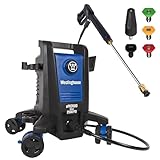
Westinghouse ePX3500 Electric Pressure Washer, 2500 Max PSI 1.76 Max GPM
This sits in the sweet spot for suburban homeowners: enough power for cars, fences, deck boards, and house siding without the noise, fumes, or maintenance of a gas engine. Anti-tipping technology addresses the common complaint of narrow electric washers falling over on uneven patios. The onboard soap tank and included 5-nozzle set mean you are ready to scrub without hunting for add-ons.
- Pro: 2500 PSI clears most household surfaces in a single pass, cutting job time noticeably
- Pro: Steel wand and pro-style nozzle set feel solid where plastic equivalents flex
- Con: Still tethered to an outlet, so you need a sufficiently long extension cord for large perimeters
Skip this if your property exceeds an acre or you routinely strip paint and deep-set concrete stains; you will want gas-tier flow.
Canpump Belt-Drive Gas Pressure Washer, 3600 PSI at 5 US GPM
This is the workhorse for contractors, farm owners, and anyone cleaning commercial parking lots or heavily stained concrete. The 3600 PSI combined with 5 GPM delivers roughly triple the cleaning power of the Westinghouse electric, and the 389 cc engine sustains that output far longer than a battery or corded motor. Belt-drive pumps run cooler and quieter than direct-drive equivalents, extending component life.
- Pro: Flow and pressure together cut driveway-cleaning time by more than half versus residential units
- Pro: Belt-drive design reduces engine wear and lowers noise compared to direct-drive
- Con: At $1,650 it demands a dedicated storage space and routine fuel maintenance most homeowners will skip
Skip this unless your weekly workload justifies the price; a homeowner washing one car and a patio will never need 5 GPM.
Pressure Washer Adapter M22 14mm to 3/8″ Quick Connect and Disconnect Fitting
This tiny part solves a specific and recurring frustration: owning a wand with M22 threads but wanting to swap in a quick-connect tip set from a different manufacturer. Without it, you are locked into one brand’s nozzle ecosystem. Owners praise the solid build and the fact that it eliminates the slow screw-on process that wastes time when switching tips mid-job.
- Pro: Bridges the most common fitting mismatch in the US residential market
- Pro: Under $10 with a tool-free connection that takes seconds to swap
- Con: Adds a potential leak point if not seated firmly; quality control on the O-ring matters
Skip this if your current setup already uses matching quick-connect fittings throughout; it only helps when mixing systems.
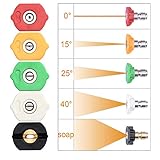
Pressure Washer Tips Soap Nozzle Tips 5-Pack (Up to 4,500 PSI, 2.5 GPM)
A five-pack covering multiple spray angles plus a dedicated soap nozzle rounds out any machine that ships with fewer tips. The 4,500 PSI rating gives comfortable headroom above most residential and mid-commercial units, so the tips will not be the limiting component on a gas washer. Owners note the quick-connect design matches standard 1/4-inch fittings, and the variety of degrees handles everything from broad rinsing to pinpoint stain removal.
- Pro: Rated above typical machine output, so tips will not fail before the pump does
- Pro: Five angles in one affordable pack removes guesswork when matching spray to surface
- Con: At 2.5 GPM ceiling they are not ideal for high-flow commercial pumps pushing 5 GPM and above
Skip this if you run a belt-drive machine above 3,600 PSI with sustained flow; those systems demand commercial-rated tips specifically sized for their output.
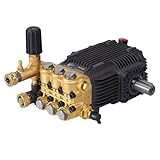
Canpump CE 3650 S Belt-Drive Pressure Washer Pump
Not a complete machine but the heart of one. DIYers building a custom cart or replacing a blown pump on an older gas washer find this triplex unit cost-effective compared to buying a new full assembly. The 24 mm solid shaft and 1725 RPM ceiling match most small-engine setups, and the external unloader allows precise pressure tuning without disassembling the pump.
- Pro: 3600 PSI at 5 GPM in pump-only form saves significant cost over a complete washer
- Pro: External unloader enables fine pressure adjustments for different surfaces on the same cart
- Con: Requires a matching engine, frame, hose, and wand—total build cost can approach a ready-made unit
Skip this unless you already own a compatible gas engine and enjoy the assembly; a homeowner wanting plug-and-play should buy the complete machine.
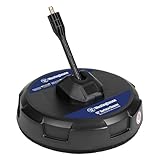
Westinghouse PWSC12 12″ Pressure Washer Surface Cleaner Attachment
A 12-inch surface cleaner turns the tedious back-and-forth of a wand on flat concrete into a guided, stripe-free pass. Rated to 3,000 PSI and connecting via a standard 1/4-inch fitting, it pairs well with the ePX3500 and most mid-range machines. Owners report driveways going from stained to uniform in roughly a third of the wand-only time.
- Pro: Eliminates overlapping swirl marks that manual wand passes leave behind
- Pro: Under $27 makes it one of the cheapest high-impact upgrades in this list
- Con: The 3,000 PSI ceiling means it cannot be used on the Canpump gas unit rated to 3,600 PSI
Skip this if your primary targets are vertical surfaces like fences or siding; surface cleaners are designed exclusively for flat horizontal areas.
Buying Guide
Matching PSI and GPM to Your Actual Workload
Pressure alone is not the whole story. Cleaning power scales roughly with the product of PSI and GPM, which is why a 2,500 PSI / 1.76 GPM unit feels dramatically weaker than a 3,600 PSI / 5 GPM machine despite only a 44 percent PSI difference. For cars, furniture, and small patio tiles, 1,450 to 2,500 PSI with moderate flow is sufficient. For large concrete, flaking paint, or caked-on organic growth, you need both high pressure and high flow simultaneously. Check the combined cleaning power rather than fixating on PSI as a standalone number.
Fitting Standards: M22, Quick-Connect, and Why They Matter
The US market has two dominant connection styles: M22 threads and 1/4-inch quick-connect. M22 is common on European-origin pumps and some gas units; quick-connect dominates North American consumer brands. Mixing them without an adapter causes leaks and time lost to frustration. When you evaluate a tip pack, surface cleaner, or nozzle, verify that its fitting matches your machine. The $9.99 adapter in this list exists precisely because owners discover the mismatch too late, often after a Saturday-morning job grinds to a halt.
Corded, Cordless, or Gas: The Real Trade-Off
Cordless units offer unmatched convenience for quick jobs and locations without outlets, but battery capacity limits continuous runtime. Corded electric washers deliver consistent pressure as long as you have an extension cord and an outlet, making them practical for 30-to-60-minute sessions. Gas machines provide the highest output and unlimited runtime but add noise, fumes, fuel mixing, and seasonal storage concerns. Match the power source to your typical session length and property size rather than defaulting to the highest number on the spec sheet.
Our Verdict
The Westinghouse ePX3500 is our top pick for most US homeowners in 2026: 2,500 PSI with 1.76 GPM covers cars, decks, fences, and house siding at a price that undercuts entry-level gas units by a wide margin, and the included nozzle set plus onboard soap tank remove the accessory tax that inflates the real cost of other electric options. For pure dollar-for-value cleaning power, the Cordless 1450 PSI unit at $69.99 is the budget pick—two batteries, six spray modes, and zero cord anxiety for spot jobs. However, if your workload is a half-acre driveway or commercial patio space, the Canpump Gas Pressure Washer wins outright despite its cost, because no electric or battery unit at any price delivers the same combined 3,600 PSI and 5 GPM throughput.
FAQ
Do I need a surface cleaner attachment?
Only if you regularly clean flat horizontal surfaces larger than a few square feet. A 12-inch surface cleaner cuts time on driveways and patios dramatically and prevents the stripe pattern that wand-only passes leave behind. For vertical surfaces and small spots, it adds unnecessary weight and bulk.
Can I use the soap tips from the 5-pack on my gas pressure washer?
The tips are rated to 4,500 PSI and 2.5 GPM. If your machine runs at or below those limits, they will work fine. The Canpump gas unit in this list produces 5 GPM, which exceeds the tips’ flow rating, so they would not be a suitable match for that specific machine.
Is the M22 adapter universal?
No. M22 comes in several thread sizes, with 14 mm being the most common in residential equipment. Verify your wand’s thread diameter before purchasing an M22 to quick-connect adapter, because a 14 mm fitting on an 18 mm thread will not seal regardless of how tightly you hand-tighten it.
Are cordless pressure washers powerful enough for house siding?
At 1,450 PSI they can rinse lightly soiled siding, but removing years of mildew, oxidation, or ground-in dirt typically requires 2,000 PSI or higher. A cordless unit is a reasonable choice for routine maintenance washing; for full restoration work, a corded electric or gas machine will do the job in half the passes.


