Key takeaways
- 0.72 lb of nitrogen per 1,000 sq ft — enough to push green, leafy growth without forcing soft tissue that invites disease in seedlings
- 0.75 lb of phosphate per 1,000 sq ft — the headline ingredient; phosphorus drives early root development, which is exactly what a germinating seed, an unrooted sod slab, or a plug needs most
- 0.12 lb of potash per 1,000 sq ft — deliberately low, because potassium matters more for stress hardiness in established turf than in week one of establishment
What's inside
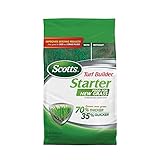
Apply Scotts Turf Builder Starter Fertilizer — sold as Scotts Turf Builder Starter Food for New Grass — on the same day you put down seed, sod, or plugs, broadcast at roughly 3 lb per 1,000 sq ft, then water it in: lightly and frequently for seed, deeply for sod and plugs. The rest of this guide breaks down what the 24-25-4 label numbers actually deliver per square foot, how much a bag covers in real lawns, and where the timing differs enough between seeding, sodding, and plugging to matter.
As an Amazon Associate we earn from qualifying purchases at no extra cost to you.


What the 24-25-4 analysis actually means
The three numbers are guaranteed minimums by weight: 24% nitrogen (N), 25% phosphate (P₂O₅), and 4% potash (K₂O). At the labeled new-seeding rate of about 3 lb per 1,000 sq ft, each application delivers roughly:
- 0.72 lb of nitrogen per 1,000 sq ft — enough to push green, leafy growth without forcing soft tissue that invites disease in seedlings
- 0.75 lb of phosphate per 1,000 sq ft — the headline ingredient; phosphorus drives early root development, which is exactly what a germinating seed, an unrooted sod slab, or a plug needs most
- 0.12 lb of potash per 1,000 sq ft — deliberately low, because potassium matters more for stress hardiness in established turf than in week one of establishment
That phosphorus-heavy ratio is the whole reason this product exists. Regular lawn foods (Scotts Turf Builder Lawn Food is 32-0-4) contain no phosphate at all, partly because several states restrict phosphorus on established lawns unless a soil test calls for it or you’re actively seeding. So starter fertilizer is one of the few cases where buying the high-P bag is the correct move rather than a waste.
Bag sizes, coverage, and real cost per lawn
The labeled rate works out to 3 lb per 1,000 sq ft, and Scotts sells the product in two main sizes:
| Bag size | Labeled coverage | Typical price range | Cost per 1,000 sq ft |
|---|---|---|---|
| ≈15 lb | 5,000 sq ft | $25–35 | $5–7 |
| ≈42 lb | 14,000 sq ft | $55–80 | $4–5.50 |
Worked example: a 2,500 sq ft yard needs 7.5 lb of product — exactly half of the small bag, costing roughly $12–18. Unused granules store well for years if you roll the bag shut and keep it dry, so leftover fertilizer isn’t wasted money. The larger bag only makes sense for lawns over about 7,000 sq ft or for households that seed annually; below that, you’re paying a lower per-pound price for product that sits in the shed.
One calibration note most listings skip: the bag prints dial settings for Scotts’ own spreaders, but for any spreader the reliable method is to weigh out 3 lb, apply it over a measured 1,000 sq ft test area, and adjust the dial until the output matches. A cheap kitchen scale beats guessing.
Starter food vs. the other Scotts options
| Product | Analysis | Best used for |
|---|---|---|
| Turf Builder Starter Food for New Grass | 24-25-4 | Seed, sod, and plugs; the flexible option |
| Turf Builder Triple Action Built for Seeding | 21-22-4 | Seeding only, where weed pressure is expected — it includes a seed-safe weed preventer |
| Turf Builder Lawn Food | 32-0-4 | Established lawns only; too much nitrogen and zero phosphorus for new planting |
Decision rule: if you’re laying sod or plugs, or seeding into a mostly clean bed, the plain starter food is the right buy. If you’re seeding a weedy or neglected area and can’t separate the weeds first, the Triple Action version earns its premium. Never substitute regular lawn food at planting — the high nitrogen without phosphorus pushes top growth the roots can’t yet support.
Timing differences: seed vs. sod vs. plugs
New seed and overseeding
Apply the same day you spread seed — immediately before, during, or after all work, since the granules and seed don’t interfere. Watering is the critical difference here: keep the top inch of soil consistently moist with light daily watering until germination (roughly 5–10 days for ryegrass, 7–14 for tall fescue, up to 30 for Kentucky bluegrass). A single heavy soaking puddles seed and granules into clumps.
Sod
Best practice is to rake the starter into the top inch of prepared soil before the sod arrives — roots reach the phosphorus directly instead of through a mat of thatch. Second-best is broadcasting over the finished grade minutes before laying. Apply at installation or within a day or two; phosphorus applied weeks early leaches or washes before roots arrive to use it. Water deeply the same day to settle the sod, then keep moisture high for the 2–3 weeks it takes roots to knit.
Plugs
Broadcast at the standard rate at planting, or work about a teaspoon into the bottom of each hole for targeted feeding. Plugs spread laterally over one to two seasons, so the follow-up feeding matters more than with sod: come back with a regular lawn food six to eight weeks after planting.
How to apply it, step by step
- Measure the actual square footage (length × width, minus beds and hardscape) — overestimating is how bags run out mid-lawn
- Weigh out product at 3 lb per 1,000 sq ft, or 0.3 lb per 100 sq ft for small patches
- Set the spreader per the bag chart, or calibrate on a test strip as described above
- Apply in two perpendicular passes at half-rate each — this eliminates the striped gaps a single pass leaves
- Water within 24 hours: light and frequent for seed, deep for sod and plugs
- Skip application if heavy rain is forecast within a day — granules that wash to the low spot feed a stripe, not a lawn
- Mark your calendar for the follow-up feeding at six to eight weeks
The seasonal window
Timing on the calendar matters as much as timing relative to planting. Cool-season grasses germinate best when soil sits around 50–65°F — typically April–May and late August–September, with fall preferred. Warm-season sod and plugs want soil above 65°F and active growth, roughly late spring through midsummer. Seeding within six weeks of your first expected frost wastes both seed and fertilizer, and germinating in summer heat above 90°F fails more often than it succeeds.
Mistakes that waste a bag
- Applying starter days before sod is delivered — nutrients migrate before roots exist
- Skipping the water-in: dry granules do nothing and can scorch when finally soaked
- Doubling the rate for “faster” results — excess phosphorus just runs off, and in some states over-application of phosphorus fertilizer is regulated
- Using it as routine feeding on an established lawn — you’re paying for phosphate your soil likely doesn’t need
- Pairing seeding with a standard pre-emergent weed preventer — most prevent grass seed from germinating too; only seed-safe formulas work
- Leaving an opened bag in a damp shed — the granules clump into unusable rock
Frequently asked questions
Can I use starter fertilizer on an established lawn?
You can without harm, but you’re paying for phosphorus an established lawn rarely needs, and some states restrict phosphorus applications to new seedings or soil-test-confirmed deficiencies. A standard lawn food is cheaper and more appropriate.
How soon can I mow after applying?
The fertilizer doesn’t set the schedule — grass height does. First mowing happens when new grass reaches about 3–3.5 inches, regardless of feeding date.
Is it safe around pets and kids?
Per label directions, once the granules are watered in and the surface has dried, normal foot traffic is fine. Keep everyone off until that point, and store the bag out of reach.