Key takeaways
- Concentration is fixed by the dial; total dose is fixed by pace. Gallons sprayed over a given area depend on flow rate (roughly 2 gallons per minute through a typical head) multiplied by time — which is your walking speed. Walk too fast and you under-dose; linger and you over-apply.
- Water added to the jar doesn’t weaken the output — it just stretches the supply — unless the label tells you to dilute in the jar and gives a matching dial setting. Always follow the label’s hose-end directions verbatim rather than improvising.
What's inside
Getting reliable results from a hose end sprayer for weed killer comes down to three numbers: the dial setting on the sprayer, the coverage rate printed on the herbicide label, and your walking speed. The sprayer head siphons concentrate out of its jar and meters it into the hose stream at a set ratio — ounces of product per gallon of water — so once the dial matches the label’s figure, the only variables left are pace and drift. Here’s the math and the technique.
As an Amazon Associate we earn from qualifying purchases at no extra cost to you.

Dial-Rate vs. Fixed-Rate Sprayers
Fixed-rate (ready-to-spray) bottles
The simplest weed killer that attaches to a hose is a ready-to-spray bottle: the herbicide arrives pre-diluted inside a container with a spray head already calibrated to a fixed draw ratio. Ortho’s WeedClear lawn weed killer, Spectracide Weed Stop for Lawns, and Roundup products are all sold in this format alongside their concentrates. You connect the bottle to the hose, open the water, and spray until the target area is evenly wet. Nothing to set, nothing to measure — but the coverage figure on the label assumes a walking pace you can’t verify, and you can’t adjust anything.
Dial-rate (adjustable) sprayers
A dial-rate sprayer — the Ortho Dial N Spray and Chapin’s adjustable hose-end models are the common examples — pairs a refillable jar (usually ~32 oz) with a metering head. Settings typically run from about 1 teaspoon up to 8 ounces per gallon. You pour in concentrate, set the dial to the ounces-per-gallon figure on the herbicide label, and the head draws product at that rate no matter how much is in the jar.
| Fixed-rate (ready-to-spray) | Dial-rate (adjustable) | |
|---|---|---|
| How it meters | Factory-set draw ratio built into the attached head | User-set dial, ~1 tsp to 8 oz per gallon |
| What you control | Walking pace only | Dilution rate plus pace |
| Container | Single-use bottle, product included | Refillable jar, ~32 oz typical |
| Upfront cost | ~$10–18 including product | ~$15–30 for the sprayer, concentrate sold separately |
| Accuracy depends on | Even coverage at the pace the label assumes | Correct dial setting plus pace |
| Best for | Small lawns, once-a-season use | Larger lawns, repeat treatments, multiple products |
The Ounces-per-Gallon Math
The number on the dial is a metering rate, not a recipe for the jar. “4 oz/gal” means the head pulls 4 ounces of jar contents for every gallon of water that flows through — whether the jar is full or nearly empty. Two consequences follow:
- Concentration is fixed by the dial; total dose is fixed by pace. Gallons sprayed over a given area depend on flow rate (roughly 2 gallons per minute through a typical head) multiplied by time — which is your walking speed. Walk too fast and you under-dose; linger and you over-apply.
- Water added to the jar doesn’t weaken the output — it just stretches the supply — unless the label tells you to dilute in the jar and gives a matching dial setting. Always follow the label’s hose-end directions verbatim rather than improvising.
A worked example, using typical lawn-concentrate label language (“set dial to 4 oz/gal; 32 fl oz treats 5,000 sq ft”):
- Lawn size: 7,500 sq ft → concentrate needed: 32 × (7,500 ÷ 5,000) = 48 oz (about 1.5 quarts).
- At 4 oz/gal, 48 oz is dispensed across 12 gallons of water.
- At ~2 gal/min, that’s about 6 minutes of spraying → ~1,250 sq ft per minute → a normal walking pace covering a 4–5 ft band. Conveniently, that matches what labels mean by “wet the foliage evenly.”
- To check your real pace: put a measured amount of plain water in the jar, spray a known area (say 1,000 sq ft), and see how much was drawn down. Adjust speed accordingly.
Reading the label correctly matters more than any formula:
| Label wording | What it means | What to do |
|---|---|---|
| “Set dial to X oz/tbsp per gallon” | Metering rate at the head | Match the dial exactly (1 oz = 2 tbsp) |
| “Apply until foliage is wet” / “spray to wet” | Coverage defined visually, not by volume | Pace so leaves are wet but not dripping |
| “Treats up to X sq ft” | Total product budget per container | Measure your lawn first; don’t spend the bottle on one zone |
| “Rainproof in X hours” | Minimum dry window after application | Check the forecast before filling the jar |
| “Do not apply to…” list | Sensitive grasses and ornamentals | Flag those areas; shield or spot-treat by hand |
Step-by-Step Application
- Mow 1–2 days before, not after. You want maximum leaf area for uptake; mowing right after removes the treated foliage before the herbicide translocates.
- Check the weather window. No rain for ~24 hours, wind under 5 mph, temperatures below ~85°F, and ideally morning after dew dries.
- Fill and attach. Pour the label-specified concentrate amount into the jar, screw on the head hand-tight (plastic threads cross-thread easily), and confirm the rubber washer is seated at the hose connection.
- Open the spigot partway. Full pressure atomizes the spray into drift-prone mist; moderate pressure gives coarser droplets.
- Spray at knee height in overlapping rows. Walk steady 4–5 ft bands, wetting foliage without runoff. Position yourself so any breeze carries spray toward open lawn — never toward beds or back at you.
- Don’t double-cover edges. Overlapped borders are where lawns get scorched.
- Flush immediately. Rinse the jar, refill with clean water, and spray 30–60 seconds to clear the siphon tube and metering orifice.
Drift Control: Keeping Herbicide Off Plants You Want
- Droplet size beats everything. Lower water pressure produces coarser droplets that fall where aimed. If your head has a pattern selector, use the stream or coarse fan, never a mist cone.
- Respect volatility, not just wind. Ingredients like 2,4-D and dicamba can vaporize and drift on hot afternoons even in dead calm — above ~85°F, wait for a cooler day.
- Keep a 10–15 ft buffer on the downwind side of flower beds, shrubs, vegetable gardens, and tree driplines. Hold a piece of cardboard or plywood as a shield along bed edges, or spot-treat those strips with a pump sprayer instead.
- Match the product to the turf. The best hose end weed killer for lawns is a selective product labeled safe for your grass species — some lawn herbicides injure St. Augustine or centipedegrass. For fence lines and gravel, non-selective products work, but they will kill any grass the spray touches.
Which Setup Fits Your Situation
| Your situation | Recommended setup | Why |
|---|---|---|
| Scattered weeds, lawn under ~3,000 sq ft, treat once a season | Ready-to-spray bottle | ~$10–18 all-in, zero setup, factory calibration |
| 3,000–10,000 sq ft, blanket treatment 1–2×/year | Dial sprayer + concentrate | Concentrate costs roughly half as much per 1,000 sq ft; sprayer pays for itself by year two |
| Want feeding and weed control in one pass | Hose-end weed & feed bottle (e.g., Scotts Liquid Turf Builder with Plus 2 Weed Control) | A weed and feed hose end sprayer in a single product — no separate fertilizer job |
| Fence lines, patios, gravel drives | Non-selective ready-to-spray | Kills everything it hits; keep a buffer from lawn edges |
| Multiple chemicals through the season | Dedicated sprayers, labeled per use | Herbicide residue in a shared jar can damage ornamentals during later feeding |
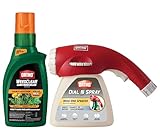
On cost: treating a 7,500 sq ft lawn takes roughly two 32-oz ready-to-spray bottles (~$20–30 per application). The same job through a dial sprayer uses about 48 oz of concentrate (~$15–30 depending on product) plus a one-time ~$15–30 sprayer — so concentrate wins from the second season onward. That’s also how a Spectracide Weed Stop for Lawns hose end sprayer job typically works: the concentrate version of that product prints dial settings on its label specifically for adjustable sprayers, while the ready-to-spray version skips the math entirely. Ortho covers both sides of the choice too — WeedClear ready-to-spray bottles on one hand, the Dial N Spray head for concentrates on the other.
Maintenance and the Mistakes That Ruin Results
- The pickup filter clogs first. Most heads have a small screen on the end of the siphon tube; if output suddenly runs clear, that’s the culprit. Rinse it after every use.
- Washers and O-rings wear next. Leaks at the hose connection or around the dial are cheap fixes — keep spares.
- Never store concentrate in the jar. Residue degrades seals, and a half-filled jar is a spill hazard.
- Dedicate the sprayer to herbicides. Trace 2,4-D left in the jar can distort tomatoes and flowers during a later foliar feed.
- Expect patience, not miracles. Systemic lawn herbicides take 1–3 weeks to show full kill; respraying at day three is over-application, not thoroughness.
- Disconnect after use. Heads include an anti-siphon valve, but leaving a pressurized sprayer attached stresses both the valve and the hose.
Quick Answers
Is a ready-to-spray bottle as accurate as a dial sprayer?
The metering is factory-calibrated, but total dose still depends on your pace — same as a dial unit. It’s simpler, not inherently more precise.
Can I run weed and feed through a dial sprayer?
Only liquid weed-and-feed products labeled for hose-end use; granular products can’t go through a sprayer at all. Easiest option is a weed killer that connects to your hose directly — the all-in-one hose-attached weed & feed bottles.
Do I need a backflow preventer?
Most heads include an anti-siphon check valve, and many plumbing codes additionally require an inexpensive vacuum breaker on the hose bib. It’s a few dollars and worth having.
Can I refill a ready-to-spray bottle with concentrate?
Don’t — the fixed metering ratio is unknown to you, so you’d be mixing off-label and guessing at the dose. Use a dial sprayer for concentrates instead.