Key takeaways
- 32-ounce chemical-resistant translucent poly jar with molded graduations
- Fixed siphon rate — approximately 1.6 fl oz of jar contents per gallon of water
- Fan-pattern nozzle with fingertip on/off control
- Built-in anti-siphon/backflow valve to protect household water
- Standard garden hose thread; well under a pound empty
- Typically priced under $20
What's inside
- What the G390 actually is
- The 20-gallon claim, translated into lawn area
- Roundup for Lawns in a hose-end sprayer
- Concentrates that flow clean vs. concentrates that clog
- G390 vs. the adjustable-dial competition
- Honest limitations
- Ownership realities: wear points and cleaning
- Is the G390 right for your lawn?
The chapin g390 lawn hose end sprayer is a fixed-ratio, 32-ounce sprayer that siphons roughly 1.6 fluid ounces of concentrate per gallon of water and empties a full jar across about 20 gallons of spray output. That makes it a genuinely good fit for applying one or two liquid lawn products over a mid-size lawn a few times a season — and the wrong tool if you need adjustable dilution, spot-spray precision, or plan to push anything that isn’t fully dissolved.
- What the G390 actually is
- The 20-gallon claim, translated into lawn area
- Roundup for Lawns in a hose-end sprayer
- Concentrates that flow clean vs. concentrates that clog
- G390 vs. the adjustable-dial competition
- Honest limitations
- Ownership realities: wear points and cleaning
- Is the G390 right for your lawn?
As an Amazon Associate we earn from qualifying purchases at no extra cost to you.
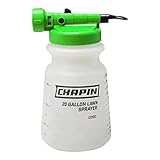


What the G390 actually is
Chapin positions the G390 as the simple end of its hose-end lineup. Instead of a metering dial, it uses a fixed siphon tube: water passing through the head pulls jar contents upward at a set rate, so the only variables you control are how much concentrate goes in the jar and how fast you walk.
- 32-ounce chemical-resistant translucent poly jar with molded graduations
- Fixed siphon rate — approximately 1.6 fl oz of jar contents per gallon of water
- Fan-pattern nozzle with fingertip on/off control
- Built-in anti-siphon/backflow valve to protect household water
- Standard garden hose thread; well under a pound empty
- Typically priced under $20
The 20-gallon claim, translated into lawn area
Thirty-two ounces siphoned at ~1.6 fl oz per gallon means the jar runs dry after roughly 20 gallons of water pass through. At typical residential pressure (40–60 psi), flow through a hose-end head runs about 2.5–4 gallons per minute, so expect the jar to empty in roughly 5–8 minutes. Walking a steady pace with the ~4-foot fan covers somewhere around 600–800 sq ft per minute, which works out to approximately 3,500–5,500 sq ft per fill. A 7,000 sq ft lawn means two fills — and two measured doses.
Because the ratio is fixed, calibration happens with your feet and a measuring cup, not a dial:
- Find the per-area rate. Most lawn concentrate labels state fl oz per 1,000 sq ft.
- Do a water-only run. Fill the jar, spray a measured area at your natural pace until it empties, and note the coverage — say 4,000 sq ft.
- Do the math. If the label calls for 5 fl oz per 1,000 sq ft, you need 20 fl oz of concentrate in the jar.
- Load and top off. Pour in the 20 fl oz, then fill to the 32 oz line with water. Topping off doesn’t change how much product lands — the jar still empties at the same rate, so all 20 fl oz still goes down over the same ~20 gallons.
- Match your pace. If the jar runs dry before you finish the measured area, you walked too slowly; if product remains, too fast. Adjust on the next fill.
Roundup for Lawns in a hose-end sprayer
Roundup for Lawns concentrate is a thin, water-like liquid, so it siphons through the G390 without any clogging issue. Two cautions matter more than flow, though. First, “Roundup for Lawns” is not the same product as classic Roundup — the lawn formulas use selective actives (MCPA, quinclorac, dicamba, sulfentrazone-type chemistry) that spare turfgrass, while standard glyphosate Roundup kills grass outright. Second, the northern formula isn’t rated for southern grasses like Bermudagrass; the Southern-labeled version is. Match the formula to your turf before it ever touches the jar.
Many Roundup for Lawns labels give instructions like “set dial to X oz” for adjustable sprayers. With the G390’s fixed rate, skip the dial directions and use the concentrate-per-area math above. Alternatively, the ready-to-spray hose-end bottle version does the metering itself — it costs more per 1,000 sq ft but is the zero-math option for small lawns.
Concentrates that flow clean vs. concentrates that clog
Generally flows fine
- Liquid lawn herbicides: Roundup for Lawns concentrate, Ortho WeedClear for Lawns, Spectracide Weed Stop for Lawns concentrates
- Liquid insecticides: Spectracide Triazicide-type concentrates
- Liquid fungicides: propiconazole-class liquids such as Bonide Infuse
- Thin liquid fertilizers, chelated iron, and liquid kelp/seaweed products
Clogs, settles, or underperforms
- Wettable powders and water-dispersible granules — they never fully dissolve and jam the siphon strainer; the jar has no agitation to keep them suspended
- Granular fertilizer, unless dissolved overnight and strained first (buying liquid is usually easier)
- Suspension concentrates that settle in the bottle — the jar sits stagnant, so dosing gets uneven fast
- Thick organic liquids like fish emulsion or heavy neem concentrates — too viscous for a fixed siphon without pre-diluting
- Anything the label restricts to pump or backpack sprayers
G390 vs. the adjustable-dial competition
| Sprayer | Tank size | Mix control | Spray pattern | Typical price |
|---|---|---|---|---|
| Chapin G390 | 32 oz | Fixed siphon, ~1.6 fl oz/gal | Fan only | Under ~$20 |
| Chapin G362 | 32 oz | 16-position metering dial | Adjustable nozzle | ~$20–30 |
| Ortho Dial N Spray | ~32 oz | 14 settings (1 tsp–8 fl oz/gal) | 3 patterns | ~$20–30 |
| Generic fixed-siphon store brands | 16–32 oz | Fixed, ratio often unstated | Fan | Under ~$15 |
The dial matters when a label gives instructions in teaspoons or ounces per gallon — common on fertilizers and insecticides — because a dial sprayer can match that directly. With the G390 you always convert through the concentrate-per-area method instead, which works fine but adds a step. For an extra ~$10, the G362 or Ortho removes that friction for multi-product users.
Honest limitations
- No adjustability: if your label says “set dial to 3 oz,” you’re doing conversion math every time
- Modest coverage per fill: beyond ~5,000 sq ft you’re stopping to remeasure and refill
- Pressure-dependent metering: on weak well pressure the jar drains slowly, the fan shortens, and dosing gets inconsistent. Quick check — if your hose can’t fill a 5-gallon bucket in under about 2 minutes, expect sluggish performance
- Fan-only pattern: no stream for fence-line weeds or reaching up into shrubs
- Suction tapers near the bottom and can break if you tilt the jar forward reaching for a corner — keep it upright while spraying
- Molded jar graduations are small; pre-measuring into a marked cup is easier than reading them in the sun
- It’s not precision equipment: for products where over-application damages turf, a pump sprayer with a measured mix is the safer tool
Ownership realities: wear points and cleaning
The G390 has almost nothing to break, which is part of the appeal. What actually wears or causes trouble:
- Hose washer — the first failure point and a cheap fix; keep a spare
- Siphon strainer — rinse it after every use and brush out any film before it hardens
- Poly jar — crazes and clouds if you store mixed chemical in it or leave it in the sun; never use the jar as a storage bottle
Cleaning ritual: dump leftovers properly per the label, rinse the jar two or three times, then run clean water through the siphon for 30–60 seconds to clear the tube and nozzle. This matters most after herbicides — residue will quietly contaminate your next fertilizer pass. If you ever run a non-selective killer like glyphosate through it for driveway edges, strongly consider dedicating the sprayer to that chemistry or marking it clearly.
Is the G390 right for your lawn?
| Your situation | Best tool |
|---|---|
| 3,000–8,000 sq ft lawn, one or two liquid products, a few applications a year | G390 — cheap, simple, hard to misuse |
| Multiple products with different label rates; want dial-it-in matching | Chapin G362 or Ortho Dial N Spray |
| Spot weeds and beds under ~1,000 sq ft | 1-gallon pump sprayer |
| Acreage or weekly treatments | Backpack or battery-powered sprayer |
| Granular fertilizer or weed-and-feed program | Broadcast spreader — no hose-end handles granules |
Buy the G390 if your routine is simple: liquid weed control and liquid feeding on a lawn under about 8,000 sq ft, decent water pressure, and a willingness to do one measuring-cup calculation per fill. If your shelf holds five different concentrates with five different label rates, the extra $10 for a dial sprayer pays for itself in skipped math on the very first use.