Key takeaways
- Run the hose at moderate pressure. Fully open is fine if flow is steady; a weak trickle reduces siphon draw and unevenly empties the bottle.
- Plan on roughly 3–5 minutes of spraying per 1,000 sq ft. Watch the bottle’s volume marks — if you’ve covered half your lawn and the bottle is only a quarter down, you’re walking too fast or pressure is too low.
- Shake before connecting and check the siphon tube inside isn’t kinked or clogged, a common cause of water spraying out while product stays in the bottle.
What's inside
Apply a weed and feed hose spray 2–3 days after mowing, on a calm, dry day below about 85°F, keep water off the lawn for 24 hours afterward, and don’t mow again for at least 48 hours — that sequence does more to prevent lawn burn than any dial setting. The dial, coverage math, and drift control still matter, so here’s the full method plus the product differences most listings gloss over.
As an Amazon Associate we earn from qualifying purchases at no extra cost to you.

What you’re actually attaching to the hose
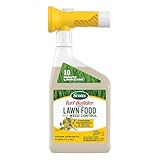
Every product in this category connects to a standard garden hose and siphons concentrate into the water stream — the same mechanism a weed killer spray with water hose hookup uses, just with fertilizer added to the mix. The big split is between ready-to-spray bottles (fixed dilution, single use) and concentrates you meter through a refillable hose-end sprayer like the Ortho Dial N Spray.
| Product | Bottle size | Labeled coverage | Product per 1,000 sq ft | Type |
|---|---|---|---|---|
| Scotts Liquid Turf Builder with Plus 2 Weed Control | 32 fl oz | Up to 6,000 sq ft | ~5.3 fl oz | Weed + feed |
| Spectracide Weed & Feed 20-0-0 Ready-to-Spray | 32 fl oz | Up to 7,500 sq ft | ~4.3 fl oz | Weed + feed |
| Ortho WeedClear Lawn Weed Killer Ready-Spray | 32 fl oz | Up to 5,000 sq ft | ~6.4 fl oz | Weed killer only |
| Broadleaf concentrate (2,4-D/dicamba/mecoprop type) + refillable hose-end sprayer | 32 fl oz concentrate | Typically 10,000–16,000 sq ft depending on labeled rate | ~1.5–3 fl oz | Weed killer only |
Two things listings won’t tell you. First, “up to” coverage assumes a brisk, steady walking pace — most people spray slower on their first pass and get 15–25% less coverage than the label claims, so budget for a second bottle on anything near the size limit. Second, cost per 1,000 sq ft differs sharply: a ready-to-spray bottle at roughly $12–18 works out to about $2.50–3.50 per 1,000 sq ft, while a quart of concentrate in the $15–30 range can drop that to under $1.50 — the trade-off is you must calibrate the sprayer yourself.
Dial settings, by product type
Ready-to-spray bottles (Scotts, Spectracide, Ortho)
These have no dial — just an on/off lever or twist tab. The dilution ratio is fixed inside the bottle, so your “setting” is walking speed and water pressure. Practical guidance:
- Run the hose at moderate pressure. Fully open is fine if flow is steady; a weak trickle reduces siphon draw and unevenly empties the bottle.
- Plan on roughly 3–5 minutes of spraying per 1,000 sq ft. Watch the bottle’s volume marks — if you’ve covered half your lawn and the bottle is only a quarter down, you’re walking too fast or pressure is too low.
- Shake before connecting and check the siphon tube inside isn’t kinked or clogged, a common cause of water spraying out while product stays in the bottle.
Concentrates in a dial-type sprayer
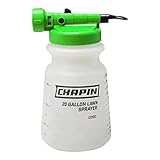
A refillable sprayer like the Ortho Dial N Spray meters concentrate in teaspoons or ounces per gallon of water emitted. To convert a label rate into a dial setting, you need to know how much water your sprayer puts down per 1,000 sq ft. Worked example:
- Label rate: 6 fl oz of product treats 2,500 sq ft.
- Your pace test: spray a marked 1,000 sq ft section with plain water, time it, then spray into a bucket for the same time and measure. Say you emit 2 gallons per 1,000 sq ft at your comfortable pace.
- Math: 6 fl oz ÷ 2,500 sq ft = 2.4 fl oz per 1,000 sq ft. At 2 gallons of water per 1,000 sq ft, that’s 1.2 fl oz per gallon — set the dial to the nearest mark, roughly 1 oz, and walk slightly slower to compensate.
This calibration step is the whole game with dial sprayers. Skipping it is how people either waste half a jar on 500 sq ft or mist the lawn with water and get no weed kill.
The mow-and-water timing that protects your grass and garden
| When | What to do | Why |
|---|---|---|
| 2–3 days before | Mow at normal height | Leaves weeds tall enough to absorb herbicide while reducing how much spray gets removed by the next mow |
| Day before (if dry) | Water deeply only if soil is dry | A drought-stressed lawn is the one that burns; moist soil buffers nitrogen uptake |
| Day of application | Spray on calm conditions (wind under ~5 mph), temps roughly 60–85°F, no rain forecast for 24 hours, foliage dry to lightly damp | Wind drifts 2,4-D-type herbicides onto ornamentals; heat above ~90°F volatilizes them and stresses turf |
| 24 hours after | No watering, no mowing | The herbicide needs leaf contact time to translocate into the weed’s roots; the fertilizer is already in solution and doesn’t need watering in |
| 48–72 hours after | First mow and normal watering resume | Herbicide has been absorbed; clippings no longer strip active ingredient off blades |
| Seeding window | Wait ~4 weeks after application to overseed; don’t treat new grass until it’s been mowed 2–3 times | Broadleaf herbicides inhibit germination and can kill tender seedlings |
The ornamental-plant part deserves emphasis: 2,4-D, dicamba, and mecoprop drift readily and damage tomatoes, grapes, roses, beans, and most flowering beds at tiny doses. Leave a 3–5 ft unsprayed buffer around beds, keep the spray pattern low and coarse rather than misting, and spot-treat near edges by hand instead of trusting the wind.
How to spray without burning stripes into the lawn
- Measure your lawn first (length × width, minus beds and paths). Knowing you’re treating 3,200 sq ft — not “about half an acre” — is what lets you pace the bottle correctly.
- Start at the far corner and walk backward in straight, slightly overlapping passes, sweeping the nozzle side to side at knee height pointed down. Overlapping by more than a few inches doubles the nitrogen and herbicide on those strips — that’s where the classic brown burn lines come from.
- Never spray a drought-dormant or already-yellowing lawn, and skip the application entirely if daytime highs will exceed the label’s cutoff (usually 85–90°F).
- Match the product to your grass. Standard 2,4-D-based weed and feed is labeled for most cool-season turf but can injure St. Augustine (especially Floratam), centipede, bahia, bentgrass, and dichondra lawns. For St. Augustine and centipede, use a hose-end product specifically formulated with atrazine instead — Spectracide makes one for southern lawns.
- Keep kids and pets off until the spray has dried, typically a few hours, and follow the re-entry language on your specific label.
Ownership realities and common mistakes
- Ready-to-spray bottles are disposable. Don’t refill them — the fixed siphon ratio won’t be correct for a different concentrate, and the seals degrade.
- Dial sprayers need a rinse routine. Empty the jar, rinse it three times, and run clear water through the sprayer for 30 seconds after every use. Leftover concentrate crystallizes in the metering orifice and is the main reason these sprayers clog by season two.
- Slight yellowing isn’t always burn. A mild whitening of grass tips for a week after a weed and feed application is common; true burn shows as sharp brown lines where passes overlapped, or uniform scorch if you sprayed a stressed lawn in heat.
- The siphon tube check matters. If water sprays but the bottle level doesn’t drop, the pickup tube is kinked, the screen is blocked, or hose pressure is too low to draw.
- Don’t double up. If the weed control part fails (rain washes it off, weeds are too mature), wait the label interval — often 30 days — before reapplying rather than going back out the next weekend.
Quick answers
Can I apply weed and feed hose spray to wet grass?
Dry to lightly damp foliage is ideal for liquid products — the droplets need to stay on weed leaves. (The “apply to wet grass” rule you may have heard applies to granular weed and feed, where moisture makes granules stick.) What matters most is the 24 hours after: no irrigation and no rain.
Why did my weeds survive?
Usually one of four causes: you walked too fast and under-dosed, the weeds weren’t actively growing (too cold, too hot, or drought), rain or sprinklers hit within the contact window, or the weeds are a species the product doesn’t control — most lawn broadleaf sprays don’t touch crabgrass or sedges.
Is weed and feed hose spray better than granular?
It’s faster to apply on lawns under ~5,000 sq ft and works when you can’t run a spreader evenly. Granular wins on larger lawns for cost per square foot and for products (like atrazine-based southern weed and feed) that don’t come in hose-end form. For most suburban lots, the hose spray is the lower-effort choice — just respect the timing table above.