Key takeaways
- The best weed killer that hooks up to a hose is a turf-labelled selective herbicide in a ready-to-spray bottle for large lawns, while a refillable dial-a-mix hose-end sprayer is usually cheaper for repeated applications.Table of ContentsQuick picks by situationHow hose-end…
What's inside
The best weed killer that hooks up to a hose is a turf-labelled selective herbicide in a ready-to-spray bottle for large lawns, while a refillable dial-a-mix hose-end sprayer is usually cheaper for repeated applications.
As an Amazon Associate we earn from qualifying purchases at no extra cost to you.



Quick picks by situation
| Situation | Best choice | Why it fits | Main limitation |
|---|---|---|---|
| One or two lawn treatments each year | 32-ounce ready-to-spray selective lawn herbicide | No measuring or separate sprayer; commonly covers about 5,000 square feet | Higher cost per treatment and more plastic waste |
| Several lawn treatments or a large yard | Refillable dial-a-mix hose-end sprayer plus concentrate | Adjustable dilution and lower cost per use | Requires accurate setup, cleaning and storage |
| Broadleaf weeds in established cool-season turf | Product containing 2,4-D with MCPP/MCPA and sometimes dicamba | Controls dandelion, plantain, clover and similar broadleaf weeds | Can injure trees, shrubs and sensitive warm-season grasses through drift |
| Crabgrass mixed with broadleaf weeds | Lawns product specifically listing quinclorac, often with broadleaf actives | Quinclorac adds post-emergence crabgrass control | Not every turf species tolerates it; read the label carefully |
| Warm-season grass in hot weather | A turf-specific product labelled for that grass, used below the label temperature limit | Reduces the risk of yellowing or temporary injury | Some formulations cannot be used on St. Augustinegrass, centipedegrass or fine fescue |
| Driveway, gravel or fence-line weeds | Non-selective glyphosate hose-end product | Kills grass and broadleaf plants rather than preserving turf | Will damage desirable plants it contacts |
How hose-end weed killers work
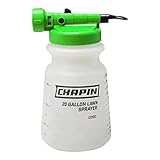
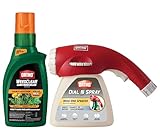
A hose-end sprayer mixes water from the tap with a concentrated herbicide as you spray. Ready-to-spray bottles have the concentrate already sealed inside and normally use a selector such as “water,” “spray” or “off.” A refillable unit, such as an Ortho Dial N Spray-style sprayer, draws concentrate from its jar and lets you select a dilution rate, often expressed as ounces of product per gallon of water.
The dial setting is not a universal strength rating. “2 ounces per gallon” means two fluid ounces of concentrate for each gallon of finished spray water; it does not mean two ounces per gallon of tap water in every sprayer design. Some models meter concentrate continuously while others use numbered settings. Use the setting printed on the herbicide label, then match the sprayer’s instructions to that rate.
Dial-a-mix calculation
Suppose a label calls for 2 fluid ounces of concentrate per gallon and you need 4 gallons of finished spray. The concentrate requirement is:
2 fl oz × 4 gallons = 8 fl oz of concentrate.
If a refillable bottle holds 32 fluid ounces, it can make roughly 16 gallons of finished spray at that setting. If the label says one gallon treats 1,000 square feet, that batch covers about 16,000 square feet. Real coverage will be lower if you overlap passes, spray dense weeds or use a coarse setting, so treat these figures as planning limits rather than guarantees.
Coverage: read the bottle instead of guessing
Many 32-ounce ready-to-spray lawn products advertise approximately 5,000 square feet of coverage, but the exact area depends on the product, weed size and application rate. A simple comparison is:
| Container | Typical stated lawn coverage | Approximate product per square foot | Best use |
|---|---|---|---|
| 32-ounce ready-to-spray bottle | About 5,000 sq ft | 0.0064 fl oz, or about 0.19 mL | Small to medium lawn, occasional use |
| 64-ounce concentrate | Often 10,000–20,000 sq ft, depending on label rate | Varies by dilution | Several applications or larger property |
| 32-ounce refillable sprayer jar | Depends on dial setting and water flow | Set by the herbicide label | Repeat applications with one sprayer |
| 1-gallon concentrate jug | Commonly tens of thousands of square feet | Varies widely by active ingredient | Large acreage, lawn-care routines |
For a 3,000-square-foot lawn, a 5,000-square-foot bottle is not automatically a reason to spray more heavily. Apply only the amount needed for the measured area. Over-application can injure turf and does not reliably improve control. For a concentrate, calculate the required finished volume from the label and mix only that amount.
Which active ingredients are turf-compatible?
Broadleaf weeds
2,4-D is a common selective herbicide for dandelion, chickweed, plantain and other broadleaf weeds in labelled turf. Combination products may add MCPP or MCPA for a wider range of weeds and dicamba for difficult broadleaf species. These ingredients kill or suppress broadleaf weeds while generally leaving listed grasses unharmed when applied at the correct rate.
“Generally” is important. A product safe on Kentucky bluegrass may be unsuitable for St. Augustinegrass, centipedegrass, carpetgrass or some fine fescues. Dicamba and related products can also injure nearby ornamentals, vegetables and trees if spray drifts or reaches roots through contaminated soil.
Crabgrass and grassy weeds
Quinclorac is used in some post-emergence lawn herbicides for crabgrass and selected broadleaf weeds. It is not a universal grass-safe ingredient: the label may restrict use on certain turf types or newly seeded lawns. If the main problem is crabgrass, choose a product whose label specifically names crabgrass and your grass species rather than selecting a broadleaf killer and hoping it works.
Non-selective vegetation control
Glyphosate kills many plants, including lawn grass. It makes sense for cracks, gravel and fence edges where no desirable vegetation should remain, but it is the wrong choice for a lawn. Some hose-end products marketed for “weed and grass killer” are deliberately non-selective; keep them separate from turf products to avoid a costly mistake.
Ready-to-spray versus refillable dial sprayer
Ready-to-spray products are easiest for first-time users. Connect the bottle, turn on the water, and walk at a steady pace. They avoid measuring errors, but their coverage is fixed and the container may cost more per 1,000 square feet. Examples in this category include Ortho WeedClear Lawn Weed Killer Ready-To-Spray and Spectracide Weed Stop for Lawns Ready-to-Spray; available formulations and labelled grasses can change, so check the current packaging.
A refillable sprayer is the better ownership choice when you treat more than once or maintain a large lawn. It can accept different labelled concentrates, and a 32-ounce jar may produce many gallons of spray. The trade-off is responsibility: the wrong dial setting, an incorrectly seated pickup tube or an uncleaned reservoir can produce either weak control or turf damage.
How to apply a hose-end lawn herbicide accurately
- Identify the grass and weeds. Confirm both on the product label. Do not rely solely on a brand name or a picture.
- Measure the lawn. Multiply length by width for rectangles and add sections together. Exclude patios, beds and buildings.
- Check conditions. Avoid windy weather, rain in the label’s stated rain-free period, drought-stressed turf and freshly mown grass if the label advises against them.
- Set the sprayer. Use the label’s ounces-per-gallon setting, not a stronger setting because weeds look severe.
- Spray evenly. Walk at a consistent pace and keep the nozzle at a uniform height. Stop at property boundaries and avoid ornamental plants.
- Clean immediately. Run clean water through a refillable sprayer, rinse the jar and flush the hose connection. Do not pour leftover herbicide into drains, soil or waterways.
Durability and ownership details people often miss
The first parts to wear on inexpensive hose-end sprayers are usually the selector seal, pickup tube, screen filter and hose washer. Hard water can leave mineral deposits in the venturi, while concentrated herbicide residue can make the selector sticky. Store the sprayer empty, out of freezing temperatures and away from direct sun. Replace cracked washers rather than forcing a leaking connection.
Keep herbicide containers in their original labelled packaging, tightly closed and secured away from children, pets and food. Wear the label-specified protective equipment, and wash hands and clothing after use. Do not mow immediately before or after treatment unless the label permits it; leaf area is needed for many systemic herbicides to enter the weed.
Bottom line
Choose a ready-to-spray bottle for convenience and a refillable dial-a-mix sprayer for repeated, lower-cost treatments. For turf, look first for the correct grass species and then for an active ingredient suited to the weed: 2,4-D combinations for broadleaf weeds, quinclorac-labelled products for crabgrass, and glyphosate only where killing the existing vegetation is acceptable. Coverage numbers and dial settings are meaningful only when they come from the specific product label.