Key takeaways
- Automatic shut-off: The unit should stop when the water is depleted or an unsafe temperature is detected.
- Overheat protection: This reduces risk if the steamer is accidentally left running.
- Stable base: A broad, non-slip base matters because a hot-water appliance should not wobble near the edge of a counter.
- Insulated housing: The casing and handle should remain comfortable to touch during normal use.
- Clear fill and maximum lines: Overfilling can cause spluttering and water droplets.
- Covered controls and protected cable: These help keep moisture away from electrical connections.
Best Facial Steamers for At-Home Skincare
The best facial steamers for regular home use are countertop models with a 70–100 ml removable tank, a warm-up time of about 60–90 seconds, an adjustable nozzle, and automatic shut-off if the tank empties or the unit overheats.
Steamers differ less in their basic purpose than in how safely and conveniently they deliver it. The important buying questions are whether the steam output feels consistent, whether the tank lasts through a session, how easily you can clean the water path, and whether the nozzle can direct steam without forcing your face too close to the outlet. The comparison below focuses on those ownership details rather than cosmetic claims.
Our top picks


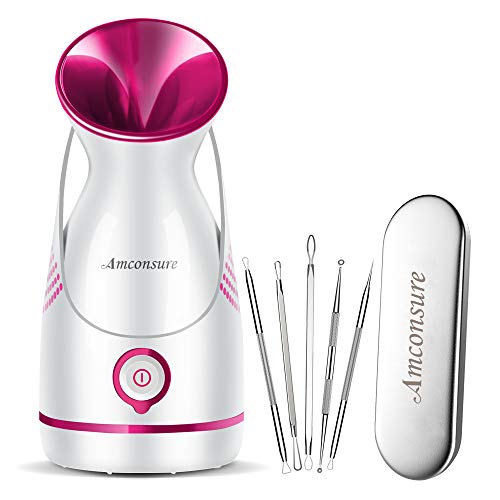
As an Amazon Associate we earn from qualifying purchases at no extra cost to you. Ratings are shown as listed on Amazon.
Quick comparison of facial steamer types
| Type | Typical steam output | Tank capacity | Warm-up time | Best suited to | Main compromise |
|---|---|---|---|---|---|
| Compact personal steamer | 4–6 ml/min | 50–80 ml | 45–75 seconds | Occasional use and small bathrooms | Shorter runtime and smaller face coverage |
| Standard countertop steamer | 5–8 ml/min | 80–120 ml | 60–120 seconds | Regular home skincare | Larger footprint and more cleaning |
| Professional-style tabletop unit | 7–12 ml/min | 150–250 ml | 90–180 seconds | Frequent use or shared households | Higher price, weight, and storage needs |
| Portable USB or rechargeable model | 1–4 ml/min | 15–40 ml | 10–60 seconds | Travel and very short sessions | Less powerful steam and battery charging |
These are useful category ranges, not a promise that every model will perform identically. Manufacturers may measure output under different conditions, so output figures should be compared alongside tank size, nozzle design, and user controls.
What makes a facial steamer a good regular-use choice?
Consistent steam output
A strong output number is not automatically better. A narrow, forceful jet can feel uncomfortably hot, while a weak mist may disappear before it reaches your face. For most home users, a steady 5–8 ml per minute is a practical middle ground. Look for a broad outlet or diffuser that distributes vapor across the face rather than concentrating it in one spot.
Some models advertise “nano” or ionic steam. These labels describe how the vapor is generated or dispersed, but they do not remove the need for sensible distance and temperature control. A unit with adjustable intensity is generally more useful than one relying on a single high-output setting.
Tank capacity and runtime
Capacity determines convenience more than headline power. A 100 ml tank producing 6 ml per minute could theoretically provide about 16 minutes of output:
100 ml ÷ 6 ml/min = approximately 16.7 minutes
In practice, the heater may stop before every last millilitre is used, so expect somewhat less. A 5–10 minute session usually needs only 30–80 ml, depending on the steamer. A 50 ml tank is adequate for occasional personal use; an 80–120 ml tank is more comfortable when you want a margin against refilling. Very large tanks can be inconvenient if water sits unused for several days.
Warm-up time
Warm-up times under two minutes are convenient for a normal routine. Portable models may start faster, but their lower output often means less even coverage. A longer warm-up is not necessarily a defect if it produces stable steam, but the unit should indicate when it is ready. Avoid models that begin sputtering or ejecting hot droplets during startup.
Nozzle adjustability
A nozzle that tilts, swivels, or telescopes is valuable because seating position and face size vary. The adjustment should hold its position without slowly drooping toward you. A wide-angle outlet helps cover the cheeks and forehead, while a narrower setting can suit someone who prefers a more concentrated flow.
Do not choose a design that requires your face to be very close to the outlet. The steamer should work comfortably with your face roughly 20–30 cm away, or at the distance specified in its instructions. Steam should feel warm and comfortable, never painful or sharply hot.
Cleaning access
Cleaning access is one of the clearest differences between a convenient steamer and a frustrating one. Prefer a tank that lifts out completely, a wide filling opening, and a drain plug or accessible reservoir floor. A permanently sealed water chamber may look neat but can trap mineral deposits and stale water.
Transparent or clearly marked tanks make it easier to check the water level. A removable nozzle or diffuser is also useful because condensation can collect around the outlet. If the manual permits descaling, follow its recommended solution and frequency; do not assume that vinegar, essential oils, or household disinfectants are safe for every internal component.
Best facial steamers by situation
| Your situation | Look for | Why this choice works |
|---|---|---|
| First-time user | 50–100 ml tank, automatic shut-off, fixed safe-distance guidance | Simple controls reduce setup and positioning mistakes |
| Use several times per week | 80–120 ml removable tank, 5–8 ml/min output, drain access | Balances runtime with manageable cleaning |
| Limited counter space | Footprint under roughly 15 × 15 cm and a retractable or short nozzle | Easier to store without sacrificing basic safety features |
| Shared household | 150 ml or larger tank, washable nozzle, easy-to-wipe exterior | Fewer refills, with better hygiene between users |
| Travel | Portable model with a 15–40 ml tank and protected charging port | Compact and adequate for brief sessions, though less powerful |
| Hard-water area | Wide tank opening, visible water path, descaling instructions | Mineral buildup is easier to detect and remove |
Safety features worth paying for
- Automatic shut-off: The unit should stop when the water is depleted or an unsafe temperature is detected.
- Overheat protection: This reduces risk if the steamer is accidentally left running.
- Stable base: A broad, non-slip base matters because a hot-water appliance should not wobble near the edge of a counter.
- Insulated housing: The casing and handle should remain comfortable to touch during normal use.
- Clear fill and maximum lines: Overfilling can cause spluttering and water droplets.
- Covered controls and protected cable: These help keep moisture away from electrical connections.
Steam can burn skin. Keep children and pets away, never move a full heated unit unnecessarily, and stop immediately if the heat feels painful. People with conditions affected by heat, reduced facial sensation, persistent skin irritation, or respiratory concerns should ask a qualified healthcare professional whether facial steaming is appropriate. Steam is not a substitute for treatment.
Setup and maintenance that extends service life
- Fill with the recommended water. Use the manual’s guidance; some units permit filtered water, while others specify distilled water to reduce deposits.
- Place the steamer on a level, dry surface. Leave clearance around vents and keep the cord away from the sink.
- Wait until steam is stable. Do not put your face over the outlet during sputtering or startup.
- Set the nozzle before leaning in. Maintain the stated distance and use a short session rather than increasing heat to compensate for weak output.
- Empty the tank afterward. Standing water can develop odors and leave mineral residue.
- Wipe and air-dry the reservoir. Clean the nozzle and exterior with a soft, damp cloth, keeping liquid away from electrical openings.
- Descale on schedule. Frequency depends on water hardness and use. A household using the steamer three times weekly may need inspection every few weeks, while occasional users may need it less often.
The parts most likely to cause trouble are the heating plate, nozzle seal, tank cap, and water-level sensor. Mineral scale can reduce output and lengthen warm-up time; forcing a tight cap or dropping a removable tank can damage its seal. Essential oils are a common mistake: unless the manufacturer specifically provides an oil-safe compartment, they can clog the water path, degrade plastics, and create irritating airborne vapors.
How much should you spend?
General market pricing is roughly $20–$50 for basic compact models, $40–$100 for better-equipped countertop steamers, and $100–$250 or more for professional-style units. The sensible upgrade is usually better construction, tank access, nozzle control, and safety circuitry—not simply a larger steam figure.
For most households, a standard countertop steamer with an 80–120 ml removable tank, 5–8 ml per minute output, sub-two-minute warm-up, adjustable nozzle, and automatic shut-off offers the best balance. Choose a compact model when storage is the deciding factor, a portable unit for travel, and a larger tabletop model only when frequent or shared use justifies its extra cleaning and counter space.