Key takeaways
- Best for Most Multi-Cat Homes: SureFeed Microchip Pet Feeder (Model MPF001) – reliable sealed lid, stores 32 IDs, runs on batteries without Wi-Fi dependency.
- Best for Prescription Diets & Portion Control: SureFeed Microchip Pet Feeder Connect – adds app-based portion tracking, lid open/close history, and low-food alerts.
- Best for Large or Pushy Cats: SureFeed Microchip Pet Feeder with Rear Cover Accessory – prevents a second cat from stealing from behind while the authorized cat eats.
- Alternative Selective Feeder (No Microchip): Wireless Whiskers AutoDiet Feeder – RFID tag-based system for cats that are not microchipped or have incompatible chips.
The best microchip activated cat feeders for multi cat homes are the Sure Petcare SureFeed Microchip Pet Feeder and the SureFeed Microchip Pet Feeder Connect, because they offer the most reliable chip compatibility, the only truly sealed lid design on the market, and proven portion control for prescription, weight-management, and life-stage diets.
Our top picks
 PETLIBRO RFID Automatic Cat Feeder
- Collar Tag Sensor-Activated Personalized Meals: Each cat wears…
- Prevent Food Stealing & Support Different Diets: RFID-controlled…
- Smart Cat Recognition & Real-Time Diet Tracking: Monitor…
 PETLIBRO RFID Automatic Cat Feeders for 3
- Collar Tag Sensor-Activated Personalized Meals: Each cat wears…
- Smart Cat Recognition & Real-Time Diet Tracking: Monitor…
- Prevent Food Stealing & Support Different Diets: RFID-controlled…
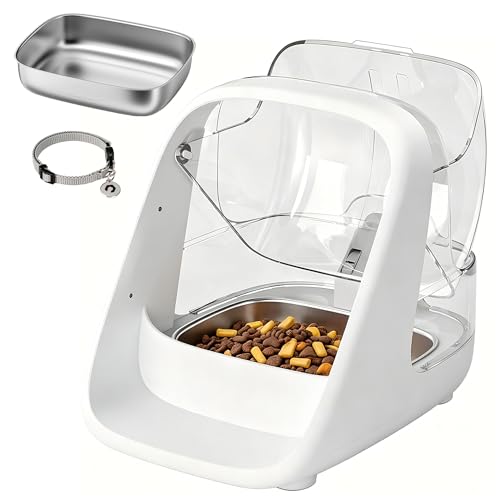 ePawDen Microchip Pet Feeder
- 🔒 Prevent Food Stealing
- 🔋 Rechargeable via USB-C
- 🥣 Stainless Steel Bowl Included
| Product | Key specs | |
|---|---|---|
| PETLIBRO RFID Automatic Cat Feeder | Collar Tag Sensor-Activated Personalized Meals: Each cat wears… Prevent Food Stealing & Support Different Diets: RFID-controlled… Smart Cat Recognition & Real-Time Diet Tracking: Monitor… | Check price |
| PETLIBRO RFID Automatic Cat Feeders for 3 | Collar Tag Sensor-Activated Personalized Meals: Each cat wears… Smart Cat Recognition & Real-Time Diet Tracking: Monitor… Prevent Food Stealing & Support Different Diets: RFID-controlled… | Check price |
| ePawDen Microchip Pet Feeder | 🔒 Prevent Food Stealing 🔋 Rechargeable via USB-C 🥣 Stainless Steel Bowl Included | Check price |
 PETLIBRO Automatic Cat Feeders for 2 Cats PETLIBRO Automatic Cat Feeders for 2 Cats | Dual-Cat Exclusive Feeding System (Pack of 2) :… Real-Time Diet Tracking: Compare and monitor both cats'… Prevent Food Stealing & Support Different Diets: Perfectly… | Check price |
As an Amazon Associate we earn from qualifying purchases at no extra cost to you.
Top Picks at a Glance
Not every multi-cat home needs the same feeder. Use this quick selector before diving into the full comparison:
- Best for Most Multi-Cat Homes: SureFeed Microchip Pet Feeder (Model MPF001) – reliable sealed lid, stores 32 IDs, runs on batteries without Wi-Fi dependency.
- Best for Prescription Diets & Portion Control: SureFeed Microchip Pet Feeder Connect – adds app-based portion tracking, lid open/close history, and low-food alerts.
- Best for Large or Pushy Cats: SureFeed Microchip Pet Feeder with Rear Cover Accessory – prevents a second cat from stealing from behind while the authorized cat eats.
- Alternative Selective Feeder (No Microchip): Wireless Whiskers AutoDiet Feeder – RFID tag-based system for cats that are not microchipped or have incompatible chips.
Spec Comparison: Sealed Microchip Feeders for 2026
Sure Petcare (now part of Closer Pets) remains the only major manufacturer with a fully sealed, microchip-activated bowl design. RFID-tag alternatives exist, but they do not read implanted microchips. Here is how the core options compare on the specs that matter for food stealing:
| Feature | SureFeed Microchip Pet Feeder (MPF001) | SureFeed Microchip Pet Feeder Connect | Wireless Whiskers AutoDiet Feeder |
|---|---|---|---|
| Identification Method | Microchip (15-digit FDX-B 134.2 kHz) + RFID collar tag | Microchip (15-digit FDX-B 134.2 kHz) + RFID collar tag | RFID collar tag only (no microchip reading) |
| IDs Stored | 32 pets | 32 pets | 10 pets (1 tag included) |
| Lid Type | Sealed, neoprene lip + sensor-activated wrap-around lid | Sealed, neoprene lip + sensor-activated wrap-around lid | Open bowl with selective cover that slides open, no seal |
| Food Capacity | 2 x 400 ml sealed bowls (approx. 350g dry food total) | 2 x 400 ml sealed bowls (approx. 350g dry food total) | Single 3.5 cup (approx. 830 ml) hopper |
| Portion Control | Manual (weigh / measure food yourself) | Manual + app tracks weight removed per visit (via integrated scales, accuracy +/- 1g) | Automatic dispensing, 1/8 cup (approx. 15g) increments |
| Power Source | 4 x C-cell batteries | 4 x C-cell batteries + Hub (requires mains power) | Mains adapter + battery backup |
| Battery Life | ~6 months with typical use | ~6 months (feeder), Hub always plugged in | Battery backup ~24 hours |
| Weight / Dimensions | 2.1 kg / 30 x 20 x 19 cm | 2.2 kg / 30 x 20 x 19 cm | 3.6 kg / 36 x 33 x 38 cm |
| Material | ABS plastic housing, sealed neoprene seal, stainless-steel bowl insert | ABS plastic housing, sealed neoprene seal, stainless-steel bowl insert | ABS plastic, stainless-steel bowl |
| Typical Market Range (2026) | $180 – $210 | $250 – $300 plus Hub if not bundled | $200 – $240 |
Decision Matrix: Which Feeder Matches Your Situation?
Microchip feeders solve one problem, but homes fail when the feeder does not match the cat dynamic. Use this matrix to choose by situation:
| Your Situation | Recommended Choice | Why |
|---|---|---|
| You have 2-3 cats, one steals food or needs a urinary/renal diet | SureFeed Microchip Pet Feeder | Sealed lid keeps prescription kibble from being grazed; no Wi-Fi needed, lower ongoing cost. |
| You need to monitor exactly how much each cat eats daily | SureFeed Microchip Pet Feeder Connect | Integrated scales log grams eaten and lid events in the app, useful for weight loss or vet monitoring. |
| One cat guards or bullies another cat off the feeder | SureFeed + Rear Cover + strategic placement | Open-backed design is vulnerable from behind; the rear cover and placing feeders in separate rooms is essential. |
| Cat is not chipped, chip has migrated, or kitten too small to chip | Wireless Whiskers AutoDiet or SureFeed with RFID tag | RFID tag works independently of implantation; tag must stay on a breakaway collar. |
| Frequent power outages or no reliable Wi-Fi | SureFeed Microchip Pet Feeder (non-Connect) | Battery-only operation is more resilient than Hub or mains-dependent dispensers. |
| Budget is tight and you only need to block dry food stealing | SureFeed Microchip Pet Feeder (standard) | Connect premium only justified if you need data; basic model provides same seal and chip reading. |
Chip Compatibility: What Actually Works
Compatibility is the number one failure point buyers discover after unboxing. The SureFeed range reads the universal 15-digit FDX-B microchip operating at 134.2 kHz, which is the ISO 11784/11785 standard used for cats in the US, UK, EU, and Australia since the mid-2010s. If your cat was chipped before 2010 or outside those regions, confirm it is a 15-digit chip. Older 10-digit Avid Encrypted or Trovan chips will not be read.
Practical nuances that listings rarely explain:
- Chip migration matters. If the chip has moved from the shoulder blades to the shoulder or chest, the reading distance (typically 2-4 cm from the feeder’s sensor) can fail. The feeder has a Learn Mode that confirms reading during setup – if it does not beep and learn within 10 seconds, reposition the cat or try the included RFID collar tag.
- Multiple cats, one feeder. Each feeder can learn up to 32 IDs, but that does not mean one feeder can selectively dispense different portions to different cats. It means you can authorize which cats may open that specific feeder. For most homes you need one feeder per special diet.
- Collars vs. chips. The included Sure Petcare RFID tag is a lightweight disc for cats that are not chipped, but it requires a collar. Many cats lose collars. If your cat is collar-averse, an implanted chip is far more reliable.
Sealed Lid Design: Why It Is the Difference in Multi-Cat Homes
An open automatic feeder that simply recognizes a chip but leaves food exposed does not stop stealing. Cats quickly learn to rush in as soon as the lid opens for the other cat.
The SureFeed mechanism is fundamentally different: the bowl sits inside a sealed compartment with a silicone neoprene seal around the rim. The wrap-around lid stays closed via a partial vacuum and only retracts when an authorized chip is detected within ~10 cm. When the cat moves away, the lid closes in under 2 seconds. This design does three things generic selective feeders do not:
- Blocks scent, which reduces food-seeking behavior from the non-authorized cat.
- Keeps wet food fresher for 8-12 hours (dry food for 24+ hours) compared to an open bowl, slowing drying and oxidation.
- Prevents flies and airborne bacteria compared to uncovered bowls.
Limitations to plan for: the seal is not airtight like a container. Wet food will still dry at the edges after half a day, and the rear of the feeder is open so the authorized cat can enter. A determined second cat can still approach from behind and try to insert its head alongside. The optional Rear Cover closes this gap and is strongly recommended for homes with a food-aggressive cat. Placing feeders on opposite sides of a room, or in different rooms, further reduces guarding.
Portion Control Reality: Sealed Bowl vs. Automatic Dispensing
Owners often confuse portion control with portion dispensing. They are not the same.
SureFeed (sealed bowl): You control the portion by weighing what you put in. The Connect model then weighs what was removed. For example, if you add 70g of renal kibble in the morning and the app shows Cat A removed 42g by 2pm, you know 28g remains and Cat B has not accessed it. You still need to remove and refresh old food daily. This system is ideal for ad-libitum feeding or measured daily allowances where freshness matters.
Wireless Whiskers AutoDiet (dispensing): You set a daily allowance (e.g., 200g) and the feeder dispenses in 1/8-cup increments only when the authorized tag is present. It is better for strict calorie restriction without owner measuring, but it cannot seal food and is louder due to the auger motor.
Worked Example: Cost and Amount Fit
A common multi-cat scenario: Cat A (4kg, indoor, needs weight loss) is prescribed 190 calories per day. Cat B (5kg, healthy) eats 250 calories per day. Using a typical indoor dry food at ~3,600 kcal per kg:
- Cat A needs approx. 53g per day (190 / 3.6). Cat B needs approx. 69g per day.
- A single 400 ml SureFeed bowl holds ~175g of that kibble. Filling one bowl per cat covers 3 days for Cat A (53g x 3 = 159g) or 2.5 days for Cat B.
- If you refill daily for freshness, you will use roughly 1.6 kg per month for Cat A and 2.1 kg per month for Cat B. At a general market range of $45-$65 for a 3.5kg bag, the monthly food cost remains ~$20-$30 per cat. The feeder itself amortized over 3 years equals $5-$8 per month – less than wasted prescription food from stealing.
This calculation shows why a 350g total capacity is sufficient for cats; dogs need larger hoppers, but cats need freshness and sealing more than bulk storage.
Setup Steps That Prevent Most Returns
Most faults are setup errors, not hardware defects. Follow this order for reliable reading:
- 1. Add batteries and let it calibrate empty. Place the feeder on a hard, flat floor. Carpets can tilt the sensor and cause false triggers. Keep it at least 1 meter from metal appliances, microwaves, or large steel bowls.
- 2. Train one cat at a time. Use Training Mode (lid stays open and slowly closes more). Let the shyest cat learn first without competition. Keep the other cats out of the room for the first two days.
- 3. Learn the chip correctly. Press Add/Remove Pet, wait for the flashing light, and lure the cat’s head over the bowl with a treat until you hear the confirmation beep. If using a tag, attach it so it hangs below the chin, not to the side.
- 4. Position for social dynamics. Do not place two chip feeders side-by-side. Dominant cats will patrol both. Place them in separate corners or rooms with escape routes so a timid cat is not cornered while eating.
- 5. Set lid-close delay. For slow eaters, set the lid to wait 3-5 seconds longer after the cat steps back. For fast thieves, keep the default 1-2 seconds.
Durability and Ownership Realities
Sealed microchip feeders have consumables and wear points that product listings gloss over:
- Seal and hinge wear first. The neoprene seal needs wiping every 2-3 days (wet food residue degrades it) and replacement every 12-18 months. The lid motor hinge can collect hair. Vacuum the rear vents monthly.
- Batteries vs. power. Expect 4 C-cells to last 5-7 months with 4-6 openings per day. Low batteries cause slow or incomplete lid retraction – replace all four at once, do not mix old and new cells. Rechargeable C-cells work but give 20-30% shorter run time.
- Cleaning mistakes. The main housing is not waterproof. Never submerge it. Remove the stainless-steel bowl and neoprene seal and wash them separately. Wipe the sensor window (small dark plastic near the bowl rim) with a dry cloth; scratched or wet sensors misread chips.
- The one-feeder-per-diet rule. A single microchip feeder cannot feed two cats different foods at the same time. Homes with two prescription diets need two feeders. Trying to use one feeder for both inevitably leads to stealing.
- Connect Hub placement. The Connect Hub needs to be within 10 meters, ideally same room, with no thick masonry walls in between. If your feeders are in separate rooms, place the Hub centrally. Without the Hub, the Connect feeder works exactly like the standard model, so you do not lose feeding function if Wi-Fi drops.
For general health-related diets, use microchip feeders as a management tool only. They do not diagnose or treat conditions and are not a substitute for veterinary advice. If a cat stops eating, loses weight rapidly, or you are managing kidney disease, diabetes, or allergies with prescription food, consult your veterinarian about daily amounts and monitoring.
Frequently Asked Questions
Can one microchip feeder stop my cat from eating the other cat’s food if they eat at the same time?
No. One feeder only protects the food inside it. The other cat’s bowl remains unprotected unless it is also in a microchip feeder. For complete separation, each diet needs its own sealed feeder.
Will a microchip feeder work if my cat’s chip is on its left side or has migrated?
Often yes, if the chip is still within ~4 cm of the sensor when the cat’s head is in the bowl. Use Learn Mode to test before committing. If it fails repeatedly, use the included RFID tag on a collar as a backup – the feeder will prioritize whichever ID it detects first.
Can kittens use microchip feeders?
Kittens must be large enough to reach the sensor, typically from about 12 weeks or 1.3kg, and already microchipped. Very small kittens may not reliably trigger the sensor and are better managed with separate feeding times until they grow.
Do these feeders work for wet food?
Yes, the sealed SureFeed design is specifically intended for wet food to keep it moist and prevent other cats from accessing it. Replace wet food every 12 hours for hygiene, and clean the seal daily. Dry food can stay for 24 hours.
What if I have more than two cats with different needs?
You can allocate one feeder per special diet and allow healthy cats to share a feeder (program multiple authorized chips to one feeder) or use a communal bowl for cats with no restrictions. Labelling feeders with cat names avoids confusion for family members.