Key takeaways
- Best overall gas pick: Stihl SR 430. A 63.3 cc engine, a 14-liter (3.7-gallon) tank and a published horizontal reach of about 48 feet.
- Best for daily professional-style use: Stihl SR 450, the higher-spec Stihl in the same class.
- Best alternative brand: Solo 451, a long-running mistblower design with a straightforward layout and a large parts network.
- Best lighter gas option: Solo 435, aimed at smaller properties and users who want less weight on the back.
- Best battery alternative for large lots: EGO Power+ SP150, a 4-gallon-class backpack sprayer on a 56V battery platform.
- Best battery pick for tool-platform owners: Milwaukee M18 4-gallon backpack sprayer.
- Best entry-level battery option: Chapin 63985, a 4-gallon-class battery backpack sprayer from a sprayer specialist.
The Stihl SR 430 is the best gas-powered backpack sprayer for most people who need engine power, with the Stihl SR 450 as the step-up pick for heavier daily use and the Solo 451 and Solo 435 as the other gas options worth a look. If your spraying fits inside roughly an acre per session, a battery backpack such as the Milwaukee M18 4-gallon, the EGO Power+ SP150 or the Chapin 63985 will be quieter, easier to maintain and good enough.
Gas backpack sprayers are a narrow category. Most of what gets sold under that label is really a mistblower: a small two-stroke engine drives a fan, and the fan throws a fine, fast cloud of liquid far higher and farther than a hand-pumped or battery diaphragm sprayer can. That is the reason to buy one. You pay for it in weight, noise, fuel handling and engine upkeep. This guide explains how to decide whether gas power earns its place on your property, what the numbers on the spec sheet mean, and which models fit which jobs.
Our top picks

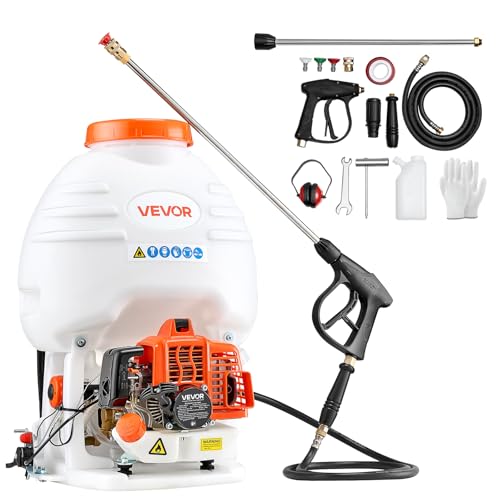


As an Amazon Associate we earn from qualifying purchases at no extra cost to you.
Quick picks
- Best overall gas pick: Stihl SR 430. A 63.3 cc engine, a 14-liter (3.7-gallon) tank and a published horizontal reach of about 48 feet.
- Best for daily professional-style use: Stihl SR 450, the higher-spec Stihl in the same class.
- Best alternative brand: Solo 451, a long-running mistblower design with a straightforward layout and a large parts network.
- Best lighter gas option: Solo 435, aimed at smaller properties and users who want less weight on the back.
- Best battery alternative for large lots: EGO Power+ SP150, a 4-gallon-class backpack sprayer on a 56V battery platform.
- Best battery pick for tool-platform owners: Milwaukee M18 4-gallon backpack sprayer.
- Best entry-level battery option: Chapin 63985, a 4-gallon-class battery backpack sprayer from a sprayer specialist.
Do you actually need gas power?
Before comparing engines, check the job against three questions.
- How high do you need to reach? A standard wand sprayer, gas or battery, reaches about as high as you can lift your arm. A mistblower pushes spray 30 to 40 feet upward. Tall hedges, mature fruit trees, pole-barn eaves and wasp nests under high gables are mistblower work.
- How much ground per session? A diaphragm pump on a battery backpack can cover one to two acres of broadcast spraying on a single charge if you keep a spare battery. Past that, runtime and refill logistics become the limit, and a gas engine that you refuel in 30 seconds keeps going.
- What are you spraying? Mistblowers atomize liquid into very fine droplets. That helps with dense foliage coverage for insecticide and fungicide. It also means drift. Herbicide, especially non-selective or growth-regulator products, belongs in a low-pressure, coarse-droplet wand sprayer, not a mistblower.
If your honest answers are “ground level, under an acre, mostly herbicide or fertilizer,” skip gas and read the battery section below. If you answered “tall trees, orchard rows, big acreage, or treating hedges, bamboo or tall brush,” gas is the right tool.
How we chose
This guide is research-based. We compared manufacturer specification sheets, published dealer listings and the way each machine is described for use, then weighed them against the criteria that matter in practice: engine displacement, tank volume, empty weight, reach, whether a pressure pump is included, and the safety and maintenance burden. Where a figure could not be confirmed from a current official or dealer listing, the table below describes the spec class instead of quoting a number, and the point is flagged. No model is ranked on brand reputation alone.
Spec criteria that decide the purchase
Engine size
Backpack sprayer engines in this class run from the high 20s to the low 60s in cubic centimeters. Smaller engines around 25 to 30 cc are common on lighter mistblowers and are fine for hedges and shrubs. Engines near 60 cc, like the 63.3 cc unit in the Stihl SR 430, move much more air, which is what gives reach into tall canopies. Bigger is not automatically better: more displacement means more weight, more noise and more fuel.
Tank size
Tanks usually run 2.5 to 4 gallons. Water weighs about 8.3 pounds per gallon, so a 3.7-gallon tank adds roughly 31 pounds of liquid. Bigger tanks mean fewer refills but a steeper load when full. Most users do better with a tank they can carry for the length of a session than the largest one on the shelf.
Flow rate and pump
On a mistblower the fan carries the liquid, and a pressure pump (the SR 430 includes one) keeps discharge steady when you tilt the nozzle upward. For a conventional pressure backpack, flow is set by pump output and nozzle choice. For broadcast work, the flow you need is simple arithmetic, shown in the worked example below.
Weight and vibration
Empty weight is what you feel in the shoulders after an hour. The SR 430 is listed at 27.3 pounds empty. Add a full tank and the pack is well above 55 pounds, which is a real load. Look for a padded, adjustable harness, a hip belt if one is offered, and an anti-vibration system. Two-stroke engines against your back also transmit heat and vibration, so a good harness matters more than the cc figure.
Starting and fuel
Easy-start recoil systems reduce the pull effort. Two-stroke models need the correct oil-and-fuel mix unless the manufacturer specifies otherwise, and fuel older than a month or two can cause hard starts. Plan on a fuel stabilizer and an empty-the-tank routine before storage.
Worked example: sizing a sprayer to your acreage
Use this logic to see what you really need.
- Pick an application rate. Many broadcast liquid products call for about 20 gallons of finished spray per acre; check your own product label, because rates vary.
- Estimate coverage speed. Walking at 3 miles per hour with an effective swath of 10 feet gives 3 x 5,280 x 10 / 43,560 = about 3.6 acres per hour in theory. Real-world efficiency with turns, stops and overlap is around 70 percent, so assume 2.5 acres per hour.
- Calculate the flow you need. 2.5 acres per hour x 20 gallons per acre = 50 gallons per hour, or about 0.83 gallons per minute.
- Count the refills. A 4-gallon tank covers 4 / 20 = 0.2 acre per fill, so one acre needs five fills. A 3.7-gallon tank, like the SR 430, needs about 5.4.
- Check the load. A full 3.7-gallon tank is about 31 pounds of liquid. Add the SR 430’s 27.3 pounds empty and you carry roughly 58 pounds at the start of each fill, dropping as you spray.
The takeaway: for a 5-acre field, the problem is not the sprayer, it is 25 refills and hours of carrying 40-plus pounds. At that scale, a pull-behind or ATV sprayer is a better tool than any backpack. Gas backpacks make the most sense for 1 to 5 acres of mixed terrain, tall canopy work and spots a vehicle cannot reach.
Comparison table
| Model | Power | Tank class | Weight class | Best use | Spec status |
|---|---|---|---|---|---|
| Stihl SR 430 | 63.3 cc, 2.9 kW (3.9 bhp), gas | 14 L (3.7 gal) | 27.3 lb empty | Orchards, tall hedges, large yards | Verified from manufacturer and dealer listings |
| Stihl SR 450 | Gas, same engine class | Large, around 4-gallon class | Heavier-duty frame | Frequent professional use | Class only, confirm on the maker page |
| Solo 451 | Gas mistblower engine | Mid to large class | Mid-weight | Orchard and nursery work | Class only, confirm on the maker page |
| Solo 435 | Gas, smaller-class engine | Smaller class | Lighter | Small properties, shrubs | Class only, confirm on the maker page |
| EGO Power+ SP150 | 56V battery | About 4-gallon class | Mid-weight with battery | Large lots, low-noise spraying | Class only, confirm on the maker page |
| Milwaukee M18 4-gallon | 18V battery | 4-gallon class | Mid-weight with battery | Tool-platform owners | Class only, confirm on the maker page |
| Chapin 63985 | Rechargeable battery | About 4-gallon class | Mid-weight with battery | Entry-level battery spraying | Class only, confirm on the maker page |
Gas-powered picks
Stihl SR 430: best overall gas backpack sprayer
Specs: 63.3 cc engine · 2.9 kW (3.9 bhp) · 14 L (3.7 gal) tank · 27.3 lb empty · 48 ft horizontal and 43 ft vertical spray reach · 542 cfm airflow · pressure pump kit included.
Best for: Property owners and small commercial crews who need to put insecticide or fungicide on tall trees, long hedges or dense foliage and want a major-brand engine and dealer service.
Skip if: You mostly spray herbicide at ground level, you have a small yard, or you cannot comfortably carry about 58 pounds when full.
- Pros: Strong reach for the class; pressure pump keeps output steady when aiming upward; agitation while the engine runs keeps mixes uniform; anti-vibration design and an adjustable harness; sold as liquid-only, which keeps the machine aligned with its intended use.
- Cons: Heavy when full; loud; two-stroke fuel handling; premium-tier cost.
Stihl SR 450: best for heavy, frequent use
Specs: gas engine in the same class as the SR 430 · large tank in the 4-gallon class · higher-duty build · confirm published airflow and reach figures on the manufacturer page before buying.
Best for: Landscaping and orchard work where the machine runs most days and the added durability pays for itself.
Skip if: You spray a few times a season. The SR 430 covers that use at a lower cost.
- Pros: Built for a higher duty cycle; same dealer-servicing ecosystem as the SR 430; suited to long spray days.
- Cons: Premium cost; same weight and noise realities as every engine-driven sprayer.
Solo 451: best alternative brand for orchard-style work
Specs: gas mistblower engine · tank in the mid-to-large class · agitation and pressure options in the line · confirm exact displacement and tank volume on the manufacturer page before purchase.
Best for: Users who want a simple, serviceable gas mistblower from a brand with a long history in sprayers and a wide parts supply.
Skip if: You want the longest published reach in the class, or you need a pressure pump included in the box.
- Pros: Straightforward design; broad parts availability; suited to repeated orchard and nursery use.
- Cons: Fewer comfort features than newer designs; confirm what is included in the box.
Solo 435: lighter gas option for smaller properties
Specs: smaller gas engine · smaller tank class · lighter carry weight · confirm displacement and tank volume on the manufacturer page.
Best for: A half-acre to two-acre property with shrubs, roses and small fruit trees where you want engine-driven coverage without a very heavy pack.
Skip if: You need to reach tall canopies. A smaller engine gives less air, and less air means less height.
- Pros: Lighter to carry; lower fuel use; easier handling on slopes.
- Cons: Shorter reach; more refills per acre.
Battery alternatives worth considering
Gas power is not the only way to cover a lot of ground. Battery backpack sprayers handle most ground-level and low-canopy work with less noise, no fuel mixing and no engine to winterize. They do not match a mistblower’s height, so treat them as the alternative for herbicide, fertilizer and low-shrub work.
EGO Power+ SP150
Specs: 56V lithium battery platform · 4-gallon-class tank · adjustable pressure at the wand · confirm tank volume and runtime on the manufacturer page.
Best for: Homeowners already on the EGO battery system who want a quiet sprayer for yards up to a couple of acres.
Skip if: You need to reach tall trees; a battery diaphragm pump cannot do that.
- Pros: Quiet; no fuel; shared batteries across tools.
- Cons: Runtime depends on battery size; less reach than a mistblower.
Milwaukee M18 4-gallon backpack sprayer
Specs: 18V battery platform · 4-gallon-class tank · wand with adjustable flow · confirm runtime and tank volume on the manufacturer page.
Best for: Contractors and homeowners with M18 batteries and chargers already on the shelf.
Skip if: You do not own M18 batteries; the sprayer plus a battery kit becomes a large investment.
- Pros: Familiar platform; steady output on a charged battery; no fuel to store.
- Cons: Full weight is a lot of load; does not replace a mistblower for height.
Chapin 63985
Specs: rechargeable battery · about 4-gallon-class tank · adjustable-pressure wand · confirm exact capacity on the manufacturer page.
Best for: Buyers who want a battery backpack from a sprayer-focused brand without joining a tool battery platform.
Skip if: You want a tool-platform battery that works across a wider range of tools.
- Pros: Purpose-built sprayer; no fuel; simple controls.
- Cons: Battery is specific to the sprayer; runtime varies with pressure setting.
Match the sprayer to the property
| Your situation | Choose | Why |
|---|---|---|
| Tall trees or hedges above 15 ft, insects or fungus | Stihl SR 430 or SR 450 | Air-driven reach and steady pressure |
| 1 to 5 acres, mixed terrain, frequent spraying | Stihl SR 430, Solo 451 | Fast refuel, no battery limit |
| Under an acre, ground-level spraying | Battery backpack | Lighter upkeep, quieter |
| Shrubs and small fruit trees, lighter carry | Solo 435 | Smaller engine, lighter pack |
| More than 5 acres of open ground | Pull-behind or ATV sprayer | Backpack becomes the bottleneck |
Safety and use guidance
- Read the product label first. The pesticide label is the law. Follow its protective equipment list, application rate and weather limits.
- Wear protection. Use chemical-resistant gloves, eye protection, long sleeves and long pants, a respirator rated for the product if the label requires it, and hearing protection. Engine-driven sprayers are loud enough to warrant earplugs or muffs.
- Control drift. Do not spray in wind above the label limit, and never use a mistblower for herbicides that can damage neighboring plants. Fine droplets travel.
- Refuel safely. Shut off the engine, let it cool, refuel outdoors on bare ground away from sparks and open flame, and never fill the fuel tank while the sprayer is on your back.
- Keep liquids and fuel separate. Use a dedicated container for pesticide and never reuse it for anything else.
- Rinse after each session. Flush the tank, pump and nozzle with clean water, spray the rinse onto a labeled site, then store the unit dry. Residue left in the pump shortens life and can clog the tip.
- Take breaks. A loaded gas pack is a heavy, vibrating load. Stop and rest before you are tired.
Maintenance that keeps a gas sprayer running
- Use fresh fuel, mixed in the ratio the manual calls for, and add a stabilizer if the machine sits.
- Clean or replace the air filter often, since spraying near dusty ground clogs it fast.
- Check the spark plug each season.
- Run the engine out of fuel before long-term storage.
- Flush the pump and hose after every use and store with the tank cap loose.
FAQ
Is a gas backpack sprayer better than a battery one?
Not always. Gas wins on reach and unlimited runtime, while battery wins on noise, upkeep and ease of use for ground-level work. Match the machine to your tallest target and total acreage.
If your targets are all below shoulder height and your property is under an acre or two, a battery backpack will do the job with less fuss. Choose gas when tall canopy reach or all-day runtime is the deciding factor.
How far can a gas backpack sprayer spray?
Reach depends on the model. The Stihl SR 430 lists about 48 feet horizontally and 43 feet vertically under ideal conditions, and real reach is shorter in wind or with thick spray mixes.
Smaller engines reach less. Expect shorter distance when you use heavier liquids, wider nozzle settings or windy conditions.
Can I use herbicide in a gas mistblower sprayer?
Generally you should not. Mistblowers create fine, drift-prone droplets that can damage non-target plants, so use a coarse-droplet, low-pressure wand sprayer for herbicides.
Always read the product label, because some labels explicitly restrict application methods. If the label does not allow air-assisted application, do not use a mistblower.
How heavy is a gas backpack sprayer when full?
A 3.7-gallon unit like the SR 430 weighs about 27 pounds empty and adds roughly 31 pounds of liquid, so you carry close to 58 pounds when full.
That weight drops as you spray. Fill the tank only part way when working on slopes, uneven ground or for long sessions.
What fuel does a gas backpack sprayer use?
Most use a two-stroke gas-and-oil mixture. Follow the exact ratio in the owner’s manual, because the wrong mix can damage the engine or cause smoking and fouling.
Use fresh fuel, avoid blends the manual warns against, and add a stabilizer if the unit will sit for more than a month.
Do I need a respirator when using a mistblower?
Check the pesticide label. Many products require a respirator, gloves, goggles and long sleeves, and mistblowers create fine airborne mist that increases exposure.
If the label lists a respirator, wear the type it specifies. Hearing protection is separately advisable because of engine noise.
How many acres can a backpack sprayer handle?
A backpack sprayer practically covers a few acres per day on a typical broadcast job, but the refills and carry load add up quickly.
For example, at 20 gallons per acre with a 4-gallon tank, each acre needs five fills. Beyond a few acres, a pull-behind or ATV sprayer saves time and strain.
How do I maintain a gas backpack sprayer?
Flush the tank, hose and pump with clean water after each use, keep the air filter clean, use fresh fuel and empty the fuel before storage.
Inspect hoses and seals each season, and replace worn parts before spraying. A clogged nozzle or cracked hose is a common cause of poor spray pattern.