Key takeaways
- Long run of thick, overgrown hedge, experienced user: Stihl HS 87 R, about 30 inch blade.
- Tall or wide hedges where you cannot reach the top: Echo HCA-2620, 21 inch articulating blade on a shaft.
- Typical large residential hedges, one hand-held machine: Echo HC-2020, 20 inch blade, about 10 lb.
- Lightest long blade in the class: Husqvarna 522HDR60X, about 23.6 inch cutter bar.
- Lighter budget options with 22 inch blades: Shindaiwa DH232 or Senix HT4QL-L.
- Pole option at a lower price tier: Craftsman HT2200.
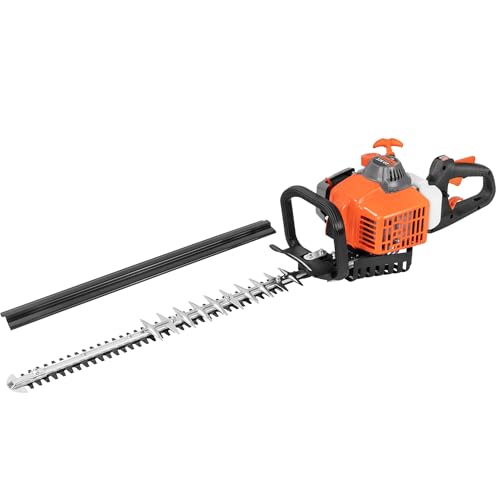
The best gas powered hedge trimmers for large hedges are the Stihl HS 87 R for long, thick hedge runs, the Echo HCA-2620 for tall hedges that need an articulating pole, and the Echo HC-2020 for a lighter handheld option on mid-size hedges. Choose by blade length, tooth spacing and weight, because a trimmer you can hold steady for an hour beats a bigger one that tires you in ten minutes.
Gas hedge trimmers earn their place when the hedge is long, thick, or far from an outlet. A two-stroke engine gives constant power without a cord or battery swap, and the longer blades cut a wide swath through each pass. The trade-offs are weight, noise, vibration and fuel handling. This guide explains how to size blade length and tooth spacing to your hedge, how fuel mix works, and compares seven current models by spec class. Specs come from manufacturer pages and independent roundups. Engine details and weights differ between variants and regions, so confirm the exact model before you buy.
Our top picks



As an Amazon Associate we earn from qualifying purchases at no extra cost to you.
Quick answer: which gas trimmer for which hedge
- Long run of thick, overgrown hedge, experienced user: Stihl HS 87 R, about 30 inch blade.
- Tall or wide hedges where you cannot reach the top: Echo HCA-2620, 21 inch articulating blade on a shaft.
- Typical large residential hedges, one hand-held machine: Echo HC-2020, 20 inch blade, about 10 lb.
- Lightest long blade in the class: Husqvarna 522HDR60X, about 23.6 inch cutter bar.
- Lighter budget options with 22 inch blades: Shindaiwa DH232 or Senix HT4QL-L.
- Pole option at a lower price tier: Craftsman HT2200.
How we chose
This is a research-based comparison, not a first-hand evaluation. We compared manufacturer spec pages and independent roundups, checked that every model named is a current 2026 line, and used only specs that appeared on a manufacturer page or in more than one source. Where we could not verify a spec, we describe the model by class. We weighted blade length, engine class, cutting capacity, weight, fuel type and the features that control vibration and fatigue.
Blade length: how long do you need
Most gas hedge trimmers have blades from about 18 to 38 inches, and blades over about 30 inches are mostly for professionals. A longer blade covers more hedge per pass, but it is harder to hold level and gets heavier at the end of your arms.
- 18 to 22 inches: good for most residential hedges, easy to control, suits shaping and light cutting.
- 24 to 26 inches: a compromise for long, flat-topped hedges.
- 28 to 30 inches and above: fast on long, straight hedges and rejuvenation work, but heavy and best for experienced users. Overgrown or tall hedges also call for a pole or articulating head.
Worked example: time on a 120-foot hedge
- Suppose the hedge is 120 feet long, 5 feet tall and has two sides plus a top. Assume each stroke advances the cut by about 1 foot with a 20-inch blade and about 1.8 feet with a 30-inch blade, after overlap.
- Each pass covers one stroke length of hedge. 120 ft / 1.0 ft = 120 strokes for the 20-inch blade. 120 / 1.8 = about 67 strokes for the 30-inch blade.
- For three surfaces (two sides and top), multiply by three: about 360 versus 200 strokes.
- At roughly 10 seconds per stroke including repositioning, that is about 60 minutes versus 33 minutes of cutting.
The numbers are illustrative assumptions, not measurements. The key point is that the longer blade saves about 45 percent of strokes, but only if you can hold it steady. If the heavier machine forces you to rest more, the saving shrinks.
Tooth spacing and cutting capacity
Tooth spacing, the gap between blade teeth, sets the thickest branch the blade can bite before it stalls. Published cutting capacities in the sources we reviewed include about 0.75 inch for the Shindaiwa DH232, about 1 inch for the Echo HC-2020 and HCA-2620, and about 1.125 inch for the Senix HT4QL-L and Craftsman HT2200.
- Wide spacing (about 1 inch or more): cuts thicker stems and woody growth, leaves a rougher finish.
- Narrow spacing (under about 0.75 inch): smoother finish on soft growth, but jams on thick stems.
- Double-sided blades cut in both directions, so you can sweep forward and back, which is faster and less tiring than single-sided blades.
If the hedge has stems thicker than your blade’s rated capacity, use loppers or a pruning saw for those first. Forcing a trimmer through thick wood is the most common way to damage the blades and gear case.
Two-stroke engines and fuel mix
Most gas hedge trimmers use air-cooled two-stroke engines in the 21 to 28 cc range. They are light for the power they make, but they need premixed fuel and oil. Many manufacturers specify 50:1 gasoline to two-stroke oil, which means 2.6 fluid ounces of oil per gallon of gas. Always follow the ratio and oil type in your manual, because the wrong ratio can damage the engine or void the warranty.
- Mix fresh fuel in an approved container, and use it within a month or so.
- Use gasoline without more ethanol than the manual allows.
- Four-stroke trimmers such as the Senix HT4QL-L do not need premix, but are usually heavier.
- Drain or stabilize fuel before long storage, and run the carburetor dry if the manual suggests it.
Weight, vibration and noise
Handheld gas trimmers in the sources we reviewed weigh about 10 to 12 pounds, and pole models about 13 to 15 pounds. That weight is with an engine running and vibrating, and it adds up in the second half hour of work. Anti-vibration mounts, a good harness or strap, and a balanced handle reduce fatigue.
Gas hedge trimmers are loud. Expect noise in the range where hearing protection is needed, and check local rules on hours for gas power tools. Vibration is a real factor on thick hedges. Reviewers described the Craftsman HT2200 as a heavier-vibrating model, which makes it a better choice for short sessions.
Comparison table
| Model | Style | Engine | Blade | Weight | Cutting capacity |
|---|---|---|---|---|---|
| Stihl HS 87 R | Handheld, single-sided | 2-stroke, 1.4 cu in, 0.9 BHP | About 30 in (29.5 in cutting) | About 12.1 lb without fuel | Thick growth, pro class |
| Echo HCA-2620 | Articulating pole | 25.4 cc 2-stroke | 21 in, double-sided | 14.3 lb | About 1 in |
| Echo HC-2020 | Handheld | 21.2 cc 2-stroke | 20 in | About 10 lb | About 1 in |
| Husqvarna 522HDR60X | Handheld, double-sided | 21.7 cc 2-stroke | About 23.6 in (60 cm) | About 11 lb (5 kg) | Check listing |
| Shindaiwa DH232 | Handheld | 21.2 cc 2-stroke | 22 in | About 11 lb | About 0.75 in |
| Senix HT4QL-L | Handheld | 26.5 cc 4-stroke | 22 in | About 11 lb | About 1.125 in |
| Craftsman HT2200 | Pole | 25 cc 2-stroke | 22 in | About 13.5 lb | About 1.125 in |
Best for long hedge runs and thick growth
Stihl HS 87 R
Spec line: 2-stroke engine, 1.4 cu in · 0.9 BHP · 3,200 rpm · about 30 in blade (29.5 in cutting length) · single-sided blade · about 12.1 lb without fuel.
Best for: long, thick, overgrown hedges where speed and bite matter, and for users comfortable with a long blade.
Skip if: your hedge is short, you have limited strength, or you prefer double-sided blades for comfort. A blade this long is tiring and easier to steer into trouble.
- Pros: very long blade, strong engine, light for its blade length, built for thick growth.
- Cons: premium price tier, single-sided blade only cuts efficiently one direction, long reach demands experience.
Husqvarna 522HDR60X
Spec line: 21.7 cc 2-stroke · double-sided blade · about 23.6 in (60 cm) cutter bar · about 11 lb (5 kg) · high-torque gear.
Best for: large residential hedges where you want a long double-sided blade at a manageable weight.
Skip if: you need the longest reach or an articulating head. The figures here come from Husqvarna’s UK page, so check that the US listing matches.
- Pros: light per inch of blade, double-sided cutting, high-torque gear helps in dense growth.
- Cons: regional spec differences, no pole version in this model, cutting capacity not confirmed in our sources.
Best for tall hedges and long reach
Echo HCA-2620
Spec line: 25.4 cc 2-stroke · 21 in double-sided RazorEdge blades · articulating gear case with 135 degree range · 59 in shaft · 14.3 lb · about 1 in cutting capacity.
Best for: tall hedges and wide tops where a ladder would otherwise be needed, since the head angles to cut from ground level.
Skip if: your hedge is low. A shorter shaft or a handheld is lighter and easier to control. Echo also sells a shorter-shaft version, the HCA-2620S, with a 33 in shaft at about 13.6 lb.
- Pros: articulating head reaches tops and sides, double-sided blades, a strong service network.
- Cons: 14.3 lb on a long pole is tiring overhead, heavy for short sessions, premium price tier.
Craftsman HT2200
Spec line: 25 cc 2-stroke · 22 in blade · about 13.5 lb · about 1.125 in cutting capacity · pole style.
Best for: occasional reach work on a budget.
Skip if: you cut for long periods. Reviewers noted heavy vibration, which gets tiring quickly.
- Pros: lower price tier for a pole trimmer, decent capacity, 22 in blade.
- Cons: heavy vibration, less refined than Echo or Stihl, fewer dealer options.
Best everyday handheld trimmers
Echo HC-2020
Spec line: 21.2 cc 2-stroke · 20 in blade · about 10 lb · about 1 in cutting capacity.
Best for: a homeowner with a mid-size or large hedge who wants a light, simple gas machine from a well-known brand.
Skip if: hedges are over about 6 feet tall or very thick. Choose a pole or a longer blade.
- Pros: light at about 10 lb, easy to control, trusted brand, simple to service.
- Cons: 20 in blade covers less per stroke, limited capacity for thick stems.
Shindaiwa DH232
Spec line: 21.2 cc 2-stroke · 22 in blade · about 11 lb · about 0.75 in cutting capacity.
Best for: soft growth hedges such as privet and boxwood where a clean finish matters.
Skip if: your hedge has woody stems thicker than three-quarters of an inch.
- Pros: 22 in blade at a modest weight, narrow tooth spacing for a smooth cut.
- Cons: lower capacity, may jam on thick growth.
Senix HT4QL-L
Spec line: 26.5 cc 4-stroke · 22 in blade · about 11 lb · about 1.125 in cutting capacity · no fuel mixing.
Best for: owners who dislike mixing oil and gas and want a quieter, cleaner-running engine.
Skip if: you want the lightest possible machine or the broadest dealer network.
- Pros: no premix, larger cutting capacity, 22 in blade at 11 lb.
- Cons: four-stroke engines are typically heavier, oil level still needs checking, fewer service points.
Decision matrix
| Your hedge | Threshold | Choose |
|---|---|---|
| Over 100 ft long, thick stems | Stems over 1 in, run time over 45 min | Stihl HS 87 R |
| Over 6 ft tall or deep | Cannot reach top safely from ground | Echo HCA-2620 |
| 50 to 100 ft, medium growth | Stems up to 1 in | Echo HC-2020 or Husqvarna 522HDR60X |
| Soft growth, neat finish | Stems under 0.75 in | Shindaiwa DH232 |
| No-mix fuel | Four-stroke wanted | Senix HT4QL-L |
| Occasional reach work | One or two cuts per year | Craftsman HT2200 |
No-outlet yards: why gas still makes sense
If your hedge is far from the house, a gas trimmer removes the need for an extension cord that can be cut or tangle. Battery trimmers are quieter and easier, but long hedges can exhaust a pack mid-job. Gas gives unlimited runtime as long as you carry fuel. Keep a safe fuel can away from the work area, and refuel only with the engine cold.
Safety
- Wear eye protection, hearing protection, sturdy gloves, long pants and non-slip boots.
- Use both hands on the handles and keep the blade away from your body and legs.
- Never cut overhead with a handheld trimmer on a ladder. Use a pole trimmer from the ground.
- Stop the engine and wait for the blade to stop before clearing jams or checking the blade.
- Check the hedge for nests and wildlife first. In many places, cutting is restricted during bird nesting season, so check local rules.
- Do not refuel a hot engine and store fuel in an approved container away from ignition sources.
- Keep power lines and cords in view and stay clear of utility lines when using a pole.
Maintenance
- Clean resin from the blades after each use and lubricate them with blade oil.
- Check the air filter and spark plug at the interval in the manual.
- Sharpen or replace blades if they tear instead of cut.
- Grease the gear case on the schedule listed in the manual.
- Store with stabilized fuel or drained tank, and use the blade cover.
Frequently asked questions
What blade length is best for large hedges?
For most large residential hedges, 20 to 24 inches is the best balance of speed and control. Go to about 30 inches only for long, straight, thick hedges.
A longer blade saves strokes but adds weight and fatigue.
What fuel mix do gas hedge trimmers use?
Most two-stroke models call for a 50:1 gasoline to two-stroke oil mix, which is about 2.6 fluid ounces of oil per gallon. Follow your manual.
Four-stroke trimmers such as the Senix HT4QL-L do not need premix.
Are gas hedge trimmers better than battery models?
Gas trimmers give unlimited runtime and strong power on long, thick hedges. Battery models are quieter, lighter and need less maintenance.
For no-outlet yards and long runs, gas is still the practical choice.
What does tooth spacing mean?
Tooth spacing is the gap between blade teeth and sets the thickest branch the blade can bite. About 1 inch cuts woody stems, while about 0.75 inch gives a finer finish.
Use loppers for stems thicker than your blade’s rated capacity.
Is a pole trimmer or a handheld better?
A pole or articulating trimmer such as the Echo HCA-2620 is better for tall hedges, because you cut from the ground. A handheld is lighter and better for hedges you can reach.
Pole models are heavier and tiring overhead, so plan breaks.
How loud and vibrating are gas hedge trimmers?
They are loud enough to need hearing protection and produce noticeable vibration. Anti-vibration mounts and a balanced build reduce fatigue.
Heavier-vibrating models, like the Craftsman HT2200 in reviews, suit short sessions.
When should I trim a large hedge?
Trim after the main growth flush, typically late spring through summer, and avoid nesting season in your area. Many hedges can take two trims a year.
Check local wildlife rules before heavy cutting.
How do I store a gas hedge trimmer for winter?
Drain the fuel or add stabilizer and run the engine for a minute, clean and oil the blades, and fit the blade cover. Store in a dry place.
Follow the manual for carburetor and gear case care.