Key takeaways
- Compare the best drip hoses for raised beds, from pressure-compensating emitter tubing to a flat weeper soaker hose, by spacing, flow, length and fit.
A raised bed is the easiest place in the garden to water well, because the layout is fixed, the soil mix drains freely and the planting rows rarely move. It is also the easiest place to water badly with the wrong line: a soaker hose that floods the near end, or a drip line with emitters spaced for shrubs when you are growing lettuce. The right drip hose for a raised bed comes down to three things — emitter spacing that matches your planting pattern, a tube size that suits the length of the run, and flow that stays even from the first plant to the last.
This guide covers the four formats that work in raised beds: half-inch emitter tubing for the main runs, quarter-inch emitter tubing and micro dripline for dense rows, and one flat soaker hose for gardeners who want to connect a hose and be done. Each pick below is a hose or line only, sold on its own, so you can build the layout your beds actually need.
As an Amazon Associate, we earn from qualifying purchases.
Quick Picks
| Product | Best for | Key point |
|---|---|---|
| Rain Bird ET63918-50 Emitter Tubing | The main drip line for standard vegetable beds | Pressure-compensating emitters on an 18-inch grid built into half-inch tubing |
| Rain Bird ET256-50S Emitter Tubing | Dense rows of greens, carrots and herbs | Quarter-inch line with emitters every 6 inches for close planting |
| DIG ML-106 Microline Dripline | Long laterals and looped layouts fed from a header line | A 100-foot coil of quarter-inch dripline with dual-outlet emitters |
| Gilmour Flat Weeper Soaker Hose 50 ft | The simplest setup, straight off a garden hose | A flat weeper hose that seeps along its whole length, no fittings kit needed |
How to Choose
Emitter tubing versus soaker hose. These are two different tools. Emitter tubing has individual drip emitters moulded inside the tube at fixed intervals, so each plant position gets a known amount of water. A soaker hose weeps along its entire length through a porous wall, which is simpler but less precise: output is heaviest near the inlet and fades toward the far end. For a raised bed planted in rows, emitter tubing gives the more even result; a soaker hose suits mixed plantings where exact placement matters less.
Match the spacing to the crop. Emitter spacing is the decision most buyers get wrong. Wide-spaced crops such as tomatoes, peppers and squash sit happily on 18-inch spacing. Leafy greens, carrots, radish and herbs planted in tight rows need 6-inch spacing, or the soil between emitters stays dry while the spots under each emitter stay wet. Measure your planting pattern first, then buy the line that matches it.
Half-inch lines carry, quarter-inch lines deliver. A typical raised bed layout uses a half-inch main line as the supply and quarter-inch lines as the laterals that run along each row. Half-inch emitter tubing can also serve as the watering line itself in a simple bed. Quarter-inch line has a much lower flow capacity and a short recommended run length, so treat it as a branch line fed from a header, never as a long run straight from the faucet.
Pressure compensation matters on uneven setups. Emitters labelled pressure-compensating deliver close to the same flow across a range of inlet pressures, which keeps the far end of a bed watering evenly when the bed sits on a slope or several beds share one supply. Basic emitters deliver less as pressure drops along the line, so keep their runs short.
Plan the layout before the length. A standard four-by-eight-foot bed usually takes two or three parallel runs of line. Work out the total linear feet across all your beds, add the runs up and down the bed walls, and buy rolls with a little spare for mistakes and end caps. It is far easier to trim a coil than to join two short ones mid-season.
Budget for the small parts. Any emitter tubing setup needs a filter and, on most home water supplies, a pressure regulator at the head of the system, plus stakes to hold the line in place and end caps or plugs for each run. A soaker hose skips most of that, which is its real advantage.
Best Options
Rain Bird ET63918-50 Emitter Tubing

This is the line to build a raised bed system around. The ET63918-50 is a 50-foot roll of half-inch emitter tubing with pressure-compensating emitters set 18 inches apart, and Rain Bird positions it for vegetable gardens, raised beds and container plantings. The pressure compensation is the point: each emitter delivers a consistent 0.9 gallons per hour, so plants at the far corner of a bed get the same water as plants beside the inlet, even when the bed is not perfectly level.
The brown polyethylene blends into soil and mulch instead of crossing the bed in black stripes, and the tubing is flexible enough to turn the corners of a framed bed without kinking when you give it a sensible radius. Run it in parallel lines down a bed, stake it in place, cap the ends and the bed waters itself on a timer. For widely spaced fruiting crops, the 18-inch grid lands an emitter close to every plant without wasting water between them.
Specs
- Half-inch emitter tubing, 0.634-inch outside diameter; 50-foot roll; pressure-compensating emitters spaced 18 inches apart; 0.9 gallons per hour per emitter; brown polyethylene; resistant to UV damage, chemicals and algae growth per the manufacturer listing
Best for: The main watering line in standard raised beds growing tomatoes, peppers, squash and other widely spaced vegetables
Watch out for: The 18-inch spacing is too wide for dense rows of salad greens or carrots; pair it with a filter and pressure regulator at the head of the system, and expect the coil to hold some curve memory until it warms up in the sun
Rain Bird ET256-50S Emitter Tubing

The ET256-50S shrinks the same idea down to quarter-inch line with emitters every 6 inches, which is the spacing dense raised bed planting actually needs. Lettuce, spinach, carrots, beets and herbs are usually sown or transplanted a few inches apart, and a 6-inch emitter grid keeps the whole row evenly moist instead of leaving dry gaps between water points. The emitters are pressure-compensating, so flow stays consistent along the run within the limits of a small line.
Use it the way quarter-inch line is meant to be used: branch it off a half-inch header that runs along the head of the bed, then send one lateral down each planting row. A 50-foot roll covers the rows of one or two typical beds in this role. The brown finish disappears under mulch, and the tubing is flexible enough to snake around the corners of small beds and planter boxes where half-inch line feels clumsy.
Specs
- Quarter-inch emitter tubing; 50-foot roll; pressure-compensating emitters spaced 6 inches apart; 0.8 gallons per hour per emitter; brown polyethylene; resistant to UV damage, chemicals and algae growth per the manufacturer listing
Best for: Dense rows of greens, root vegetables and herbs that need closely spaced water points
Watch out for: Quarter-inch line cannot carry a whole garden; keep each lateral short, feed it from a half-inch header, and do not run it directly from a faucet across several beds or the far rows will run dry
DIG ML-106 Microline Dripline
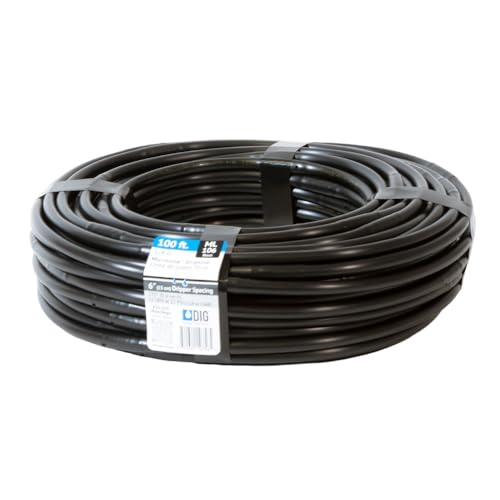
DIG’s Microline is the other established quarter-inch option, and it wins on roll length and emitter design. The ML-106 coil holds 100 feet of quarter-inch dripline with emitters every 6 inches, each emitter built with a dual outlet and a large internal filter area to resist clogging. Flow is rated at 0.52 gallons per hour per emitter at 15 PSI, and the line is made for low-pressure operation between 10 and 25 PSI, which suits gravity-fed and regulated drip setups well.
Because the emitters are not pressure-compensating, DIG’s own guidance keeps individual runs short — around 16 feet at this spacing — and that fits raised beds neatly: one lateral per row, fed from a header line, sits inside the limit with room to spare. The 100-foot coil means one purchase covers the laterals for several beds, and the black tubing takes standard quarter-inch barbed fittings, so tees, elbows and end plugs from any drip kit connect without fuss. It can sit on the surface or run under a layer of mulch.
Specs
- Quarter-inch dripline, 0.170-inch inside diameter by 0.250-inch outside diameter; 100-foot coil; emitters spaced 6 inches apart with dual outlets; 0.52 gallons per hour per emitter at 15 PSI; operating pressure 10 to 25 PSI; black linear low-density polyethylene; works with standard quarter-inch barbed fittings
Best for: Gardeners plumbing several beds from one header line who want a long coil of small dripline for row laterals and loops
Watch out for: Output falls off on over-long runs because the emitters are not pressure-compensating; respect the short per-run guidance, and fit fine filtration ahead of the line as the manufacturer specifies
Gilmour Flat Weeper Soaker Hose 50 ft

Not every raised bed needs a plumbed system. The Gilmour Flat Weeper is a 50-foot flat soaker hose that connects straight to a garden hose or faucet, lies flat along a row, and seeps water through its fabric jacket directly into the soil along its whole length. There are no emitters to space and no header to build: unroll it, snake it between the plants, turn the water on low and let it weep.
The flat profile is genuinely useful in a framed bed. It slips under mulch, turns tight corners around plantings, and rolls up small for storage between seasons, and at 1.4 pounds it is easy to move from bed to bed. The vinyl construction uses recycled material and the hose is rated for use above or below ground. What you give up is precision: a soaker hose cannot put a measured amount of water at each plant the way emitter tubing can, and output is stronger near the inlet than at the far end, so it suits mixed beds and borders better than strict row grids.
Specs
- Flat soaker (weeper) hose; 50 feet long; vinyl construction with a fabric jacket that seeps along the full length; 0.63-inch outside diameter; weight 1.4 pounds; for use above or below ground; connects to a standard garden hose thread
Best for: Gardeners who want raised bed watering with zero system building, especially mixed plantings and beds watered one at a time
Watch out for: Watering is the least even of the four picks, especially toward the far end of the run; keep the supply pressure modest, and flush the hose occasionally in hard-water areas because the porous jacket can clog over time
Which One Fits
- Choose the Rain Bird ET63918-50 if you are building a fixed system for vegetable beds and your crops sit on a wide grid; it is the strongest foundation line here.
- Choose the Rain Bird ET256-50S if your beds are mostly greens, carrots and herbs in tight rows and you want pressure-compensating emitters at close spacing.
- Choose the DIG ML-106 if you have several beds to plumb from one header and want a long, economical coil of quarter-inch laterals with clog-resistant emitters.
- Choose the Gilmour Flat Weeper if you would rather connect a hose, water a bed, and roll the whole thing away, and your planting is mixed rather than gridded.
Common Mistakes
Running quarter-inch line straight from the faucet. Small dripline is a branch line. Fed directly from a tap and stretched across a whole bed, it loses pressure so quickly that the far half of the row barely drips. Give it a half-inch header to feed from.
Buying spacing that fights the planting. An 18-inch emitter grid under lettuce sown two inches apart leaves most of the row dry; a 6-inch grid under tomatoes waters a lot of bare soil. The crop pattern decides the spacing, not the other way round.
Skipping the filter and regulator. Emitter tubing is built around small water passages. Unfiltered water clogs them with grit and algae, and full household pressure can push fittings apart and make emitters deliver unevenly. The head assembly is a small part of the system and protects all of it.
Leaving the far end open or unflushed. Every run needs an end cap, and every line benefits from a flush at the beginning of the season. Open ends drain pressure from the whole layout, and sediment that settled over winter ends up in the first emitters it reaches.
Judging a soaker hose like an emitter line. A weeper hose waters a strip, not a set of points. Gardeners who lay one down a row of widely spaced plants and expect measured water at each root will be disappointed; that job belongs to emitter tubing.
FAQ
Is a drip hose or a soaker hose better for raised beds?
For rows of vegetables, emitter tubing is usually better because each emitter delivers a known flow at a fixed spacing, so the whole bed waters evenly. A soaker hose is better when simplicity wins: mixed plantings, a single bed, or a bed you water by hand-held hose connection rather than a fixed system.
How far apart should drip lines run in a raised bed?
Place laterals so every plant sits within a few inches of an emitter. In practice that means lines roughly a foot to a foot and a half apart across the bed for mixed vegetables, tightened for dense greens. Match the line spacing to the emitter spacing on the tubing you choose, so the wetting patterns overlap into one evenly moist bed.
Do I need a pressure regulator and filter with drip tubing?
In almost every home setup, yes. Drip emitters are designed for low pressure, well below typical household supply pressure, and a regulator keeps flow even and fittings seated. A filter keeps grit and algae out of the small emitter passages. A soaker hose is more forgiving and can run at low faucet pressure without either, though a filter still helps it last.
Can I bury a drip hose under mulch in a raised bed?
Yes, and it is usually a good idea. A shallow mulch layer over emitter tubing or a soaker hose cuts evaporation, hides the line and keeps it from shifting. Keep the line on the soil surface under the mulch rather than buried in the soil itself, so emitters stay clear and you can lift the line to check or repair it.
Final Verdict
For most raised bed gardeners, the Rain Bird ET63918-50 is the right foundation: pressure-compensating emitters on a half-inch line water a whole bed evenly and forgive small slopes and long runs. Pair it with the ET256-50S or the DIG ML-106 where rows are dense, choosing between them on whether you value pressure compensation or a longer coil with clog-resistant emitters. If building a system sounds like more project than your beds need, the Gilmour Flat Weeper waters a raised bed the simple way, one connection at a time.
More from Amazon
Programs that pair well with the guide above. Offers and eligibility are set by Amazon and may change.
Collect the home and kitchen items you want in one registry that guests can shop from.
Create a wedding registrySet up recurring deliveries of everyday items on eligible products. Terms and savings are set by Amazon.
Explore Subscribe & SaveFree shipping on eligible items, Prime Video and more. Eligible new members can start with a free trial.
Start a Prime free trialAudiobooks and podcasts to listen to on the go. Eligible new members can start with a free trial.
Try Audible freeAs an Amazon Associate we earn from qualifying purchases.