Key takeaways
- Best overall: Chapin 20002 SureSpray, for balanced capacity, an anti-clog in-tank filter and an easy-twist pressure release.
- Best for heavy use: Chapin 26021XP ProSeries, for a longer wand, a longer hose and multiple nozzles.
- Best for mixed jobs: Smith 2-Gallon Contractor, for a canvas shoulder strap, a 21-inch wand and five nozzle types.
- Best ready-to-use kit: Roundup 190260 2-gallon, for a three-nozzle kit and simple assembly.
- Best for durability-minded buyers: Hudson Bugweiser 2-gallon, for a galvanized steel tank.
- Best for continuous spraying: Hudson Ultimate All-In-One 2-gallon, for a lock-on trigger.
The Chapin 20002 SureSpray is the best all-round 2 gallon pump sprayer for most home gardens, the Chapin 26021XP ProSeries is the better pick for frequent or heavy use, and the Smith 2-Gallon Contractor sprayer is the most versatile when you switch between fertilizer, herbicide and foaming jobs. The Roundup 190260 and the Hudson Bugweiser are solid alternatives, and a 4-gallon backpack such as the D.B. Smith Field King 190328 makes sense once a yard outgrows a hand-carried tank.
A 2-gallon pump sprayer is the sweet spot for a typical residential lot: big enough to cover a few hundred square feet per fill, light enough to carry across a yard, and simple enough to maintain. This guide compares the models buyers most often shortlist by the criteria that decide whether a sprayer is pleasant or miserable to use: tank weight when full, strap comfort, wand length, seal chemistry, pressure control and how safely it releases pressure.
Our top picks


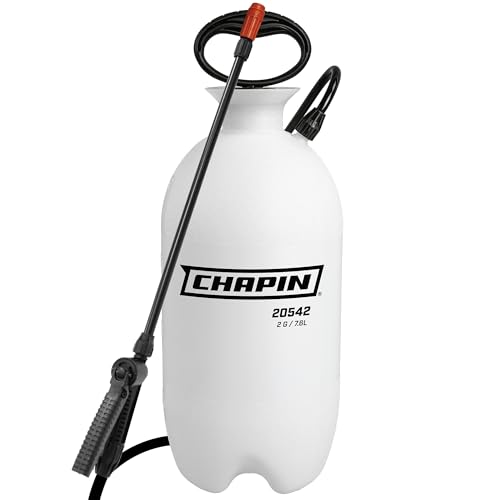
As an Amazon Associate we earn from qualifying purchases at no extra cost to you.
Quick answer: which 2 gallon pump sprayer fits which job
- Best overall: Chapin 20002 SureSpray, for balanced capacity, an anti-clog in-tank filter and an easy-twist pressure release.
- Best for heavy use: Chapin 26021XP ProSeries, for a longer wand, a longer hose and multiple nozzles.
- Best for mixed jobs: Smith 2-Gallon Contractor, for a canvas shoulder strap, a 21-inch wand and five nozzle types.
- Best ready-to-use kit: Roundup 190260 2-gallon, for a three-nozzle kit and simple assembly.
- Best for durability-minded buyers: Hudson Bugweiser 2-gallon, for a galvanized steel tank.
- Best for continuous spraying: Hudson Ultimate All-In-One 2-gallon, for a lock-on trigger.
How we chose
This is a research-based comparison built from manufacturer specification pages and published expert buying guides, not from lab work. We kept models that are widely sold in the United States in the 2-gallon class, plus two reference models (a 1-gallon and a 4-gallon) so you can see where 2 gallons stops being the right size. Where a spec could not be confirmed from a manufacturer or a recent guide, we describe the feature by class (for example, “multi-nozzle kit”) rather than quoting a number. We weighted five criteria:
- Weight when full: water weighs about 8.3 pounds per gallon, so a full 2-gallon tank is roughly 16.7 pounds of liquid before the sprayer itself.
- Carry system: a shoulder strap beats a single handle once the tank is more than half full.
- Wand and hose length: a 12-inch wand forces you to bend; 20 inches or more lets you reach under shrubs and across beds.
- Seal quality: nitrile (Buna-N) seals handle most lawn and garden products; Viton is the premium upgrade for aggressive solvents and some oil-based mixes.
- Pressure control: a working relief valve is a safety feature, because a tank under pressure can spray product at your face when you open it.
Comparison table
| Model | Tank | Wand | Hose | Nozzles | Carry system | Pressure relief |
|---|---|---|---|---|---|---|
| Chapin 20002 SureSpray | 2 gal | 12 in curved poly | 34 in PVC | Adjustable cone | D-shaped handle | EZ Twist valve |
| Chapin 26021XP ProSeries | 2 gal | About 20 in poly | About 48 in PVC | Three (cone, brass adjustable, fan) | Handle | Relief valve class |
| Smith 2-Gallon Contractor | 2 gal | 21 in | Not confirmed | Five (poly, brass, two fans, foaming) | Adjustable canvas shoulder strap | Pressure-release valve |
| Roundup 190260 | 2 gal | Not confirmed | Not confirmed | Three-nozzle kit | Handle | Not confirmed |
| Hudson Bugweiser | 2 gal (also 3 gal) | About 15 in curved poly | Braided | Adjustable cone | Handle | Not confirmed |
| Hudson Ultimate All-In-One | 2 gal (also 1 and 3 gal) | Not confirmed | Not confirmed | Adjustable | Handle | Pressure-release valve |
| Chapin 20000 (reference) | 1 gal | 12 in | Not confirmed | Adjustable | Pump handle | Not confirmed |
| D.B. Smith Field King 190328 (reference) | 4 gal backpack | 21 in poly | Not confirmed | Four (two fans, brass adjustable, foaming) | Padded harness, chest and back straps | Piston pump, adjustable to 150 psi |
Product reviews
1. Chapin 20002 SureSpray 2-Gallon
Specs: 2-gallon translucent poly tank · 12-inch curved poly wand · 34-inch PVC hose · nitrile seals · adjustable poly cone nozzle · 40-60 psi · about 0.4-0.5 gallons per minute · 1-year limited warranty.
Best for: homeowners who spray fertilizer, weed killer and pest control a few times a season and want something that does not clog or leak.
Skip if: you need a shoulder strap or a wand that reaches far under dense shrubs.
- Pros: in-tank anti-clog filter, funnel-style top that reduces spills, translucent tank for reading the fill level, vertical wand storage on the handle.
- Cons: wand is short, only one nozzle, no strap.
2. Chapin 26021XP ProSeries 2-Gallon
Specs: 2-gallon tank · about 20-inch poly wand · about 48-inch PVC hose · three nozzles (poly cone, brass adjustable, poly fan) · heavier-duty build with a longer warranty than the entry model. Confirm exact wand and hose lengths on the box before buying, because retailer descriptions vary.
Best for: larger beds, hedges and anyone who sprays often enough to wear out a basic unit.
Skip if: you only spray two or three times a year; the extra reach and nozzles will go unused.
- Pros: longer reach reduces bending, three nozzle choices for streams, cones and flat fans, heavier-duty construction.
- Cons: costs more than the entry-level Chapin, still hand-carried.
3. Smith 2-Gallon Contractor Sprayer
Specs: 2-gallon tank · 21-inch wand · five nozzle types (poly, brass, two flat fans, foaming) · adjustable canvas shoulder strap · pressure-release valve.
Best for: mixed-use yards where you move between a flat fan for herbicide on a driveway edge, a cone for insecticide on shrubs and a foaming tip for surface treatments.
Skip if: you want the simplest possible setup; five nozzles mean more parts to keep clean and track.
- Pros: the strap moves the weight to your shoulder, long wand, broad nozzle choice.
- Cons: more nozzles to rinse, warranty terms not confirmed in the sources we reviewed.
4. Roundup 190260 2-Gallon
Specs: 2-gallon tank · three-nozzle kit · one-step assembly · wand and hose lengths vary by listing, so check the packaging.
Best for: first-time buyers who want a ready-to-use kit with a few nozzle options.
Skip if: you plan to spray large areas; a 2-gallon tank means frequent refills, and the brand name does not make the sprayer suitable for only one product type.
- Pros: simple assembly, multiple nozzles included, widely stocked.
- Cons: fewer confirmed specs, handle-only carry.
5. Hudson Bugweiser 2-Gallon
Specs: galvanized steel tank with epoxy coating · about 15-inch curved poly wand · braided chemical-resistant hose · adjustable cone nozzle · five-year limited U.S. warranty reported in older guides (verify current terms).
Best for: buyers who want a metal tank that resists impact and sun and plan to keep one sprayer for years.
Skip if: weight matters most; a steel tank adds weight compared with poly, and you cannot see the liquid level through the wall.
- Pros: rugged tank, braided hose resists kinking, long warranty history.
- Cons: heavier than poly rivals, no see-through level.
6. Hudson Ultimate All-In-One 2-Gallon
Specs: 2-gallon tank (1- and 3-gallon versions exist) · lock feature for continuous spraying · pressure-release safety valve.
Best for: people with hand fatigue who dislike holding a trigger through a long session.
Skip if: you often spray in tight spots where a locked-open trigger could waste product.
- Pros: lock-on trigger, safety valve, size options.
- Cons: details beyond those above vary by retailer listing.
7. Chapin 20000 1-Gallon (reference model)
Specs: 1-gallon tank · 12-inch wand · single adjustable nozzle · pump handle doubles as carry handle.
Best for: patio pots, a vegetable bed or spot treatments where a 2-gallon tank would be overkill.
Skip if: you spray a whole lawn or a long border; expect to refill often.
- Pros: light when full, entry-level cost class, easy to store.
- Cons: small tank, short wand.
8. D.B. Smith Field King 190328 (reference backpack)
Specs: 4-gallon tank · 21-inch poly wand · four nozzles (two flat fans, brass adjustable, foaming) · padded harness with chest and back straps · piston pump, adjustable up to 150 psi.
Best for: yards where you refill a 2-gallon tank more than three times per session.
Skip if: your yard is small; a full 4-gallon tank carries about 33 pounds of liquid.
- Pros: hands-free pumping, padded harness, double the capacity.
- Cons: heavy when full, more parts to clean.
Buying criteria with thresholds
Tank capacity versus weight
Two gallons of liquid is about 16.7 pounds, and the sprayer adds a few more. That is the practical limit of a one-handed carry for most adults over a 15-minute session. A 4-gallon tank doubles the liquid to about 33 pounds, which only works with a padded backpack harness. If you have a bad back or wrists, a 1-gallon unit filled twice is often kinder than one heavy 2-gallon load.
Shoulder strap comfort
Look for a strap at least an inch wide with an adjustable length and a clip that does not bite. Canvas or webbing straps spread the load better than thin plastic cords. If a model ships without a strap, many tank handles accept an aftermarket strap, though confirm the attachment points first.
Wand length
Under 15 inches forces stooping. Between 18 and 24 inches covers most beds and shrubs. Anything longer is better suited to tall hedges and fruit trees, where a telescoping or extension wand is a better route than a longer fixed one.
Seal quality
Nitrile is fine for water-based fertilizers, glyphosate-type herbicides and most insecticides. If a product label calls for oil-based, solvent-based or very acidic formulations, check the sprayer’s manual first; Viton seals are the usual upgrade, and many basic units do not offer them at all. Replace dry or cracked seals before the season, since a leaking pump seal is the most common failure.
Pressure release
Prefer a valve you can open with one hand without unscrewing the pump. Always release pressure before refilling, unclogging a nozzle or putting the sprayer away. A tank that stays pressurized in a hot garage can weep at its seals or vent unexpectedly.
Worked example: how many fills for a real yard
Say you are applying a liquid lawn fertilizer whose label calls for 2 gallons of mixed solution per 1,000 square feet, and your lawn is 4,500 square feet.
- Total mix needed: 4,500 / 1,000 x 2 gallons = 9 gallons.
- With a 2-gallon tank filled to the marked line, that is 9 / 2 = 4.5, so five fills.
- Time per fill: at about 0.45 gallons per minute (the middle of the Chapin 20002’s published 0.4-0.5 range), 2 gallons takes about 4.4 minutes of continuous spraying, plus the time for pumping, walking and refilling.
- With a 4-gallon backpack, the same job is 9 / 4 = 2.25, so three fills.
- Weight comparison: five fills of about 16.7 pounds of liquid each versus three fills of about 33 pounds each.
Conclusion: below roughly 2,000 square feet, a 2-gallon sprayer is faster to set up and kinder to carry. Above about 5,000 square feet of broadcast spraying, a backpack saves several refill trips, though spot-treating beds and weeds still favors the smaller unit.
Decision matrix by buyer type
| If you are | Choose | Why |
|---|---|---|
| A casual gardener, a few sprays per season | Chapin 20002 | Simple, filter included, easy pressure release |
| Spraying beds and hedges weekly in season | Chapin 26021XP | Longer reach and hose, three nozzles |
| Switching between herbicide, insecticide and surface jobs | Smith 2-Gallon Contractor | Five nozzles and a shoulder strap |
| Wanting a metal tank for the long haul | Hudson Bugweiser | Galvanized steel tank, braided hose |
| Dealing with hand fatigue | Hudson Ultimate All-In-One | Lock-on trigger |
| Covering more than 5,000 square feet | D.B. Smith Field King 190328 | 4 gallons, harness, hands-free pumping |
Matching sprayers to fertilizer, herbicide and insecticide
- Liquid fertilizer: use a fan or cone nozzle for even coverage; rinse well afterward, because salts can crystallize in the nozzle.
- Herbicide: use a flat fan at low pressure to limit drift, and a dedicated sprayer so residue never reaches ornamental plants. Label the tank.
- Insecticide and fungicide: use an adjustable cone that makes a fine mist and reach leaf undersides; a longer wand helps.
Safety essentials
- Read the product label first; it sets the mix rate, protective gear and weather limits.
- Wear chemical-resistant gloves, long sleeves, closed shoes and eye protection when mixing and spraying.
- Do not spray in wind or when rain is forecast soon after application unless the label allows it.
- Release pressure before opening the tank; never exceed the rated pressure or pump past firm resistance.
- Keep children and pets away until the label says the area is safe.
- Do not mix chemicals unless the label says it is allowed.
- Triple-rinse after use and dispose of leftover mix according to local rules.
Maintenance that extends a sprayer’s life
- Rinse the tank, hose and wand with clean water after every session and spray a little through the nozzle.
- Pull and clean the filter or nozzle screen when output turns uneven.
- Lubricate the pump cup with a drop of silicone-based lubricant; avoid petroleum products that may swell seals.
- Store with the lid loose, pressure released and the tank empty and dry.
Common mistakes to avoid
- Overfilling: fill only to the marked line. Air space is what stores the pressure, and overfilling makes the sprayer harder to pump and more likely to leak at the lid.
- Using one sprayer for everything: keep herbicide separate. Even a careful rinse may leave enough residue to harm roses or vegetables.
- Mixing too much: mix only what you will use that day, since some products lose strength or settle out when left in the tank.
- Skipping the nozzle check: a worn nozzle sprays a wider or heavier pattern than the label assumes, which changes how much product lands on each square foot.
- Spraying in midday heat: early morning or late evening reduces drift, evaporation and leaf burn.
Frequently asked questions
What is the best 2 gallon pump sprayer for a home garden?
The Chapin 20002 SureSpray is the best fit for most gardeners. It has an in-tank filter, nitrile seals and an easy pressure release, and it is simple to maintain.
Step up to the Chapin 26021XP or the Smith Contractor if you spray often or want a longer wand and extra nozzles.
How much does a full 2 gallon sprayer weigh?
The liquid alone weighs about 16.7 pounds, and the sprayer adds a few more. A shoulder strap makes carrying it far more comfortable.
Can I use the same sprayer for herbicide and fertilizer?
It is better not to. Herbicide residue can damage plants later even after rinsing. Keep one sprayer for herbicide and mark it clearly, and use a separate one for fertilizer and insecticide.
What seals should I look for?
Nitrile seals are fine for most lawn and garden products. Choose Viton seals if the product label involves solvents or oil-based formulations.
How long does a 2 gallon tank last?
At around 0.45 gallons per minute, about four to five minutes of continuous spraying. In real use with pumping and walking, it covers roughly 1,000 square feet per fill at a typical fertilizer rate.
Is a 2 gallon sprayer big enough for a large yard?
It works up to a couple thousand square feet without too many refills. Beyond roughly 5,000 square feet, a 4-gallon backpack or a battery sprayer saves time.
Why does my pump sprayer leak or clog?
Dry seals and dirty filters are the usual causes. Clean the filter and nozzle, replace worn seals and rinse after each use to prevent buildup.
How do I release pressure safely?
Turn the relief valve slowly with the nozzle pointed away from you until the hiss stops, then open the lid. Do this before every refill and before storage.