Key takeaways
- Best overall: Rain Bird 5004 (4-inch pop-up, 25 to 50 ft radius).
- Best for pressure problems: Rain Bird 5004 with the PRS (pressure-regulating) option.
- Best for sloped lawns: Rain Bird 5004 with a check valve (PC models).
- Best for small and medium lawns: Rain Bird 3504 (about 15 to 40 ft radius).
- Best nozzle flexibility: Hunter PGP-ULTRA.
- Best rugged and serviceable: Hunter I-20 (34 nozzle choices, 17 to 46 ft).
- Best for mixed repairs on a budget: Toro T5 series (verify spec details on the box).
The best rotor sprinkler heads for inground systems are the Rain Bird 5004 for adjustable radius up to about 50 feet, the Hunter PGP-ULTRA for the widest range of nozzle options and easy servicing, and the Hunter I-20 when you want a rugged rotor with a 17 to 46 foot reach. The Rain Bird 3504 suits smaller lawns, and the check-valve and pressure-regulating versions of these heads solve low-head drainage and misting on sloped or high-pressure systems.
A rotor head is a gear-driven sprinkler that throws one or more streams of water in a slow sweep. It delivers water at a much lower rate than a spray head, which is why it is the standard choice for lawns larger than about 15 feet across. Buying the wrong rotor, or mixing rotors with spray heads on the same valve, is the most common reason for dry spots, puddles and wasted water. This guide covers how rotors differ, how to match precipitation rates, and seven heads worth comparing.
Our top picks


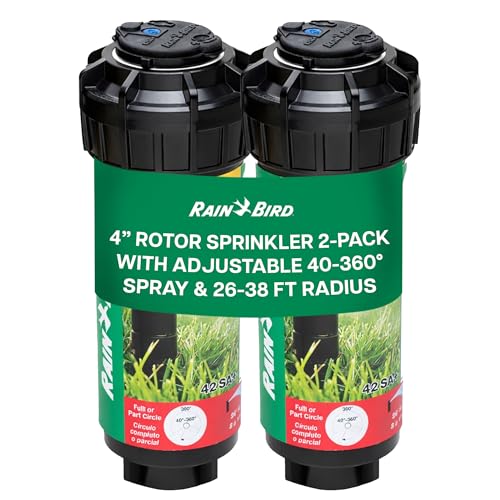

As an Amazon Associate we earn from qualifying purchases at no extra cost to you.
Quick Picks
- Best overall: Rain Bird 5004 (4-inch pop-up, 25 to 50 ft radius).
- Best for pressure problems: Rain Bird 5004 with the PRS (pressure-regulating) option.
- Best for sloped lawns: Rain Bird 5004 with a check valve (PC models).
- Best for small and medium lawns: Rain Bird 3504 (about 15 to 40 ft radius).
- Best nozzle flexibility: Hunter PGP-ULTRA.
- Best rugged and serviceable: Hunter I-20 (34 nozzle choices, 17 to 46 ft).
- Best for mixed repairs on a budget: Toro T5 series (verify spec details on the box).
How We Chose
This guide relies on manufacturer technical sheets, irrigation design references and buying guides, not on physical use. We compare heads on radius and arc range, precipitation rate, operating pressure window, pop-up height, nozzle choices, compatibility with common riser sizes and serviceability features such as top-access adjustment and check valves. Where we could not verify a specification for a particular model, we describe it by spec class. Confirm current model numbers and inlet thread sizes with the manufacturer before ordering, because model lines and nozzle sets change.
Rotor vs Spray Heads: Why You Cannot Mix Them
Spray heads fan out a fixed arc at a short range, typically up to about 15 feet, and apply water fast. Rotors send out a slower stream and apply water at a much lower rate. If a rotor and a spray head share a valve, the spray area is soaked while the rotor zone is barely wet by the time the timer ends.
| Feature | Spray head | Rotor head |
|---|---|---|
| Typical radius | Up to about 15 ft | About 15 to 50 ft |
| Typical precipitation rate | High, often 1.5 in/hr or more | Low, about 0.2 to 0.6 in/hr for matched sets |
| Best use | Narrow strips, small beds | Open lawns, large turf zones |
| Typical run time per zone | Short: 10 to 15 minutes | Longer: 30 to 60 minutes |
| Pressure range | Roughly 20 to 40 psi | Roughly 25 to 70 psi |
Replace mixed zones by converting all heads on a valve to the same type. If you must keep a spray head in a rotor zone, put it on its own valve.
What to Look For
Radius and Arc
Rotor radius is set by the nozzle and trimmed with the radius-reduction screw. The Rain Bird 5000 series covers about 25 to 50 feet, and the retention screw can reduce radius by up to 25 percent. The Hunter I-20 covers 17 to 46 feet. Arc is adjustable from about 40 to 360 degrees on most models. Measure the area from head to head and choose a rotor whose radius is at least equal to your spacing. Head-to-head coverage, meaning each head reaches the next head, is the standard for even watering.
Matched Precipitation Rate
A matched-precipitation nozzle applies the same depth of water per hour whether the head is set to a quarter, half or full circle. A full circle spreads its flow over four times the area of a quarter circle, so a matched set must use four times the flow for the full-circle nozzle. Rain Bird’s MPR nozzle for the 5000 series delivers about 0.6 inches per hour at 45 psi and comes in 25, 30 and 35 foot radii. Hunter’s PGP-ULTRA and I-20 share a large nozzle family, and several of its nozzles in the 25 foot class list rates around 0.6 to 0.7 inches per hour at 45 psi.
Worked Calculation: Matching Heads and Setting Run Time
The precipitation-rate formula is: inches per hour = 96.25 x gallons per minute (GPM) / area covered in square feet. Here is a worked example with illustrative numbers.
- Suppose a corner head is set to a quarter circle with a nozzle that delivers 0.75 GPM, a side head to a half circle at 1.5 GPM, and a center head to a full circle at 3.0 GPM, all spaced 30 feet apart.
- Each head covers a proportion of a 30 x 30 foot square (900 sq ft). The quarter covers 225 sq ft, the half 450 sq ft, the full 900 sq ft.
- Quarter: 96.25 x 0.75 / 225 = 0.32 in/hr. Half: 96.25 x 1.5 / 450 = 0.32 in/hr. Full: 96.25 x 3.0 / 900 = 0.32 in/hr. The rates match, so the zone waters evenly.
- To apply one inch of water in a week, divide 1 by 0.32: about 3.1 hours. Split into three cycles of about 1 hour each, or use shorter cycles if the soil puddles.
Now compare a spray head at 1.6 in/hr. It needs only about 38 minutes (1 / 1.6 x 60) to deliver the same inch. That mismatch is why rotors and sprays belong on separate valves.
Pop-Up Height
The standard rotor riser rises 4 inches. Taller risers of 6 or 12 inches clear tall grass or groundcover. A 4-inch pop-up is correct for most lawns. Match the pop-up height to your existing body, because some heads share bodies with swappable internals.
Check Valves and Pressure Regulation
A check valve holds back water in the lateral line when the zone shuts off, which prevents the low heads on a slope from draining and puddling. Many manufacturers sell heads with a built-in check valve, often labeled PC for Rain Bird or with FloStop and check-valve options for Hunter. A pressure-regulating version holds a set pressure at the nozzle, which stops misting and uneven throw on systems above about 55 psi.
Compatibility With Existing Risers
Most residential rotors use a 3/4 inch female thread inlet, but verify yours before buying. Models in the same family generally swap into the same body, so you can upgrade internals without digging. Check the arc adjustment style, either top-adjustable with a key or tool, and the thread size. If you are replacing a different brand, bring the old head to the store or measure the body diameter and riser height.
Comparison Table
| Model | Radius | Pop-up | Key feature | Operating pressure |
|---|---|---|---|---|
| Rain Bird 5004 | 25 to 50 ft | 4 in | Radius trim up to 25 percent, MPR nozzles | Check manufacturer sheet |
| Rain Bird 5004 PRS | 25 to 50 ft | 4 in | Pressure regulation at the head | Regulated, verify setting |
| Rain Bird 5004 PC | 25 to 50 ft | 4 in | Built-in check valve | Check manufacturer sheet |
| Rain Bird 3504 | About 15 to 40 ft | 4 in | Compact residential rotor | Check manufacturer sheet |
| Hunter PGP-ULTRA | Verify on nozzle chart | 4 in | Shares nozzle family with I-20 | 25 to 70 psi recommended |
| Hunter I-20 | 17 to 46 ft | 4 in | 34 nozzles, 13 or 25 degree trajectory | 25 to 70 psi recommended |
| Toro T5 | Verify on box | Verify | Mid-range alternative | Verify |
The Best Rotor Heads by Buyer Criteria
Best for Wide Coverage and Large Lawns
1. Rain Bird 5004
Specs: 25 to 50 ft radius · 0.20 to 1.50 in/hr range depending on nozzle · radius trim up to 25 percent via retention screw · MPR nozzles in 25, 30 and 35 ft radii · quarter, third, half and full patterns · 4 in pop-up
Best for: Large open lawns and anyone who wants broad radius adjustment without changing nozzles.
Skip if: Your spacing is under about 20 feet. You will get less value from a 50-foot head, and a smaller rotor fits better.
- Pros: Long reach; MPR nozzles for matched precipitation; widely stocked, so parts are easy to find; reputation for reliability.
- Cons: A fixed nozzle set means fewer small-radius options than the Hunter family offers; verify the pop-up height of the variant you buy.
2. Hunter I-20
Specs: 17 to 46 ft radius · 0.36 to 14.8 GPM · 34 nozzle choices · 25 degree standard or 13 degree low-angle trajectory · 25 to 70 psi recommended, 20 to 100 psi operating
Best for: Properties with irregular shapes, windy sites and mixed distances, where selecting from many nozzles saves effort.
Skip if: You want the simplest possible head to replace. The wider choice of nozzles requires attention to flow and radius so zones stay matched.
- Pros: Very broad nozzle selection; low-angle option for wind; strong feature set including check valve and stop options on certain versions.
- Cons: Slightly shorter maximum radius than the Rain Bird 5004; riser material and similar features vary by version, so confirm which variant you are buying.
3. Hunter PGP-ULTRA
Specs: 4 in pop-up · shares nozzle family with the I-20 · top-adjustable arc · 25 to 70 psi recommended range · verify exact radius on the nozzle chart
Best for: Replacement in older Hunter PGP zones and for owners who already stock Hunter nozzles.
Skip if: You need the maximum radius or advanced options available on the I-20, and your site needs those features.
- Pros: Familiar design; easy to service; the same nozzles as the I-20 mean stocking one set of spare nozzles.
- Cons: We could not verify some feature details for the current version, so confirm check-valve and riser options before ordering.
Best for Problem Sites: Slopes, High Pressure
4. Rain Bird 5004 PC (Check Valve)
Specs: Same 25 to 50 ft radius and nozzle options as the 5004 · built-in check valve · 4 in pop-up
Best for: Sloped lawns where the lowest heads weep after the valve closes, and for anyone replacing heads that leave puddles at the bottom of a slope.
Skip if: Your lawn is flat and your lateral lines drain evenly. The extra feature adds cost without benefit.
- Pros: Prevents low-head drainage; saves water; avoids erosion.
- Cons: A check valve adds a small amount of pressure loss; heads should be matched in the same zone so none behave differently.
5. Rain Bird 5004 PRS (Pressure Regulating)
Specs: Same 25 to 50 ft radius as the 5004 · pressure regulation inside the head · 4 in pop-up
Best for: Systems with static pressure above about 55 to 60 psi, where heads mist, fog and lose throw distance.
Skip if: Your pressure is already at or under about 45 psi. Regulation can reduce an already low pressure.
- Pros: Consistent nozzle pressure; reduces misting; consistent radius across zones.
- Cons: Check the regulated pressure setting on the product page, because it may not match the 45 psi design pressure of your nozzles.
Best for Smaller Lawns and Tight Budgets
6. Rain Bird 3504
Specs: About 15 to 40 ft radius · 4 in pop-up · compact body · adjustable arc
Best for: Small and medium yards where the 5000 series is more throw than you need.
Skip if: Your head spacing exceeds 35 to 40 feet.
- Pros: Right-sized for typical suburban lawns; fewer misaligned sweeps; parts are widely available.
- Cons: Lower maximum radius; verify arc and flow specifications on the current datasheet.
7. Toro T5 Series
Specs: Rotor-class head · specifications not verified in the sources reviewed
Best for: Owners with existing Toro systems who want a same-brand replacement.
Skip if: You need documented radius and flow numbers before buying. Compare the manufacturer chart with the Rain Bird and Hunter data above.
- Pros: Direct same-brand replacement for existing Toro zones.
- Cons: We could not verify radius, pressure and feature specs, so treat this as a conditional pick.
Decision Matrix
| Your site | Pick | Why |
|---|---|---|
| Open lawn, 35 to 45 ft spacing | Rain Bird 5004 or Hunter I-20 | Radius up to 46 to 50 ft |
| Small yard, 20 to 30 ft spacing | Rain Bird 3504 or Hunter nozzle in the 25 ft class | Right-sized throw |
| Slope with puddles at the bottom | Rain Bird 5004 PC | Check valve stops low-head drainage |
| Static pressure above 60 psi, misting | Rain Bird 5004 PRS | Pressure regulation |
| Windy site | Hunter I-20 with 13 degree nozzle | Lower trajectory resists wind drift |
| Replacing old PGP heads | Hunter PGP-ULTRA | Drop-in same family |
How to Replace a Rotor Head
- Turn off the water. Shut off the zone valve or the main supply, and relieve pressure.
- Locate and dig around the head. Cut a neat circle of turf and set it aside so you can replace it. Check the buried lines for damage before using a shovel.
- Unscrew the old head. Twist counterclockwise. If it will not turn, hold the riser with a wrench or pliers on the body rather than the lines.
- Clean the threads. Flush debris from the riser or swing joint before installing the new head.
- Check the riser height. Seat the head so its top is flush with the soil or slightly below, which lets mowers pass over safely.
- Set arc and radius. Use the arc key or tool on the top of the head. Run the zone and watch for dry spots and overspray onto pavement.
- Backfill and replace turf. Firm the soil gently and keep the head level.
Safety notes: call your local utility locator before digging deeper than a few inches, and shut off power to the controller before touching valves or wires.
Common Mistakes
- Mixing rotors and spray heads on the same valve.
- Using different nozzle flows on a zone without checking matched precipitation.
- Setting radius so large the water lands on pavement or fences.
- Skipping check valves on slopes.
- Ignoring static pressure. Use a gauge on a hose bib to measure it.
Frequently Asked Questions
What is the difference between rotor and spray heads?
Rotors throw slow streams over 15 to 50 feet at a low precipitation rate, while spray heads fan out up to about 15 feet at a high rate. Use rotors for open lawns and sprays for narrow areas.
Can I put rotors and sprays on the same zone?
No. Their precipitation rates differ many times over, so one type floods or the other stays dry. Put each type on its own valve or convert the whole zone to one type.
What does matched precipitation mean?
Matched precipitation means each nozzle in a zone applies water at the same rate, in inches per hour, whatever its arc. Quarter-circle heads use a quarter of the flow of full-circle heads to achieve this.
What pressure do rotors need?
Many rotors work well at around 45 psi at the nozzle. Hunter lists a recommended range of 25 to 70 psi for its I-20. Pressures well above or below that cause misting or short throw.
How long should I run rotors?
Divide the inches you want by the zone’s precipitation rate. At 0.32 inches per hour, one inch takes about three hours per week, best split into shorter cycles to prevent runoff.
Do I need a check valve?
Use one on slopes, or where low heads leak after shutoff. On flat, evenly graded lawns the benefit is small, though some owners add them to reduce water waste.
Will new rotors fit my old risers?
Most residential rotors use a 3/4 inch female thread, but check your existing riser and body. Same-brand heads usually interchange, and different brands often need adapters.
How far apart should I space rotor heads?
Space heads so each one reaches the next one, which is called head-to-head spacing. Reduce spacing in windy conditions, as wind distorts throw and creates dry areas.
Bottom Line
Start with spacing, pressure and slope. The Rain Bird 5004 and Hunter I-20 cover most lawns, the PC and PRS options solve slope and pressure problems, and the Rain Bird 3504 suits smaller yards. Convert whole zones to a single head type, match precipitation rates with matched nozzles, and set run times from the calculation above instead of guessing.