Key takeaways
- Pro: Pressure headroom makes it nearly impossible to overtax in normal use.
- Pro: Five-layer braid resists kinking at tight corners.
- Con: Noticeably heavier than polymer or expandable alternatives, so hauling it across a large yard gets tiring.
A 3/4 inch garden hose is the workhorse size for anyone who needs more volume than a standard 5/8 inch line can deliver—think long runs to a remote irrigation zone, filling a stock tank, or running a pressure washer without starving it of flow. The problem is that the category is deceptively hard to shop. A hose might advertise “heavy duty” while using a thin rubber wall that kinks at the first sharp bend, or it might be rated for high burst pressure but feel so stiff in cold weather that you cannot coil it back onto a reel.
The best 3/4 inch garden hose balances pressure tolerance, kink resistance, and handling weight without forcing you to choose one at the expense of the others. Owner feedback consistently flags the same failure points: fittings that crack at the crimp, rubber compounds that go rock-hard below 40°F, and expandable cores that balloon past their brass fittings after a summer in direct sun. We narrowed these eight options by published specs, real-world pricing, and patterns in long-term owner reports to show where each model earns its spot and where it falls short.
Our top picks


As an Amazon Associate we earn from qualifying purchases at no extra cost to you.
Quick Picks
| Product | Best for | Price |
|---|---|---|
| Guitrees 50FT Rubber | High-pressure commercial use | $66.99 |
| Gilmour Pro Commercial 50ft | Best value kink resistance | $41.99 |
| Guitrees 25FT Rubber | Compact high-pressure jobs | $47.99 |
| Solution4Patio 25ft | Tightest budget | $27.99 |
| Flexi Hose 50FT | Lightweight expandable with nozzle | $42.49 |
| Flexzilla 50ft | All-weather flexibility | $62.17 |
| Guitrees 100FT Rubber | Longest heavy-duty run | $92.39 |
| Gilmour Pro Commercial 75ft | Extended kink-resistant reach | $74.27 |
How We Picked
We focused on four criteria that separate a hose you will replace within a season from one that lasts: published burst and working pressure ratings, because a hose rated for only 200 psi working pressure will fail if you pair it with a municipal supply running 60+ psi for hours; construction method (layered braiding versus single-wall rubber versus expandable latex), which determines kink behavior and UV resistance; fitting quality, since brass male-to-female connections outlast plastic or crimped aluminum; and length-to-weight handling, because a 100-foot rubber line that is impossible to coil defeats its own purpose. Owner feedback across 2026 purchase cycles helped us flag models where the spec sheet and the real experience diverged.
The 8 Best 3/4 Inch Garden Hose in 2026
Guitrees 50FT Heavy Duty Rubber
This is the pick for anyone running a pressure washer, irrigating acreage, or working on a construction site where hose failure costs an afternoon. The 300 psi working and 1000 psi burst ratings sit well above what a residential spigot can generate, and the five-layered braiding gives it structural rigidity that cheaper single-wall rubber lacks. It handles hot water without softening the core.
- Pro: Pressure headroom makes it nearly impossible to overtax in normal use.
- Pro: Five-layer braid resists kinking at tight corners.
- Con: Noticeably heavier than polymer or expandable alternatives, so hauling it across a large yard gets tiring.
Skip it if your main concern is storage space or if you need to coil it weekly onto a wall-mounted reel.
Gilmour Pro Commercial 50ft
At under $42 for a 50-foot commercial-grade line, this hose undercuts most rubber competitors while still earning praise for kink resistance. Gilmour’s Pro Commercial line targets landscape contractors, and owner feedback confirms it handles repeated full-day use without the memory coils that plague cheaper vinyl blends. It is not rated for hot water, so keep it to cold-supply applications.
- Pro: Exceptional price-to-durability ratio for a 50-foot 3/4 inch hose.
- Pro: Kink-resistant construction holds up to all-day dragging across gravel.
- Con: Lacks a published psi burst rating, making it harder to compare on raw strength.
Skip it if you need confirmed high-pressure specs for industrial equipment.
Guitrees 25FT Heavy Duty Rubber
Identical construction to the 50-foot version in a shorter footprint, this suits users who need the rubber and braiding benefits but have limited storage or a smaller property. It carries the same 300/1000 psi ratings. The trade-off is value: it costs more than Gilmour’s 50-foot Pro Commercial, so you are paying for material quality in a compact form.
- Pro: Same five-layer braid and pressure ratings as the longer Guitrees models.
- Pro: Easy to manage on a reel or hang on a shed wall without dragging.
- Con: Higher cost per foot than any other option in this roundup.
Skip it if you can manage a 50-foot line; the extra length gives better reach for only a few dollars more per foot.
Solution4Patio 25ft Heavy Duty
The cheapest entry in this group by a wide margin, this 25-footer covers basic watering tasks without pretension. Male-to-female brass fittings are a genuine plus at this price, since many budget hoses use plastic couplers that crack within a season. Owner feedback highlights it as a solid backup or garage-sale-grade option.
- Pro: Lowest price point with metal fittings at 3/4 inch.
- Pro: Short enough to store anywhere without a dedicated reel.
- Con: No published pressure ratings and lighter construction that owners report kinks more easily than rubber models.
Skip it for any application over 25 feet or if you expect to drag it over rough terrain daily.
Flexi Hose 50FT Expandable
This expandable option appeals to users who want the smallest possible storage footprint and a free nozzle. The double latex core and solid brass fittings are the right material choices for a flexi-style hose, though expandable construction inherently trades burst strength for convenience. The 8-function nozzle adds utility for users who want one tool for everything from gentle misting to jet cleaning.
- Pro: Extremely lightweight and compact when drained and coiled.
- Pro: Included nozzle eliminates a separate purchase.
- Con: Expandable hoses are more vulnerable to UV degradation and puncture than solid rubber.
Skip it if you leave the hose connected to the spigot outdoors for weeks at a time, as sustained pressure accelerates latex fatigue.
Flexzilla 3/4 in. x 50 ft.
Flexzilla built its reputation on staying pliable across a wide temperature range, and the 50-foot commercial size extends that advantage to higher-volume watering. The polymer blend resists the cold-weather stiffening that owners of rubber hoses complain about. Leak-free connections are a design focus, and real-world reports confirm fewer fitting seep issues than typical aluminum-crimp alternatives.
- Pro: Remains flexible in near-freezing temperatures where rubber goes board-like.
- Pro: Leak-free fitting design reduces connection drips over time.
- Con: Premium pricing with no published burst-pressure figure for direct spec comparison.
Skip it if budget is your primary filter and you live in a climate that rarely dips below 40°F.
Guitrees 100FT Heavy Duty Rubber
For users who need a single unbroken 3/4 inch line across a large property—say, from the house to a barn or pasture—this is the highest-capacity rubber option in the group. Same five-layer braid, same pressure ratings, doubled length. The reality, though, is that 100 feet of heavy-duty rubber is a genuine physical burden to maneuver and store.
- Pro: Longest confirmed pressure-rated run without couplers or splicing.
- Pro: Identical construction quality to the 50-foot Guitrees, so you get the same durability per foot.
- Con: Weight and bulk make it impractical for anyone who cannot leave it permanently laid out.
Skip it if you need to retrieve and store the hose after each use; consider two 50-foot segments joined by a coupler instead.
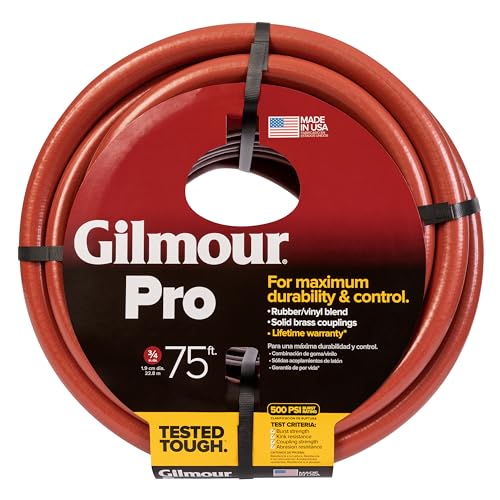
Gilmour Pro Commercial 75ft
This bridges the gap between the 50-foot and 100-foot options, giving extra reach without the full weight penalty of a century of rubber. Gilmour’s kink-resistant construction scales well to longer lengths, and at $74.27 it costs less than the Guitrees 100-foot model while still being a manageable distance for most yards.
- Pro: Strong reach at a mid-range price between the 50-foot Guitrees and the 100-foot rubber.
- Pro: Commercial kink-resistance holds up well even when the line is partially coiled during use.
- Con: Still lacks published psi figures for buyers comparing on raw pressure data.
Skip it if you specifically need a documented burst rating for a job-site safety requirement.
Buying Guide
Pressure Ratings: Working vs. Burst
Working pressure tells you the sustained load the hose can handle; burst pressure is the failure ceiling. Residential water systems typically deliver 40 to 80 psi, so a 300 psi working rating like the Guitrees models provides massive headroom. What matters more is consistency: a hose with no published rating may still perform well, but you lose the ability to match it to a pressure washer that demands 4 gpm at a specific inlet pressure.
Material and Construction Method
Layered rubber with braiding is the most durable construction but the heaviest. Polymer blends like Flexzilla’s trade some abrasion resistance for cold flexibility and lighter handling. Expandable latex cores with fabric sleeves win on storage and weight but are the most vulnerable to UV, puncture, and sustained static pressure. Match the construction to how you store and deploy the hose, not just to the specs on the box.
Fittings, Length, and Practical Handling
Brass fittings with a male-to-female design seal more reliably than crimped aluminum, and they resist cross-threading. For length, 50 feet covers most residential lots; anything beyond 75 feet introduces real handling friction unless the hose is permanently laid. Factor in that 100 feet of rubber hose weighs enough that two people become necessary for retrieval on uneven terrain.
Our Verdict
The Guitrees 50FT Heavy Duty Rubber is the top pick when you need confirmed pressure ratings and a construction method proven across thousands of owner reports, and its 300/1000 psi specs give unmatched confidence for demanding applications. The Gilmour Pro Commercial 50ft is the best value pick, delivering commercial kink resistance at a price well below rubber competitors with fewer published figures. However, if you live in a climate with freezing winters, the Flexzilla wins outright because it stays pliable where rubber becomes unmanageable.
FAQ
Is 3/4 inch overkill for a home garden?
It depends on your watering method and lot size. A 3/4 inch line delivers roughly 25 to 30 percent more volume per minute than 5/8 inch, which matters when feeding multiple drip zones or running a pressure washer. For a single hose-end sprinkler on a small yard, 5/8 inch suffices.
Can I use a 3/4 inch hose with standard fittings?
Most 3/4 inch garden hoses use the same GHT (garden hose thread) coupling size as 5/8 inch hoses, so they are interchangeable with standard nozzles, timers, and adapters. The diameter difference is internal, not at the fitting.
How long do rubber hoses last compared to expandable ones?
With proper storage and no sustained sun exposure, layered rubber hoses commonly reach five to ten years of regular use. Expandable latex-core hoses often show degradation within two to three seasons, particularly if left pressurized or stored under UV exposure.
Does length affect water pressure?
Yes, but mildly for residential applications. Each additional 50 feet of 3/4 inch hose introduces friction loss that can reduce pressure by a few psi at the nozzle. The effect becomes noticeable mainly when combining long runs with narrow-diameter nozzles or elevation changes.