Key takeaways
- Pro: Rule set is intuitive enough for a six-year-old to grasp in the first round.
- Pro: Games end quickly, making it suitable for bedtime-slot play or short party rotations.
- Con: Older children and adults may find the luck-dominant mechanic shallow after a dozen plays.
Every holiday season and birthday party cycle, the same frustration resurfaces on the kitchen table: a board game gets opened, played once, and never touched again. The buyer’s real problem is not a shortage of options — it is the difficulty of predicting which game will survive more than a single evening with the specific group sitting down to play. A game that bores a five-year-old can frustrate an eight-year-old who was ready for more complexity, and a title that thrills adults can lose kids within two rounds because the rules demand abstract reasoning they have not yet developed.
What separates a worthwhile purchase from a closet ornament comes down to three things: a rule set matched to the youngest player at the table, a play time that fits the evening rather than consuming it, and enough variability that the same game does not feel stale by the third session. Price alone is a weak signal — a nine-dollar classic and a twenty-two-dollar staple can both earn repeated plays if they hit the right age band. This roundup compares eight widely available titles across price tiers so you can match a game to your household without guessing.
Our top picks




As an Amazon Associate we earn from qualifying purchases at no extra cost to you.
Quick Picks
| Product | Best for | Price |
|---|---|---|
| Sorry! | Quick family play | $8.98 |
| Monopoly | Long strategy nights | $15.99 |
| UNO | Travel and parties | $11.65 |
| Trouble | Youngest players | $9.84 |
| Connect 4 | First strategy game | $12.78 |
| Yahtzee | Dice-game fans | $8.88 |
| Candy Land | Preschoolers | $14.07 |
| Scrabble | Word-game lovers | $21.92 |
How We Picked
We evaluated these titles against four criteria drawn from published specifications and aggregated owner feedback. First, the manufacturer age recommendation as a reliable floor for comprehension — games played by younger children than suggested tend to generate frustration reports. Second, player-count flexibility, because a game that only works with exactly four players becomes dead weight in a three-person household. Third, component durability relative to price, since plastic tokens and cardboard tokens age very differently under repeated use. Fourth, replay variability, meaning the game changes meaningfully from round to round rather than relying on memorized optimal paths.
The 8 Best Board Games in 2026
Sorry!
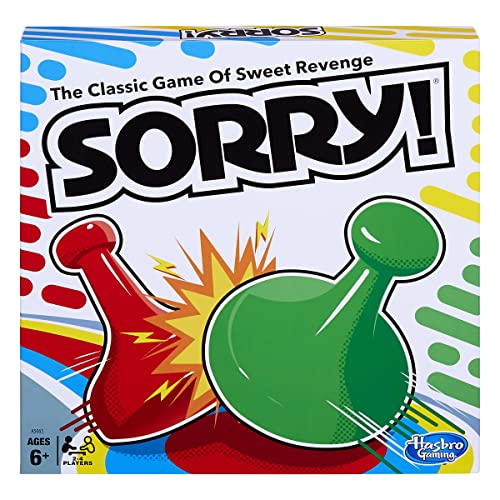
Sorry! targets families with children at the six-year mark who want a game that ends in under thirty minutes and never requires arithmetic beyond counting spaces. Owner feedback consistently praises the simplicity of the card-based movement and the dramatic slide-and-knock-home mechanic that younger kids find thrilling. The price keeps it a low-risk entry point for households still discovering what their children will enjoy. It pairs well as a first “real” board game before a family graduates to longer strategy titles.
- Pro: Rule set is intuitive enough for a six-year-old to grasp in the first round.
- Pro: Games end quickly, making it suitable for bedtime-slot play or short party rotations.
- Con: Older children and adults may find the luck-dominant mechanic shallow after a dozen plays.
Skip it if your group skews older or you want meaningful strategic depth on every turn.
Monopoly
Monopoly remains the reference point for long-form family strategy in 2026. The updated edition ships with a storage tray and larger tokens, addressing two of the most common owner complaints about older versions: component loss and fiddly pieces. It suits households with children eight and up who can manage the slower pace and understand basic property economics. The two-to-six-player range makes it adaptable to most family sizes, and the storage tray means the board is not a weekly reassembly project.
- Pro: The larger tokens and storage tray materially improve the setup-and-teardown experience over legacy editions.
- Pro: Six-player capacity accommodates extended family gatherings without needing a second board.
- Con: Game length can stretch well past ninety minutes, which tests patience with younger participants.
Skip it if your children are under eight or you cannot commit to an extended play session.
UNO
UNO is the most portable serious game on this list and the one that earns its “party” reputation. The color-blind accessible edition removes the visual barrier that made standard decks unusable for some players, and the customizable deck lets households add house rules without marking up cards with pen. Owner feedback highlights its performance in travel, waiting rooms, and vacation settings where component loss is a realistic concern. It requires reading only for number cards, making the effective entry age lower than the stated recommendation.
- Pro: Extremely compact storage and light weight make it ideal for travel and bag-packing.
- Pro: Color-blind accessibility broadens the age and ability range of who can play comfortably.
- Con: The deck thins with use as cards get misplaced, and replacements can be inconsistent.
Skip it if you need a game with spatial or strategic components beyond number-matching.
Trouble
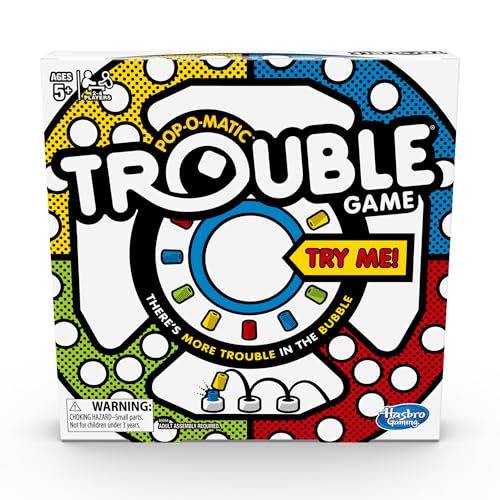
Trouble is the pop-o’-dice classic that converts screen-averse four- and five-year-olds into engaged board-game participants. The mechanical dice popper eliminates the fine-motor and rolling-accuracy problems that frustrate younger children with standard dice. At the lowest entry age on this list, it serves as a bridge between Candy Land and something with more decision-making. Two-to-four players means it works well as a parent-child game without needing a full table of siblings.
- Pro: The built-in dice popper removes a major physical barrier for children under six.
- Pro: Short games keep attention from wandering during the critical early-reading-age window.
- Con: The same simplicity that engages a five-year-old offers almost no growth room by age seven.
Skip it if your child is already past seven or you want a title that lasts multiple school-age years.
Connect 4
Connect 4 occupies the strategic-gateway role: it is the first game where children encounter a decision tree, because every placement either builds toward a four-line or blocks an opponent’s line. The Amazon Exclusive version includes a vertical grid and sturdy disc set. Owner reports praise the replayability — no two games play identically, and the strategy deepens noticeably with age. It is also one of the few titles on this list where an adult can compete without hand-holding yet still be beaten by a focused child.
- Pro: Genuinely strategic without requiring reading, making it a rare all-ages competitive option.
- Pro: Games last only a few minutes, fitting easily into short play windows.
- Con: The fixed two-player format excludes siblings or family members from participating simultaneously.
Skip it if you need a multiplayer family title rather than a one-on-one duel.
Yahtzee
Yahtzee is the best low-cost entry into dice-based strategy. The scoring sheet introduces multiplication and combination planning at a level appropriate for eight-year-olds who are solidifying arithmetic skills. Owner feedback highlights the game’s adaptability across age groups — a child can focus on a single category per turn while an adult pursues bonus optimization. At the lowest price on this list, the value proposition is unusually strong for the amount of thinking it demands.
- Pro: Combines luck and decision-making in a way that keeps both children and adults invested.
- Pro: The price point makes it an easy secondary purchase for households that already own a long-form classic.
- Con: The score sheet requires reading comprehension and basic arithmetic, narrowing the true younger limit.
Skip it if your group prefers spatial or tile-based play over numerical scoring.
Candy Land
Candy Land is the standard recommendation for three-to-five-year-olds because its path-following mechanic requires zero reading, zero strategy, and zero decision-making beyond color matching. The Amazon Exclusive edition includes updated artwork and thicker path cards that resist tearing from small hands. It serves as a confidence-building first board game — the guaranteed path to the finish line means every child wins eventually, which matters more than the mechanic itself at that developmental stage.
- Pro: No reading, counting, or strategy required — accessible to the youngest possible age group.
- Pro: Every player finishes, reinforcing participation without introducing the concept of losing too early.
- Con: Zero decision-making means adult interest evaporates within the first few turns.
Skip it if any player in your household is older than five or already comfortable with color matching.
Scrabble
Scrabble is the highest-priced entry here and the only title where vocabulary size directly determines competitive advantage. It suits families with children eight and up who are building reading and spelling fluency, and it earns its premium through genuinely deep replayability — no two games produce the same board. Owner reports note that the board’s grid layout makes it one of the most satisfying end-game displays, but the learning curve for younger children is steeper than its price might suggest.
- Pro: Effectively unlimited replay value, since every game generates a unique board state.
- Pro: Reinforces spelling, vocabulary, and spatial planning simultaneously without feeling academic.
- Con: The premium price is only justified for groups that will play repeatedly across years.
Skip it if your youngest players have not yet reached the spelling confidence to participate without frustration.
Buying Guide
Match the age floor, not the age ceiling
Manufacturer age recommendations mark the minimum comprehension threshold, not a maximum enjoyment level. If your group includes a child two years below the recommended age, plan for that child to spectate or leave early. The better strategy is to buy at the recommended floor of the youngest regular player rather than the average age. This single adjustment eliminates the most common source of post-holiday abandonment.
Play time versus calendar time
Stated play times are optimistic. Owner feedback consistently reports that younger players extend game length by half or more through hesitation, mid-game renegotiation of rules, and bathroom breaks. For bedtime play or tight party schedules, a game with a stated fifteen-minute duration will reliably take closer to thirty with children in the group. Budget accordingly: longer games belong on weekend afternoons, not Tuesday nights.
Component durability and replacement costs
Plastic tokens and dice outlast cardboard pieces by years, especially under small hands. Card-based games with high shuffle counts will show wear faster than tile- or disc-based games. If a title loses components easily, factor in the difficulty and cost of replacement — UNO and Yahtzee lose pieces most frequently based on owner reports, while Monopoly’s updated storage tray specifically addresses this failure mode at the design level.
Our Verdict
The top pick is Connect 4: it offers real strategy without reading, works across a wide age range, produces short games that fit any schedule, and remains engaging for adults — a combination no other title on this list fully delivers. The budget pick is Yahtzee, which at the lowest price on this list introduces genuine decision-making and arithmetic in a format that grows with the player for years. The exception: UNO wins outright when the primary use case is travel or parties, because its portability and low stakes make it the only title here that thrives outside the living room.
FAQ
What is the best first board game for a family with mixed ages?
Choose a title matched to the youngest regular player and accept that older participants will find it simple. Connect 4 works well for this scenario because it has no reading requirement, plays in minutes, and allows a four-year-old and an eight-year-old to compete meaningfully on the same board.
How many board games does a family actually need?
Owner feedback from households with children suggests three titles cover most situations: one short-form game for weeknights, one long-form game for weekends, and one portable game for travel. The eight options here are designed so that any combination of three from this list fills those roles without redundancy.
Do expensive board games last longer?
Price correlates with component quality but not reliably with durability. Monopoly’s updated storage tray is a durability feature at a mid-tier price, while Scrabble’s cardboard tiles and letter racks wear at a rate similar to cheaper games. The real longevity factor is whether the family plays the game repeatedly, which depends on engagement rather than cost.
Can these games help with reading and math skills?
Several do indirectly. Scrabble reinforces spelling and vocabulary recall under time pressure, Yahtzee practices multiplication and combination counting, and Monopoly introduces basic arithmetic with larger numbers. The skill development is a byproduct of engagement rather than a designed educational outcome, which is why the games work better than dedicated learning tools for reluctant learners.