The best foosball tables for most home game rooms are full-size 56-inch competition-style tables with 1-inch thick MDF cabinets, hollow steel rods, and counterbalanced players, while compact 48-inch to 54-inch tables make more sense for smaller spaces or casual family play where stability and safety matter more than tournament speed.
Our top picks
 Best Choice Products 54-Inch Regulation Foosball Table
- A full-sized foosball table is perfectly built for…
- Features a robust design and a large play…
- This game room classic is crafted with sturdy…
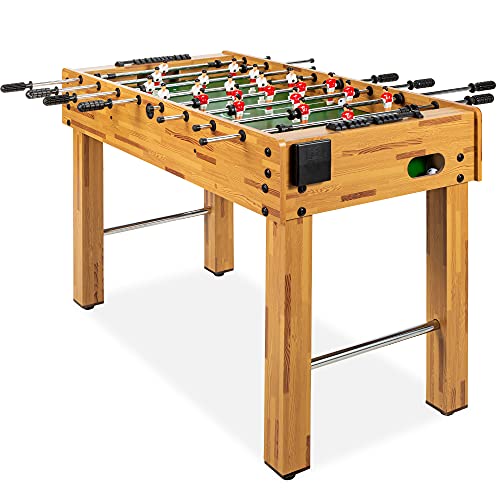 Best Choice Products 48-Inch Foosball Table for
- Competition-sized foosball table brings fun to any setting,…
- Control bars have comfortable grips for better ball…
- This game room classic is crafted with sturdy…
 GoSports 54 Inch Full Size Foosball Table
- Full size game table for competitive foosball games…
- Includes illustrated step-by-step instructions and installation video guide…
- Features an updated style and color scheme that…
| Product | Key specs | |
|---|---|---|
| Best Choice Products 54-Inch Regulation Foosball Table | A full-sized foosball table is perfectly built for… Features a robust design and a large play… This game room classic is crafted with sturdy… | Check price |
| Best Choice Products 48-Inch Foosball Table for | Competition-sized foosball table brings fun to any setting,… Control bars have comfortable grips for better ball… This game room classic is crafted with sturdy… | Check price |
| GoSports 54 Inch Full Size Foosball Table | Full size game table for competitive foosball games… Includes illustrated step-by-step instructions and installation video guide… Features an updated style and color scheme that… | Check price |
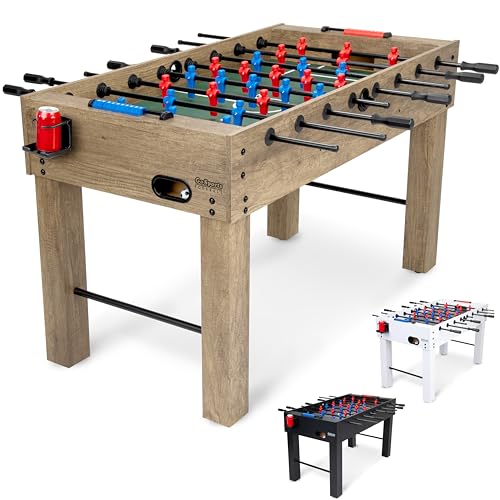 GoSports 54 Inch Full Size Foosball Table GoSports 54 Inch Full Size Foosball Table | Full size game table for competitive foosball games… Includes illustrated step-by-step instructions and installation video guide… Features an updated style and color scheme that… | Check price |
As an Amazon Associate we earn from qualifying purchases at no extra cost to you.
How to Choose the Right Foosball Table for Your Home
Buying a foosball table is a trade-off between play quality, footprint, and long-term durability. A table that feels fast and precise in a dedicated game room can feel oversized and unstable in a multipurpose family room. Use these five criteria to narrow your choice before looking at specific models.
1. Dimensions and Room Fit
Regulation foosball tables are 56″ L x 30″ W x 36″ H. You need at least 3 feet of clearance on each long side for rod extension and player movement, and 2 feet on each end. That means a 56-inch table actually requires a floor space of roughly 10′ x 6′.
48-inch and 54-inch tables reduce length but rarely reduce width, and they often use thinner cabinets to save weight. For a 12′ x 12′ bedroom or bonus room, a 54-inch table is usually the largest you can fit without blocking traffic flow. For basements and dedicated game rooms over 14 feet long, a full 56-inch table is worth the upgrade for consistent ball control.
2. Playing Surface Quality
The playfield determines ball speed and control. Three common types:
- Laminated MDF with printed markings: Found on most casual tables. Fast, low friction, but the ball can slide unpredictably if the surface is too slick. Better for quick family games than for pin shots.
- Sand-coated or textured laminate: Used on Tornado and Garlando competition tables. Adds grip so you can actually pin and pass the ball between figures. Essential if you want to learn controlled play.
- Linoleum or glass-style surfaces: Rare in home tables, more common in European-style Garlando and Bonzini tables. Very fast and durable but requires silicone treatment to prevent wear.
Look for a playfield thickness of at least 0.75 inches and corner ramps or beveled walls that prevent dead balls. Thin 0.5-inch playfields warp over time, especially in humid basements.
3. Rod Systems: The Biggest Difference in Feel
- Solid steel rods: Heavy, slow, and durable. Common on entry-level Barrington and Hathaway tables. They add stability but fatigue your wrists faster and make snake shots difficult.
- Hollow steel rods: Lighter, faster rotation, standard on mid-range to competitive tables like KICK Legend and Tornado Sport. Chrome-plated hollow rods resist bending and reduce weight by 30-40% compared to solid rods.
- Telescoping rods (safety rods): The rod does not protrude through the opposite side of the cabinet. Required if children will use the table. They are slightly heavier and have more friction than single-piece rods, but they prevent impact injuries.
- Bearings: Nylon bushings are standard on budget tables and need periodic lubrication. Ball-bearing systems, found on Garlando and Tornado, allow smoother, faster rod spin and last longer under frequent use.
Counterbalanced men (players stay horizontal when you let go of the rod) are a competitive feature that prevents your figures from blocking shots unintentionally. Non-counterbalanced men are fine for casual play but frustrating for practiced players.
4. Stability and Weight
Weight is a proxy for stability. A table under 120 lbs will shift during aggressive play unless it is anchored. Tables over 180 lbs with leg levelers stay planted and level on carpet or uneven concrete. Cross-braced legs and a center beam between legs prevent racking. If your table will sit on carpet, choose adjustable leg levelers with at least 1.5 inches of adjustment. For hard floors, non-marking rubber feet prevent sliding.
5. Assembly Requirements
Most foosball tables ship flat-packed. Expect 45 minutes for a 48-inch casual table and 90 to 150 minutes for a 56-inch competition table with two people. Key assembly factors:
- Pre-assembled cabinet vs. panel assembly: KICK and Tornado cabinets often arrive mostly assembled, requiring only leg and rod installation. Budget tables require full panel assembly and alignment.
- Rod installation: Hollow rods with pre-mounted players save 30+ minutes versus threading individual players and bumpers.
- Leveling: After assembly, check level across the playfield diagonally, not just side-to-side. An unleveled table causes constant ball drift to one side.
Spec Comparison: Popular Home Foosball Tables in 2026
This comparison focuses on models widely available for home use in 2026 and highlights the trade-offs between size, weight, and play system.
| Model | Length | Weight | Cabinet / Playfield | Rod System | Ideal Use |
|---|---|---|---|---|---|
| Tornado Sport | 56″ x 30″ x 36″ | 225 lbs | 1″ MDF cabinet, 1″ textured laminate playfield | Hollow chrome, ball bearings, counterbalanced men | Competitive home play, leagues |
| Garlando G-500 Evolution | 55.5″ x 29.5″ x 35.5″ | 185 lbs | 1″ MDF cabinet, tempered glass playfield with sand texture | Telescoping hollow rods, roller bearings, counterbalanced | European-style control, family-safe rods |
| KICK Legend | 55″ x 29.5″ x 34.5″ | 195 lbs | 1″ MDF cabinet, laminated MDF with grip coating | Hollow steel, ball bearings, counterbalanced | Mid-range competitive without full Tornado price |
| Warrior Table Soccer Professional | 56″ x 30″ x 36″ | 200 lbs | 1″ MDF cabinet, textured laminate | Hollow chrome, ball bearings, counterbalanced | Tournament-style at home, ITSF-recognized geometry |
| Barrington 56″ Allendale | 56″ x 29.5″ x 34.5″ | 145 lbs | 0.75″ MDF cabinet, laminated MDF playfield | Solid steel, nylon bushings, non-counterbalanced | Casual family game room |
| Hathaway Primo 54″ | 54″ x 29″ x 34″ | 118 lbs | 0.625″ MDF cabinet, laminated MDF playfield | Solid steel, telescoping option, nylon bushings | Small spaces, kids and casual play |
Decision Matrix: Which Table Fits Your Situation?
| Your Situation | Recommended Type | Why |
|---|---|---|
| Limited space (room under 12′ x 10′), kids under 12 play regularly | 48″–54″ with telescoping rods, under 130 lbs | Safer rods, easier to move, fits with 2.5 ft clearance instead of 3 ft |
| Family game room, 2–4 sessions per week, mixed skill levels | 54″–56″ mid-range 140–195 lbs, hollow rods, nylon or entry ball bearings | Balances stability and speed without requiring competition maintenance |
| Serious hobby or former league player, weekly competitive practice | Full 56″ 180+ lbs, hollow rods, ball bearings, counterbalanced men, textured playfield | Necessary for pin control, consistent rebound, and shot development |
| Basement on concrete, humidity varies seasonally | 1″ cabinet with sealed laminate and leg levelers | Thicker cabinet resists warping; levelers compensate for uneven floors |
| Need to move table upstairs or reconfigure room often | Split-cabinet or sub-150 lb model with removable legs | Heavier one-piece cabinets are difficult to move through 30″ doorways |
Fit and Space Calculation: Will It Actually Fit?
Before buying, run this quick check:
1. Calculate required footprint: Table Length + 6 feet (3 ft per side for rods and stance) = Minimum Room Length. Table Width + 4 feet (2 ft per end) = Minimum Room Width.
Example for a 56″ Tornado Sport (56″ L x 30″ W): 56″ + 72″ = 128″ (10.7 ft) long. 30″ + 48″ = 78″ (6.5 ft) wide. You need at least an 11′ x 7′ clear rectangle, and that does not include chairs or other furniture.
2. Check doorway and stair access: Measure your narrowest doorway and stairwell turn. A 56-inch cabinet is typically 56″ x 30″ in one piece and will not fit through a 28″ doorway without tilting. If access is tight, choose a model that ships in two cabinet halves or has detachable playfield.
3. Cost per use estimate: A general market range in 2026 is $400–$700 for casual 54-inch tables, $800–$1,400 for mid-range hollow-rod tables, and $1,600–$2,500+ for competition-grade home tables. If a $1,200 table is used twice weekly for three years (312 sessions), cost per session is about $3.85 before maintenance. A $500 table used the same amount is $1.60 per session, but will likely need earlier rod and player replacement if play is aggressive.
Durability and Ownership Realities
Foosball tables are mechanical. Knowing what wears first saves money and frustration.
- Players (men) cracking: Molded plastic men crack at the foot under hard shooting. Single-mold men last longer than two-piece screwed men. Keep 2–4 spare men compatible with your rod diameter; they are model-specific and not universal.
- Bumpers and bearings: Rubber bumpers dry out and compress within 12–24 months of frequent play. Nylon bushings develop play and cause rod wobble. Ball bearings last longer but need occasional cleaning to remove dust.
- Rods bending: Solid rods bend less but hollow rods bend if the table is lifted by the rods. Always lift by the cabinet, never the rods.
- Playfield wear: Slick laminate develops bald spots where the ball is pinned. Clean with isopropyl alcohol, then apply a drop of 100% silicone on the rods and bearings, not on the playfield. Wax-based sprays make the surface too fast and attract dust.
- Common mistakes: Over-tightening leg bolts that strip MDF, using WD-40 instead of silicone on rods (it degrades nylon bearings), storing the table uncovered in a humid garage which swells the cabinet, and leaving the ball on the playfield in direct sunlight which can warp thin playfields.
Maintenance every 2–3 months for a table used weekly: wipe rods with a dry cloth, add silicone to bearings, check leg levelers, tighten player screws, and inspect bumpers for splits. Replace foosballs when they become smooth or chipped — a worn ball reduces grip and makes controlled passing nearly impossible. Standard 36mm regulation balls work on most 56-inch tables; smaller 35mm balls are common on 48-inch models.
Our Picks by Home Use Case
Best for Competitive Home Practice: Tornado Sport or Warrior Professional
If you want to practice real tournament shots at home, you need a 56-inch textured playfield, hollow rods, and counterbalanced men. Both the Tornado Sport and Warrior Professional meet those specs, weigh over 200 lbs for stability, and use ball bearings that stay smooth under daily play. The Tornado is the established standard in the U.S., while the Warrior offers similar geometry often at a slightly lower general market price within the competitive tier.
Best for Mixed Family and Hobby Play: KICK Legend or Garlando G-500
These mid-range tables offer 80% of the competitive feel with more family-friendly trade-offs. The KICK Legend keeps single-piece hollow rods for speed, while the Garlando G-500 uses telescoping rods that are safer for children and a glass playfield that resists wear. Either is heavy enough to stay planted during hard play without requiring a dedicated, leveled game room.
Best for Small Spaces and Casual Budgets: Hathaway Primo 54″ or Barrington 56″ Allendale
When space and budget are the priority, a 54-inch or lightweight 56-inch table with solid rods and laminated playfield is the practical choice. You lose counterbalancing and ball-bearing speed, but you gain easier assembly, lower weight for moving, and a footprint that works in a shared living area. Add furniture pads under the legs if you play on hard floors, as lighter tables will creep during play.
FAQ
What is the official foosball table size for home use?
There is no single home standard, but 56 inches long is considered full-size and matches tournament dimensions. Tables labeled 54-inch or 48-inch are scaled for home recreation and have slightly narrower goal spacing and smaller playfields, which changes ball rebound angles.
Are telescoping rods worth it?
Yes if children or tight spaces are involved. Telescoping rods do not poke out the opposite side, reducing injury risk and wall damage. For adult-only competitive play, non-telescoping hollow rods are faster and have less friction.
How heavy should a good home foosball table be?
For stable play, aim for at least 150 lbs for casual use and 180+ lbs for competitive practice. Below 120 lbs, the table will need to be placed against a wall or on a non-slip mat to prevent walking during games.
Can I put a foosball table on carpet?
Yes, but use leg levelers to compensate for carpet compression. On thick carpet, a lighter table may feel unstable because the legs sink unevenly. A heavier cabinet with wide feet distributes weight better.