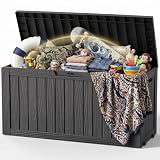
Key takeaways
- Largest storage: Keter Westwood 150-gallon.
- Most durable construction: Lifetime 60298 130-gallon (dual-wall HDPE).
- Best bench-style box for small patios: Keter Solana 70-gallon.
- Narrow footprint, tall storage: Keter Astoria 150-gallon.
- Best for cold climates: Lifetime 60059 80-gallon.
- Entry-level looks-first pick: Suncast 99-gallon wicker-style box.
The best deck boxes for most patios are the Keter Westwood 150-gallon for sheer capacity, the Lifetime 60298 130-gallon for durability and long life, the Keter Solana 70-gallon when you want a bench that also hides clutter, and the Suncast 99-gallon wicker box when appearance and a modest price matter more than a lock. Pick by the volume of what you actually need to hide, not by the number printed on the box, because usable space is always smaller than the gallon rating suggests.
A deck box does three jobs at once: it keeps cushions, pool toys, and garden tools dry enough to avoid mildew, it clears floor space on a small patio, and in many cases it doubles as extra seating. Those jobs pull in different directions. A tall box holds more but makes a poor bench, a wicker-look box looks like furniture but flexes under load, and a heavy dual-wall box lasts longer but is awkward to move. This guide sorts the field by buyer criteria with concrete thresholds so you can match a box to your yard instead of guessing.
Quick picks
- Largest storage: Keter Westwood 150-gallon.
- Most durable construction: Lifetime 60298 130-gallon (dual-wall HDPE).
- Best bench-style box for small patios: Keter Solana 70-gallon.
- Narrow footprint, tall storage: Keter Astoria 150-gallon.
- Best for cold climates: Lifetime 60059 80-gallon.
- Entry-level looks-first pick: Suncast 99-gallon wicker-style box.
How we chose
This guide is built from research, not from physical trials. We compared manufacturer specification pages and several independent buying guides, looked for the models that appear repeatedly across them, and checked that each named product is a current, widely sold model. Where sources disagreed on a figure, we either used the manufacturer figure or described the product by spec class instead of quoting a number. We weighted five criteria: usable capacity, material and wall construction, lid and hinge behavior, seating and weight rating, and lockability. Water resistance is treated as a baseline, because no resin deck box in this class is sealed like a dry bag.
Comparison table
| Model | Capacity | Material | Seating | Lock | Best for |
|---|---|---|---|---|---|
| Keter Westwood | 150 gal | UV-stabilized resin | Seats 2 adults | Padlock compatible | Full cushion sets |
| Keter Astoria | 150 gal | Resin, hydraulic lid pistons | 660 lb rating | Yes | Tight spaces, tall storage |
| Lifetime 60298 | 130 gal | Dual-wall HDPE | Bench use suitable | Padlock compatible | Long-term durability |
| Keter Brightwood | 120 gal | Resin | Check listing | Lockable, wheeled | Moving the box around |
| Suncast 99-gallon wicker | 99 gal | Wicker-weave resin | Storage only, not rated | No | Looks on a budget |
| Lifetime 60059 | 80 gal | HDPE | Check listing | Padlock bracket | Cold winters |
| Suncast 73-gallon medium box with seat | 73 gal | Resin | Seat designed in | Check listing | Value bench box |
| Keter Solana | 70 gal | Resin | 551 lb rating | Yes | Porches and small patios |
Step-by-step: how big a deck box do you really need
The gallon rating is the volume of the empty cavity at its maximum. Your real storage is smaller, because cushions are irregular, interior corners are rounded, and a lid needs to close without crushing contents. Use this worked calculation before you buy.
- Convert gallons to cubic feet. One US gallon is about 0.134 cubic feet. A 150-gallon box is therefore about 20 cubic feet, a 120-gallon box about 16, an 80-gallon box about 10.7, and a 70-gallon box about 9.4.
- Estimate your cushion volume. A typical 24 by 24 inch seat cushion that is 4 inches thick is 2,304 cubic inches, or about 1.3 cubic feet. A back cushion is similar or slightly less. A four-chair dining set with seat and back cushions is about eight cushions, roughly 10 cubic feet.
- Apply a packing factor. Plan on using about 70 to 75 percent of the rated volume for soft goods. Divide your cushion volume by 0.7 to get the minimum rated volume you need.
- Do the math. Ten cubic feet of cushions divided by 0.7 is about 14.3 cubic feet, which is roughly 107 gallons. That puts a four-chair set in the 120-gallon class at minimum, and a six-chair set in the 150-gallon class.
- Check interior length separately. Volume does not help if a long item cannot lie flat. Measure your longest cushion, such as a 60-inch bench or chaise pad, and compare it to the interior length, not the exterior length.
That last step is where many buyers go wrong. A box that is advertised at 130 gallons can still have an interior that is too short for a 60-inch cushion, so confirm the interior dimension on the product page before ordering.
Buying criteria with thresholds
Capacity
Under 80 gallons is a bench-and-throw-pillow box. Between 80 and 120 gallons handles a bistro or four-seat set. Above 120 gallons is for six-seat sets, kids’ outdoor toys, and gear. Going bigger than needed has a cost: a larger box has a bigger footprint, and a lid that is large enough to flex can allow water to pool on top.
Material and wall construction
Most boxes in this class are molded resin or polyethylene. Dual-wall HDPE is stiffer and handles repeated sitting, and it tends to hold up better when temperatures drop well below freezing. Single-wall resin with decorative texture is lighter and cheaper, but flexes more, so treat it as a storage box with an occasional seat rather than a daily bench.
Seat rating
If you plan to sit on the lid, look for a published weight rating. Two ratings in this guide come from published product figures: 551 pounds on the Keter Solana and 660 pounds on the Keter Astoria. A box with no published rating should be treated as storage only. Never let children stand or jump on a lid, and keep the lid fully closed whenever someone sits on it.
Lid, hinge, and lock
Controlled hinges and hydraulic pistons slow the lid so it does not slam onto fingers. A padlock hasp matters if you store tools, pool chemicals, or anything a child should not reach. Store pool chemicals only in their original containers, away from fuel and cushions, and keep them separate from other items.
Water resistance
All of these boxes are water resistant rather than waterproof. A lid that overlaps the body sheds rain well, but wind-driven rain and standing water can find seams. Place the box on a level surface that drains, raise it slightly on pavers if the ground is damp, and add a few silica packs or a ventilated liner for cushions. Never store cushions soaked or damp, because trapped moisture causes mildew even in a well-sealed box.
The best deck boxes in detail
1. Keter Westwood 150-gallon
Spec line: 150 gal · UV-stabilized resin · seats 2 adults · padlock compatible · roughly 5 feet wide.
Best for: Households with a full outdoor dining or conversation set that need one place for every cushion.
Skip if: Your patio is narrow, or you need a fully waterproof container.
- Pros: Large cavity fits a full cushion set with room left over, easy-lifting lid, padlock compatible, doubles as a two-person bench.
- Cons: Wide footprint, water resistant rather than waterproof in driving rain.
2. Lifetime 60298 130-gallon
Spec line: 130 gal · dual-wall HDPE · about 57 in long, 21 in wide · about 55 lb · padlock compatible.
Best for: Buyers who want a box to last a decade and are not concerned with style.
Skip if: You have 60-inch cushions, because the interior length is reported as slightly short for them, or you dislike bolted assembly, which takes roughly half an hour.
- Pros: Noticeably heavier build, controlled spring hinge, long-term owners report few leaks, suitable for sitting.
- Cons: Plain looks, assembly effort.
3. Keter Astoria 150-gallon
Spec line: 150 gal · resin · about 31 in tall, 26 in deep · 660 lb rating · hydraulic lid pistons.
Best for: Narrow porches and side yards where you want vertical storage and a quiet-closing lid.
Skip if: You want a low bench, because the taller profile makes a less comfortable seat for some users.
- Pros: Large capacity in a smaller footprint, consistent lid action, lockable.
- Cons: A newer design with less long-term owner feedback, and some owners report concern about lid connector durability.
4. Keter Brightwood 120-gallon
Spec line: 120 gal · resin · wheeled · lockable. Other specifications not verified; check the current listing for dimensions and weight rating.
Best for: People who need to reposition the box for cleaning, storm prep, or seasonal changes.
Skip if: You want a verified seat rating before buying.
- Pros: Wheels make it practical to move when partly loaded, lockable, sits in the 120-gallon class that fits a four-seat set.
- Cons: Wheel hardware adds parts that can wear on rough surfaces.
5. Lifetime 60059 80-gallon
Spec line: 80 gal · HDPE · padlock bracket · 10-year warranty reported for the brand line.
Best for: Cold-climate buyers in USDA zone 5 and colder who need a box that stays rigid in winter.
Skip if: You need to store a full six-seat cushion set.
- Pros: Sturdy HDPE, lockable, a sensible size for a bistro set or garden tools.
- Cons: Mid-size capacity limits full dining sets.
6. Suncast 99-gallon wicker-style
Spec line: 99 gal · wicker-weave resin · about 50 in long · no lock · handles on both ends · storage only.
Best for: Shoppers who want a box that looks like patio furniture and who store low-value items.
Skip if: You need a lock, a seat rating, or a deep interior.
- Pros: Attractive furniture-like finish, handles for portability, entry-level cost tier.
- Cons: No lock, shallow interior, flexible panels, limited weight capacity.
7. Suncast 73-gallon medium deck box with seat
Spec line: 73 gal · resin · built-in seat design. Other specifications not verified.
Best for: Budget buyers who want a bench-style box for a small deck.
Skip if: You need a lock or a published weight rating before you commit.
- Pros: Frequently chosen as the value pick, compact, seat-focused design.
- Cons: Smaller capacity limits it to a few cushions.
8. Keter Solana 70-gallon bench
Spec line: 70 gal · resin · about 55 in wide · 15 in interior depth · 551 lb rating · lockable.
Best for: Porches, entryways, and small patios where the box has to be the bench.
Skip if: You store anything deep, because the interior is shallow, or if you worry about missing hardware on delivery, which some buyers report.
- Pros: Genuine seating furniture, a published weight rating, lockable.
- Cons: Shallow interior.
Match the box to your situation
| Your situation | Capacity target | Prioritize | Good fit |
|---|---|---|---|
| Bistro set, two to three chairs | 70 to 80 gal | Seat rating, shallow depth is fine | Keter Solana, Lifetime 60059 |
| Four-chair dining set | 110 to 130 gal | Interior length, lid hinge | Lifetime 60298, Keter Brightwood |
| Six-seat sectional or large set | 150 gal | Footprint and lid strength | Keter Westwood, Keter Astoria |
| Tools, hoses, or kids’ toys | 80 to 100 gal | Lock, rigid walls | Lifetime 60059 |
| Decorative corner, light items | 99 gal | Appearance | Suncast wicker-style |
| Freezing winters | Any | Dual-wall or HDPE | Lifetime line |
Setup and care tips that extend life
- Level the base. A box on a slope twists, and the lid stops sealing. Use pavers or a level pad.
- Keep air moving. Cushions stored in a closed box need to be fully dry. Add moisture absorber packs and leave the lid ajar on dry days.
- Do not overload the lid. Even rated boxes are rated for distributed weight, not for a person standing on one corner.
- Keep fuel and chemicals out. Gas cans, propane cylinders, and open pool chemicals do not belong in a resin box, especially one in direct sun.
- Clean seasonally. Wipe with mild soap and water and rinse. Harsh solvents can cloud and weaken resin.
- Plan for sun. Dark boxes in full sun get hot inside. Avoid storing heat-sensitive items such as candles, sprays, or batteries.
Common mistakes
The most common mistake is buying on gallons alone. A tall, narrow 150-gallon box and a long, low 150-gallon box hold the same volume but suit different cushions and different patios. The second is expecting waterproof performance from a water-resistant lid. The third is skipping the weight rating when the box will be used as a bench, because a box that seats one adult is not necessarily built for repeated use by a family. The fourth is ignoring assembly: several boxes ship in many pieces and need an hour of work with basic tools.
FAQ
What size deck box do I need for patio cushions?
Most four-chair sets need a box in the 110 to 130 gallon range. Add up cushion volume, divide by 0.7, then convert cubic feet to gallons, and check interior length for long pads.
A typical seat cushion is about 1.3 cubic feet. Eight cushions is roughly 10 cubic feet, so a box of about 107 gallons is the practical minimum.
Are deck boxes waterproof?
No. Resin deck boxes in this class are water resistant, not fully waterproof, and wind-driven rain can enter at the lid seam.
Keep the box on a level, draining surface, store only dry cushions, and consider a water-resistant cushion bag inside for added protection during storm season.
Can you sit on a deck box?
Only if the manufacturer publishes a seat rating. For example, the Keter Solana is listed at 551 pounds and the Keter Astoria at 660 pounds.
Models without a rating, such as wicker-style boxes, should be treated as storage only. Keep the lid closed when sitting and never allow standing or jumping.
Which deck box lasts the longest?
Dual-wall HDPE boxes, such as the Lifetime 60298, generally hold up longest, with owner reports of a decade or more of use.
Single-wall resin boxes with decorative texture usually flex more and age faster, especially in strong sun and freezing weather.
Which deck box is best for cold winters?
A rigid HDPE box such as the Lifetime 60059 is a sensible choice in USDA zone 5 and colder, because it resists cracking and flexing better than thinner resin.
Whatever you choose, empty the box of heavy snow and keep the lid and hinge free of ice buildup.
Do I need a lock on a deck box?
A lock is worthwhile if you store tools, chemicals, or items children should not reach. It deters casual access, not determined theft.
Look for a padlock-compatible hasp, as on the Keter Westwood, Lifetime 60298, and Lifetime 60059.
How do I keep cushions from getting moldy in a deck box?
Store cushions only when they are fully dry, and give them airflow. Moisture trapped inside a closed box is the main cause of mildew.
Use moisture-absorbing packs, crack the lid on dry days, and clean cushions at the end of each season before storing them for winter.
Is a bigger deck box always better?
No. A larger box takes more floor space and a bigger lid can flex or pool water. Match the box to your actual cushion volume with a modest buffer.
If you only need to hide a few cushions, a 70 to 80 gallon bench-style box usually fits better than a 150-gallon box.
Bottom line
For capacity, choose the Keter Westwood. For longevity, choose the Lifetime 60298. For a small patio where the box is also the bench, choose the Keter Solana. For a budget-friendly decorative option, choose the Suncast 99-gallon wicker-style box and accept that it is storage only. Measure your longest cushion, calculate your cushion volume, and pick the model that fits that number rather than the biggest gallon figure.