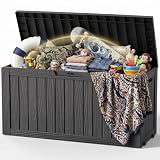
Key takeaways
- Best Overall: Keter Westwood 150 Gal Outdoor Storage Box, a large resin box that is waterproof and lockable per its listing.
- Best Value: Devoko 100 Gallon Waterproof Deck Box, a 100 gallon resin box with a lockable lid at a mid-range price tier.
- Best Storage Bench: Keter Solana 70 Gal Outdoor Storage Bench, a seating-height box with a lockable lid.
- Best Large Alternative: LIFETIME 60012 Extra Large Deck Box, 130 gallon, in Desert Sand.
- Best Budget 100 Gallon: Quictent 100 Gallon Resin Deck Box with a lockable lid.
- Best for Cushions and Tools: EAST OAK 100 Gallon Deck Box, marketed for patio cushions and gardening tools.
- Best Rolling Box: DRATO 100 Gallon Deck Box with wheels, for moving cushions across a deck.
The best outdoor storage box for cushions is a lockable resin deck box in the 90 to 150 gallon range, because that size swallows a full set of patio cushions without crushing them. For most patios, the Keter Westwood 150 Gal is the best outdoor storage for cushions if you want the most room and a lid that lifts easily, while the Devoko 100 Gallon Waterproof Deck Box is the best value for a typical four-chair set. This guide compares seven boxes and benches, explains how to work out the capacity you actually need, and covers the part listings skip: moisture, ventilation and what to do about mice.
This guide is research-based. We did not personally use these products. We compared the details in each product listing, the maker descriptions, and general advice from furniture-care and outdoor-storage makers. Where a listing does not state a figure, such as interior dimensions or weight, we write “not listed.”
Our top picks


As an Amazon Associate we earn from qualifying purchases at no extra cost to you.
Top Picks at a Glance
- Best Overall: Keter Westwood 150 Gal Outdoor Storage Box, a large resin box that is waterproof and lockable per its listing.
- Best Value: Devoko 100 Gallon Waterproof Deck Box, a 100 gallon resin box with a lockable lid at a mid-range price tier.
- Best Storage Bench: Keter Solana 70 Gal Outdoor Storage Bench, a seating-height box with a lockable lid.
- Best Large Alternative: LIFETIME 60012 Extra Large Deck Box, 130 gallon, in Desert Sand.
- Best Budget 100 Gallon: Quictent 100 Gallon Resin Deck Box with a lockable lid.
- Best for Cushions and Tools: EAST OAK 100 Gallon Deck Box, marketed for patio cushions and gardening tools.
- Best Rolling Box: DRATO 100 Gallon Deck Box with wheels, for moving cushions across a deck.
Quick Comparison Table
| Product | Capacity (listed) | Best for | Key specs | Watch for | Price tier |
|---|---|---|---|---|---|
| Keter Westwood | 150 gal | Large patios and whole-set storage | Resin; waterproof; lockable; easy-lift lid | Big footprint; interior dimensions not listed here | Premium |
| Keter Solana (bench) | 70 gal | Small patios needing extra seating | Resin; seating; waterproof; lockable | Lower capacity than a 100 gallon box | Mid-range to premium |
| LIFETIME 60012 | 130 gal | Big cushion sets, heavy-duty use | Extra large deck box; Desert Sand color | Waterproof claim not stated in the short listing | Mid-range to premium |
| Devoko 100 Gallon | 100 gal (110 external gal listed) | Typical four-to-six chair set | Resin; waterproof; lockable | Lid hardware details not listed | Budget to mid-range |
| Quictent 100 Gallon | 100 gal | Budget storage that doubles as a bench | Resin; lockable lid; waterproof; bench use | Weight limit for sitting not stated in the short listing | Budget |
| EAST OAK 100 Gallon | 100 gal | Cushions plus garden tools | Resin; waterproof; bench for patio cushions | Lock type not listed in the short title | Mid-range |
| DRATO 100 Gallon with wheels | 100 gal | Moving cushions between deck and shed | Black resin; wheels; lockable; weatherproof | Wheels are a stress point on rough ground | Budget |
How Big a Box Do Your Cushions Need?
Capacity in gallons is a poor guide on its own, so here is a simple way to turn it into something useful. One gallon is about 231 cubic inches. A 100 gallon box therefore holds about 23,100 cubic inches of space, or roughly 13.4 cubic feet. A typical chair seat cushion that measures 20 by 20 inches and is 4 inches thick fills 1,600 cubic inches. In perfect conditions you could fit about 14 of them in a 100 gallon box.
In real life you cannot. Boxes have sloped sides, internal ribs and lid hinges, and cushions do not stack into every corner. A sensible rule is to use only about half of the nominal volume. By that rule, a 100 gallon box holds around 6 to 8 standard seat cushions, a 70 gallon bench holds around 4 to 5, and a 150 gallon box holds around 10 to 12. Add the back cushions too: a chair with a separate back cushion counts as roughly two cushions for planning purposes.
So a patio with four dining chairs, each with a seat and a back cushion, needs space for eight cushions. A 100 gallon box is the minimum, and a 130 to 150 gallon box is more comfortable. A bistro set with two chairs fits happily into a 70 gallon bench. Measure your thickest cushion and the longest dimension, then check the box’s interior length and depth on the maker page. This guide marks interior dimensions as “not listed” where the short listing does not give them.
1. Keter Westwood 150 Gal Outdoor Storage Box: Best Overall
- Capacity: 150 gallons
- Resin construction, brown finish
- Listed as waterproof and lockable
- Lid designed to lift easily (piston-style assist indicated in the listing)
- Interior dimensions and empty weight: not listed in the short title
Best for: Larger patios and households that want to store every cushion, plus pool or garden accessories, in one place. Skip if: You have a small balcony; this is a big box.
This is the box to buy when space is not the limiting factor. A 150 gallon capacity lets you store a full set of cushions without compressing them, which matters because crushing foam for months can flatten it. The lid’s assist mechanism, as described in the listing, helps especially when you have a lid that would otherwise be heavy to lift.
Keter is a long-established maker of resin outdoor storage, and the Westwood line is among the better known. Resin is the right material for cushions because it does not rust, rot or need paint. The listing describes the box as waterproof and lockable, which are the two features that matter most.
Note that “waterproof” on a resin box usually describes the lid and seams resisting rain, not a guarantee against condensation inside. We cover that below.
Pros: Very large capacity; lockable; waterproof per listing; easy-lift lid; resin does not rust. Cons: Premium price tier; large footprint; interior dimensions not listed.
2. Keter Solana 70 Gal Outdoor Storage Bench: Best Storage Bench
- Capacity: 70 gallons
- Resin, brown finish, seating design
- Listed as waterproof and lockable
- Seating weight limit: not listed in the short title
- Interior dimensions: not listed
Best for: Small patios, balconies and entry decks where you want extra seating that hides cushions. Skip if: You have more than four chairs’ worth of cushions.
A bench-shaped box does two jobs at once. It stores cushions out of the weather and offers a place to sit, which helps small outdoor spaces. At 70 gallons, it holds roughly four to five standard seat cushions by the half-volume rule above. It is a good match for a bistro set or a couple of chairs.
If you plan to sit on it, check the seating weight rating on the maker page, because the short listing does not state one. Do not let children stand on a lid unless the maker approves it.
Pros: Doubles as seating; lockable; resin; compact. Cons: Smaller capacity; seating weight limit not listed; mid-range to premium price tier.
3. LIFETIME 60012 Extra Large Deck Box, 130 Gallon: Best Large Alternative
- Capacity: 130 gallons
- Extra large deck box in Desert Sand
- Maker is known for durable outdoor products
- Waterproof and lock details: not listed in the short title
- Interior dimensions: not listed
Best for: Households with large cushion sets who want a name-brand box between 100 and 150 gallons. Skip if: You need confirmed lockability from the listing alone; check the maker page for locking hardware.
Lifetime is a well-established maker of outdoor storage and utility products, and this model sits neatly between the 100 gallon and 150 gallon classes. The 130 gallon size is the sweet spot for many families: bigger than the common 100 gallon boxes but still manageable on a typical deck.
Desert Sand is a lighter color that suits sun-exposed locations better than black. Dark surfaces absorb more heat, and a hotter interior can speed foam breakdown and promote odor if moisture is present. If your box sits in full sun, a lighter shade is a practical choice.
Pros: Generous size; light color for sun; established brand. Cons: Short listing does not confirm waterproofing or locks; interior dimensions not listed.
4. Devoko 100 Gallon Waterproof Deck Box: Best Value
- Capacity: 100 gallons (listing also cites 110 external gallons)
- Resin, large outdoor storage box
- Listed as waterproof and lockable
- Weight and interior dimensions: not listed
- Fits patio cushions, according to the maker’s marketing
Best for: A typical set of four to six chairs, at a price that undercuts premium brands. Skip if: You want a long-established brand with a deep service network.
The Devoko 100 gallon box is the practical middle ground. It offers the capacity most households need, a lockable lid and waterproof construction at a lower price tier than the premium brands. The “110 external gallons” detail in the listing is a good reminder that gallon figures can be measured differently. Internal usable volume is what matters for cushions.
Because this is a lesser-known brand, read the warranty terms on the maker page and look at what other owners report about lid fit and hinge durability over multiple seasons. We did not summarize independent long-term feedback for this guide.
Pros: Good capacity for the money; lockable; waterproof per listing. Cons: Less established brand; details like hinge type are not listed; durability data limited.
5. Quictent 100 Gallon Resin Deck Box: Best Budget 100 Gallon
- Capacity: 100 gallons
- Resin with a lockable lid
- Marketed as waterproof; storage bench use indicated
- Seating weight limit: not listed in the short title
- Interior dimensions: not listed
Best for: Budget-minded shoppers who want 100 gallons of cushion storage and occasional seating. Skip if: You will use the lid as a daily bench with adults, unless the maker states the weight rating.
Quictent is better known for canopies and tents, but this deck box covers the same cushion-storage job as pricier alternatives. The lockable lid is the feature to note, since locks keep lids closed in wind and discourage casual tampering. Like most budget boxes, the plastic is thinner than premium models, so expect more flex in the lid when you press on it.
If you keep cushions in a box all winter, a budget box is perfectly workable, provided you place it on level ground and keep the lid free of heavy snow.
Pros: Budget price tier; 100 gallon capacity; lockable lid. Cons: Thinner feel at this price; seating rating not listed; less known in this category.
6. EAST OAK 100 Gallon Deck Box: Best for Cushions and Tools
- Capacity: 100 gallons
- Waterproof resin, used as a storage bench
- Marketed for patio cushions, gardening tools and pool accessories
- Lock type: not listed in the short title
- Interior dimensions: not listed
Best for: Households that want one box for both cushions and garden gear. Skip if: You want to keep cushions away from tools, which can scratch or leave oil on fabric.
The listing explicitly mentions patio cushions along with gardening tools and pool gear, which fits how many people actually use a deck box. If you share the box with other gear, protect the cushions: place them in zippered storage bags so oil, fertilizer and soil do not stain the fabric. Never store gasoline, solvents or chemicals with cushions.
The bench configuration is helpful on decks where seating is limited. Again, confirm the maker’s seating rating.
Pros: Versatile; 100 gallon capacity; bench use; mid-range price tier. Cons: Lock type not listed; shared storage risks stains; limited independent data.
7. DRATO 100 Gallon Deck Box with Wheels: Best Rolling Box
- Capacity: 100 gallons
- Black resin, weatherproof and lockable per the listing
- Wheels for moving the box
- Wheel durability: not listed
- Interior dimensions: not listed
Best for: Decks where you want to roll cushions to a shed or garage for winter. Skip if: Your yard is rough or sloped; small wheels struggle there.
A rolling deck box is useful if you want to move the whole set of cushions in one go. Roll it to the garage in autumn, or push it to a sheltered corner during storms. On a smooth deck or patio, wheels make that easy.
The weak point on any wheeled box is the axle and wheel mount, particularly when the box is full. Move it only when it is lightly loaded or empty, and avoid pulling it over steps. Black resin also absorbs heat, so keep it out of full afternoon sun if you can.
Pros: Easy to move; 100 gallon capacity; lockable; budget price tier. Cons: Wheels add a wear point; dark color heats up; interior dimensions not listed.
Also Consider
Bicherub Zippered Cushion Storage Bag
A water-resistant extra large zippered bag with handles, listed at 68 inches long by 30 inches. Good for stacking cushions inside a shed or garage, and a useful liner inside a deck box. Not a replacement for a rigid box outside.
NettyPro Rolling Cushion Storage Bags
Cushion bags with a wheel and handle, intended for large patio items and pillows. A convenient way to move cushions across a yard, but a bag is less protective against crushing and pests than a resin box.
Devoko 30 Gallon Resin Deck Box
A small deck box for a bistro set or a handful of cushions. It suits balconies and small patios where a large box would not fit.
Fancyango 50 Gallon Waterproof Deck Box
A mid-size resin option marketed as a lockable cushion storage bin. Consider it for two-chair sets plus a few throw pillows.
How We Chose
We started with the deck boxes and storage benches in the shop catalog, then filtered for products that name cushions or patio furniture storage in the listing. We did not personally use these products. For each pick we recorded only the stated capacity, material, lock and waterproofing details, and wrote “not listed” for anything missing.
Our criteria were capacity that suits real cushion sets, resin construction, lockable lids, brand variety (no more than two from one brand) and a spread across budget, mid-range and premium tiers. We drew on manufacturer pages for the Keter and Lifetime lines and general guidance from furniture-care makers on cleaning, drying and storing outdoor cushions. We did not use ratings or review counts.
Buying Guide
Capacity: use the half-volume rule
Use the worked example above to size your box. Count your cushions (seat plus back for each chair), then choose a box whose nominal capacity is about double the combined volume of the cushions. Thick deep-seating cushions at 5 to 6 inches thick need a larger box than slim 2 to 3 inch dining pads. If your longest cushion is 28 inches or more, check the interior length before you buy, since many boxes measure shorter inside than the outside suggests.
Waterproof, not airtight
Most resin deck boxes are described as waterproof, which means rain should not enter through the lid and seams. They are not airtight, and they are not a guarantee against condensation. Warm, humid air that enters the box can condense on cool plastic and drip onto cushions. The safest approach is to store only dry cushions, and to keep the box off the ground on feet or a pad so water cannot pool beneath it.
Ventilation and moisture control
Ventilation is the feature that listings rarely mention. Mildew needs moisture, so the goal is to avoid sealing damp cushions inside. Dry cushions in open air for several hours after rain before storing them. Many people add moisture-absorbing packets or a small bag of silica gel and replace them seasonally. Some boxes include small vents or gaps; if a listing does not mention vents, assume there are none and plan for airflow by opening the lid on dry, sunny days.
Locks and lids
A lockable lid matters for two reasons: it keeps the lid shut in high wind, and it deters casual theft. Check whether the lock is a built-in hasp that accepts a padlock, since many boxes do not include a padlock. A lid with a gas-assist or piston, like the Westwood, is easier on the back. Make sure the lid has a lip that sheds water instead of pooling it.
Material, color and placement
Resin resists rust and rot. Choose a UV-stabilized resin, which the maker should state. Lighter colors reflect heat; darker colors absorb it. Place the box on a level surface; an uneven base can twist the lid and let water in. Leave a few inches of clearance from walls for airflow.
Keeping Mice and Pests Out
No deck box is a guarantee against rodents, and this guide does not promise one. Mice can squeeze through small gaps and chew soft plastic. You can reduce the risk by keeping the lid closed and latched, filling or sealing any gaps in the base or around the hinges, and storing cushions in sealed zippered bags. Do not store pet food, bird seed or other attractants in the same box. If you notice droppings or chewed fabric, clean the area with gloves and a mask and consult a pest-control professional if the problem persists.
Common Mistakes
- Storing damp cushions and assuming “waterproof” will dry them.
- Buying by gallons without checking the longest interior dimension.
- Putting the box directly on soil or wet decking.
- Stacking heavy items on top of foam and flattening it.
- Sharing the box with fuel, fertilizer or tools that can stain cushions.
Frequently Asked Questions
What is the best outdoor storage box for cushions?
A lockable resin deck box between 100 and 150 gallons suits most patios. The Keter Westwood 150 Gal is the top pick for capacity and build, and the Devoko 100 Gallon is the best value.
How many cushions fit in a 100 gallon deck box?
Roughly 6 to 8 standard 20-by-20-inch seat cushions, depending on thickness and shape. Back cushions count too, so a set of four chairs with separate backs often needs more than 100 gallons for comfort.
Can I store cushions in a deck box year-round?
Yes, if the cushions are dry when you put them in and you give them some airflow now and then. Add moisture-absorbing packets and open the lid on dry days to reduce mildew risk.
Will a deck box keep mice out?
Not reliably. A closed, latched lid helps, but mice can use small gaps. Store cushions in sealed bags and avoid storing food or seed in the same box. We cannot promise any box is rodent-proof.
What is the best outdoor storage for patio cushions if I have a small balcony?
A compact bench such as the Keter Solana 70 Gal, or a small 30 to 50 gallon deck box, saves space and doubles as seating. Zippered cushion bags stored indoors also work for the off-season.
Are storage benches strong enough to sit on?
Many are designed for seating, but weight ratings vary and are not always in the listing. Check the maker’s stated limit before you sit on the lid, and do not let children stand on it unless the maker approves.
Should the box have ventilation holes?
Ventilation can help with moisture, but most resin deck boxes do not have vents. If yours has none, dry cushions fully before storing and use moisture packets. Do not drill holes unless the maker approves, since it may void the warranty.
Which One Should You Buy?
If you have a large patio, buy the Keter Westwood 150 Gal Outdoor Storage Box. It gives you the most room and an easy-lift lid. If you want the best balance of price and capacity, go for the Devoko 100 Gallon Waterproof Deck Box, or the Quictent 100 Gallon if your budget is tighter. For a small patio or balcony, the Keter Solana 70 Gal Storage Bench keeps cushions dry while giving you a place to sit.
For households that want one box for cushions and garden gear, the EAST OAK 100 Gallon is a flexible option, and the DRATO 100 Gallon with wheels makes sense if you roll cushions to a shed each winter. If you want a mid-sized name brand, check the LIFETIME 60012 at 130 gallons. Whichever you choose, store dry cushions only, leave airflow where you can, and confirm interior dimensions with the maker before you buy.
Sources
- Keter Westwood and Solana product pages
- Lifetime Products deck box information
- Devoko, Quictent, EAST OAK and DRATO product listings
- Outdoor fabric maker guidance on cleaning and storing cushions
- University extension guidance on mildew and moisture control
Last updated: October 2026