Key takeaways
- Resolution: 4K is preferable if you edit, crop, or display footage on a large screen. The Mini 4 Pro’s 4K/60 option captures smoother movement, while the Mini 3 and Mini 4K are limited to 4K/30.
- Flight time: A quoted 34-minute battery does not mean 34 minutes of useful exploration. If you land with a 25% reserve, a 34-minute maximum becomes about 25.5 minutes before allowing for wind and cold.
- Wind resistance: Level 5 is a resistance rating, not a promise that footage will remain smooth in strong gusts. A tiny drone may remain airborne while its video shakes, its battery drains faster, and its return journey becomes difficult.
- Weight: The under-249 g class makes travel and recreational compliance simpler, but weight changes when you add batteries, propeller guards, lights, or other accessories.
The best DJI mini drones for most backyard and travel pilots are the DJI Mini 4 Pro for the strongest all-round camera and safety features, the DJI Mini 4K for the lowest-cost entry point, and the DJI Mini 3 for longer basic flights and excellent daylight images. All three standard configurations weigh under 249 g, which can avoid FAA registration for purely recreational flying in the United States, provided the aircraft remains below 250 g at takeoff and is not being operated under Part 107.
Our top picks
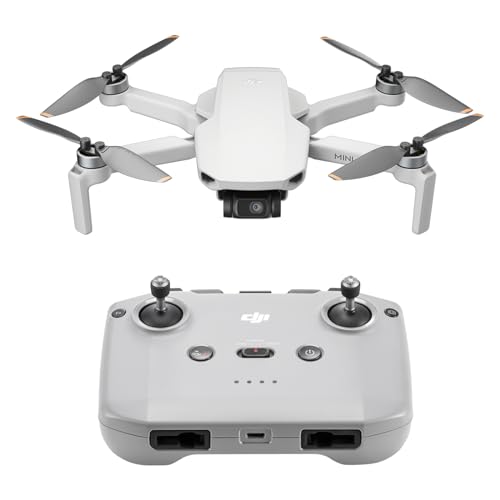 DJI Mini 4K
- No Registration Needed - Under 249 g, this…
- 4K Ultra HD & 3-Axis Gimbal for Cinematic…
- 38kph (Level 5) Wind Resistant - This drone…
 DJI Mini 4K Camera Drone Combo
- No Registration Needed - Under 249 g, this…
- 4K Ultra HD & 3-Axis Gimbal for Cinematic…
- 38kph (Level 5) Wind Resistant - This drone…
 DJI Mini 3
- No Registration Needed - Under 249 g, FAA…
- 4K UHD Stunning Imagery- Film in 4K HDR…
- Striking Vertical Videos are Ready to Share -…
| Product | Key specs | |
|---|---|---|
| DJI Mini 4K | No Registration Needed - Under 249 g, this… 4K Ultra HD & 3-Axis Gimbal for Cinematic… 38kph (Level 5) Wind Resistant - This drone… | Check price |
| DJI Mini 4K Camera Drone Combo | No Registration Needed - Under 249 g, this… 4K Ultra HD & 3-Axis Gimbal for Cinematic… 38kph (Level 5) Wind Resistant - This drone… | Check price |
| DJI Mini 3 | No Registration Needed - Under 249 g, FAA… 4K UHD Stunning Imagery- Film in 4K HDR… Striking Vertical Videos are Ready to Share -… | Check price |
 DJI Mini 4K Fly More Combo DJI Mini 4K Fly More Combo | No Registration Needed - Under 249 g, this… 4K Ultra HD & 3-Axis Gimbal for Cinematic… 38kph (Level 5) Wind Resistant - This drone… | Check price |
As an Amazon Associate we earn from qualifying purchases at no extra cost to you.
Best DJI mini drones at a glance
| Model | Takeoff weight | Maximum standard flight time | Video resolution | Wind resistance | Best for |
|---|---|---|---|---|---|
| DJI Mini 4 Pro | Under 249 g | 34 minutes | 4K up to 60 fps, HDR | Level 5, up to 10.7 m/s | Best overall travel and backyard drone |
| DJI Mini 3 | Under 249 g | 38 minutes | 4K up to 30 fps, HDR | Level 5, up to 10.7 m/s | Long daylight flights and vertical video |
| DJI Mini 4K | 246 g | 31 minutes | 4K up to 30 fps | Level 5, up to 10.7 m/s | Budget beginners |
| DJI Mini 2 SE | Under 249 g | 31 minutes | 2.7K up to 30 fps | Level 5, up to 10.7 m/s | Basic aerial photos at a lower price |
Flight-time figures are manufacturer maximums measured in controlled conditions. Wind, cold weather, fast flying, repeated takeoffs, and keeping a safety reserve can reduce usable airtime substantially.
Our picks by flying situation
Choose the DJI Mini 4 Pro for the best overall capability
The DJI Mini 4 Pro is the most complete choice if you want one small drone for garden inspections, travel landscapes, family trips, and social-media video. Its camera records 4K video at up to 60 frames per second and supports HDR recording, giving it more flexibility in bright skies and high-contrast scenes than the less expensive models.
Its major advantage is not just resolution. Omnidirectional obstacle sensing helps the drone detect objects in more directions, while automated return-to-home and tracking features make it more forgiving for inexperienced pilots. The camera also rotates for true vertical video, useful for portrait-oriented travel clips.
The standard battery keeps the aircraft below 249 g. Some extended batteries increase the takeoff weight above that threshold, so check the loaded aircraft rather than relying on the name “Mini.” The Mini 4 Pro usually costs more than the other options, but that premium is easier to justify if you fly regularly or often work around trees, fences, and buildings.
Choose the DJI Mini 3 for long, simple flights
The DJI Mini 3 offers up to 38 minutes with its standard battery, the longest maximum flight time in this comparison. It is a strong fit for a large backyard, scenic travel, or someone who prefers to make fewer battery changes during a walk.
Its 4K video is limited to 30 fps, so it is less suited to smooth slow-motion footage than the Mini 4 Pro. In good daylight, however, the camera can produce attractive images, and its vertically rotating camera is useful for tall subjects, property photos, and phone-first video.
Obstacle sensing is more limited than on the Mini 4 Pro. That matters when flying near branches or structures, so the Mini 3 is best for open spaces and pilots willing to maintain a careful line of sight.
Choose the DJI Mini 4K for the value option
The DJI Mini 4K is the sensible starting point if your budget is limited but you still want 4K video, GPS positioning, a compact foldable design, and a controller-based flying experience. It records 4K at up to 30 fps and has the same Level 5 wind-resistance rating listed for the other Mini models here.
It does not provide the Mini 4 Pro’s advanced obstacle avoidance or the same high-end tracking and imaging features. That is not a serious disadvantage for open lawns, beaches, fields, and uncomplicated travel shots. It becomes more important if you expect to fly close to trees or want automated subject-following footage.
Choose the DJI Mini 2 SE only for basic aerial use
The Mini 2 SE remains adequate for learning manual control, checking a roof from a safe distance, and taking casual aerial photographs. Its 2.7K video is less detailed than 4K, so it is harder to crop footage or maintain clarity on larger displays.
It can make sense when found at a substantially lower general market price than the Mini 4K. Otherwise, the Mini 4K is usually the better long-term purchase because 4K footage gives you more editing flexibility.
Camera, flight time, and wind resistance: what changes in practice?
- Resolution: 4K is preferable if you edit, crop, or display footage on a large screen. The Mini 4 Pro’s 4K/60 option captures smoother movement, while the Mini 3 and Mini 4K are limited to 4K/30.
- Flight time: A quoted 34-minute battery does not mean 34 minutes of useful exploration. If you land with a 25% reserve, a 34-minute maximum becomes about 25.5 minutes before allowing for wind and cold.
- Wind resistance: Level 5 is a resistance rating, not a promise that footage will remain smooth in strong gusts. A tiny drone may remain airborne while its video shakes, its battery drains faster, and its return journey becomes difficult.
- Weight: The under-249 g class makes travel and recreational compliance simpler, but weight changes when you add batteries, propeller guards, lights, or other accessories.
Decision matrix
| Your situation | Recommended model | Why | Main compromise |
|---|---|---|---|
| First drone, limited budget, open flying area | DJI Mini 4K | 4K video and simple controls without the Pro price | Fewer safety sensors and automated features |
| Frequent traveler who wants the smallest capable kit | DJI Mini 4 Pro | Advanced sensing, 4K/60, HDR, and vertical shooting | Higher purchase cost |
| Long daylight flights in open spaces | DJI Mini 3 | Up to 38 minutes with the standard battery | No omnidirectional obstacle sensing |
| Occasional casual flying at the lowest possible cost | DJI Mini 2 SE | Compact GPS drone with usable beginner features | 2.7K rather than 4K video |
| Backyard with many branches, poles, or structures | DJI Mini 4 Pro | More comprehensive obstacle detection | Sensors do not replace slow, attentive flying |
Which DJI Minis avoid FAA registration?
For recreational flying in the United States, an aircraft that weighs less than 250 g at takeoff generally does not need FAA registration. The standard configurations of the DJI Mini 4 Pro, DJI Mini 3, DJI Mini 4K, and DJI Mini 2 SE are designed around that limit.
This exemption has important conditions. Recreational pilots must follow FAA safety rules, keep the drone within visual line of sight, take the required TRUST recreational-knowledge test, and comply with airspace restrictions. If you fly for business, paid photography, property work, or another non-recreational purpose, Part 107 rules apply and the drone must be registered even when it weighs under 250 g.
Also weigh the drone in its actual flying configuration. An extended-capacity battery, propeller guards, a mounted accessory, or another payload may push it to 250 g or more. At that point, registration is required. Registration and Remote ID requirements can also change according to how the aircraft is used, so verify the current FAA guidance before flying.
Ownership details that product listings often omit
Propellers are the first routine consumable. A small nick can create vibration, extra noise, reduced efficiency, and unstable video, even if the drone still appears to fly normally. Inspect every blade after contact with grass, branches, walls, or gravel, and replace damaged propellers as a balanced set according to DJI’s instructions.
Battery care has a larger effect on ownership than the headline flight-time number. Store intelligent flight batteries partly charged rather than fully charged for long periods, avoid charging them while hot, and do not fly with a swollen, damaged, or unusually hot battery. Cold weather reduces available performance, so keep batteries warm before takeoff and expect less flight time.
After dusty or sandy flights, check the gimbal, cooling vents, motors, and propeller mounts. Do not spray household cleaner into the aircraft. Use a soft brush or suitable air blower, and wipe the camera lens with a clean lens cloth. Keep the drone away from rain and mist unless the specific equipment is rated for those conditions; these Mini models are not waterproof.
Final recommendation
Buy the DJI Mini 4 Pro if camera flexibility, obstacle awareness, and long-term capability matter most. Buy the DJI Mini 3 if you value maximum standard flight time and mostly fly in open daylight. For a first drone and a tighter budget, the DJI Mini 4K delivers the best balance of 4K quality, portability, and simplicity. The DJI Mini 2 SE is worth considering only when its lower general market price outweighs the limitations of 2.7K video.