Key takeaways
- Long, vehicle-only approach: A wired or wireless magnetic probe system, such as the Dakota Alert MURS system with a buried probe, is a strong fit when you want to detect vehicles while filtering out pedestrians and animals. MURS receivers use licensed-free radio channels, but actual range depends on terrain, buildings, antenna placement, and local interference.
- Short driveway or mixed traffic: A PIR system such as the Dakota Alert DCR-2500 is easier to place without burying a sensor. It detects changes in infrared energy as a warm object moves through its coverage area, so it can alert for people and animals as well as vehicles.
- Budget-conscious, simple entry warning: A basic wireless PIR kit is usually the least expensive route. Check that the package includes the receiver you need, and expect to reposition the sensor if it triggers on the road, sun-heated surfaces, or passing animals.
- Remote gate or outbuilding: Consider a system with a separate external antenna or a compatible repeater. A nominal range number is not a guarantee that the signal will pass through a hill, metal-sided building, or dense tree cover.
The best driveway alarm systems for a long rural drive are usually a long-range, weather-resistant magnetic probe when you need to detect vehicles specifically; for a shorter or mixed-use drive, a properly aimed passive infrared (PIR) sensor is often easier to install and more versatile. Choose by verified sensor-to-receiver range, detection method, and site conditions—not by advertised range alone.
Our top picks
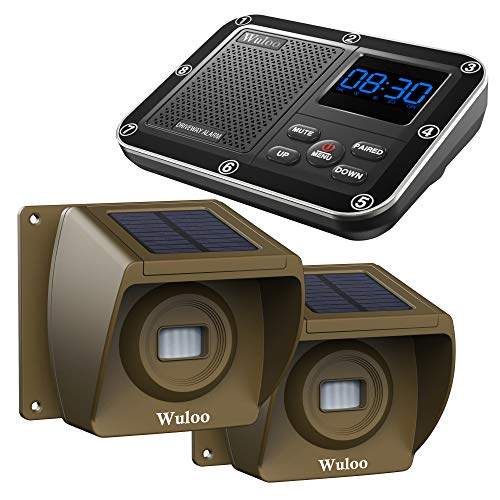
 Solar Driveway Alarm Wireless Outside 1800ft Range
- Reliable & Dependable: 1/3-mile long range (1760 ft.
- Multi-functional Receiver: The included receiver also works as…
- Rechargeable & Expandable Sensor: With the solar panel,…
 Solar Driveway Alarm Wireless Outside 1800ft Range
- Reliable & Dependable: 1/3-mile long range (1760 ft.
- Multi-functional Receiver: The included receiver also works as…
- Rechargeable & Expandable Sensor: With the solar panel,…
As an Amazon Associate we earn from qualifying purchases at no extra cost to you.
Best picks by driveway situation
- Long, vehicle-only approach: A wired or wireless magnetic probe system, such as the Dakota Alert MURS system with a buried probe, is a strong fit when you want to detect vehicles while filtering out pedestrians and animals. MURS receivers use licensed-free radio channels, but actual range depends on terrain, buildings, antenna placement, and local interference.
- Short driveway or mixed traffic: A PIR system such as the Dakota Alert DCR-2500 is easier to place without burying a sensor. It detects changes in infrared energy as a warm object moves through its coverage area, so it can alert for people and animals as well as vehicles.
- Budget-conscious, simple entry warning: A basic wireless PIR kit is usually the least expensive route. Check that the package includes the receiver you need, and expect to reposition the sensor if it triggers on the road, sun-heated surfaces, or passing animals.
- Remote gate or outbuilding: Consider a system with a separate external antenna or a compatible repeater. A nominal range number is not a guarantee that the signal will pass through a hill, metal-sided building, or dense tree cover.
Compare the detection methods
PIR and magnetic systems solve different problems. PIR sensors monitor a zone; magnetic probes detect the disturbance a large metal vehicle makes in the earth’s magnetic field. Neither is universally more reliable. The right choice depends on what should trigger the alert and what else moves near the driveway.
| System type | What it detects | Typical placement | Useful range planning | Main trade-off |
|---|---|---|---|---|
| PIR wireless sensor | Movement of warm objects across its field of view | Mounted beside the drive, aimed across the approach | Coverage is often roughly 20–100 ft; radio claims can run from several hundred feet to over a mile in ideal conditions | Can alert for people, wildlife, sun-heated objects, or movement outside the intended zone |
| Magnetic probe | Large metal vehicles passing close to the probe | Buried beside or beneath the vehicle path, as directed by the maker | Detection is generally a few feet from the probe; the separate radio link may be rated for a mile or more in open conditions | More installation work; may not detect pedestrians, bicycles, or some small vehicles |
| Wired beam or loop sensor | A person or vehicle interrupting a beam, or a vehicle crossing a loop | Across a controlled entrance or installed in the pavement | Set by the beam or loop design; receiver distance is less important when wired | More trenching and installation effort, but a defined detection line |
These are planning ranges, not universal specifications. Before buying, confirm the exact model’s detection distance, radio frequency, receiver compatibility, and environmental rating in its current manual. Sensor detection range and sensor-to-receiver radio range are separate measurements; a long radio claim does not mean a PIR sensor can cover the same distance across the driveway.
How to choose for your property
For a long drive with a clear vehicle path
Start with a magnetic probe if the goal is to know when a car or truck enters, rather than when anything moves nearby. It is less exposed to wind-blown vegetation and animals than an exposed PIR sensor. Place it close enough to the expected tire path for reliable vehicle detection, but follow the manufacturer’s burial depth and orientation instructions. Avoid placing it directly beside large metal objects, buried utilities, or a gate motor without checking the manual; nearby metal and repeated vehicle movement can complicate installation and troubleshooting.
For the radio link, measure the route from the sensor to the receiver—not just the straight-line distance. A one-mile open-field specification can fall short when the signal must cross a ridge, dense woodland, or a metal building. If the receiver is inside a house, test from the intended location before finalizing the probe installation. A receiver with an external antenna or a supported repeater may be more useful than simply choosing a sensor with a larger headline range.
For a short drive, pedestrians, or several approach paths
Choose PIR when you want to detect people as well as vehicles, or when digging is impractical. Mount it a little off the drive and aim it across the direction of travel rather than straight down the length of the road. Cross-traffic is generally easier for a PIR sensor to detect than an object moving directly toward it. Keep the field of view away from public roads, swinging branches, and sunlit surfaces that heat and cool rapidly.
Adjust sensitivity and detection zones in small steps. If a sensor keeps alerting, first change its position or angle; turning sensitivity down too far can make it miss a slow-moving vehicle. For a wide entrance, two sensors aimed at separate zones may be more dependable than one sensor stretched to its maximum coverage.
False alarms, weather, and ownership costs
“False-alarm filtering” usually means a combination of sensor design, adjustable sensitivity, detection-zone control, and receiver settings—not a guarantee that every alert is a vehicle. PIR models may offer sensitivity or pet-immunity controls, but those features are limited by the sensor’s design and mounting height. Magnetic probes are naturally more selective for metal vehicles, though they may still react to other large metal objects or nearby sources of magnetic disturbance.
Check the weather rating of the outdoor sensor, not only the receiver. An IP rating such as IP65 indicates protection against dust and water jets under standardized conditions; it does not mean the unit can be submerged or left in standing water. For an exposed rural installation, look for a sealed housing rated for outdoor use, a temperature range suited to local winters and summers, and a mounting method that keeps water from collecting around cable entries. A receiver intended for indoor use should stay dry and within its specified temperature range.
Ownership is usually simpler than installation, but batteries, seals, and mounting hardware are wear points. Cold weather can shorten battery life, while weak batteries may cause intermittent alerts before the unit stops working. Check battery status at the start of the cold season, clear weeds that grow into a PIR’s view, and inspect probe cables and enclosure seals after landscaping or frost heave. Keep a note of sensor position and settings so you can restore them after maintenance.
Estimate whether the radio range is enough
Use the manufacturer’s maximum range as a best-case starting point, not a promise. For example, if a system claims 1,000 feet in open conditions and the sensor is 700 feet from the receiver, the nominal distance leaves only 300 feet of margin. Trees, walls, elevation changes, and interference can consume that margin. That is not a reliable way to predict signal loss, but it shows why a site test matters: temporarily place the sensor at the intended spot, trigger it several times, and check reception with doors closed and the receiver in its normal location. If alerts are inconsistent, improve antenna placement, move the receiver, or use a compatible repeater before relying on the system.
Quick decision guide
| Your situation | Best starting point | Check before purchase |
|---|---|---|
| Long rural drive; vehicles only | Magnetic probe with a long-range radio link | Probe installation instructions, receiver range at your site, and vehicle detection limits |
| Short drive; want alerts for people too | Adjustable PIR system | Field-of-view width, sensitivity controls, outdoor rating, and mounting options |
| Dense trees, hill, or metal-sided buildings | System with antenna or repeater options, or a wired solution | Signal test procedure and exact receiver compatibility |
| Frequent wildlife or roadside movement | Vehicle-selective magnetic probe, if vehicle alerts are sufficient | Whether the sensor can be positioned to avoid nearby metal disturbances |
In short, pick a probe for vehicle-focused alerts on a long approach and PIR for easier, broader detection on a shorter one. Then confirm the complete system’s outdoor rating and test the radio path at the actual sensor and receiver locations before treating the range printed on the box as dependable.