Key takeaways
- Use a buffer: set the evening lock 15 to 30 minutes after the pet normally returns, rather than at the exact expected arrival time.
- Check offline behaviour: find out whether schedules remain stored locally if the Wi-Fi or internet connection fails.
- Do not assume instant alerts: notifications can be delayed by a phone, router or cloud-service problem.
- Keep a manual override: power loss, illness, storms and unfamiliar visitors can make the ordinary schedule unsuitable.
The best electronic smart pet doors with app timers are the PetSafe SmartDoor Connected for larger dogs and flexible scheduling, and the SureFlap Microchip Pet Door Connect for cats and households that prioritise microchip-only entry.
Our top picks
 Automatic Dog Door with Timer
- 𝐒𝐦𝐚𝐫𝐭 𝐀𝐧𝐭𝐢-𝐏𝐢𝐧𝐜𝐡 𝐏𝐫𝐨𝐭𝐞𝐜𝐭𝐢𝐨𝐧 𝐃𝐨𝐠 𝐃𝐨𝐨𝐫
- 𝟐 𝐏𝐨𝐰𝐞𝐫 𝐒𝐮𝐩𝐩𝐥𝐲 𝐌𝐨𝐝𝐞𝐬 𝐰𝐢𝐭𝐡 𝟒𝟎𝟎𝟎𝐦𝐀𝐡 𝐁𝐚𝐭𝐭𝐞𝐫𝐲
- 𝐌𝐮𝐥𝐭𝐢𝐟𝐮𝐧𝐜𝐭𝐢𝐨𝐧𝐚𝐥 𝐋𝐂𝐃 𝐒𝐜𝐫𝐞𝐞𝐧 𝐰𝐢𝐭𝐡 𝐒𝐚𝐟𝐞 𝐋𝐨𝐜𝐤
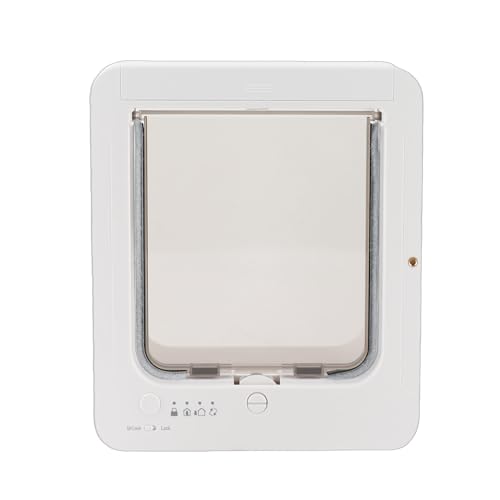 SUNGOOYUE Smart Pet Door Plastic Electronic Cat
- 【App Control Access】Manage entry and exit from your…
- 【Smart Sensing Entry】Electronic cat door uses smart sensing…
- 【Timer And Locking】Set access times to match feeding…
As an Amazon Associate we earn from qualifying purchases at no extra cost to you.
Best electronic pet doors by situation
| Situation | Best fit | Why it makes sense | Main compromise |
|---|---|---|---|
| Cat household, no collar wanted | SureFlap Microchip Pet Door Connect | Reads implanted microchips and supports app-based curfews | Not intended for medium or large dogs |
| Small dog or cat, frequent schedule changes | PetSafe SmartDoor Connected, small size | Remote controls and scheduled access through the app | Collar access may be preferable where pets are not microchipped |
| Medium or large dog | PetSafe SmartDoor Connected, large size | One of the more practical app-connected options for a wider shoulder and chest | Requires more wall or door cutting and careful weather sealing |
| Very limited installation space | Small electronic flap, door-mounted | Less structural work than a wall tunnel | May not suit a stocky dog even if its weight is within the stated limit |
| Maximum security against neighbouring animals | Microchip-selective flap | Entry is tied to the pet’s implanted identifier rather than a transferable tag | Every pet needs a registered microchip and the correct reading position |
Flap size: use shoulder width, not weight alone
Weight is a useful first filter, but body shape determines whether a pet can pass comfortably. Measure the widest part of the chest, then measure from the floor to the top of the shoulders. Add roughly 25 to 40 mm to the chest measurement for a practical opening width. Do not add that allowance to the pet’s height: the opening should usually be at least 25 mm taller than the shoulder height, while still preventing the pet from having to crouch excessively.
| Pet category | Typical pet weight | Useful clear-opening target | What to check |
|---|---|---|---|
| Small cat | Up to about 5 kg | Approximately 120–145 mm wide by 120–150 mm high | Neck position relative to the microchip reader |
| Large cat or small dog | About 5–10 kg | Approximately 145–180 mm wide by 150–200 mm high | Chest depth and whether the pet wears a harness |
| Medium dog | About 10–25 kg | Approximately 180–250 mm wide by 220–300 mm high | Shoulder width, not the advertised weight ceiling |
| Large dog | About 25–45 kg | Approximately 250–300 mm wide by 300–450 mm high | Wall thickness, flap rigidity and draught resistance |
These are planning ranges rather than substitutes for the model’s cut-out drawing. A 12 kg bulldog can need a wider opening than a slim 18 kg spaniel. Have the pet walk through a cardboard mock-up before cutting a door or wall.
PetSafe SmartDoor Connected versus SureFlap Connect
PetSafe SmartDoor Connected
The PetSafe SmartDoor Connected is the stronger choice when the household needs a dog-sized opening and remote control. Its connected system is designed around app management, allowing owners to control access and create schedules rather than relying only on a physical lock. It is available in sizes aimed at smaller and larger pets, making it more versatile for mixed cat-and-dog households.
Its key decision is the access method. Depending on the setup, the door can work with compatible electronic pet access devices, so check whether the version and pet’s collar arrangement match before buying. A collar-based system is convenient for an unchipped animal, but a tag can be lost, removed or transferred to another pet. Keep a spare compatible tag if outside access is important.
SureFlap Microchip Pet Door Connect
The SureFlap Microchip Pet Door Connect is particularly compelling for cats and small pets because it identifies registered microchips. That prevents many visiting cats from entering even when the flap is physically open. The connected hub and app add remote status information and curfew-style scheduling, subject to a reliable home network and the model’s compatibility requirements.
Microchip entry is less dependent on a collar, but it is not completely maintenance-free. The pet’s microchip must be registered correctly, and a chip that migrates or is difficult to read may require the pet to approach the reader in a particular way. Test the door with every animal before leaving it as the only route in or out.
App curfews: useful controls and their limits
A good app timer should let you set at least an evening lock time and a morning unlock time, temporarily override the schedule, and control pets individually where the system supports individual profiles. Look for an “in only” or “out only” mode as well as a full lock. These modes are more useful than a simple open/closed switch: you can allow a cat to return indoors while preventing another exit.
- Use a buffer: set the evening lock 15 to 30 minutes after the pet normally returns, rather than at the exact expected arrival time.
- Check offline behaviour: find out whether schedules remain stored locally if the Wi-Fi or internet connection fails.
- Do not assume instant alerts: notifications can be delayed by a phone, router or cloud-service problem.
- Keep a manual override: power loss, illness, storms and unfamiliar visitors can make the ordinary schedule unsuitable.
For a household with two pets, calculate the practical schedule rather than buying on the word “smart”. For example, if one cat needs access from 6:30 am to 9:00 pm and another must remain indoors after 7:00 pm, the door needs individual identification and per-pet permissions. A shared collar tag or non-selective flap cannot provide that distinction.
Door mounting or wall mounting?
Door mounting
Door installation is usually the simpler option for a timber, uPVC or composite panel, provided the panel’s structure can accept the cut-out. It keeps the tunnel short, reduces the number of joins that can leak air, and is easier to replace later. A thin hollow door may need a mounting adapter or reinforcement so the screws do not crush the panel.
Glass doors are more complicated. Double-glazed and toughened panes generally cannot be cut on site. The usual solution is a replacement pane manufactured with the correct aperture, which can make installation substantially more expensive than the flap itself.
Wall mounting
Wall installation suits homes where the door opens onto a hallway, utility room or unsuitable position. It can also provide a more stable, level passage for a large dog. However, the tunnel must match the wall thickness, and the installer needs to avoid electrical cables, plumbing, insulation damage and structural members. A long tunnel can reduce the effective opening if its interior is narrow.
For either method, fit the bottom of the opening low enough that the smallest pet can step through without jumping, but high enough to avoid standing water and heavy snow where relevant. External trim, a sloping sill and a flexible seal around the frame help prevent water entering the building fabric.
Weather sealing and ownership costs
Electronic pet doors are not automatically draught-proof. The flap edge, brush seals, magnetic closure and the installation joint are the parts most likely to admit cold air or rain. A rigid flap that closes securely is normally better for a windy location than an extremely light flap, but it must still open easily for the smallest pet.
- Inspect the flap edge and hinge every month during wet weather.
- Remove fur and grit from the reader area and threshold with a dry or slightly damp cloth.
- Replace batteries before winter or use the manufacturer’s specified power supply where supported.
- Do not spray lubricant or water into the reader, motor or battery compartment.
- Recheck screws after the first few weeks because repeated animal traffic can loosen a frame.
Typical market pricing in 2026 is roughly £120–£250 or $150–$300 for a connected cat flap, and about £250–£500 or $300–$600 for a connected dog door, before specialist glass, wall or professional installation. Ongoing costs can include batteries, replacement collar tags, a Wi-Fi hub where required, and replacement seals. The cheapest door can therefore cost more over several years if its flap or access tag is difficult to replace.
Final buying checklist
- Measure the pet’s chest width and shoulder height; then compare those figures with the clear opening, not the outer frame.
- Choose microchip entry for collar-free, pet-specific access; choose collar-key entry when the pet is unchipped or the reader location is unsuitable.
- Confirm whether the app supports individual pets, temporary overrides and an offline schedule.
- Choose a door mount for simpler work, or a wall mount when location, insulation and large-pet clearance justify the extra installation.
- Check flap seals, tunnel depth, battery life and replacement parts before focusing on app features.
- For a rental, a glass door or a structural wall, obtain permission and use an installer who understands the door or wall construction.
For most cat owners, the SureFlap Microchip Pet Door Connect offers the cleaner security model because the pet does not need to carry a tag. For dog owners who need a genuinely larger passage and flexible remote schedules, the PetSafe SmartDoor Connected is the more natural shortlist choice. In both cases, accurate sizing and weatherproof installation matter at least as much as the app.