Key takeaways
- Pro: Burst-resistant, non-expandable construction maintains steady pressure under load
- Pro: Kink-free performance across tight turns and varied terrain
- Con: Heavier than expandable options when coiled for storage
A 100-foot garden hose is the most common length homeowners reach for, but “flexible” means different things across price tiers. Cheap hoses kink at the first turn, fittings strip within a season, and the inner liner degrades after two freezes. The best flexible garden hose 100 ft balances wall thickness, fitting quality, and material memory so that it coils without creasing yet still handles pressure without ballooning or splitting.
The eight options below span non-expandable and expandable constructions, solid brass versus metal fittings, and single versus dual latex cores. We compared published specifications, list prices, and recurring themes in owner reviews to separate the genuinely durable from those that merely sound robust on a product page. The right choice depends on whether you prioritize burst resistance, weight at full capacity, or all-season storage flexibility.
Our top picks




As an Amazon Associate we earn from qualifying purchases at no extra cost to you.
Quick Picks
| Product | Best for | Price |
|---|---|---|
| Non-Expandable 8-Function Hose | High-pressure car washing | $49.97 |
| No-Kink 10-Function Brass Hose | Versatile spray patterns | $49.99 |
| All-Weather Lightweight Hose | Budget-conscious buyers | $35.27 |
| Non-Expanding 10-Function Sprayer | Leak-proof fittings on a value budget | $43.58 |
| Flexi Hose Double-Latex Core | Maximum lightness when drained | $79.99 |
| Kink-Free Metal-Fitting Hose | Outdoor storage in varied weather | $48.30 |
| Non-Expanding Ultra-Lightweight | Minimum weight with no expansion trade-offs | $37.99 |
| Flexzilla 5/8-Inch | Brand-name reliability and all-season use | $69 |
How We Picked
Four criteria drove every decision here. First, kink resistance backed by owner reports rather than marketing adjectives. Second, fitting material and construction, because brass outlasts plastic or thin aluminum regardless of hose quality. Third, weight when filled versus empty, which determines whether a 100-foot run stays manageable around beds and corners. Fourth, expandable versus non-expandable design, since each trades off burst protection against coilability and drag on uneven ground.
The 8 Best Flexible Garden Hose 100 Ft in 2026
Non-Expandable 8-Function Hose
This hose targets gardeners and car owners who want consistent flow without the spongy feel of an expandable tube. The 3/4-inch diameter delivers strong pressure through all eight nozzle functions, and the burst-resistant construction handles municipal water pressures without the diameter swelling. Owners praise its lightweight profile for a non-expandable design and its resistance to kinking at tight bends. The main drawback is that it lacks the ultra-light empty weight of latex-core competitors, so carrying it coiled from storage to the yard feels heavier than some rivals.
- Pro: Burst-resistant, non-expandable construction maintains steady pressure under load
- Pro: Kink-free performance across tight turns and varied terrain
- Con: Heavier than expandable options when coiled for storage
Skip it if you need the absolute lightest possible hose for hauling upstairs or around a large property with long carry distances.
No-Kink 10-Function Brass Hose
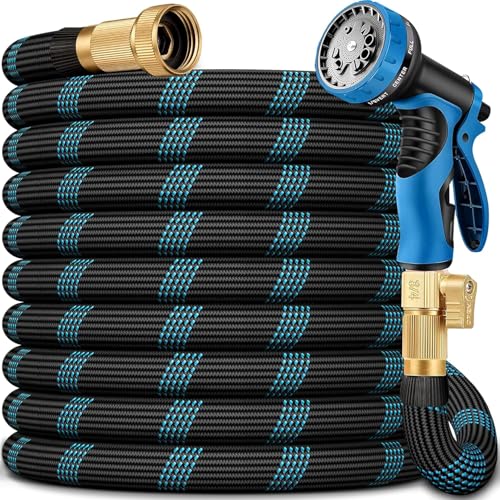
A solid pick for anyone who wants spray-pattern variety without paying premium brand pricing. The ten-function nozzle covers everything from a gentle mist for seedlings to a hard jet for rinsing patios. Reinforced outer fabric paired with a dedicated inner core gives this hose abrasion resistance that pure vinyl tubes cannot match, and the solid brass fittings thread onto standard spigots without cross-threading or stripping. Owner feedback highlights its ultra-lightweight feel relative to its durability. The slight downside is that the fabric sheath, while protective, adds marginal drag on rough concrete compared to slicker rubber jackets.
- Pro: Solid brass fittings resist corrosion and cross-threading
- Pro: Ten spray functions cover the widest practical range
- Con: Fabric outer adds slight drag on rough surfaces
Skip it if you only ever use one spray pattern and want the lowest price available.
All-Weather Lightweight Hose
At under thirty-six dollars, this is the most affordable option in the lineup, and it earns that price through a stripped-down but functional design. The 2026 upgraded construction emphasizes kink-free flexibility and abrasion resistance in an all-weather jacket that stores without cracking in cold conditions. Owners consistently note its surprising lightness for a full-diameter non-expandable hose. The trade-off is the absence of a bundled nozzle, so you supply your own spray head, which adds a few dollars and a separate item to keep track of.
- Pro: Lowest price in the roundup by a clear margin
- Pro: All-weather jacket resists cracking in freezing storage
- Con: No included spray nozzle
Skip it if you want a complete watering setup in one purchase or need multiple spray patterns without a separate attachment.
Non-Expanding 10-Function Sprayer
This hose occupies a middle ground: non-expandable for pressure stability, ten spray functions for versatility, and a price under forty-five dollars. The leak-proof fitting design addresses a common complaint with cheaper hoses that seep at the connection point, and the pressure-resistant inner core handles high-flow municipal lines without bulging. Owner reviews highlight the lightweight construction and the durable outer layer. The main limitation is that the sprayer attachment, while functional, feels less refined than standalone nozzles priced separately.
- Pro: Leak-proof connections reduce water waste at the spigot
- Pro: Pressure-resistant core handles high PSI without deformation
- Con: Included sprayer is adequate but not exceptional
Skip it if you already own a quality trigger nozzle and want to minimize cost by buying the hose bare.
Flexi Hose Double-Latex Core
The most expensive entry here, and it justifies its premium with a double-latex inner core that is the industry standard for expandable durability. At nearly thirty-three feet when filled, it contracts to a fraction of that length when drained, making storage trivial even in a crowded shed. The 3/4-inch solid brass fittings anchor the connection without threading issues. Owners love the no-kink flexibility and the minimal weight when coiled. The honest drawback is cost and the inherent vulnerability of expandable hoses: a single puncture in the latex liner is far harder to repair than a cut in a woven-jacket tube.
- Pro: Double-latex core resists punctures better than single-layer expandables
- Pro: Shrinks dramatically when empty, simplifying storage and transport
- Con: Highest price and a less field-repairable construction
Skip it if you store hoses on rough gravel or around thorny beds where a single snag can compromise the liner.
Kink-Free Metal-Fitting Hose
Built around a high-density outer fabric and an enhanced inner core, this 2026 model emphasizes protection against the two most common hose failures: abrasion and kinking. The solid metal fittings provide a secure, corrosion-resistant connection, and the ten-function nozzle handles diverse tasks from gentle watering to focused jetting. Owners describe it as genuinely lightweight for a non-expandable hose, which matters when dragging 100 feet across a sloped yard. The fitting material is described as “metal” rather than specifically “brass,” so long-term corrosion resistance is a mild question mark versus the brass-equipped rivals.
- Pro: High-density outer fabric resists cuts and abrasion on rough ground
- Pro: Ten functions with a solid, well-seated nozzle
- Con: Fittings are described as metal without confirmed brass composition
Skip it if you live near a coast and want guaranteed brass fittings to prevent salt-air corrosion.
Non-Expanding Ultra-Lightweight
The name says everything: this hose exists to be the lightest possible non-expandable 100-foot tube. At just under thirty-eight dollars, it appeals to older gardeners or anyone managing long runs across uneven terrain where every pound of hose weight compounds fatigue. The non-expanding design means no latex liner to puncture, and the ultra-lightweight construction is its defining and singular selling point. The specification sheet is notably sparse, with no mention of included fittings, nozzle type, or burst rating, which makes long-term durability harder to predict from published information alone.
- Pro: Among the lightest non-expandable hoses available at this length
- Pro: No expandable liner means fewer failure points
- Con: Minimal published specification detail makes comparison difficult
Skip it if you need a known burst rating or want a bundled nozzle for a complete setup.
Flexzilla 5/8-Inch
Flexzilla carries genuine brand recognition and a reputation that predates the listings above. The 5/8-inch diameter delivers slightly less flow than 3/4-inch competitors, which can matter for high-volume tasks like filling a pool or running a pressure washer intake. The all-weather construction stays pliable in freezing conditions, and leak-free connections at both ends eliminate the most common frustration with new hoses. At sixty-nine dollars it sits between the budget tier and the premium Flexi Hose. The diameter is the primary consideration: adequate for watering, limiting for volume-critical applications.
- Pro: Proven all-weather flexibility from a long-established brand
- Pro: Leak-free connections at both ends out of the box
- Con: 5/8-inch diameter limits maximum flow volume
Skip it if you routinely need high GPM for power-washing or filling large containers quickly.
Buying Guide
Expandable Versus Non-Expandable Construction
Expandable hoses use one or two latex tubes that swell with water pressure and contract when drained. They win on empty weight and storage footprint but fail when the liner punctures, and a repaired puncture rarely holds under full pressure. Non-expandable hoses rely on woven or reinforced polymer walls that resist bursts, tolerate abrasion, and can be patched with standard hose repair couplers. For 100 feet, the length amplifies the drag of a non-expandable tube on rough ground, so if you have a paved or smooth path, non-expandable is the safer long-term investment.
Fitting Material and Connection Reliability
Solid brass fittings are the durability benchmark: they resist corrosion, survive repeated threading without deforming, and seal reliably against rubber washers. Aluminum and zinc alloy fittings cost less but gall or crack in freeze-thaw cycles. When comparing products, confirm whether the manufacturer specifies “brass” or uses the vaguer term “metal.” A leak at the spigot wastes water and erodes the connection threads over time, so fitting quality directly determines how many seasons the hose survives without dripping at both ends.
Diameter and Flow Requirements
A 3/4-inch inner diameter carries roughly thirty to forty percent more water than a 5/8-inch tube at identical pressure. If you attach a pressure washer, fill a pond, or water a large lawn in minimum time, choose 3/4 inch. For garden beds, a single car wash, or a spot sprinkler, the 5/8-inch diameter reduces weight and cost without a meaningful performance loss. Matching diameter to your actual use case prevents overpaying for volume you never need or frustrating yourself with a weak stream.
Our Verdict
The top pick is the No-Kink 10-Function Brass Hose at $49.99: solid brass fittings, ten spray functions, reinforced construction, and a price that sits well below the premium brands without sacrificing the materials that determine lifespan.
The budget pick is the All-Weather Lightweight Hose at $35.27, the cheapest option that still delivers kink-free, all-season performance, provided you already own a nozzle.
The Flexi Hose with its double-latex core becomes the better choice if storage space is genuinely tight and you need a hose that contracts to a fraction of its length when empty, accepting the puncture vulnerability that trade-off.
FAQ
Will a 100-foot hose lose too much water pressure?
Some pressure drop is unavoidable over 100 feet, typically a few PSI depending on municipal supply strength. A 3/4-inch diameter minimizes the loss noticeably compared to 5/8 inch, so if your home pressure already feels weak at a 50-foot run, prioritize the larger diameter.
Are expandable hoses worth the extra cost?
They are worth it when storage space is the limiting factor and you handle the hose gently. If your yard has gravel, thorns, or a dog that chews corners, a non-expandable hose with a woven jacket will outlast an expandable by multiple seasons despite the higher initial price of some models.
How do I winterize a flexible garden hose?
Disconnect it from the spigot, drain both ends by elevating the hose into a U-shape, and coil it in a dry location above freezing. All-weather and anti-kink constructions resist cracking, but trapped water expanding during a freeze will split any hose regardless of material grade.
What nozzle pattern works best for car washing with a 100-foot hose?
A fan or cone pattern at medium pressure rinses suds without etching paint, while a jet setting reaches wheel wells and undercarriage crevices. Hoses with eight or ten functions let you switch between these without returning to the spigot, which is the practical reason the multi-function options dominate this category.