Key takeaways
- Pro: Generous component count for the price, covering up to 40 plant stations
- Pro: Dual-tube design adds layout flexibility without extra purchases
- Con: Barbed fittings are more prone to popping off if water pressure is not reduced with a regulator
Most gardeners who reach for a drip irrigation kit are solving the same frustrating problem: hand-watering a raised bed, a row of potted plants, or a small greenhouse takes time and rarely delivers water evenly to every root zone. A hose and sprinkler overspray wastes water, promotes leaf disease, and leaves the back corners of the bed bone dry. A drip system fixes that by metering water directly to the soil at each plant, but the market is flooded with kits that look nearly identical in photos yet vary wildly in tubing quality, fitting durability, and how well the emitters actually stay clog-free after a full season.
What separates a kit worth installing from one that frustrates you by mid-summer comes down to a handful of concrete details: whether the main line uses true half-inch polyethylene or a thin film that kinks, whether emitters lock in place or creep along the tube under pressure, and whether the adjustable nozzles seal tightly or weep at the base. The eight best garden drip system options in 2026 span a wide price range and different design philosophies, so we lined them up by published specs and owner-reported experience to make the comparison straightforward.
Our top picks



As an Amazon Associate we earn from qualifying purchases at no extra cost to you.
Quick Picks
| Product | Best for | Price |
|---|---|---|
| TJJFMM 230FT | Large mixed layouts on a budget | $24.99 |
| 230FT Copper Nozzle Kit | Premium emitter quality and longevity | $59.99 |
| CARPATHEN 100 ft | Small beds and patios | $39.87 |
| 240FT Quick Connect | Maximum coverage for the lowest price | $19.99 |
| MIXC 230FT Quick-Connect | Fast installation with reliable locking | $42.99 |
| MIXC 200Ft Copper | Atomizing mist over dense plantings | $48.59 |
| Bluepro 200FT | Directional watering with full rotation | $44.99 |
| HIRALIY 50ft | DIY micro-plots and single containers | $19.99 |
How We Picked
We narrowed this list by weighing four criteria that consistently drive owner satisfaction in drip kits. First, tubing material and wall thickness: thicker polyethylene resists UV cracking and holds its shape when you bury the line under mulch. Second, emitter and fitting reliability: copper or brass nozzles outlast plastic ones by years, and quick-connect fittings that truly snap and lock save hours versus barbed push-together joints that pop off under pressure spikes. Third, adjustability: a kit whose nozzles can be dialed from a fine mist to a steady stream covers more plant types without needing a second product. Fourth, coverage-to-price ratio, because the per-foot cost tells you whether you are paying for better materials or simply a longer tube of the same thin film.
The 8 Best Garden Drip System in 2026
TJJFMM 230FT Drip Irrigation System
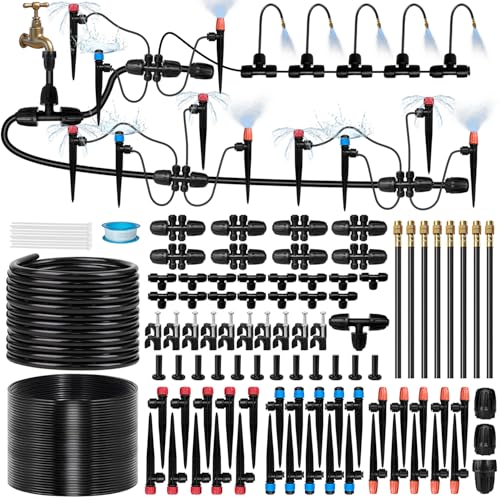
This kit packs 230 feet of tubing and 40 nozzles into a package under twenty-five dollars, making it a pragmatic choice for gardeners with a large layout on a tight budget. The inclusion of both half-inch and quarter-inch lines with barbed fittings means you can run a main feed along a fence and branch off to individual beds without adapters. Owners appreciate the adjustable sprinklers that switch between gentle mist and a wider spray pattern.
- Pro: Generous component count for the price, covering up to 40 plant stations
- Pro: Dual-tube design adds layout flexibility without extra purchases
- Con: Barbed fittings are more prone to popping off if water pressure is not reduced with a regulator
Skip this one if your water pressure exceeds typical residential levels or if you dislike hand-pressing barbed joints into tubing.
230FT Copper Nozzle Drip Irrigation System
At roughly $60, this kit asks you to pay a premium for 38 adjustable copper nozzles rather than plastic ones. Copper resists the mineral scaling and UV brittleness that degrade cheaper emitters within a season or two, so the long-term value proposition is strong for gardeners who plan to leave the system installed year after year. The dual 1/2-inch and 1/4-inch tubing suits raised beds, potted plants, and greenhouse benches in the same run.
- Pro: Copper nozzles hold calibration longer and resist clogging better than plastic equivalents
- Pro: Full 230-foot coverage in a single purchase
- Con: Priced well above every other option on this list, which is hard to justify for a one-season project
If you are renting or only need irrigation for a short trial, the cost premium over plastic-nozzle kits is not worth it.
CARPATHEN 100 ft Drip Irrigation System Kit
With 100 feet of line, the CARPATHEN sits in a sweet spot for small-to-medium gardens, patios, and row-crop setups where 230 feet would be overkill. The included sprinkler heads and emitters give you both targeted root-zone watering and a light overhead mist for seedlings. Owners report the layout is simple enough for a first-time drip installer to assemble in under an hour.
- Pro: Manageable length reduces excess tubing and excess fittings cluttering your storage
- Pro: Good balance of spray heads and point emitters for mixed planting needs
- Con: 100 feet fills up fast if you want to cover more than two raised beds
Skip it if your plot exceeds roughly 100 linear feet of planting edge, because adding a second kit means matching fittings and pressure zones across two lines.
240FT Quick Connect Drip Irrigation System
At $19.99 for 240 feet, this kit offers the best raw coverage-per-dollar on the list. The quick-connect 1/2-inch main tube and 5/16-inch ID design means you snap branches together rather than fighting barbed joints, which cuts installation time noticeably. Adjustable 1/4-inch misting parts let you tune flow at each plant. It is a solid entry point for yard-wide coverage on a budget.
- Pro: Fastest assembly method among the budget options thanks to true quick-connect fittings
- Pro: Longest tube run on this list at a rock-bottom price
- Con: Nozzle materials and wall thickness are the trade-off for that low cost, so expect a shorter service life
If you need a system that survives multiple seasons without replacing emitters, spend a little more on the copper-nozzle kits.
MIXC 230FT Quick-Connect Drip Irrigation System Kit
MIXC combines 230 feet of coverage with 1/4-inch and 1/2-inch fast-lock tubing, giving you the speed of quick-connect assembly at a mid-range price. Owners highlight that the locking tabs hold firmly even after winter freeze-thaw cycles, which is a common failure point with cheaper barbed systems. The adjustable nozzles and sprinklers cover greenhouse benches, lawn edges, and potted plants without needing separate heads.
- Pro: Fast-lock tubing stays connected under pressure fluctuations better than push-fit alternatives
- Pro: Balanced price at $42.99 for the component count included
- Con: Slightly shorter total coverage than the TJJFMM at a higher price, so compare linear foot cost if you need maximum reach
If your main constraint is sheer footage rather than fitting quality, a budget kit might cover you for less.
MIXC 200Ft 1/4″ Drip Irrigation System
This 2026-upgraded variant swaps standard plastic tips for 32 adjustable copper nozzles and adds atomizing spray heads that produce a fine mist ideal for seedlings, ferns, and moisture-loving container plants. At $48.59 it sits between the pure-copper premium kit and the plastic-nozzle mid-range options. The quarter-inch distribution tubing is easier to hide under mulch or coiled around a single raised bed.
- Pro: Copper nozzles paired with atomizing heads deliver precise micro-spraying that plastic tips cannot match
- Pro: 200-foot length handles most suburban backyard layouts in one purchase
- Con: No half-inch main line included, so you may need a separate supply feeder for larger gardens
Skip it if you need a thick main run feeding long lateral branches; pair it with a half-inch supply line instead.
Bluepro 200FT Drip Irrigation System with 360° Nozzles
The Bluepro distinguishes itself with 360-degree adjustable copper nozzles that can be aimed in any horizontal direction, which solves a common complaint about fixed-spray emitters that only water a narrow arc. Owners with irregular bed shapes or curved walkway plantings report that full rotation means fewer dry spots. The 200-foot tube length is practical for most residential setups.
- Pro: True 360° aim eliminates the guesswork of aligning spray direction during installation
- Pro: Copper construction promises multi-season durability at a mid-tier price
- Con: Fewer total emitters than some competitors at a similar price point, limiting station count
If your garden has many tight-spaced plants that each need their own emitter, count stations first before committing.
HIRALIY 50ft Drip Irrigation Kit
At $19.99 with 50 feet of blank 8x5mm distribution tubing, the HIRALIY is a minimalist DIY solution for a single raised bed, a greenhouse shelf, or a cluster of patio pots. The blank tube lets you cut custom lengths and insert emitters exactly where your plants sit, which is a level of flexibility larger kit formats cannot match. It rewards gardeners willing to plan their layout on paper before cutting.
- Pro: Fully customizable emitter placement since the tube ships without pre-punched holes
- Pro: Lowest complexity, making it the least intimidating kit for a first drip project
- Con: Only 50 feet, and the small-diameter tubing restricts flow if you add too many stations on one run
For anything larger than a single bed or a handful of containers, you will outgrow this kit quickly.
Buying Guide
Tubing Diameter and Wall Thickness
Most kits pair a half-inch or five-eighths-inch main supply line with quarter-inch lateral tubes that carry water to individual plants. The main line needs sufficient wall thickness to resist kinking when you route it along a fence or under mulch; thin film lines flatten under a few inches of soil and restrict flow to everything downstream. Quarter-inch tubes are forgiving because they operate at lower pressure, but they clog faster if your water carries sediment. Check whether the kit includes a supply filter, and if not, budget a few dollars for one.
Emitter Material and Adjustment Range
Plastic emitters are adequate for a single season but become brittle after two summers of UV exposure, and mineral deposits glue their internal passages shut. Copper or brass alternatives cost more per unit but survive scaling and sunlight indefinitely. Adjustable nozzles that sweep from a pinpoint drip to a gentle mist give you one fitting that works for both a thirsty tomato plant and a delicate seedling, which reduces the number of separate emitter types you need to stock.
Fitting Type and Pressure Management
Barbed push-together fittings are the cheapest to manufacture and the most likely to separate when municipal pressure spikes. Quick-connect or fast-lock fittings with a positive-click tab stay seated reliably and save reinstallation time each spring. Regardless of fitting style, every drip system needs a pressure regulator on the faucet line; typical garden hose pressure of 60 PSI or more will blow emitters off barbed joints and burst thin lateral tubes within the first week.
Our Verdict
The MIXC 230FT Quick-Connect is our top pick for most gardeners because it balances fast-lock fitting reliability, generous coverage, and a price that undercuts copper-nozzle kits without resorting to barbed joints that fail under pressure. For the tightest budget, the 240FT Quick Connect at $19.99 offers the longest run and a no-fuss snap-together install, accepting a shorter expected lifespan as the trade. If your primary need is multi-season durability and you are willing to pay for it, the 230FT Copper Nozzle system justifies its premium through emitter longevity alone.
FAQ
Do drip irrigation kits need a pressure regulator?
Yes, virtually every kit benefits from one, and barbed-fitting designs absolutely require it. Standard hose pressure from a spigot often exceeds 50 PSI, which will blow emitters off push-fit joints and split thin tubing within hours. A simple inline regulator that drops pressure to 25-30 PSI is inexpensive and prevents the most common cause of early system failure.
How many emitters can one run support?
It depends on main-line diameter and available pressure. A half-inch supply line at regulated 25 PSI can typically feed 20-30 quarter-inch laterals before flow drops too low at the far end. If you need more stations, split into two zones or add a small booster pump rather than stretching one line beyond its hydraulic limit.
Can I leave a drip system installed over winter?
In freeze-prone climates, you must drain the lines or blow them out with compressed air before the first hard freeze. Water trapped inside tubing expands and ruptures it, which is the single most common reason owners replace a kit the following spring. Some gardeners disconnect, flush, coil, and store kits indoors over winter; others run them year-round in mild zones without issue.
Is copper really better than plastic for emitters?
Over multiple seasons, yes. Copper resists UV degradation and tolerates minor mineral scaling without losing its orifice size. Plastic emitters work fine for a year or two but become brittle, crack at the barb, and accumulate calcium deposits that narrow flow. If you plan to keep the same layout for three or more years, the per-season cost of a copper kit is often lower than replacing a plastic one.