A garden impact sprinkler solves a deceptively simple problem: pushing a uniform volume of water in a full or partial circle without dragging a hose in a manual pattern every morning. Done well, one unit can replace an oscillating sprinkler that only covers a rectangle, or a stationary head that creates a wet ring with a dry center. Done poorly, it wobbles off-level after two weeks, sprays your fence line for the first ten seconds of every cycle, or quietly dies mid-season when the internal spring fatigues.
What separates the best garden impact sprinkler options from the rest comes down to a handful of factors — base stability under pressure, corrosion resistance of the housing, the range and precision of the arc adjustment, and whether the internal mechanism uses brass or plastic pivots. Price alone is a poor predictor of performance here, which is why comparing published coverage ratings and reading long-term owner reports matters more than sorting by dollar amount.
Our top picks




As an Amazon Associate we earn from qualifying purchases at no extra cost to you.
Quick Picks
| Product | Best for | Price |
|---|---|---|
| Meekamar Heavy Duty Pulsating | Large lawns on a budget | $18.77 |
| Orbit Tripod Zinc 56667 | Uneven terrain and raised beds | $31.90 |
| WEMADE Heavy Duty Metal | Maximum radius coverage | $17.99 |
| 2 Packs Spike Sprinklers | Watering two zones simultaneously | $20.99 |
| Hourleey Impact Pulsating | Mid-size to large lawns | $19.99 |
| Hourleey Tripod Brass | Elevated coverage with precision | $29.99 |
| Biswing Tripod 2 Pack | Durable, long-term heavy use | $65.99 |
| CHAPIN 4984 T-Post | Lowest upfront cost | $13.14 |
How We Picked
We narrowed this list using four criteria that consistently drive owner satisfaction in this category. First, rated coverage area or radius — we compared published specs side by side and cross-referenced them against long-term owner reports for accuracy. Second, base material and stability — metal bases and tripod legs outperform thin stakes under real water pressure. Third, arc adjustability — a true 360-degree range with a positive lock beats fixed partial arcs for versatility. Fourth, internal construction quality — brass or heavy-gauge metal pivots last significantly longer than molded plastic, especially in hard-water regions.
The 8 Best Garden Impact Sprinkler in 2026
Meekamar Heavy Duty Pulsating Impact Sprinkler
For homeowners who need reliable full-circle coverage without spending much, the Meekamar is a strong starting point. Its metal base keeps it planted through a full watering cycle, and the 4,500-square-foot rated spread handles most suburban lawns. The 360-degree adjustment ring lets you dial in a partial arc when you don’t want water hitting the driveway. Owner feedback praises the consistent pulse pattern and quiet operation relative to cheaper alternatives. The main downside is the plastic internal mechanism, which several long-term users report wearing faster than expected under hard water conditions. Skip this if your water supply is mineral-heavy or you need a sprinkler that will survive more than two or three seasons of daily use.
Orbit Tripod Zinc Impact Sprinkler
The Orbit Tripod earns its place for anyone whose yard has slopes, raised beds, or obstacles that block a ground-level spray pattern. The adjustable-height tripod lifts the head well above obstructions, and the zinc alloy construction resists corrosion better than the plastic housings on cheaper competitors. The 360-degree coverage is consistent, and the threaded connection is standard 3/4-inch, so it fits any common hose adapter. Where it falls short is reach: owner reviews note the spray radius doesn’t match the wider throws of competitors with larger bases, making it better suited to smaller or segmented areas. Skip this if you need to irrigate one large open lawn in a single pass.
WEMADE Heavy Duty Metal Pulsating Sprinkler
If raw coverage area is your priority, the WEMADE tops this list with a rated 85-foot diameter throw. The metal base and pulsating mechanism deliver that radius consistently across a wide arc, and the 360-degree rotation can be locked to any partial angle. Owners frequently mention the solid build feel, noting it doesn’t wobble the way thin-aluminum stakes do under pressure. The trade-off is noise: several reviewers describe a loud, repetitive clack that some find acceptable in a backyard but neighbors might not. It is also the cheapest option here at $17.99. Skip this if quiet operation matters or if your water pressure runs low, since the full-radius claim assumes adequate pressure at the inlet.
2 Packs Spike Sprinklers for Yard
Two sprinklers for the price of most singles makes this the obvious choice for gardeners who need to water separate zones — a front lawn and a backyard patch, for example — without dragging a hose between them. The zinc alloy bodies and step-spike bases are straightforward, and the 360-degree adjustment works well for locking partial arcs around fences. Owner feedback highlights the value proposition repeatedly. The limitation is that these are entry-level mechanisms: the springs and pivot points are thinner than on dedicated premium units, so longevity under heavy use is questionable. Skip this if you need one sprinkler to cover an entire large yard or if you plan to run it on a timer for multiple daily cycles.
Hourleey Impact Pulsating Sprinkler
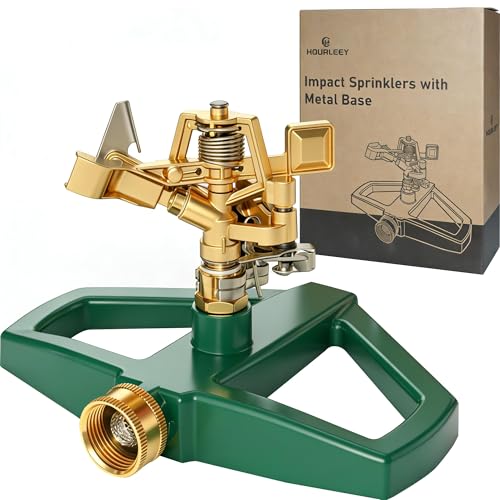
The Hourleey Pulsating sits in a sweet spot between bare-bones budget models and premium tripod units. With a 5,800-square-foot coverage rating, it handles mid-to-large lawns comfortably, and the metal base provides the stability needed for consistent rotation. The 360-degree adjustable arc is intuitive, and owners note the spray pattern is even without dry patches at the center — a common flaw on lesser impact heads. The one recurring complaint is the connection fitting: a few reviewers report the threaded joint loosens over time, requiring occasional hand-tightening. Skip this if you need it to stay locked at a precise partial arc for weeks without checking on it.
Hourleey Impact Sprinkler on Tripod Base
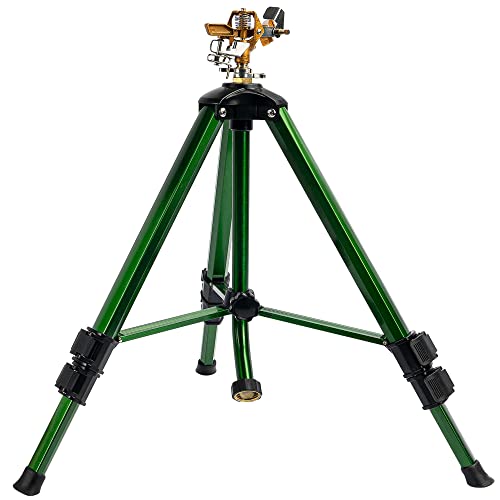
For elevated coverage on rough terrain, the Hourleey Brass Tripod is the most refined option in this group. The brass sprinkler head paired with a 0-to-360-degree adjustment ring gives precise control over both arc and height, while the three flip-lock legs set up quickly on uneven ground. The 3/4-inch connector is standard, and the tripod base adds working height well above ground obstacles. The $29.99 price reflects the material upgrade, but it remains modest for a brass-head unit. The downside is weight: fully assembled it is noticeably heavier than stake-based competitors, which matters if you move the sprinkler between zones often. Skip this if you want a lightweight throw-and-go solution for a flat, open lawn.
Biswing Impact Sprinkler Head on Tripod Base (2 Pack)
The Biswing 2-Pack is the premium option here, and the $65.99 price tag signals that. You get two full tripod assemblies with solid alloy extension legs, metal nozzles, and flip-lock adjustments — essentially commercial-grade hardware for residential use. Owners describe the build as significantly sturdier than anything under $30, with less vibration and wear over repeated watering cycles. The 360-degree coverage per head is wide, so two units can handle a very large property or simultaneously serve two distinct zones. The con is straightforward overkill for most suburban yards: unless you have genuinely demanding coverage needs or run irrigation daily, you are paying for durability you may never fully use. Skip this for casual weekend watering or small lots.
CHAPIN 4984 T-Post Impact Sprinkler
CHAPIN has been a name in agricultural and garden spraying for decades, and the 4984 T-Post model carries that reputation into the impact sprinkler space. At $13.14, it is the lowest-priced unit here, yet it claims coverage up to 85 feet on a full 360-degree rotation. The T-post mounting style makes it easy to reposition in soft soil or attach to a garden stake. Owner reviews confirm the throw radius is competitive with units costing twice as much. The weakness is build material: the body is lighter and more plastic-heavy than premium competitors, so expect it to be a multi-season workhorse rather than a lifetime investment. Skip this if you need maximum durability or brass fittings.
Buying Guide
Coverage Radius vs. Your Yard Geometry
Published coverage numbers assume ideal conditions — full water pressure at the inlet, a level surface, and an unobstructed circle. A sprinkler rated at 85 feet will rarely hit that mark if you are connecting it through a long or narrow-diameter hose. Before purchasing, measure the longest single distance you need to reach from your water spigot to the farthest corner of your lawn. If that distance exceeds 60 feet, prioritize units with a large base for stability and a brass or heavy-metal head, since lighter plastic units tend to lose throw distance as the pivot wears.
Base Type Determines Real-World Usability
Spike bases work on soft soil and are the cheapest option, but they tip easily on slopes or in wind. Metal weighted bases sit flat and resist movement, making them the best choice for hard-packed or slightly uneven ground. Tripod legs are the most versatile — they handle slopes, raised beds, and obstacles — but they add height, which means a partial-arc setting will hit nearby walls or trees unless you angle the head downward. Match the base to your terrain first; coverage specs mean little if the sprinkler falls over every cycle.
Arc Adjustability and Lock Quality
Every unit on this list advertises 360-degree coverage, but the practical range of motion differs. Some require you to manually set and release a locking pin each time you adjust the arc, which is imprecise and tedious. Others use a friction collar or a positive detent mechanism that holds a partial arc securely for the entire watering session. If you plan to use a timer and only check on the sprinkler weekly, the lock quality matters more than the headline coverage number — a sprinkler that drifts off its set arc will over-water one edge while starving the opposite side.
Our Verdict
Our top pick is the Hourleey Impact Pulsating Sprinkler at $19.99. Its 5,800-square-foot coverage rating, metal base, and even spray pattern give the best balance of capability and value for the typical suburban lawn, and owner feedback consistently confirms the published specs are realistic. For a budget pick, the CHAPIN 4984 T-Post at $13.14 delivers surprising throw distance for the price, accepting shorter lifespan as the trade-off. The exception to this ranking: if your terrain is uneven or you water around raised beds and garden structures, the Hourleey Brass Tripod at $29.99 wins outright because no ground-based sprinkler can match its working height and stability in those conditions.
FAQ
Do impact sprinklers work on low water pressure?
Impact sprinklers rely on water force to push the hammer arm and rotate the head, so they perform best at moderate to high pressure. At very low pressure, the rotation slows and the spray pattern becomes uneven, with water falling short of the rated radius. If your pressure is consistently below 30 PSI, a stationary or rotary sprinkler may deliver more uniform coverage.
How long should an impact sprinkler last?
Brass or heavy-metal models used seasonally typically last five or more years. Plastic-internal units used on daily timer schedules in hard-water areas may show pivot wear after two or three seasons. Flushing the mechanism with clean water after each use and applying a light silicone spray to the spring and hinge points can meaningfully extend service life.
Can I connect multiple impact sprinklers to one hose?
Yes, using a Y-splitter or multi-outlet adapter, but doing so divides available pressure and flow between both heads. Each sprinkler will underperform its rated coverage. A common rule is to run one impact sprinkler per 5/8-inch hose line at normal household pressure; beyond that, the trade-off in reach is noticeable.
What causes a sprinkler to wobble or tip over?
Wobbling usually results from an unstable base on soft or sloped ground, or from internal pivot wear that lets the head shift off-center during rotation. Tipping is almost always a base problem: narrow stakes sink unevenly, and lightweight plastic housings shift the center of gravity too high. Switching to a weighted metal base or tripod resolves both issues in most cases.