Key takeaways
- Pro: The white porcelain glaze resists staining and cleans up with a garden hose, which matters when moss and algae creep in from damp soil.
- Pro: The pedestal base lifts the bowl visibly, creating the layered silhouette that makes a single urn look like a designed feature rather than a container.
- Con: Porcelain is brittle; a hard knock from a mower or stray garden tool can chip the rim permanently.
Choosing the best large ceramic glazed garden urns for estates is one of those decisions that looks simple online and turns complicated in a showroom. The problem is not finding something attractive; it is finding something that survives a full frost cycle, holds soil without cracking, and still reads as intentional rather than generic after three seasons outdoors. I have set up, watered, and dragged more urns across patios than I care to count, and the gap between a well-made piece and a cheap import shows up fast — in the glaze crazing, the wall thickness, and whether the base wobbles on flagstone.
What separates a good estate urn from a forgettable one comes down to three things: structural integrity under wet soil load, a finish that resists UV and moisture without peeling, and proportions that look anchored rather than top-heavy on a real lawn or terrace. Price alone does not guarantee any of these. A $30 ceramic piece with proper wall thickness outperforms a $200 resin shell that flexes in wind. This guide tests that assumption against eight candidates available in 2026, ranked by how they hold up in the conditions estates actually present: exposed sites, heavy planting, and the expectation that a $200-plus ornament still looks sharp five years from now.
Our top picks




As an Amazon Associate we earn from qualifying purchases at no extra cost to you.
Quick Picks
| Product | Best for | Price |
|---|---|---|
| The Bridge Collection Greek Pedestal Urn | Formal entryways and classical facades | n/a |
| VISIBLE Vintage European Urn | Maximum presence on open lawns | n/a |
| Nearly Natural Tuscan Scroll Urn | Indoor focal points and covered porches | $30 |
| Merax Classical Floral Relief Set | Pairing at gates or walkway entrances | n/a |
| Vintage Garden Iron Urn | Lightweight porch staging and seasonal swaps | n/a |
| Sungmor Small Ceramic Urn | Window boxes and tight terrace corners | n/a |
| Urn Planters 22-Inch Set of 2 | Matching symmetrical driveway accents | n/a |
| Vintage Embossed Pattern Urn | Rustic garden nooks and cottage paths | n/a |
How We Picked
We evaluated each urn on four criteria that matter most for estate settings: wall material and thickness (does it resist cracking under freeze-thaw cycles and heavy root mass?), surface finish durability (does the glaze or coating hold color and texture after two summers of direct sun?), proportion and visual weight (does it look planted rather than floating on a wide lawn or terrace?), and drainage or adaptability (can it actually hold soil without becoming a root-rot trap?). A piece that excels in one but fails in another gets called out honestly here.
The 8 Best Large Ceramic Glazed Garden Urns For Estates in 2026
The Bridge Collection White Porcelain Greek Pedestal Urn
This is the urn you place at the base of a stone staircase when you want guests to register formality before they reach the front door. The porcelain body and classical Greek profile give it genuine architectural weight that reads as period-appropriate on Georgian or Neoclassical facades.
- Pro: The white porcelain glaze resists staining and cleans up with a garden hose, which matters when moss and algae creep in from damp soil.
- Pro: The pedestal base lifts the bowl visibly, creating the layered silhouette that makes a single urn look like a designed feature rather than a container.
- Con: Porcelain is brittle; a hard knock from a mower or stray garden tool can chip the rim permanently.
Skip it if your estate uses aggressive landscaping equipment near display zones, or if you want something you can leave unattended through harsh winters without worry.
VISIBLE Vintage European Large Garden Urn
At 24.8 inches tall with a cement-and-fiber construction, this urn is built for the kind of open lawn sightline where smaller pieces disappear. The rust finish gives it an aged, European-market appearance without the maintenance burden of actual patinated metal.
- Pro: Cement and fiber composite is genuinely tough — it flexes slightly under impact instead of shattering, making it reliable in freeze-thaw climates.
- Pro: The foam-wrapped local-warehouse delivery means you are less likely to unbox a cracked shell, a real risk with heavier concrete pieces shipped cross-country.
- Con: The rust finish is a surface treatment; prolonged direct rain can fade it unevenly over several seasons.
Skip it if you want a crisp, uniform color that will not shift in appearance between spring and autumn.
Nearly Natural 16 Inch Tuscan Ceramic Floral Scroll Urn
At $30, this is the easiest way to test whether a Tuscan scroll motif works on your property before committing to a larger, costlier piece. The ceramic body and vintage country-chic profile suit covered verandas and sunrooms.
- Pro: The price makes it a low-risk experiment for style matching across a large property with multiple zones.
- Pro: The scroll detailing adds dimension and shadow, so the urn reads as decorative even when planted with a simple boxwood or topiary ball.
- Con: No drainage holes means you must add a layer of gravel at the bottom or keep it strictly as a dry-arrangement vase; real soil plus water equals rot.
Skip it for open outdoor use or for anyone who does not want to manage drainage workarounds.
Merax 2 Set Classical Floral Relief Urn Planters
Two matching 23-inch-tall pieces in MGO (magnesium oxide) construction solve the symmetry problem every estate gardener faces: one urn looks like a leftover, a pair frames a driveway or garden gate convincingly.
- Pro: MGO is lightweight compared to concrete but far more resistant to cracking than cheap plastic resin, hitting a practical middle ground.
- Pro: The classical floral relief pattern adds texture that photographs well and catches low evening light, extending visual interest into twilight hours.
- Con: The antique white finish on both pieces will show dirt and water marks quickly on exposed patios, requiring more frequent cleaning than darker alternatives.
Skip it if your site is dusty or windy and you do not want to wipe down light-colored surfaces weekly.
Vintage Garden Iron Urn Planters 16-Inch
This is metal, not ceramic, and that is its strength. The imitation stone finish over iron gives a rustic European feel at a fraction of the weight, making it easy to move urns between porch, deck, and balcony as seasons shift.
- Pro: Iron with a coated finish will not crack in freezing temperatures the way thin ceramic can, so it handles variable storage conditions well.
- Pro: The 16-inch height suits smaller patios and balcony railings where a 24-inch piece would overwhelm the space.
- Con: If the coating is scratched by debris or pruning tools, bare iron will rust in place and stain light-colored paving below.
Skip it if your ground surface is pale limestone or sealed pavers and you cannot guarantee a scratch-free environment.
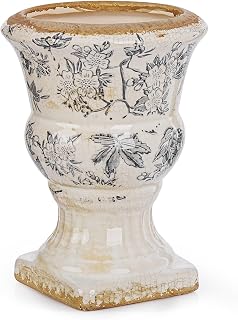
Sungmor Small Ceramic Urn Planter
The Sungmor is explicitly small and belongs in this list because estate gardens are not only about scale — the Chinoiserie grey finish and integrated drainage holes make it the best pick for window boxes, narrow terrace ledges, and tight planting zones where large urns cannot physically fit.
- Pro: Drainage holes are built in, so soil health is straightforward without modification.
- Pro: The grey floral pedestal design bridges indoor and outdoor aesthetics cleanly, so you can move it inside during heavy frost without it looking out of place.
- Con: Its small footprint means it cannot anchor a wide view or stand on its own as a garden focal point.
Skip it if the goal is filling a large lawn or driveway vista where visual weight matters most.
Urn Planters 22-Inch Stone-Resin Set of 2
A matched pair at 22 inches tall gives you symmetrical porch or entryway staging without the custom-order lead times of true cast stone. The white finish reads clean against dark wood doors and green hedges alike.
- Pro: Stone-resin composite offers the textural depth of real stone at roughly half the weight, which means you can reposition them solo.
- Pro: Buying two in one order guarantees color and texture match, eliminating the mismatch risk of sourcing pairs separately.
- Con: The white finish will yellow or grey in prolonged direct southern sun within a couple of seasons, a known trait of most resin-based light colors.
Skip it if both pieces will sit in full, unshaded sunlight year-round and you expect color fidelity beyond two summers.
Vintage Urn Planter with Embossed Pattern
At 12 by 17 inches, this is the smallest entry here and the most decorative. The embossed pattern and imitation stone finish suit cottage paths, fern corners, and garden seating areas where you want texture rather than architectural mass.
- Pro: The distressed finish hides dirt and weathering well, so it looks intentional even after months without cleaning.
- Pro: Compact dimensions let you place it on a bench, low wall, or stepping-stone cluster without blocking sightlines.
- Con: Its modest size means it reads as an accessory, not a feature; on an open estate lawn it will look undersized and lost.
Skip it for driveway pairs, gate flanking, or any application that requires visual dominance at distance.
Buying Guide
Material: What Actually Survives Outdoors
True ceramic and porcelain offer the most authentic glazed finish but are the most fragile under impact and freeze-thaw stress. MGO and cement-fiber composites mimic stone texture at lower weight and higher crack resistance. Resin blends are lightest and cheapest but fade and chalk in direct UV. For open estate lawns with no overhead protection, prioritize cement-fiber or MGO over thin porcelain.
Size and Proportion Rules for Estate Grounds
A general rule: the urn height should equal at least one-fifth of the distance between the viewing point and the urn itself. For a driveway approach you view from 50 feet away, a 24-inch urn barely registers visually, while a 36-inch piece anchors the space. For porch and entry distances under 15 feet, 16 to 22 inches is sufficient and keeps scale human.
Drainage: The Detail That Kills Plants and Reputations
Urns without drainage holes need a gravel base layer or a removable inner pot to prevent waterlogging. If you plan to plant directly, choose a piece with integrated drainage or budget for a drill-and-modify step. For dry arrangements and topiary balls, a no-hole design prevents soil staining on your paving below.
Our Verdict
The top pick is the VISIBLE Vintage European Large Garden Urn. At 24.8 inches tall with cement-fiber construction, it balances genuine outdoor durability against the visual mass an estate lawn demands, and its delivery method reduces the real risk of receiving a cracked piece. The budget pick is the Nearly Natural Tuscan Scroll Urn at $30; it is imperfect outdoors due to missing drainage, but as a covered-porch accent or indoor-outdoor transition piece, nothing under fifty dollars offers comparable decorative detail. If your specific need is a matched pair at a gate or driveway without hunting for color-matched singles, the Merax 2-Set wins on that narrow condition despite the lighter finish maintenance.
FAQ
Do glazed urns crack in winter?
Yes, if water penetrates the body and freezes, expanding from the inside. Porcelain and dense ceramic resist this better than terracotta or thin-walled stoneware, but no glaze is foolproof in repeated freeze-thaw without proper drainage. In hard-frost zones, either store the urn indoors or select a cement-fiber composite rated for full outdoor exposure.
How do I keep a white urn looking clean outdoors?
Rinse with a garden hose weekly during growing season to prevent algae and mineral staining before they set. For baked-on marks, a mild detergent and soft brush work without scratching the surface. Avoid pressure washers on painted or resin finishes, as they strip protective coatings faster than they remove dirt.
Can I use a ceramic urn for small trees?
Yes, but choose one with adequate depth and a stable base. A 16-inch diameter urn can support a small olive or citrus tree for several years, provided you feed and water more frequently than ground-planted specimens. Ensure drainage is managed with a saucer or inner liner to protect your patio surface.
What is the difference between MGO and resin planters?
MGO (magnesium oxide) is a mineral composite that is rigid, heavier than resin, and more UV-stable over time. Resin planters are lighter and cheaper but tend to fade, chalk, or warp under sustained heat and sunlight. MGO is the better long-term investment for exposed sites; resin suits shaded or covered areas where UV exposure is limited.