Key takeaways
- Indoor basketball, volleyball, and hockey: Choose a 70-200mm f/2.8. Its wide maximum aperture helps maintain fast shutter speeds under gym or rink lighting.
- Outdoor soccer, football, and field hockey: Choose a 100-400mm or 180-600mm zoom if you need to cover changing distances from the sideline.
- Motorsport and athletics: A 100-500mm or 200-600mm zoom provides flexible framing, while a 400mm f/2.8 prime is preferable for professional work.
- Low-light professional sports: A 300mm or 400mm f/2.8 prime delivers more light and cleaner subject separation than most zooms.
- Beginner or occasional use: A 70-300mm or 100-400mm lens is easier to afford and carry, provided the event is outdoors in good light.
The best lens for sports photography is usually a 70-200mm f/2.8 for indoor courts and nearby outdoor action, while serious field-sports photographers will get more reach from a 100-400mm, 180-600mm, or 400mm f/2.8 prime.
Your decision comes down to four questions: how far you are from the action, how much light is available, whether you need to follow rapidly changing subjects, and how much weight you can carry. A bright f/2.8 zoom is the safest all-round choice; a long telephoto zoom offers reach for less money; and a 300mm or 400mm f/2.8 prime gives the strongest autofocus performance and background separation at a much higher cost.
Our top picks
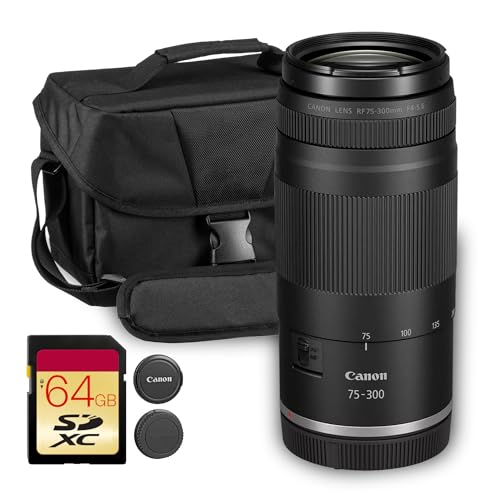 Canon RF 75-300mm f/4-5.6 Compact Telephoto Zoom
- Canon USA Authorized
- Lightweight telephoto zoom for Canon RF-mount full-frame and…
- Variable f/4-5.6 aperture design balances reach with portability,…
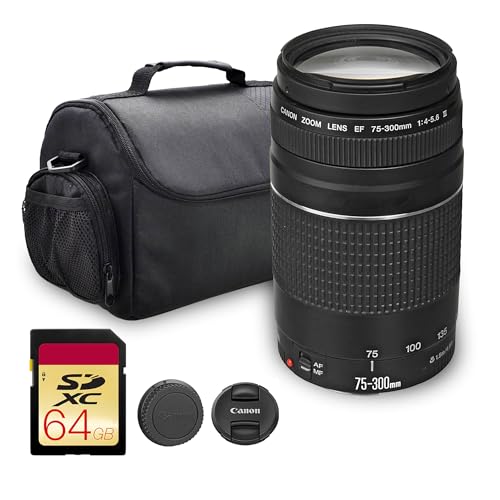 Canon EF 75-300mm f/4-5.6 III Compact Telephoto
- Canon USA Authorized
- The Canon EF 75–300mm f/4–5.6 III is a…
- Its optical design features Canon’s Super Spectra coating…
 Sigma 70-200mm f/2.8 DG DN OS Sports
- Pro-Level Zoom with Speed & Stability: The Sigma…
- Clear Protection with Optical Precision: The Tiffen 77mm…
- Fast, Reliable Storage for Every Shot: Capture 4K,…
As an Amazon Associate we earn from qualifying purchases at no extra cost to you.
Best sports lenses by situation
- Indoor basketball, volleyball, and hockey: Choose a 70-200mm f/2.8. Its wide maximum aperture helps maintain fast shutter speeds under gym or rink lighting.
- Outdoor soccer, football, and field hockey: Choose a 100-400mm or 180-600mm zoom if you need to cover changing distances from the sideline.
- Motorsport and athletics: A 100-500mm or 200-600mm zoom provides flexible framing, while a 400mm f/2.8 prime is preferable for professional work.
- Low-light professional sports: A 300mm or 400mm f/2.8 prime delivers more light and cleaner subject separation than most zooms.
- Beginner or occasional use: A 70-300mm or 100-400mm lens is easier to afford and carry, provided the event is outdoors in good light.
Sports lens comparison
| Lens or lens type | Typical maximum aperture | Approximate weight | Best working distance | Best use |
|---|---|---|---|---|
| 70-200mm f/2.8 zoom | f/2.8 throughout | 1.0-1.5 kg | 5-30 m | Indoor sports and nearby action |
| 100-400mm zoom | f/4.5-5.6 or f/5.6 | 1.3-1.6 kg | 15-60 m | General outdoor field sports |
| 100-500mm zoom | f/4.5-7.1 | 1.3-1.5 kg | 20-80 m | Portable outdoor reach |
| 180-600mm zoom | f/5.6-6.3 | 2.0-2.2 kg | 30-150 m | Distant soccer, wildlife, and motorsport |
| 300mm or 400mm f/2.8 prime | f/2.8 | 2.4-3.9 kg | 20-100 m | Professional low-light coverage |
Weights vary by mount and generation, but the differences are large enough to affect how you shoot. A 70-200mm can be carried all day with a shoulder strap. A 400mm f/2.8 usually needs a monopod or a carefully supported shooting position, especially during a long tournament.
Best 70-200mm lenses for indoor sports
A 70-200mm f/2.8 is the strongest first choice for indoor sports because it combines useful framing with a bright aperture. At 70mm, you can include an athlete close to the baseline; at 200mm, you can isolate action across a court. The f/2.8 aperture also allows a faster shutter speed than an f/5.6 lens at the same ISO setting.
Strong examples include the Canon RF 70-200mm F2.8 L IS USM, Sony FE 70-200mm F2.8 GM OSS II, Nikon NIKKOR Z 70-200mm f/2.8 VR S, and Panasonic Lumix S PRO 70-200mm F2.8 O.I.S. These lenses offer fast autofocus motors, optical stabilization, and weather-resistant construction, although stabilization is less important for freezing athletes than shutter speed.
For indoor action, use continuous autofocus with subject tracking and begin around 1/1000 second. If the venue is exceptionally dark, 1/640 second may be a practical compromise, but expect more motion blur in fast movement. Stabilization can reduce camera shake; it cannot freeze a moving player.
Best outdoor zooms for changing distances
100-400mm and 100-500mm: the flexible choice
A 100-400mm lens is often the best balance for outdoor sports. It reaches far enough for action on the opposite side of a football or soccer pitch, yet the shorter end remains useful when players approach. Canon’s RF 100-500mm F4.5-7.1 L IS USM, Sony’s FE 100-400mm F4.5-5.6 GM OSS, Nikon’s NIKKOR Z 100-400mm f/4.5-5.6 VR S, and Panasonic’s Leica DG Vario-Elmar 100-400mm F4.0-6.3 II ASPH. Power O.I.S. represent this category across different systems.
The trade-off is aperture. At the long end, many of these lenses are between f/5.6 and f/7.1, so they need brighter conditions, higher ISO, or a slower shutter speed than a 70-200mm f/2.8. Their backgrounds will also be less blurred at the same framing, although 400mm still produces strong compression when the subject is distant from the background.
180-600mm and 200-600mm: maximum reach for the money
Long zooms are valuable when you are restricted to a distant spectator area or want to photograph motorsport from behind a safety barrier. The Nikon NIKKOR Z 180-600mm f/5.6-6.3 VR, Sony FE 200-600mm F5.6-6.3 G OSS, and Canon RF 200-800mm F6.3-9 IS USM provide substantially more reach than a 70-200mm.
They are less suitable for dim indoor venues. Their narrower apertures may force ISO settings several stops higher than an f/2.8 lens. They are also physically longer, so panning and finding a fast-moving subject through the viewfinder take more practice. A monopod is useful for long sessions, but keep image stabilization and autofocus settings appropriate for panning rather than assuming stabilization solves every movement problem.
When a 300mm or 400mm f/2.8 prime is worth it
Professional sports photographers often choose a 300mm or 400mm f/2.8 prime because it admits four times as much light as an f/5.6 lens. That difference can mean moving from 1/500 second to 1/2000 second at the same ISO, which is significant for jumping, sprinting, and motorsport.
The Canon RF 400mm F2.8 L IS USM, Sony FE 300mm F2.8 GM OSS, Nikon NIKKOR Z 400mm f/2.8 TC VR S, and Canon EF 400mm f/2.8L IS III USM are examples of this class. The Nikon model includes a built-in teleconverter, allowing a 560mm equivalent focal length at the cost of one stop of light.
These lenses generally deliver outstanding subject separation, highly responsive autofocus, and excellent optical quality. Their disadvantages are price, size, and reduced framing flexibility. A fixed 400mm can be too tight when an athlete comes close, so professionals often pair it with a 70-200mm or use a second camera body.
Autofocus, stabilization, and background separation
- Autofocus tracking: Look for a lens with a modern linear, ultrasonic, or stepping autofocus motor and a camera body with animal, human, or vehicle subject recognition. The lens matters, but tracking performance also depends heavily on the camera.
- Stabilization: Optical stabilization helps with hand shake and panning, particularly on long lenses. It does not stop an athlete’s limbs from moving. Use a high shutter speed first, then treat stabilization as additional support.
- Background separation: Wider apertures create a brighter viewfinder image and stronger blur. A 400mm f/2.8 usually separates a subject more dramatically than a 400mm f/6.3, even when both are framed identically.
- Weather resistance: Sealed mounts, switches, and extending barrels help in rain and dust, but no lens should be treated as waterproof. A rain cover remains useful for prolonged exposure.
Decision matrix for choosing your first sports lens
| Your situation | Recommended type | Why | Main compromise |
|---|---|---|---|
| Beginner, occasional outdoor games, limited budget | 70-300mm or 100-400mm | Affordable reach and manageable weight | Slower aperture in shade or late evening |
| Frequent indoor court sports | 70-200mm f/2.8 | Bright aperture, fast focusing, flexible framing | May be too short for distant field sports |
| Outdoor soccer from the sideline | 100-400mm or 100-500mm | Balances reach with the ability to reframe nearby action | Less light than an f/2.8 prime |
| Distant spectator position | 180-600mm or 200-600mm | Fills the frame from far away | Heavy and relatively slow |
| Professional low-light assignments | 300mm or 400mm f/2.8 | Maximum light, autofocus response, and background blur | High cost and limited flexibility |
Practical ownership considerations
Sports lenses usually suffer more from handling than from normal optical wear. Zoom rings, focus rings, tripod collars, switches, and lens mounts receive repeated use, while dust and moisture can enter through poorly protected extending barrels. Store the lens with both caps fitted, avoid changing lenses in blowing dust, and wipe rain from the exterior before putting it in a sealed bag.
Use a lens hood to reduce flare and protect the front element from accidental knocks. Clean the front glass only after removing loose grit with a blower; rubbing particles across the coating can cause scratches. Do not leave a heavy lens hanging from a small camera strap connection for extended periods. Support the lens itself, especially when using a monopod.
As a simple value calculation, a 70-200mm f/2.8 used for 40 games a year over four years provides roughly 160 shooting days. A higher purchase price can be worthwhile if its bright aperture replaces the need for a second low-light lens. Conversely, an expensive 400mm prime is difficult to justify if you attend only a few well-lit outdoor events each season.
Final recommendation
Choose a 70-200mm f/2.8 if you want one dependable lens for indoor sports and close outdoor action. Choose a 100-400mm or 100-500mm if outdoor flexibility matters most. Choose a 180-600mm or 200-600mm when distance is the limiting factor. For demanding professional work in poor light, a 300mm or 400mm f/2.8 prime remains the performance leader, provided its weight, fixed focal length, and cost fit your working style.