Key takeaways
- Power inverters turn vehicle DC power into AC outlets for laptops and small appliances with USB ports and cooling fans. Compare wattage and outlets.
As an Amazon Associate we earn from qualifying purchases.
A power inverter turns the 12 volt DC power held in a vehicle battery into the AC power that household plugs deliver, so a laptop, a small fan, or a tool charger can run from the front seat or the truck bed. Unlike a battery pack, an inverter carries no charge of its own: it converts what the vehicle already holds, for as long as the battery and the engine can support the load. The five models below span the full range of the form, from a 150 watt plug-in unit small enough for a glove box to a 2000 watt hardwired unit with three AC outlets, in both modified sine wave and pure sine wave designs.
Disclosure: This article may contain affiliate links. If you buy through these links, we may earn a small commission from Amazon.
FOVAL 150W Car Power Inverter

The FOVAL 150W is the smallest unit in this lineup, a cigarette lighter plug-in converter built for laptop charging and phone top-ups on ordinary drives. It plugs straight into the vehicle’s cigarette lighter socket on a cable of about 16 inches, so the body can sit in a cup holder or console while a laptop rides in the back seat. The listing counts 3 outlets in total across its AC and USB connections: an AC outlet for a laptop plug plus 2 USB ports delivering DC 5V/3.1A between them. Output is a modified sine wave, the simpler of the two waveforms in this roundup, and the makers pitch the unit at road trips, vacations, and travel emergency kits rather than workshop loads. A smart cooling fan keeps operation quiet and runs faster as the unit warms up, and an LED indicator shows green for normal operation and red for a fault. The protection set is full for a unit this size, covering short-circuit, low-voltage, over-charge, over-voltage, over-load, and over-temperature events, with a built-in fuse as the last line of defense. Everything connected has to stay within the 150 watt ceiling, so this is a charger-class inverter, not an appliance runner.
Specs
- Continuous power: 150 watts; peak output power: 300 watts
- Input: 12 volts DC; AC output: 110 volts
- Waveform: modified sine wave
- USB ports: 2, DC 5V/3.1A combined output
- Dimensions: 3.2 x 2.5 x 1.5 inches; weight: 8 oz
- Cooling: smart cooling fan; LED indicator, green for operation and red for fail
- Protections: short-circuit, low-voltage, over-charge, over-voltage, over-load, over-temperature; built-in fuse
- Warranty: 2 year manufacturer, per the listing’s item details
BESTEK 300W Pure Sine Wave Power Inverter
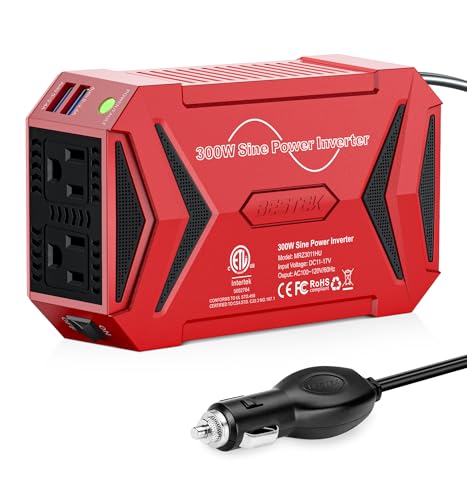
The BESTEK 300W steps up to a pure sine wave output, the cleaner waveform the listing aims at devices that require careful protection, and it doubles the FOVAL’s continuous output while staying in a compact plug-in body. Two AC outlets and 2 Smart USB charging ports cover a laptop and two phones at once, with the USB ports detecting connected devices and delivering up to 2.4 amps per port and 4.8 amps across both. A smart cooling fan handles heat quietly and runs faster once output power passes 70W, and a built-in 40 amps fuse backs a protection set spanning overheating, under and over voltage charging, short circuiting, overloads, and overcharging. The listing is unusually direct about the lighter socket limit: loads above 150W should connect with battery clamps straight to the vehicle’s battery, because most vehicles’ 12V cigarette lighter ports are fused at 150W. The box holds the inverter and a user manual, and the upgraded input range of 11-17V extends compatibility to newer energy vehicles alongside ordinary 12V cars and trucks. For drivers who want one small unit that can run a laptop all day and treat sensitive electronics gently, this is the balanced pick of the five.
Specs:
– Continuous power: 300 watts; peak power: 700 watts
– Waveform: pure sine wave
– Input voltage: 12V DC; output voltage: 110V~120V
– AC outlets: 2; USB ports: 2 Smart USB, up to 2.4 amps per port, 4.8 amps max
– Built-in fuse: 40 amps; smart cooling fan, faster above 70W output
– Dimensions: 4.92 x 3.39 x 1.93 inches; item weight: 1.4 pounds
– In the box: 300W power inverter, user manual; 18-month warranty
Renogy Inverter P2 1000W Pure Sine Wave Inverter

The Renogy P2 moves the lineup into hardwired territory: a 1000 watt pure sine wave inverter that connects to the battery with cables rather than a lighter plug, aimed at RV, truck, camping, and off-grid use. Renogy’s description contrasts its output with modified sine wave inverters directly, promising cleaner, smoother electricity and interference-free operation of tools, fans, lights, and electronics, and it notes comprehensive protections for smooth and safe performance. The package includes a pair of 3 ft 4AWG cables for the battery connection and a wired remote for switching the unit on and off from inside the cabin, with the title putting the remote lead at 16.4FT. At 12.9 x 6.8 x 3.3 inches and 6 pounds, it is a mount-and-leave unit rather than a carry-around one, sized for a van build, a work truck, or a camper that needs household-style power every day. Drivers stepping up from plug-in inverters for the first time will find this the natural landing spot: four times the BESTEK’s headroom, with the waveform sensitive electronics prefer.
Specs
- Continuous power: 1000 watts
- Waveform: pure sine wave
- Input: 12V; output: 120V AC
- Dimensions: 12.9 x 6.8 x 3.3 inches; item weight: 6 pounds
- Included: pair of 3 ft 4AWG battery cables, wired remote control
- Remote lead: 16.4FT, per the listing title
- Recommended uses, per the listing: boat, camping, home, RV, truck, vehicle
Krieger 1100 Watt 12V Power Inverter (KR1100)

The Krieger KR1100 sits one step above the Renogy on continuous output and takes the opposite waveform path: a modified sine wave design built for appliances and tools rather than delicate electronics, with the listing naming blenders, vacuums, and power tools as its intended loads. It connects DC battery cables directly to the vehicle’s battery, and the box includes a full installation kit: a wired remote control, an ANL fuse kit, and 3 feet of battery cable, so the unit can be mounted out of sight and switched from the dash area. Dual 110V AC outlets and dual USB ports at 2.1 amps cover a tool charger and a phone at the same time, and an LCD display shows output wattage, input voltage, and battery level at a glance. The inverter has been tested and validated with ETL approval under UL STD 458, and the protection set guards against overheating, short circuit, and overload conditions. Krieger backs the unit with a 3 years parts and labor warranty, the longest coverage in this lineup. For a truck that doubles as a job site, this is the workhorse pick: hardwired and remote-switched.
Specs
- Continuous power: 1100 watts; peak power: 2200 watts
- Waveform: modified sine wave
- Input: 12V DC, direct battery connection
- AC outlets: 2, 110V; USB ports: 2, 2.1 amps
- Display: LCD, showing output wattage, input voltage, and battery level
- Included: wired remote control, ANL fuse kit, 3 foot battery cables
- Certification: ETL approved under UL STD 458
- Warranty: 3 years parts and labor
Ampeak 2000W Power Inverter

The Ampeak 2000W tops this lineup on output, converting 12V DC to 110V AC with 2000 watts of continuous power and a 4000W surge peak for motor start-up loads. Three AC outlets and 2 USB ports let it run a TV, a fan, and a tool while charging phones, and the USB side pairs an 18W QC3.0 port with a 30W PD port for faster charging than the basic ports on smaller units. Ampeak prints an 89% conversion efficiency for the design, well above the 70-75% it cites for competing units, which matters on long runs because less of the battery’s charge turns into waste heat. The smart cooling fan stays quiet and switches on when the internal temperature exceeds 122°F, and six protections watch for overload, overvoltage, low voltage, overcurrent, short circuit, and over-temperature faults. The package includes the inverter and 2 cables, positive and negative, for a direct battery hookup in a car, truck, or RV. This is the pick for drivers who genuinely need appliance-level power on the road: tailgate setups, work trailers, and camp kitchens where a plug-in unit would give up early.
Specs
- Continuous power: 2000 watts; surge peak: 4000 watts
- Input: 12V DC; output: 110V AC
- AC outlets: 3; USB ports: 2 (18W QC3.0 and 30W PD)
- Conversion efficiency: 89%
- Cooling: smart cooling fan, activates when internal temperature exceeds 122°F
- Protections: overload, overvoltage, low voltage, overcurrent, short circuit, over-temperature
- Included: 2000W power inverter, 2 cables (positive and negative)
How to Choose
Start with the load. Add up the wattage figures printed on the devices you actually plan to run, then pick an inverter whose continuous figure clears that total with room to spare, because the peak figure only covers brief start-up surges from motors and compressors. A laptop and two phones live happily under 150 watts; a blender, a vacuum, or a small microwave pushes you into the hardwired class above 1000 watts.
Next, match the connection to the size. Cigarette lighter sockets in most vehicles are fused around 150W, which caps what a plug-in unit can honestly deliver; the BESTEK listing states this limit outright and directs heavier loads to battery clamps. Anything at the Krieger, Renogy, or Ampeak level connects straight to the battery with cables, and the included cable sets and remotes in those boxes exist precisely because the unit will live mounted, not in a cup holder.
Then choose the waveform. Pure sine wave units, like the BESTEK and the Renogy here, deliver the cleaner, smoother output that sensitive electronics are built for. Modified sine wave units, like the FOVAL and the Krieger, are the simpler design and are aimed by their makers at chargers, tools, and appliances. Finally, count the connections you need at one time: AC outlets range from one on the smallest plug-in units to three on the Ampeak, and USB output varies from a shared 3.1A pair to dedicated fast-charge ports.
FAQ
Can a power inverter drain my car battery?
Yes, if it runs with the engine off for long enough, since every watt it delivers comes out of the vehicle’s battery. Protections help at the margins: the BESTEK listing, for example, prints low voltage shutdown at DC 10V-11V and over voltage shutdown at DC 15V-16V, which cuts output before the battery is pulled down further. The practical habit is to run heavier loads with the engine on and treat the inverter as an engine-supported power source.
What size inverter do I need for a laptop?
Most laptop chargers draw well under 150 watts, so a plug-in unit in the FOVAL’s class covers a laptop plus phone charging through its USB ports. If the same drive also needs a second laptop, a small fan, or a camera battery charger on AC power at the same time, the 300 watt class gives comfortable headroom while staying in a compact body. Check the wattage figure printed on your charger brick and keep the total of everything plugged in below the inverter’s continuous figure.
What is the difference between pure sine wave and modified sine wave?
Both convert 12V DC into AC power, but the shape of the output differs. Renogy describes its pure sine wave output as cleaner, smoother electricity that runs tools, fans, lights, and electronics without interference, and BESTEK aims its pure sine wave model at devices that require careful protection. Modified sine wave is the simpler waveform: the FOVAL uses it for laptop and phone charging, and Krieger aims its modified sine wave unit at blenders, vacuums, and power tools. Match the waveform to the most sensitive device you plan to plug in.
Can I plug a large inverter into the cigarette lighter socket?
No. The socket itself is the limit: most vehicles’ 12V ports are fused at 150W, as the BESTEK listing notes, so a large inverter connected there still cannot draw more than the fuse allows. Inverters in the 1000 watt class and above, including the Renogy, Krieger, and Ampeak models here, are built for direct battery connection with cables, and each of them includes the cables or an installation kit for exactly that hookup.
Conclusion
The right inverter is the one whose continuous wattage, connection style, and waveform match the job. The FOVAL 150W covers laptop-and-phone duty in the smallest body, the BESTEK 300W adds a pure sine wave and a second outlet for sensitive gear, the Renogy P2 and Krieger KR1100 bring hardwired 1000 watt class power to trucks and RVs from opposite waveform directions, and the Ampeak 2000W carries appliance-level loads with three outlets and fast-charge USB ports.
More from Amazon
Programs that pair well with the guide above. Offers and eligibility are set by Amazon and may change.
Collect the home and kitchen items you want in one registry that guests can shop from.
Create a wedding registrySet up recurring deliveries of everyday items on eligible products. Terms and savings are set by Amazon.
Explore Subscribe & SaveFree shipping on eligible items, Prime Video and more. Eligible new members can start with a free trial.
Start a Prime free trialAudiobooks and podcasts to listen to on the go. Eligible new members can start with a free trial.
Try Audible freeAs an Amazon Associate we earn from qualifying purchases.