
Key takeaways
- Choose a combination if you are replacing a failing primary or installing a new pit; one set of fittings and a matched controller.
- Choose an add-on if your primary is newer or you want to keep it; check pit size and discharge routing first.
The best battery backup sump pump systems for most homes are the Wayne WSS30VN combination system, the Basement Watchdog Big Dog combination system and, as a standalone add-on to an existing primary pump, the Basement Watchdog Special (BWSP), the Zoeller Aquanot 508 or the Wayne ESP25n. A backup pays off when your basement is below grade, your pit fills during storms, and the same storms tend to knock out power, because a pump without electricity is only a bucket.
This guide ranks the options by what matters in an outage: runtime per charge, flow at the lift your discharge actually needs, battery type and size, alarms and Wi-Fi alerts, and whether the backup will physically and electrically coexist with your primary pump. It also explains the math for how long a battery lasts, and when a battery backup is the wrong answer and a water-powered pump or a generator is better.
Our top picks



As an Amazon Associate we earn from qualifying purchases at no extra cost to you.
Quick picks
| Pick | Type | Published flow (varies by source) | Battery | Alerts | Best for |
|---|---|---|---|---|---|
| Wayne WSS30VN | Combination (primary plus backup) | Backup about 2,700 GPH at zero lift; up to about 10,000 gallons per charge on the recommended 75 Ah battery | 12V deep-cycle, sold separately | Audible alarm, LED status | New installs wanting one package |
| Basement Watchdog Big Dog combination | Combination | Backup in the roughly 2,000 to 2,500 GPH class at 10 ft in published listings | 12V marine or deep-cycle AGM | Alarm and monitoring | Heavy-duty primary plus backup |
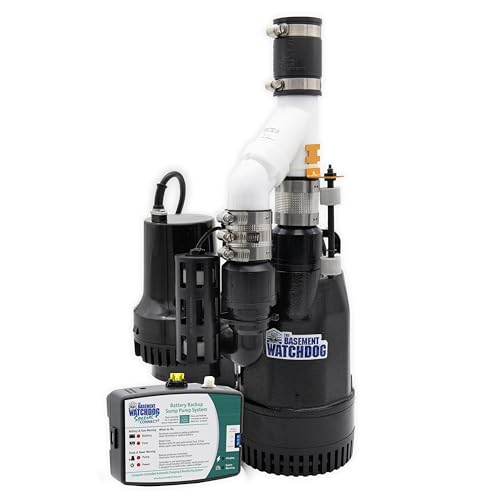
| Basement Watchdog Special (BWSP) | Backup-only add-on | About 1,850 GPH at 10 ft (2,600 GPH at zero lift) in one listing | 12V deep-cycle, not included | Alarm; optional Wi-Fi module on the Connect version | Adding backup to any existing pump |
| Zoeller Aquanot 508 | Backup-only add-on | About 2,400 to 2,600 GPH class (published as roughly 40 GPM) | 12V deep-cycle | Audible alarm, LED display, multi-stage charger | Premium, American-made backup |
| Zoeller Aquanot Fit (Wi-Fi class) | Backup-only add-on with connectivity | About 35 GPM at 10 ft in one listing | 12V deep-cycle | Wi-Fi alerts | Remote notification |
| Wayne ESP25n | Backup-only add-on | About 1,680 GPH at 10 ft (2,700 GPH at zero lift) | 12V deep-cycle, sold separately | LED display and audible alarm | Lower-cost add-on |
| Superior Pump 92900 class | Backup-only add-on | Entry-level flow class | 12V deep-cycle | Alarm | Small pits, modest storms |
Flow figures in published listings disagree because they are quoted at different lift heights. Always compare numbers at the same lift, preferably at your actual vertical rise from pit bottom to discharge point, and check the manufacturer’s spec sheet before buying.
How we chose
This is research-based, not a lab comparison. We compared manufacturer specification sheets, plumbing-association guidance and multiple 2026 buyer’s guides to find models that (1) are sold in the United States and still supported, (2) publish flow at a stated lift, (3) specify battery type and size, (4) include a charger and alarm, and (5) either work with a standard 1-1/2 inch discharge or can tie into an existing one. Where sources disagree on a number, we give a range or describe the spec class rather than pick one.
Combination system or add-on backup?
A combination system ships a primary pump and a backup pump with a controller, designed to share one pit. The backup sits in the pit next to the primary and takes over when the primary fails or when power drops. An add-on backup is a pump, float switch and controller that fits beside the pump you already own.
- Choose a combination if you are replacing a failing primary or installing a new pit; one set of fittings and a matched controller.
- Choose an add-on if your primary is newer or you want to keep it; check pit size and discharge routing first.
Compatibility checklist for an add-on backup
- Pit diameter: Typical pits are 18 inches wide; two pumps plus floats need room. Narrow pits may fit only one pump.
- Pit depth: The backup should switch on slightly above the primary’s float level so it acts only when the primary fails or the water rises too high.
- Discharge: The backup usually has its own check valve and ties into the same discharge line above the primary’s check valve using a tee. A wrong tie-in can let one pump push water back through the other.
- Air gap or vent hole: Include a small relief hole in each discharge line below the floor to prevent air lock.
- Outlet: The primary’s plug and the backup controller should be on separate circuits where possible.
The picks
Wayne WSS30VN
Spec line: Combination system · 1/2 HP primary pump plus battery backup pump · backup about 2,700 GPH at zero lift (lower at real lift) · up to about 10,000 gallons per charge on the 75 Ah deep-cycle battery Wayne recommends · automatic switchover · audible alarm and LED indicators · charger included · battery sold separately.
Best for: Homeowners who want a ready-to-install combination with a recognizable brand and clear battery guidance.
Skip if: You already have a primary pump you want to keep, or want Wi-Fi alerts without adding a separate device.
- Pros: Complete package; battery status monitoring; published gallons-per-charge figure helps planning.
- Cons: The battery is a separate purchase; flow at your real lift is lower than the zero-lift figure.
Basement Watchdog Big Dog combination system
Spec line: Cast-iron or heavy-duty primary pump paired with a battery backup pump · stated runtime of dozens of hours of intermittent cycling on a marine battery in manufacturer-class claims · backup flow roughly in the 2,000 to 2,500 GPH class at 10 ft in comparison guides · alarm and monitoring controller.
Best for: Homes with frequent storms where the primary pump also needs to be heavy duty.
Skip if: You need an add-on only; choose the BWSP instead.
- Pros: Strong reputation in the category; matched pair of pumps.
- Cons: Higher cost than add-on only; confirm the model number and current specs before you order, because Basement Watchdog lines are sold in several versions.
Basement Watchdog Special (BWSP) and Special Connect
Spec line: Backup-only system · about 1,850 GPH at 10 ft (about 2,600 GPH at zero lift in one listing; other sources quote different figures) · requires 12V deep-cycle battery (not included) · audible alarm · 24-hour monitoring controller · Connect version supports optional Wi-Fi module.
Best for: The most common upgrade: bolting on a backup to an existing primary pump.
Skip if: Your lift is high; published flow at 10 ft may drop significantly at 15 to 20 ft.
- Pros: Frequently chosen as the default add-on; optional Wi-Fi alerts; monitoring controller checks battery levels.
- Cons: Availability of the Connect version varies; battery and Wi-Fi module add cost.
Zoeller Aquanot 508
Spec line: Backup-only system · oil-filled motor · about 2,400 to 2,600 GPH class (published as roughly 40 GPM) · multi-stage automatic charger included · audible alarm with LED status display · 12V deep-cycle battery required. Manufacturer claims cited in comparisons include about six hours of continuous pumping and 48 hours or more at a low duty cycle.
Best for: Buyers who want a premium, American-made backup with an emphasis on build quality.
Skip if: You want built-in Wi-Fi; look at the Aquanot Fit or add an aftermarket alert sensor.
- Pros: Oil-filled motor helps cooling during long runs; good charger; strong brand support.
- Cons: Premium cost; battery separate.
Zoeller Aquanot Fit (Wi-Fi class)
Spec line: Backup-only system · about 35 GPM at 10 ft head in one listing · Wi-Fi notifications · 12V battery required.
Best for: Second homes and travelers who want a phone alert when the pit is rising or the battery is low.
Skip if: Your pit location has weak Wi-Fi coverage; add a mesh node or use a cellular alert.
- Pros: Connectivity plus a reputable pump.
- Cons: Features and exact specs vary by version; confirm on the Zoeller page.
Wayne ESP25n
Spec line: Backup-only system · about 1,680 GPH at 10 ft (about 2,700 GPH at zero lift in one listing) · up to about 10,000 gallons per charge claimed on the 75 Ah recommended battery · protective battery case with LED display · audible alarm.
Best for: A lower-cost add-on for small to medium pits with moderate lift.
Skip if: Your storms often produce very high inflow; choose a higher-flow unit.
- Pros: Straightforward; sensible battery guidance.
- Cons: Lower flow at lift; no Wi-Fi.
Superior Pump 92900 class
Spec line: Entry-level backup class · 12V deep-cycle battery · basic alarm · modest flow suited to small pits and shallow lifts. Confirm current model details with the manufacturer, since our sources did not agree on exact figures.
Best for: Short outages and low-inflow basements.
Skip if: You rely on it as the only protection during major storms.
- Pros: Lower cost of entry.
- Cons: Lower flow; fewer monitoring features.
Runtime math: how long will the battery last?
Manufacturers quote runtime in gallons per charge or hours at a duty cycle. You can estimate your own case with three numbers: usable battery capacity, pump current draw and pump output at your lift.
- Usable capacity: A deep-cycle lead-acid battery should not be discharged below about 50 percent. A 75 Ah battery gives about 37 Ah usable.
- Continuous runtime: If the pump draws roughly 15 amps while running, 37 divided by 15 is about 2.5 hours of continuous pumping. Real current varies by pump and lift; check the spec sheet.
- Gallons: At about 28 GPM (1,680 GPH) at 10 ft, 2.5 hours (150 minutes) is about 4,200 gallons.
Duty-cycle example. If groundwater inflow into your pit is 5 GPM and the pump moves 28 GPM, the pump runs about 5 divided by 28, or 18 percent of the time. At 18 percent, that 2.5 hours of continuous capacity stretches to roughly 14 hours of real time. If a heavy storm raises inflow to 15 GPM, duty rises to about 54 percent and runtime falls to about 4.6 hours. The numbers show why bigger batteries, or two batteries wired in parallel, matter when outages and storms last a day or longer.
A rule of thumb: add the expected outage length to your worst-case storm inflow. If the result is more than a battery can supply, plan a second battery, a generator or a water-powered backup.
Battery type and size
- Flooded deep-cycle or marine deep-cycle: Lower cost; needs ventilation and periodic water top-ups for flooded types.
- AGM (sealed): No maintenance and no spill; more costly, a common choice for basements. Brand guidance such as Basement Watchdog’s AGM battery claims roughly 36 to 48 hours of intermittent pumping, while other listings claim more; treat these as best-case.
- Size: Group 27 deep-cycle and 75 Ah class are common recommendations. A bigger Ah rating extends runtime but takes more floor space.
- Starter batteries: Not designed for deep discharge; avoid.
- Lithium: Some newer chargers support lithium, but check that the controller is compatible; most pump controllers charge for lead-acid.
Replace batteries every 3 to 5 years, or sooner if the controller warns. Keep them in a ventilated spot, off the wet floor, and follow the manufacturer’s venting guidance. Wear eye protection when handling lead-acid batteries and never smoke or use open flame nearby.
Alarms and connected alerts
An audible alarm only helps if someone is home. For vacation or remote properties, pick a Wi-Fi capable controller or add a standalone water sensor or cellular alert. Look for alerts for: water level high, battery low, AC power lost, pump running, and charger fault. Test the alarm by lifting the float or using the controller’s test button per the manual.
When a battery backup pays off
- Your basement is finished, or contains stored goods, a furnace or electrical panel.
- Your house sits in a high-water-table area or has a history of pit overflow.
- Storms in your region often cause power outages.
- Your insurer requires or discounts for backup protection; policies often exclude sump failure unless an endorsement is purchased, so check your policy.
It may not pay off if your pit rarely runs, in which case the money may be better spent on exterior grading and gutter extensions. If outages last multiple days, a generator or a large battery bank may be a better answer than a single battery.
Water-powered backup and generators
Water-powered backup pumps use municipal water pressure and need no battery, but they use municipal water while running, require adequate pressure, may be banned by local code and do not work on well water. A generator can run your primary pump for days but needs fuel, a proper transfer setup and safe outdoor operation; never run a generator indoors or in an attached garage, because of carbon monoxide risk.
Maintenance routine
- Pour water into the pit every few months to confirm the primary and backup both turn on.
- Check the battery terminals for corrosion and the charger light.
- Clear debris from the pit and float.
- Replace batteries at the interval the maker recommends.
- Keep the discharge line clear and ensure the check valve is not stuck.
Decision matrix
| Your case | Choose | Reason |
|---|---|---|
| Replacing both pumps | Wayne WSS30VN or Basement Watchdog Big Dog combination | Matched system, one controller |
| Keeping existing primary, moderate lift | Basement Watchdog Special | Common add-on, monitoring controller |
| Premium build, long storms | Zoeller Aquanot 508 | Oil-filled motor, good charger |
| Remote home, need phone alerts | Zoeller Aquanot Fit or Special Connect | Wi-Fi capable |
| Limited budget, small pit | Wayne ESP25n or Superior Pump class | Lower cost |
| Outages longer than a day | Add second battery or generator | Extends runtime |
Safety
- Have a licensed electrician or plumber handle wiring and discharge changes if you are unsure.
- Keep the battery on a stable, dry platform away from standing water.
- Use GFCI protection for the pump’s outlet where code requires.
- Do not touch a pump or cord in standing water until power is off at the panel.
Frequently asked questions
What is the best battery backup sump pump?
The Wayne WSS30VN is a strong choice for a combination system, and the Basement Watchdog Special or Zoeller Aquanot 508 are top add-on options. The best one depends on your pit and lift.
Compare flow at your actual lift, battery requirements and alerts rather than headline numbers.
How long does a sump pump battery backup last?
It depends on the battery size and how often the pump runs. A 75 Ah deep-cycle battery typically gives a few hours of continuous pumping or around a day or more at a low duty cycle.
Use your pump’s amp draw and inflow rate to estimate; a storm can cut runtime dramatically.
Can I add a battery backup to my existing sump pump?
Yes, if your pit has room and your discharge can accept a second tie-in. Backup-only systems such as the Basement Watchdog Special or Zoeller Aquanot 508 are made for this.
Check pit diameter, float positions and check valves before buying.
What size battery do I need for a backup sump pump?
Many makers recommend a 12V deep-cycle battery around 75 Ah or Group 27. Larger capacity means longer runtime.
Use a deep-cycle, not a starter, battery and follow your pump’s manual.
Do battery backup sump pumps have Wi-Fi alerts?
Some do. The Zoeller Aquanot Fit class and the Basement Watchdog Special Connect with an optional module offer Wi-Fi notifications.
If your model lacks it, add a standalone water-level sensor or cellular alert.
How often should I replace the backup battery?
Plan on every 3 to 5 years, sooner if the controller reports a fault or the battery fails a load check. Follow the battery maker’s guidance.
Test the system a few times a year so you find a weak battery before a storm.
Is a battery backup better than a water-powered backup?
Battery backups work without municipal water and with well water, but have limited runtime. Water-powered units run indefinitely but need pressure, use water and may be restricted by code.
For long outages, consider a generator or larger battery bank.
Does homeowners insurance cover sump pump failure?
Many standard policies exclude water backup unless you add an endorsement. Coverage varies by insurer and state.
Ask your agent about a water backup rider and whether a battery backup earns any discount.


